

Why Tech Strategy is Your New Growth Multiplier
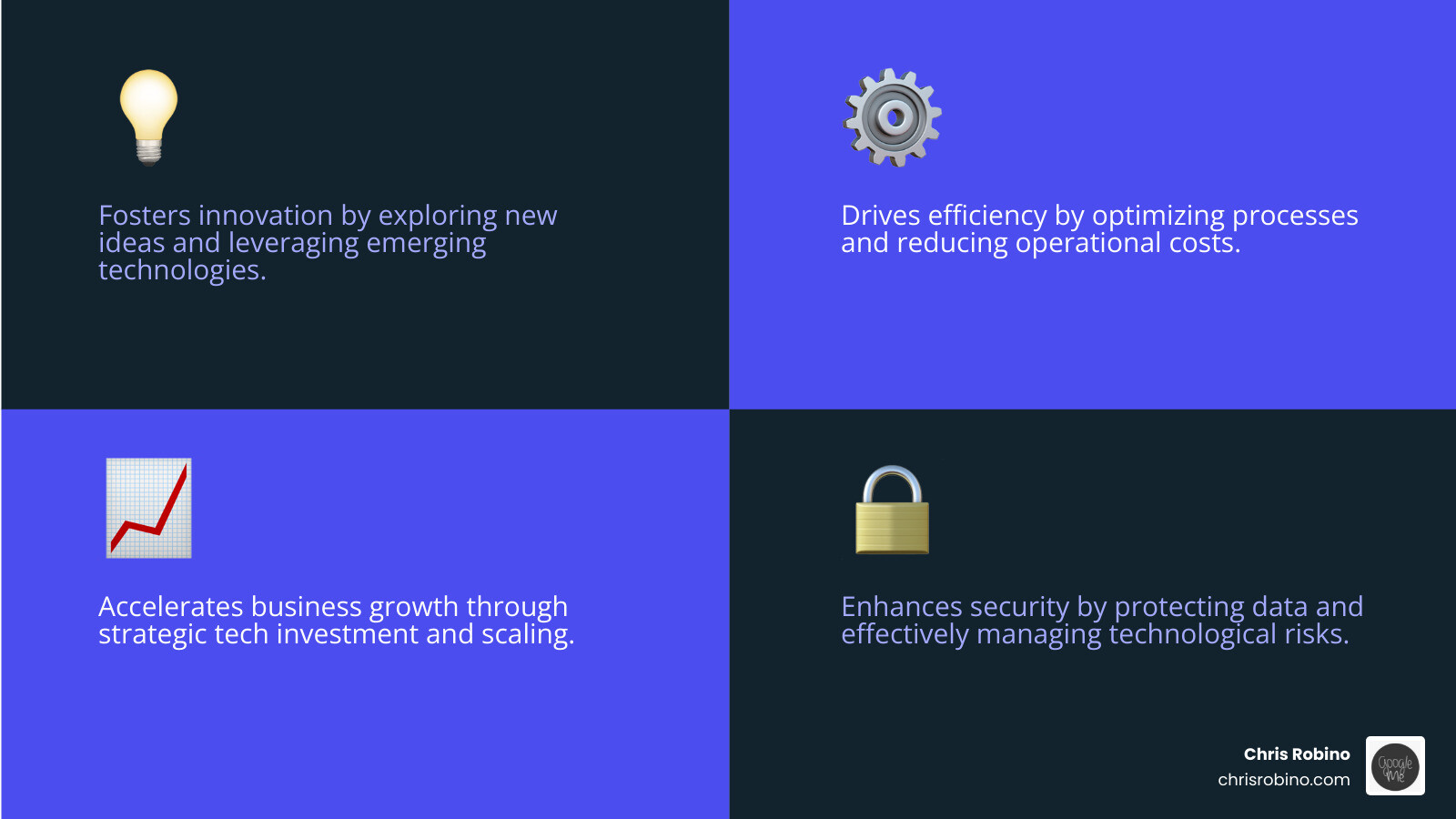
Tech strategy consulting helps businesses align their technology investments with their core business goals to drive growth, improve efficiency, and stay competitive. It provides a clear path forward by delivering:
- Strategic Alignment – Connecting technology decisions directly to business objectives.
- Digital Change Roadmaps – Guiding organizations through complex tech modernization.
- Operational Excellence – Optimizing IT systems and processes for maximum efficiency.
- Innovation Leadership – Identifying and implementing emerging technologies for a competitive edge.
- Risk Management – Strengthening cybersecurity and ensuring regulatory compliance.
In our digital economy, technology is the new growth multiplier. Industry research shows that 66% of CEOs believe digital change is vital for their organization’s survival. Yet, without a clear strategy, technology investments often fail to deliver real business value, becoming a cost center rather than a competitive advantage.
This is where tech strategy consulting makes the difference. It’s not just about implementing new systems; it’s about building a strong digital core that leverages cloud, data, and AI to open up new opportunities while improving agility. A consultant bridges the gap between what technology can do and what your business needs it to do, helping you steer complex challenges like security threats, privacy concerns, and new market entry.
From startups seeking to scale to established enterprises looking to innovate, organizations of all sizes need strategic guidance to harness technology for sustainable growth.
I’m Chris Robino, a Digital Strategy Leader and AI & Search Expert with over two decades of experience. I’ve guided diverse clients in developing technology strategies that maximize ROI and drive measurable business growth.
Tech strategy consulting vocab explained:
A Deep Dive into Tech Strategy Consulting
In an increasingly digitized world, tech strategy consulting plays a critical role in helping large organizations turn technology into a true growth engine. For enterprises and other large companies, one of the most powerful levers inside a broader tech strategy is a well-designed SEO strategy that scales.
Enterprise SEO isn’t just about ranking a few keywords. It’s about building a sustainable, repeatable system that drives qualified traffic, supports multiple business units, and connects directly to revenue and brand growth.
The Consultant’s Playbook: Process and Responsibilities
A tech strategy consultant acts as a strategic partner, blending vision with practical execution to guide organizations through the complex technology and digital landscape. When it comes to SEO for large companies, that role extends into orchestrating people, platforms, and processes across marketing, product, and engineering.

For enterprise SEO, a scalable playbook typically includes:
-
Assessment and Alignment
Start by aligning SEO with top-level business objectives, such as entering new markets, supporting product launches, or increasing self-service adoption.- Audit current organic performance, technical health, content depth, and brand visibility.
- Map business priorities (e.g., key product lines, strategic regions, high-value customer segments) to keyword themes and search intent.
- Identify internal owners (marketing, product, engineering, analytics) and define how they will collaborate.
-
Strategy and Roadmap Development
Based on the assessment, create a focused, multi-quarter SEO roadmap that is realistic for a large organization to execute.- Prioritize technical fixes that impact large sections of the site (indexation, page speed, mobile performance, structured data, internal linking).
- Develop topic clusters and content frameworks around core business themes rather than isolated blog posts.
- Set clear, shared metrics: organic traffic by segment, non-branded vs. branded search, assisted conversions, and impact on key funnels.
-
Implementation and Change Management
Enterprise SEO lives or dies on execution. Change management is as important as keyword research.- Embed SEO requirements into product and content workflows (e.g., checklists in ticketing systems, content briefs tied to search intent).
- Coordinate with engineering to include SEO in release planning and QA.
- Train non-SEO teams—writers, designers, product managers—on basic SEO principles so improvements scale without constant hand-holding.
-
Optimization and Continuous Improvement
Large companies operate in competitive markets and dynamic search environments. SEO strategy must be iterative.- Monitor performance by product, region, and intent type (informational, commercial, transactional).
- Run controlled experiments (title testing, layout changes, new internal linking patterns) at scale.
- Refresh and consolidate content regularly to avoid cannibalization and keep high-value pages current.
Opening Up Value: Enterprise SEO Strategies That Work for Large Companies
For large organizations, effective SEO strategies share a few core traits: they are scalable, measurable, and tightly linked to business outcomes. Below are key approaches that consistently perform well at the enterprise level.
1. Build a Technical Foundation That Scales
Strong technical health is the prerequisite for all other SEO efforts.
-
Crawlability and Indexation at Scale
Ensure search engines can efficiently discover and index millions of URLs if needed.- Clean up duplicate, low-value, or thin pages via canonical tags, redirects, and noindex rules.
- Maintain accurate XML sitemaps and robots.txt, especially for large, dynamic sites.
-
Site Speed and Core Web Vitals
Large companies often have complex sites with heavy scripts and legacy code.- Prioritize performance improvements that affect templates and shared components.
- Treat speed and usability as ongoing engineering work, not one-off projects.
-
Structured Data and Rich Results
Implement schema markup for products, FAQs, articles, and events where appropriate.- Use structured data to help search engines understand complex offerings and improve visibility in search features.
2. Organize Content Around Topics, Not Just Keywords
Large companies tend to have fragmented content spread across blogs, product pages, documentation, and support.
-
Topic Cluster Strategy
Group content into clusters: one authoritative “pillar” page supported by multiple in-depth subpages.- Align clusters to major business themes (solutions, industries, use cases) and stages of the customer journey.
- Use consistent internal linking to signal hierarchy and relevance.
-
Content Governance and Standards
A style guide and SEO guidelines help maintain quality at scale.- Standardize title formats, meta descriptions, URL structures, and heading patterns.
- Define what “good” looks like for different content types (landing pages, articles, support docs, resource centers).
-
Regular Content Maintenance
Large content libraries easily become outdated or redundant.- Schedule periodic audits to refresh, merge, or retire content based on performance.
- Focus updates on pages that already rank or convert reasonably well to compound gains.
3. Integrate SEO with Product, PR, and Brand
For large companies, SEO cannot live only inside the marketing team.
-
Product and Feature Launches
Embed SEO early in the product launch process.- Conduct search intent research while naming features and designing landing pages.
- Ensure product documentation and help content capture long-tail queries users will search after launch.
-
Thought Leadership and PR Synergy
Leverage executive insights, research, and announcements to build authority.- Turn major announcements into optimized evergreen content that targets strategic queries.
- Use digital assets like whitepapers, reports, and webinars to attract links and mentions.
-
Brand and Demand Capture
Ensure that branded and near-branded searches (e.g., “[brand] pricing,” “[brand] vs alternatives”) lead to clear, authoritative pages that answer user questions and support sales.
4. Local and International SEO for Large Footprints
Many large companies operate globally or with extensive physical locations.
-
Local SEO at Scale
- Maintain accurate, consistent business information across all locations (addresses, hours, categories).
- Create location pages with unique, useful content that goes beyond simple contact details.
-
International and Multilingual SEO
- Use hreflang and country-specific domains or subdirectories strategically.
- Localize content and messaging to reflect regional search behavior, regulations, and culture—not just language translation.
5. Data-Driven SEO: Measurement That Matters to Leaders
Executive teams need to see how SEO supports business growth.
-
Connect SEO to Revenue and Pipeline
- Track how organic traffic influences lead generation, product signups, and key account expansion.
- Segment performance by business unit, market, and customer type to clarify impact.
-
Dashboards and Communication
- Build dashboards that surface trends, risks, and wins in language non-specialists understand.
- Report on both leading indicators (rankings, impressions, engagement) and lagging ones (revenue, customer retention).
-
Experimentation Culture
- Use A/B testing where possible to validate SEO-related changes that affect user experience.
- Document learnings and fold them into playbooks and guidelines.
Overcoming Enterprise Challenges and Choosing Your Strategic Partner
Even well-designed SEO strategies can encounter obstacles in large organizations. Common challenges include complex approval processes, competing priorities across departments, and technical constraints from legacy platforms.
Overcoming these challenges requires:
-
Clear Ownership and Governance
Assign accountable owners for SEO across marketing, product, and engineering, with defined decision rights. -
Prioritization Frameworks
Score initiatives by anticipated impact, effort, and risk to focus on changes that move the needle for both organic performance and business outcomes. -
Executive Sponsorship
Secure C-level support so that SEO requirements are considered non-negotiable in relevant projects, rather than optional enhancements.
Selecting the right tech strategy consulting partner to support enterprise SEO means finding a team that understands not only search, but also how large companies operate. Look for:
-
Experience With Complex Environments
Familiarity with global sites, multiple business units, and legacy systems. -
Structured, Transparent Methodology
A clear process for assessment, roadmap development, execution, and ongoing optimization. -
Strong Communication and Cultural Fit
The ability to collaborate seamlessly with stakeholders across marketing, product, engineering, and leadership.
With the right strategy and execution, SEO becomes more than a marketing channel—it becomes a durable, compounding asset that supports every stage of growth for large organizations.
The Future of Tech Strategy: Trends and Your Next Move
The world of technology is constantly shifting, and tech strategy consulting must evolve with it. We stay ahead of the next wave of innovation to ensure our clients remain at the forefront.
Key Trends Shaping the Future of Tech Strategy
Several significant trends are shaping our field:
- Integration of Artificial Intelligence and Machine Learning: AI and ML are integral to modern IT strategy. We leverage these tools for predictive analytics, automating routine processes, and providing actionable insights that drive strategic decisions. Dive deeper into this area with our AI Strategy Consulting Ultimate Guide.
- Growing Emphasis on Sustainability and Green IT: Environmental responsibility is a core business driver. We help organizations develop eco-friendly initiatives, such as optimizing data center energy consumption and migrating to efficient cloud infrastructure. Green IT strategies benefit the planet while improving operational efficiency. Explore more about sustainable tech solutions.
- Adapting to Remote and Hybrid Work Environments: The shift to distributed teams has redefined IT strategy. Organizations need robust plans to support secure collaboration and maintain productivity, including cloud-based tools, VPNs, and zero-trust security frameworks.
- Navigating Emerging Technologies: Beyond AI, we guide organizations through the complexities of other emerging technologies like blockchain, IoT, and augmented reality, identifying which offer a genuine strategic advantage and how to integrate them effectively.
Taking the First Step Towards Change
The journey from vision to victory is paved with strategic technological decisions. Tech strategy consulting is the compass that guides organizations through this complex terrain, turning technology from a cost center into a powerful engine for growth, innovation, and competitive advantage.
By building a strong digital core, aligning technology with business objectives, and adapting to emerging trends, any organization can harness the power of tech and data for sustainable growth. It’s about reimagining what’s possible and making it a reality.
At ChrisRobino.com, we specialize in helping businesses like yours steer these challenges. Our expertise in emerging tech and media allows us to provide pragmatic solutions that address your current problems and drive future results.
To turn your strategic vision into a reality, start your transformation project with us today. Let’s build your future, together.