

The New Strategic Imperative: Why AI Strategy Matters for Enterprise SEO
AI strategy consulting helps large organizations design and operationalize artificial intelligence in ways that directly support their growth, including how they show up in search. For enterprises, a strong AI strategy is now inseparable from a strong SEO strategy.
At scale, search is no longer just about ranking individual pages. It is about:
- Structuring content and data so it can be easily understood by both humans and machines.
- Using AI for insight, automation, and personalization.
- Managing risk, governance, and performance across hundreds or thousands of pages and properties.
A well-defined AI and SEO strategy accelerates results, reduces wasted effort, and keeps your organization visible and competitive as search engines evolve.
According to research, generative AI is expected to deliver a 44% improvement in human productivity, and that holds true in SEO as well. AI can surface opportunities faster, automate routine optimization tasks, and help your teams focus on high-value strategic work. Without a plan, however, enterprises risk fragmented efforts, inconsistent messaging, and technical debt that undermines performance.
Companies that strategically integrate AI into their SEO operations are positioning themselves to lead their industries in organic visibility, digital experience, and lead generation. The right approach turns SEO from a tactical channel into a durable strategic asset.
I’m Chris Robino, a Digital Strategy Leader and AI Expert with over two decades of experience. In my work in AI strategy consulting, I help organizations harness AI-driven systems to lift performance and maximize ROI—including applying AI to modern, large-scale SEO.
For large companies, effective SEO strategies include:
- Building a scalable information architecture aligned to business priorities.
- Establishing technical foundations (performance, crawlability, structured data) that support thousands of URLs.
- Using AI-driven analysis to prioritize high-impact opportunities.
- Creating governance and workflows that keep content accurate, consistent, and compliant across markets.
AI strategy consulting terms simplified:
Core Components of Modern AI Strategy Consulting for Enterprise SEO
Why AI-Enabled SEO Strategy Is Crucial for Large Companies
AI strategy consulting bridges the gap between advanced AI capabilities and your organization’s specific growth goals, including how you acquire and serve customers via organic search. For large enterprises with multiple brands, regions, and product lines, a clear, AI-aware SEO strategy is essential.
Key benefits of a structured, AI-enabled SEO strategy at scale include:
- Accelerated Insights: AI models quickly analyze vast keyword sets, log files, and analytics data to uncover patterns, content gaps, and technical issues that matter most.
- Risk Mitigation: A strategy-first approach ensures SEO changes adhere to your legal, compliance, and brand standards, especially when content is generated or assisted by AI.
- Optimized Resource Allocation: Instead of optimizing everything, you prioritize the pages, topics, and markets with the highest business value and search opportunity.
- Enterprise-Wide Alignment: Product, marketing, content, UX, and IT teams align around a shared SEO roadmap supported by AI-driven insights.
The goal is to build resilient, AI-informed SEO capabilities that deliver measurable value across your digital ecosystem.
The Generative AI Shift in Search and Content

Generative AI is changing how users search and how content is produced.
For large organizations, this creates both opportunities and challenges:
- Search results increasingly surface rich answers, AI overviews, and entity-based results. Your content has to be structured and authoritative enough to be used as a source.
- AI can help draft metadata, outlines, briefs, and first-pass content, but human review is essential to ensure accuracy, depth, and brand fit.
- Large content inventories can be continuously analyzed by AI for quality, duplication, and optimization opportunities at scale.
By treating AI as a collaborative partner in your SEO program, you can speed up research and execution while maintaining strategic control over messaging and positioning.
Assessing Readiness and Building Your Enterprise SEO Framework

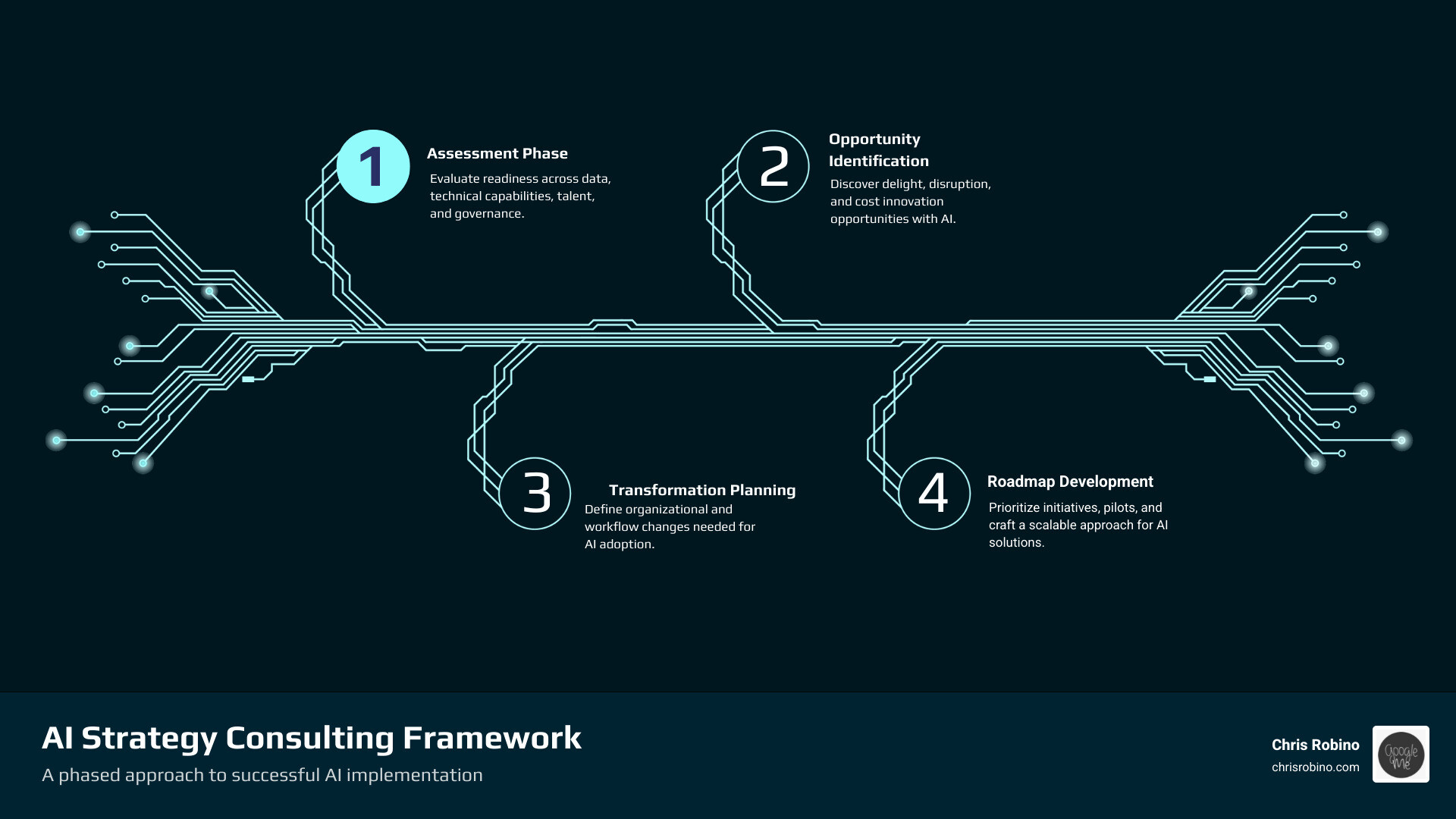
Adopting AI and scaling SEO without foundational readiness increases the risk of inconsistent content, technical issues, and wasted investment. A concise but thorough assessment should cover:
- Data & Analytics: Can you reliably see performance by product, market, and content type? Are logs, crawl data, and analytics unified enough for AI analysis?
- Technical Infrastructure: Is your platform fast, secure, mobile-friendly, and easily crawlable? Are redirects, canonical tags, and structured data under control across properties?
- Content Operations: Do you have clear standards, workflows, and approvals for content creation, localization, and updates, especially when AI is involved?
- Governance: Are there policies defining when and how AI can be used in SEO, content, and experimentation?
Once readiness is confirmed, you can develop an enterprise SEO framework built around these components:
- Customer and Business “Jobs to Be Done”: Clarify the key customer questions and intents that matter most for your core products and services. Align SEO initiatives to those intents and to revenue goals—not just traffic.
- Opportunity Triad for SEO:
- Customer delight: Create authoritative, helpful content that fully answers high-intent queries and improves experience.
- Market disruption: Use AI insights to identify emerging topics, new product categories, and underserved segments.
- Cost innovation: Apply AI to reduce manual SEO tasks (e.g., audits, clustering, metadata) and focus human effort where it adds the most value.
- Organizational Change: Define how SEO and AI fit into existing teams. This often includes central SEO leadership, embedded SEO champions, and content teams trained on AI-assisted workflows.
- Prioritized Roadmap: Build an actionable sequence of initiatives, such as:
- Fixing critical technical SEO and site performance issues.
- Optimizing high-value product and category pages.
- Consolidating duplicate or low-value content.
- Launching AI-assisted content programs in priority topics.
Navigating Risks and Maximizing Value in AI-Driven SEO
Enterprise SEO amplified by AI brings specific risks:
- Inaccurate or Thin Content: AI-generated content can be factually wrong or lack depth, harming both users and rankings.
- Brand and Compliance Issues: Unsupervised content creation can introduce off-brand language or non-compliant claims.
- Duplicate and Overlapping Pages: Rapid content production can worsen cannibalization and crawl inefficiency.
- Data Privacy and Security: Using internal data to train or prompt AI systems must follow strict data governance rules.
Mitigation strategies include:
- Clear standards on when AI can assist vs. when humans must author content.
- Human review and subject-matter expert validation for all customer-facing content.
- Strong technical foundations (canonicalization, sitemaps, internal linking) to support large inventories.
- Continuous monitoring of SEO performance, user behavior, and error logs.
To maximize value, tie AI-enabled SEO initiatives to specific business outcomes such as qualified leads, online sales, or self-service adoption. Measure, iterate, and retire activities that do not move those metrics.
Human Expertise Plus AI: The New Enterprise SEO Operating Model
AI will not replace experienced SEO leaders, strategists, and writers; it will augment them.
In modern enterprise SEO:
- AI helps surface opportunities, test hypotheses, and automate repetitive work (such as large-scale audits, clustering, and internal link suggestions).
- Humans provide strategic direction, understand stakeholder needs, and ensure content and technical changes support broader business goals.
- Cross-functional collaboration (SEO, product, engineering, content, analytics) becomes easier when AI tools provide clear, shared insights and visualizations.
A thoughtful AI strategy ensures your SEO program remains fast, consistent, and aligned with your brand, while human judgment safeguards quality and relevance.
Future-Proofing Enterprise SEO: Key Trends
To stay ahead in search, large companies should prepare for:
- Search Experiences Powered by AI: More conversational, intent-driven experiences where clear, authoritative content and strong entities matter.
- Deeper Personalization: AI-driven recommendations informed by behavior, location, and preferences, supported by robust first-party data.
- Automation of Routine SEO Tasks: Scaling audits, tag management, and reporting, freeing teams for strategy and experimentation.
- Closer Integration with Product and UX: Search insights guiding product roadmaps and on-site experiences, not just page titles and descriptions.
By embedding AI into your SEO strategy and operations, you can continuously adapt to algorithm changes and evolving user behavior without constant reinvention.
From Strategy to Execution: Implementing Your AI-Enabled SEO Roadmap
Successfully integrating AI into enterprise SEO requires linking strategic intent to specific, manageable actions. A clear roadmap helps large organizations focus on what matters, avoid disruption to critical operations, and capture value quickly.
Key steps to put your strategy into practice include:
-
Start with High-Impact Pilots
- Choose a few product lines, regions, or content clusters with clear business value.
- Use AI to accelerate keyword research, content gap analysis, and content outlines.
- Measure impact on visibility, traffic quality, and conversions.
-
Strengthen Technical Foundations
- Resolve crawl issues, slow pages, and mobile usability problems that limit visibility.
- Implement structured data at scale to help search engines understand your products, services, and content.
- Use AI tools to monitor log files and detect patterns in crawling and indexing.
-
Enhance Content Operations
- Define roles and workflows for AI-assisted content production, review, and publishing.
- Train writers, editors, and SEO specialists on how to use AI responsibly and effectively.
- Maintain a central repository of guidelines, templates, and approved prompts.
-
Create Governance and Measurement Loops
- Establish clear approval processes for SEO and content changes in regulated or high-risk areas.
- Track key performance indicators (KPIs) such as non-branded organic traffic, share of voice, conversion rate, and content engagement.
- Use dashboards to provide leadership with visibility into the impact of SEO and AI initiatives.
-
Scale What Works Across the Enterprise
- Once pilots prove successful, apply the same patterns to other business units, geographies, or product categories.
- Standardize playbooks and best practices so teams can move quickly without recreating the process each time.
- Continue refining AI models, prompts, and tools as you gather more data and feedback.
Navigating AI-enabled SEO at enterprise scale—across data, technology, content, and governance—can be complex. As AI strategy consultants, we provide structured frameworks, technical expertise, and change management support so your organization can adopt these capabilities confidently.
By pairing a clear AI strategy with disciplined SEO execution, your company can increase organic visibility, strengthen digital experiences, and build a sustainable competitive edge in search. To turn AI and SEO from isolated experiments into engines of growth, partner with a forward-thinking technology innovation consulting firm.