

Why Thought Leadership Content Ideas Are Your Most Powerful Brand Asset
Thought leadership content ideas are strategies for creating expert-driven content that shapes how your audience thinks, builds trust, and positions you as the go-to authority in your field. For large companies, these ideas must be integrated into a sophisticated SEO framework to ensure that high-level insights reach the right decision-makers at scale. Here are the most effective types to focus on:
- Proprietary research reports – Original data your audience can’t find anywhere else
- Counter-narrative opinion pieces – Challenge conventional wisdom with evidence
- Personal story posts – Authentic behind-the-scenes insights from your own experience
- Expert video content – Talking head videos, explainers, and panel discussions
- Podcasts and webinars – Long-form conversations that build deep credibility
- Data storytelling – Turn industry benchmarks into compelling narratives
- TED-style presentations – High-impact ideas worth spreading to broad audiences
- LinkedIn thought leadership posts – Short, punchy takes that spark real discussion
- White papers and ebooks – In-depth guides that influence B2B buying decisions
- Case studies with real results – Proof-backed stories that earn trust fast
The content landscape is noisier than ever. Decision-makers are drowning in generic posts, recycled advice, and AI-generated filler. Yet the demand for real expertise has never been higher. According to research, 71% of decision-makers actively read thought leadership content to develop new ideas, and 55% use it to vet vendors before making a purchase.
In the enterprise sector, the challenge is not just creating content, but ensuring it is discoverable. Large organizations often struggle with “content silos” where brilliant insights are buried on subdomains or PDF files that search engines can’t easily index. A successful strategy requires a marriage between high-level thought leadership and technical SEO excellence. This means optimizing for “information gain”—a concept where search engines reward content that provides new, unique information not found in other search results.
I’m Chris Robino, a digital strategy leader and AI and search expert with over two decades of experience helping organizations from startups to enterprises turn expertise into influence — and thought leadership content ideas are central to the strategies that drive lasting growth. In the sections below, I’ll walk you through exactly what works, why it works, and how to execute it.
Thought leadership content ideas further reading:
- innovation in media companies
- media industry networking events
- technology innovation consulting firm
Proven Thought Leadership Content Ideas to Build Authority
In high-stakes business, “content” is a commodity, but “thought leadership” is an asset. To truly stand out, we must move beyond simply answering questions that people are searching for and start asking the questions they should be asking.
Effective thought leadership content ideas are rooted in three pillars: originality, expert knowledge, and an understanding of industry trends. When we combine these, we create a “content moat”—a body of work that is difficult for competitors to replicate because it is based on our unique perspective and lived experience.
Defining Thought Leadership vs. Content Marketing
While the terms are often used interchangeably, there is a distinct difference between regular content marketing and true thought leadership.
| Feature | Regular Content Marketing | Thought Leadership Content |
|---|---|---|
| Primary Goal | Lead generation and SEO traffic | Building authority and changing perspectives |
| Source of Truth | Aggregated information / Keywords | First-hand experience / Proprietary data |
| Tone | Helpful and educational | Authoritative and often provocative |
| Audience Impact | Solves a specific “how-to” problem | Challenges the way the audience thinks |
Since the pandemic, there has been a massive boom in this space, with 66% of decision-makers reporting an increase in the consumption of thought leadership. However, the bar for quality has risen. Today, 64% of respondents expect this content to “challenge the way they think,” and 71% of decision-makers read these pieces specifically to help them develop new ideas. If your content is just a polished version of what everyone else is saying, it isn’t thought leadership—it’s “thought followship.”
For a deeper dive into these distinctions, check out our b2b thought leadership content guide.
SEO Strategies for Large Companies: Scaling Authority
For large enterprises, SEO is a different beast than it is for small businesses. When you have thousands of pages and a high domain authority, your strategy must focus on technical precision and content architecture.
1. Technical SEO and Crawl Budget Management Large sites often suffer from “crawl bloat.” Search engine bots have a limited amount of time to spend on your site. If you have thousands of low-value pages, bots may never reach your high-value thought leadership pieces. Enterprise SEO requires aggressive pruning of thin content and the use of robots.txt and canonical tags to guide bots toward your most authoritative assets.
2. The Pillar-Cluster Model for Topic Dominance Instead of targeting individual keywords, large companies should aim to own entire topics. This is achieved through a pillar-cluster model. A “pillar” page is a comprehensive guide on a broad topic (e.g., “The Future of Supply Chain Management”). This page then links to dozens of “cluster” pieces—your thought leadership articles, case studies, and research reports. This internal linking structure signals to search engines that your site is the definitive source of truth for that subject.
3. Leveraging E-E-A-T (Experience, Expertise, Authoritativeness, Trustworthiness) Search engines now prioritize content that demonstrates real-world experience. For large companies, this means moving away from anonymous corporate blogging. Every piece of content should be attributed to a real expert within the organization, complete with a detailed author bio and links to their professional credentials. This humanizes the brand and satisfies the algorithmic requirements for high-quality content.
4. Programmatic SEO for Scale Large companies can use programmatic SEO to create thousands of high-quality, data-driven pages. For example, a global logistics firm might create unique, data-backed pages for every major shipping route in the world. The key is to ensure these pages aren’t just templates, but contain unique insights and proprietary data that provide genuine value to the user.
High-Impact Video and Interactive Thought Leadership Content Ideas
Video is no longer optional. With 89% of customers wanting to see more video from brands in 2024, it has become the primary medium for humanizing a brand. For busy executives, video offers a high-impact, low-lift way to share insights without spending hours writing.
We recommend a tiered approach to video:
- Talking Head Videos (Medium Lift): These mimic one-on-one conversations. When an executive speaks directly to the camera, it fosters an immediate sense of intimacy and trust.
- Explainer Videos: These are fantastic for breaking down complex industry shifts or new regulations into understandable segments.
- Repurposed Keynotes: Did you speak at a conference? published an article on LinkedIn that reflects those remarks, embedding the video directly into the post to extend its lifespan.
By breaking recording sessions into bite-sized pieces, we can respect an executive’s schedule while still producing a consistent stream of authoritative content. You can see more examples of thought leadership content to see how these formats play out in the real world.
Leveraging Proprietary Data and Research Reports
One of the most uncopyable thought leadership content ideas is the use of proprietary data. If you have a product or service that generates unique metrics, you are sitting on a goldmine of authority.
Data storytelling turns dry numbers into a narrative that the C-suite can use for decision-making. Consider these statistics:
- 55% of decision-makers use thought leadership to vet prospective vendors.
- 47% of C-suite executives have shared their contact information after reading a high-quality research piece.
When we publish Global Research Reports, we aren’t just sharing facts; we are setting industry benchmarks. This positions our brand as the “source of truth” that others must cite, naturally building high-quality backlinks and SEO authority.
Personal Narratives and Counter-Narrative Thought Leadership Content Ideas
People don’t connect with corporations; they connect with people. Authentic journeys—including the failures and the “messy middle”—are often more persuasive than a list of successes.
Challenging the norm is equally powerful. If the entire industry believes “X,” and your experience has shown that “Y” is actually true, say it. This creates “tension,” which is a requirement for true thought leadership. For example, when a leader gave a TED Talk on the power of vulnerability, it flipped conventional wisdom on its head and garnered over 65 million views.
Expertise isn’t just about knowing the answers; it’s about having the courage to share a unique perspective. 68% of respondents agree that true thought leaders have expert knowledge derived from hands-on experience, not just theoretical study.
The Role of AI in Modern Content Strategy
AI is a tool for efficiency, not a replacement for expertise. In our strategy, we distinguish between “commodity content” and “thought leadership.”
- Commodity Content: AI is perfect for generating meta descriptions, alt tags, and basic “how-to” drafts. Never write these by hand if you can automate them.
- Thought Leadership: AI cannot write this because it lacks lived experience, opinions, and the ability to feel “tension.” However, it is an incredible research partner.
We use AI for brainstorming and discovering the questions that people in an industry are “afraid to answer.” Here are a few AI-assisted research prompts we use to generate thought leadership content ideas:
- “What are 5 controversial opinions that experts in [Industry] have but rarely say out loud?”
- “What are the most common misconceptions [Job Title] has about [Topic]?”
- “Analyze these 10 industry news articles and identify a pattern that no one is talking about yet.”
Overcoming Challenges and Measuring ROI
The biggest challenge in thought leadership is consistency. Many leaders start strong but fade away when they don’t see immediate “viral” results. However, 90% of business owners who stick with their programs report them as successful.
Measurement should move beyond vanity metrics like clicks. Instead, we look at:
- Qualitative Signals: Are you getting DMs from high-value prospects? Are peers sharing your work?
- Decision Support: 60% of C-suite executives say thought leadership helps them make better decisions.
- Sales Enablement: 95% of buyers are more open to sales outreach after consuming good thought leadership.
Executing Your Strategy and Measuring Success
Building a strategy requires more than just a list of ideas; it requires a roadmap. We begin by identifying the audience and the specific content gaps in the market. For large companies, this involves a deep audit of existing search rankings to find where the brand is underperforming despite having the expertise to lead.
Once we have our “owned beliefs”—the 1-3 arguable points our brand stands for—we build an editorial calendar. This ensures that we aren’t just chasing trends but are consistently building a “content moat” around our expertise. This moat is reinforced by a technical SEO foundation that ensures every piece of content is optimized for speed, mobile-friendliness, and semantic search relevance.
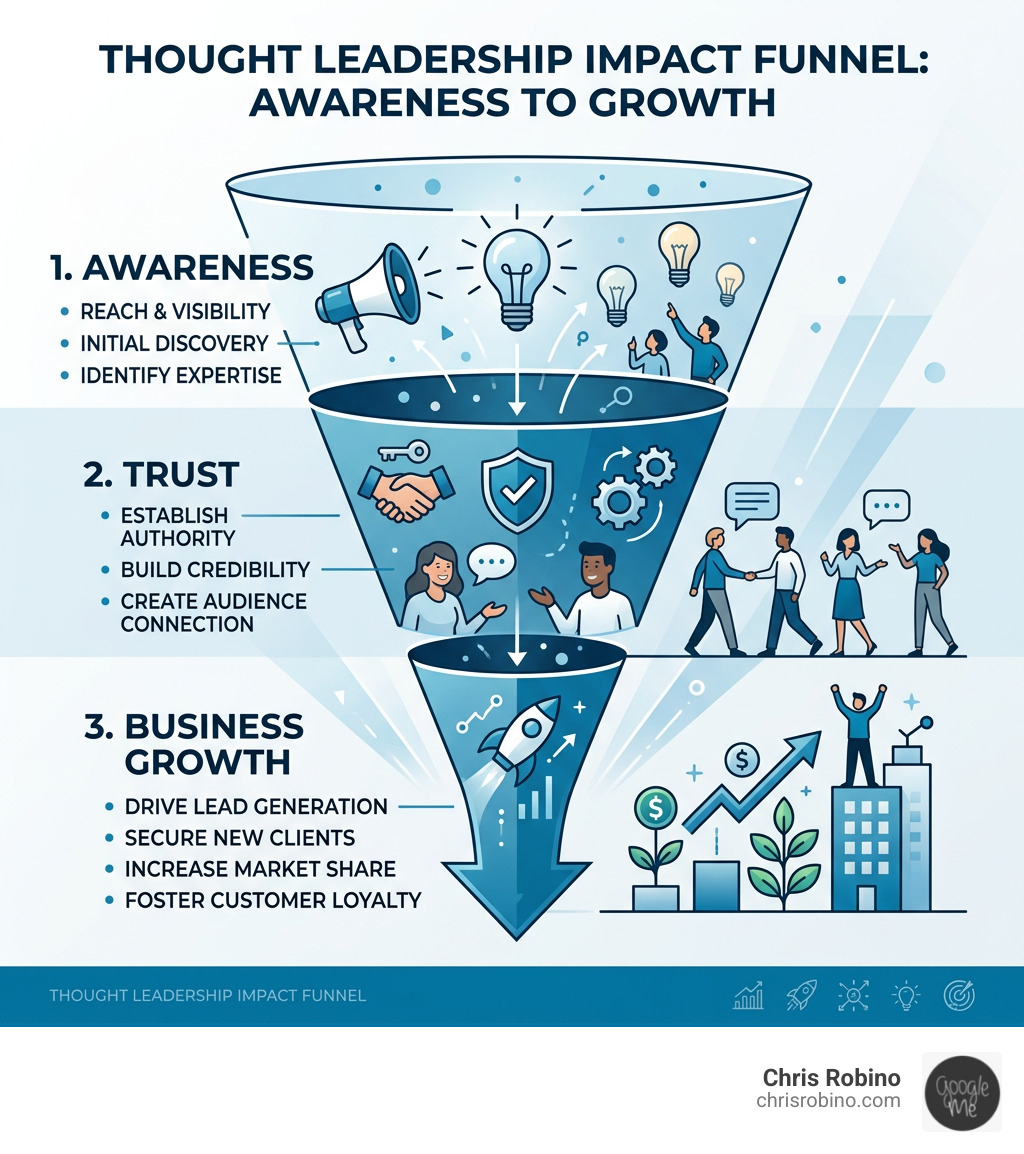
For large enterprises, this strategy supports the entire sales funnel. It moves from awareness (LinkedIn posts and high-volume SEO keywords) to consideration (webinars and research reports) to the final decision (case studies and ROI calculators). By aligning your SEO strategy with your thought leadership goals, you create a self-sustaining engine of authority that drives organic growth year after year.
At Chris Robino, we specialize in helping leaders navigate this complex landscape, ensuring that your voice isn’t just heard, but respected. To find out where your current strategy stands, See how you score with our optimization assessment.
By focusing on original insights, human storytelling, and a strategic use of technology, you can move from being a voice in the crowd to the leader of it. Book a Call today to start turning your expertise into your greatest competitive advantage.