

The Predictive Analytics Trends Every Data-Driven Marketer Needs to Know in 2026
Predictive analytics trends are moving fast — and if you’re not tracking them, your competitors already have the edge.
Here’s a quick snapshot of the top trends shaping the field right now:
- Real-time streaming inference — predictions delivered in under 100 milliseconds using tools like Apache Kafka and Flink
- Prescriptive analytics — going beyond forecasting to recommend specific actions
- Synthetic data — solving data scarcity without compromising privacy
- No-code AutoML tools — putting predictive modeling in the hands of non-technical teams
- Explainable AI (XAI) — meeting regulatory demands from the EU AI Act and NIST framework
- Causal machine learning — shifting from “X correlates with Y” to “X causes Y”
- Embedded analytics — predictions built directly into CRM and ERP workflows
The market numbers tell the same story. The global predictive analytics market was valued at over $18 billion in 2024 and is projected to surpass $95 billion by 2032 — growing at roughly 23% per year. That’s not a niche technology trend. That’s a fundamental shift in how organizations make decisions.
And yet, most businesses are still running monthly batch reports and calling it “data-driven.”
The gap between what’s possible and what most teams actually do is enormous — and that gap is where the real competitive opportunity lives right now.
I’m Chris Robino, a digital strategy and AI search expert with over two decades of experience helping organizations turn data into growth. Tracking and applying predictive analytics trends has been central to my work advising companies through digital transformation. Let’s break down exactly what’s changing and what you should act on first.
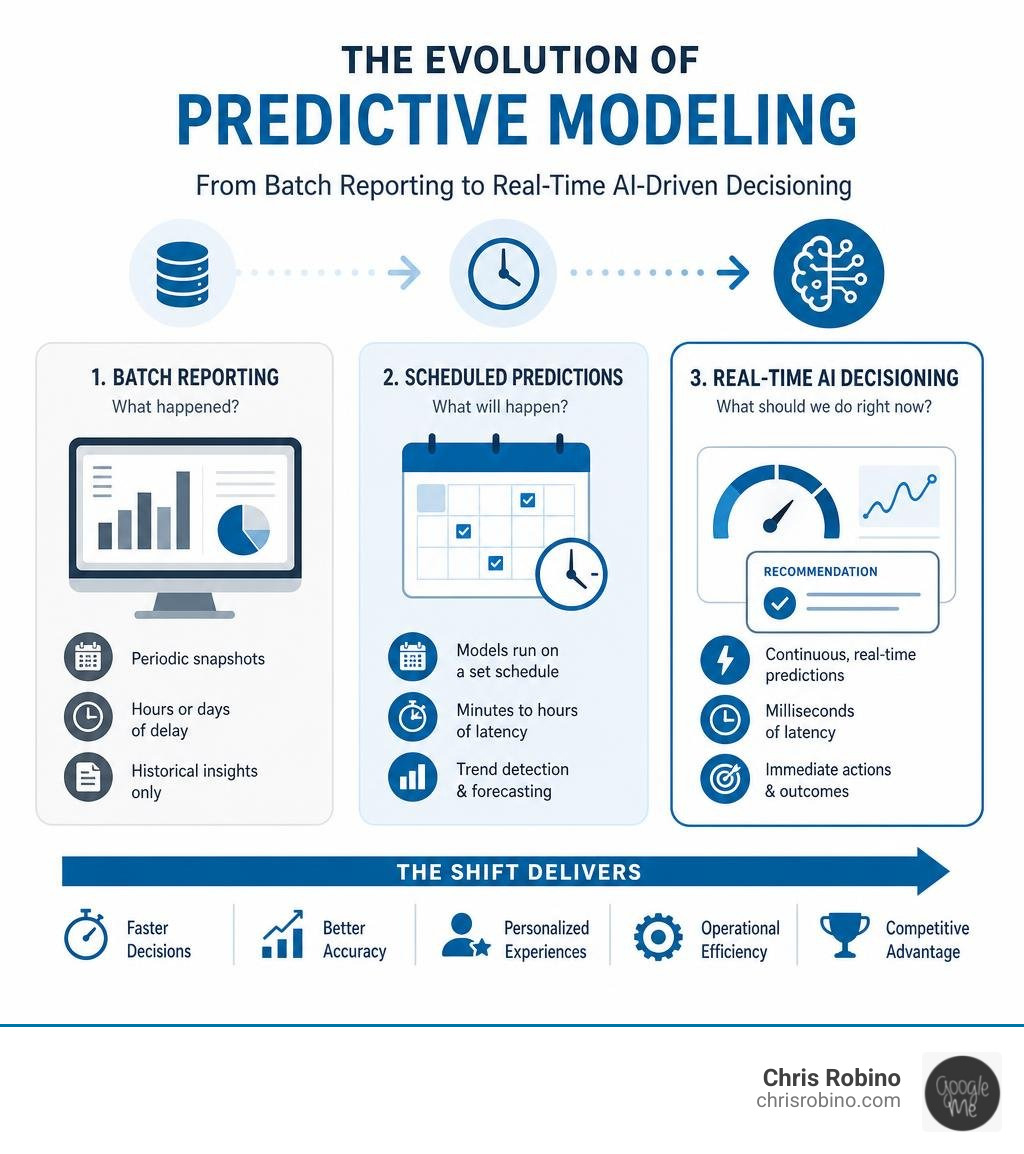
Key terms for Predictive analytics trends:
Core Predictive Analytics Trends Reshaping Modern Business

As we navigate July 2026, the enterprise landscape is undergoing a massive paradigm shift. The days of treating data as a historical record are officially over. Today, forward-thinking organizations leverage predictive models to anticipate customer needs, optimize supply chains, and mitigate risks before they manifest.
According to the latest research, the market opportunity is staggering. The industry is on a hyper-growth trajectory, highlighted in the Predictive Analytics Market: USD 81.2 Billion Opportunity by 2034 at 18.0% CAGR . Other reports, such as the Predictive Analytics Market Size, Share & Trends | Industry Report 2035 , project the market could skyrocket even further, potentially reaching $168.46 billion by 2035 at a 21.4% CAGR.
This rapid expansion is driven by a fundamental change in how we approach future trends analysis and emerging tech insights. Let’s dive into the core technical trends driving this massive commercial growth.
Real-Time Data and Streaming Architectures in Predictive Analytics Trends
The absolute gold standard in 2026 is immediate, transaction-speed intelligence. Batch processing — running data models overnight or over the weekend — is a relic of the past. Modern consumer behavior changes in milliseconds, and our models must adapt just as quickly.
This demand has accelerated the adoption of event-driven streaming architectures. By combining open-source technologies like Apache Kafka and Apache Flink, organizations can ingest high-velocity data pipelines and run real-time inference on the fly.
Whether it is detecting a fraudulent credit card transaction, adjusting dynamic pricing on an e-commerce storefront, or triggering a highly personalized retention offer, these systems achieve sub-100-millisecond delivery. Relying on ai-powered analytics allows businesses to instantly score risk and opportunity at the exact moment a customer interacts with their brand.
Prescriptive Analytics vs. Predictive Modeling
While predictive analytics is incredibly powerful, it only answers the question: “What is highly likely to happen next?”
The trend in 2026 is moving rapidly toward prescriptive analytics, which answers the next logical question: “What should we do about it?” Prescriptive systems combine predictive algorithms with advanced decision optimization, machine learning loops, and business rules to provide automated, actionable recommendations.
To understand how these two approaches compare, take a look at this quick breakdown:
| Capability | Predictive Analytics | Prescriptive Analytics |
|---|---|---|
| Primary Question | What will happen next? | What is the best course of action to take? |
| Core Output | Probability scores, future forecasts, risk rankings | Actionable recommendations, automated workflow triggers |
| Techniques Used | Regression, time-series forecasting, classification | Causal inference, optimization algorithms, simulation |
| Business Impact | Identifies upcoming trends and potential bottlenecks | Directly resolves the bottleneck or captures the opportunity |
By pairing forecasting with automated decision execution, companies can deploy ai-driven business solutions that put operational adjustments on autopilot.
Overcoming Data Scarcity with Synthetic Data
Historically, the biggest barrier to building accurate predictive models was data scarcity. If you were launching a new product, entering a new market, or dealing with highly sensitive customer data, you simply did not have the volume of clean historical data required to train complex machine learning models.
In 2026, synthetic data has emerged as the ultimate solution to this bottleneck. Using advanced generative AI frameworks, data science teams can generate mathematically identical, fully anonymous synthetic datasets to bootstrap their models.
This approach serves two critical functions:
- It bypasses cold-start problems, enabling rapid model prototyping.
- It ensures strict privacy preservation, allowing teams to train models on simulated behavioral patterns without exposing actual user identities or violating global compliance regulations.
Implementing Next-Generation Predictive Models and Overcoming Obstacles

While the mathematical engines behind these models have never been stronger, implementing them is not without friction. Organizations frequently stumble when transitioning from isolated pilot programs to enterprise-scale deployment.
The most common failure mode is not a poorly written algorithm, but a reasonable model running on fragmented, siloed data. To build a system that actually drives value, you must look beyond the numbers what data analytics consulting can do for you and address the underlying infrastructure.
Democratizing Data: No-Code Tools and Predictive Analytics Trends
One of the most exciting predictive analytics trends of the year is the democratization of model building. In the past, deploying a predictive model required a dedicated team of Ph.D. data scientists and MLOps engineers. Today, intuitive AutoML platforms and visual no-code builders have opened the door for citizen data scientists.
Leading enterprise software platforms now embed predictive templates directly into standard CRM and ERP interfaces. This means a sales manager, marketing strategist, or operations lead can build and run deal-close probabilities or customer churn models without writing a single line of code. By lowering the technical barrier, businesses can scale their predictive capabilities across every department, fostering a truly proactive, data-first culture.
Ethical AI, Explainability, and Regulatory Compliance
As predictive models take on more decision-making authority, they face unprecedented regulatory scrutiny. Global frameworks like the EU AI Act and the US NIST AI Risk Management Framework classify predictive AI used in high-stakes environments — such as credit scoring, insurance underwriting, and recruitment — as high-risk.
This has made Explainable AI (XAI) an absolute necessity. Black-box models that output predictions without showing their work are no longer legally or ethically viable. Organizations must implement robust model auditing, feature importance mapping, and bias mitigation protocols.
Furthermore, data teams must actively monitor for model drift. When real-world behavior changes, the underlying data distribution shifts, causing model accuracy to decay. Maintaining strict ai regulatory compliance requires automated retraining pipelines and transparent documentation to prove that decisions are fair, auditable, and explainable.
Industry Applications: Healthcare, Supply Chain, and Finance
These theoretical trends translate into incredible real-world utility across several key sectors:
- Healthcare Diagnostics: Clinical predictive models analyze electronic health records, lab results, and patient history to provide early-warning alerts for conditions like sepsis up to 12 hours before clinical deterioration occurs.
- Supply Chain Optimization: Using causal machine learning, manufacturers can move beyond simple demand forecasting. They can simulate how supplier changes, weather patterns, and geopolitical shifts will impact logistics, allowing them to proactively adjust inventory thresholds.
- Financial Risk Management: Banks and financial institutions utilize real-time transaction scoring to identify complex, multi-layered fraud patterns in under 100 milliseconds, saving billions in potential losses.
To see how these components come together to drive real business actions, explore the workflow diagram below:
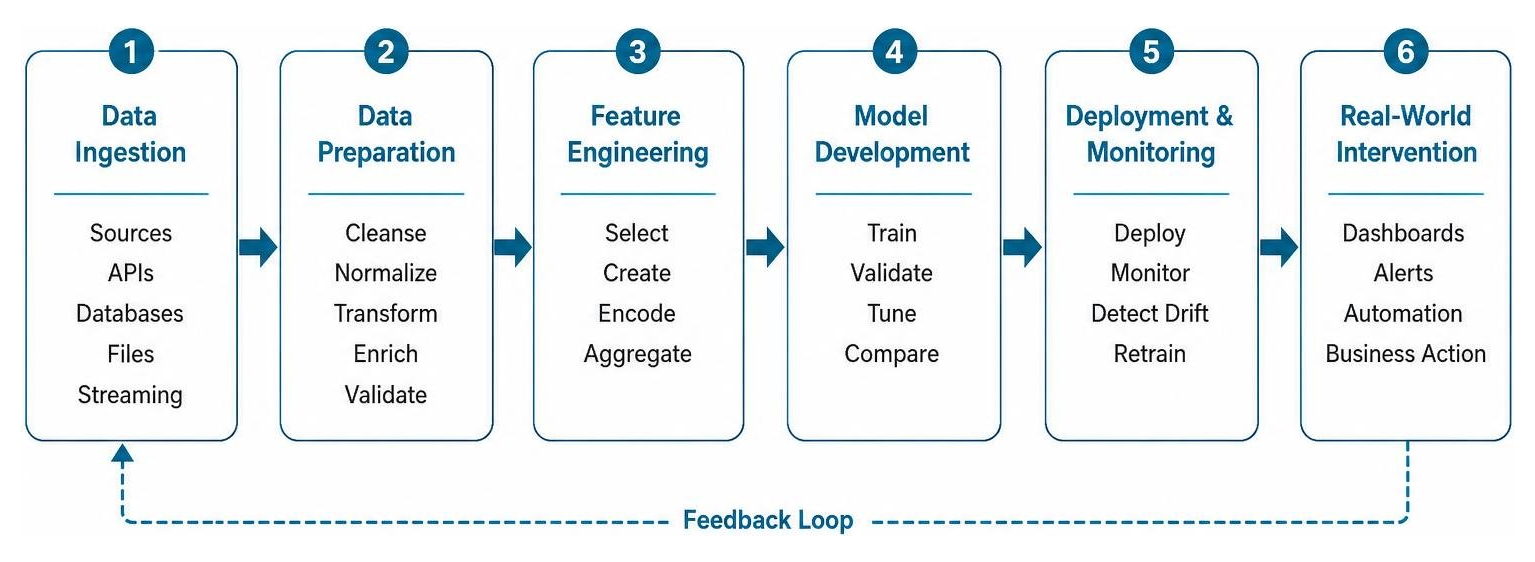
Implementing these advanced workflows is a core pillar of modern digital transformation. If you are ready to modernize your organization’s media, data, or operational strategies, exploring our comprehensive guide on digital-transformation-for-media is the perfect next step to align your technology stack with future demands.
Frequently Asked Questions
What is driving the increased demand for real-time data in predictive analytics?
Consumers expect immediate, hyper-personalized experiences, and market conditions shift in milliseconds. Real-time data processing allows organizations to score risks and opportunities instantly, delivering predictions during the active transaction window rather than hours or days after the fact.
How does prescriptive analytics differ from predictive analytics?
Predictive analytics forecasts what is likely to happen in the future based on historical patterns. Prescriptive analytics goes a step further by using optimization algorithms and decision logic to recommend and trigger the best course of action to take in response to that forecast.
What is the role of synthetic data in predictive modeling?
Synthetic data solves the challenge of data scarcity and privacy constraints. By using generative AI to create mathematically identical, completely anonymous datasets, organizations can train and validate highly accurate models without exposing sensitive real-world customer information.
How are no-code tools changing the accessibility of predictive analytics?
No-code AutoML platforms and visual model builders allow non-technical business analysts (citizen data scientists) to build, test, and deploy predictive models directly within their existing workflows, reducing reliance on specialized data science teams.
Why is Explainable AI (XAI) crucial for regulatory compliance?
New global regulations, such as the EU AI Act, require automated decisions in high-stakes areas (like credit scoring and hiring) to be transparent and auditable. XAI tools explain how a model reached a specific prediction, helping organizations prevent bias and satisfy legal compliance audits.