

Why Understanding Emerging Technology is Your Competitive Advantage
Emerging tech insights are the key to navigating the next wave of innovation. While AI dominates the conversation, the real change is the convergence of multiple exponential technologies that will redefine how we work, live, and do business.
A Glimpse of What’s Coming:
- Artificial Intelligence: Moving from generative models to autonomous systems.
- Quantum Computing: Solving problems in seconds that would take supercomputers years.
- Brain-Computer Interfaces: Enabling thought-to-text typing at over 1000 words per minute.
- Programmable Matter: Materials that change shape and properties on demand.
- Synthetic Biology: Writing new organisms and storing data in DNA (215 million GB per gram).
- Decentralized Physical Infrastructure: Peer-to-peer networks cutting costs by up to 90%.
The numbers tell a clear story: generative AI saw a 700% spike in Google searches from 2022 to 2023, even as overall technology investments fell. This signals a massive opportunity for those who know where to focus.
The internet didn’t peak with dial-up, and smartphones didn’t stop at the BlackBerry. AI is just the warm-up act. Companies that recognize this pattern and prepare now will gain a significant advantage over those still catching up to yesterday’s trends.
I’m Chris Robino, and I’ve spent two decades helping organizations steer digital change. I’ve seen how emerging tech insights can transform business outcomes when applied strategically.
Beyond the Buzzwords: What is Emerging Technology and Why Should You Care?

Let’s cut through the hype. Emerging technology isn’t just a futuristic gadget; it’s a radical innovation, still early in its commercial journey, with high growth potential to fundamentally change business and society. These are tomorrow’s game-changers, offering a digital advantage to those who pay attention now.
History shows this pattern repeatedly. We saw the shift from operating systems to browsers, then to the cloud, creating new winners and losers at each turn. You can see this evolution in our analysis of Moving from Ops System to Browser-Based to the Clouds.
The Anatomy of a Tech Trend
To separate signal from noise, I look at four key indicators:
- Interest: Generative AI saw a 700% spike in Google searches from 2022 to 2023. This signals a fundamental shift in public and business focus.
- Innovation: The processing power of large language models jumped from 100,000 to two million tokens between 2023 and 2024. This exponential pace indicates real staying power.
- Investment: While overall tech equity investments fell in 2023, generative AI saw a sevenfold increase. Smart money is placing its bets.
- Talent: Despite a dip in tech job postings, long-term growth in tech jobs hit 8% from 2021 to 2023. The challenge is a skills gap, with fewer than half of candidates possessing the high-demand skills companies need.
Why Businesses Can’t Afford to Ignore the Horizon
Ignoring emerging tech is like driving while looking in the rearview mirror. You’ll miss tomorrow’s opportunities and threats.
Smart businesses use emerging tech insights to de-risk product planning, benchmark their portfolios, and stimulate new ideas. For large companies, this means preventing disruption by integrating new technologies early. But the strategy goes beyond products; it’s about dominating the digital landscape.
A core SEO strategy for large companies is to build topical authority around these future trends. By creating expert content on emerging technologies before they become mainstream, businesses can secure top search rankings, capture future market share, and become the go-to resource in their industry. This provides a first-mover advantage that is difficult for competitors to overcome.
This forward-thinking approach also attracts top talent. The best performers want to work at the forefront of innovation, shaping the future rather than just reacting to it.
Key Emerging Tech Insights: The Technologies Shaping Tomorrow

The future isn’t waiting. The most valuable emerging tech insights show we’re witnessing the convergence of multiple exponential technologies, creating foundational shifts in how we live and work. These aren’t just improvements; they’re breakthroughs that will make today’s innovations look like dial-up internet.
The AI Revolution: From Generative to Agentic
While Generative AI grabbed headlines with a sevenfold investment increase, the next frontier is Agentic AI—systems that can plan and complete complex tasks end-to-end. Early adopters are already using GenAI to accelerate visual-effects pipelines by an order of magnitude, and hyperscale cloud providers are pouring billions into the infrastructure required for future super-intelligence. Meanwhile, decentralized AI infrastructure projects are creating alternatives to traditional vendor lock-in, allowing individuals to contribute and profit from computing power.
Quantum Computing: The Silent Revolution
Quantum computing is quietly preparing to change everything. By using qubits that exist in multiple states at once, these machines can solve problems in seconds that would take traditional supercomputers millennia. Early demonstrations of quantum advantage hint at dramatic advances in drug findy and unhackable encryption. The National Institute of Standards and Technology is already preparing for this with post-quantum cryptography standards.
The Next Human Upgrade: Brain-Computer Interfaces (BCIs)
Imagine typing more than 1,000 words per minute—with your thoughts. That’s the promise of Brain-Computer Interfaces being refined by leading neurotechnology teams. Initial clinical trials are life-changing for people with paralysis, and consumer possibilities like memory augmentation and thought-controlled devices are on the horizon. These advances raise profound ethical questions about who owns our thoughts when they’re stored on a server.
The Physical World Reimagined: Programmable Matter & DePIN
Programmable Matter (e.g., Claytronics, 4D printing) will allow objects to change shape on demand, ending the era of static devices. Simultaneously, Decentralized Physical Infrastructure (DePIN) is creating peer-to-peer networks for everything from 5G connectivity to real-time road mapping, cutting costs and putting infrastructure ownership back in the hands of users.
The Code of Life: Synthetic Biology & Bioengineering
If DNA is nature’s code, Synthetic Biology is how we rewrite it. Combined with Bioengineering tools like CRISPR, we can program organisms to create biofuels, grow materials, or even store data—up to 215 million GB per gram of DNA. Rapid advances in bio-foundries are turning cells into programmable factories, setting the stage for breakthroughs across manufacturing, agriculture, and medicine.
From Lab to Boardroom: How Businesses Are Adopting New Tech

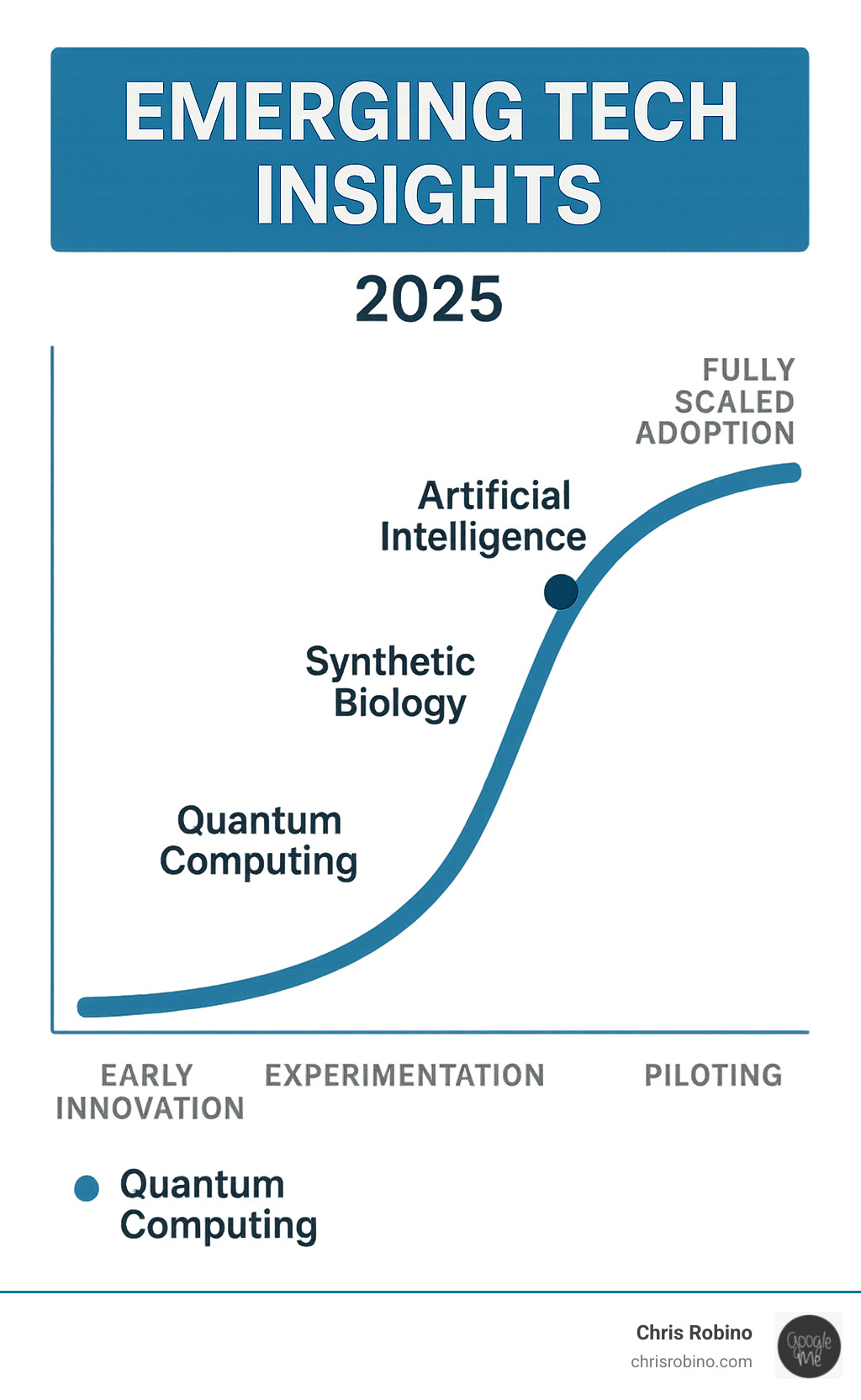
Groundbreaking lab tech is different from tech that businesses actually use. The journey follows an S-curve adoption model: from innovation and piloting to scaling and, finally, full adoption. This process varies dramatically across industries and regions, making these adoption patterns a crucial part of any emerging tech insights strategy.
Current Adoption Landscape
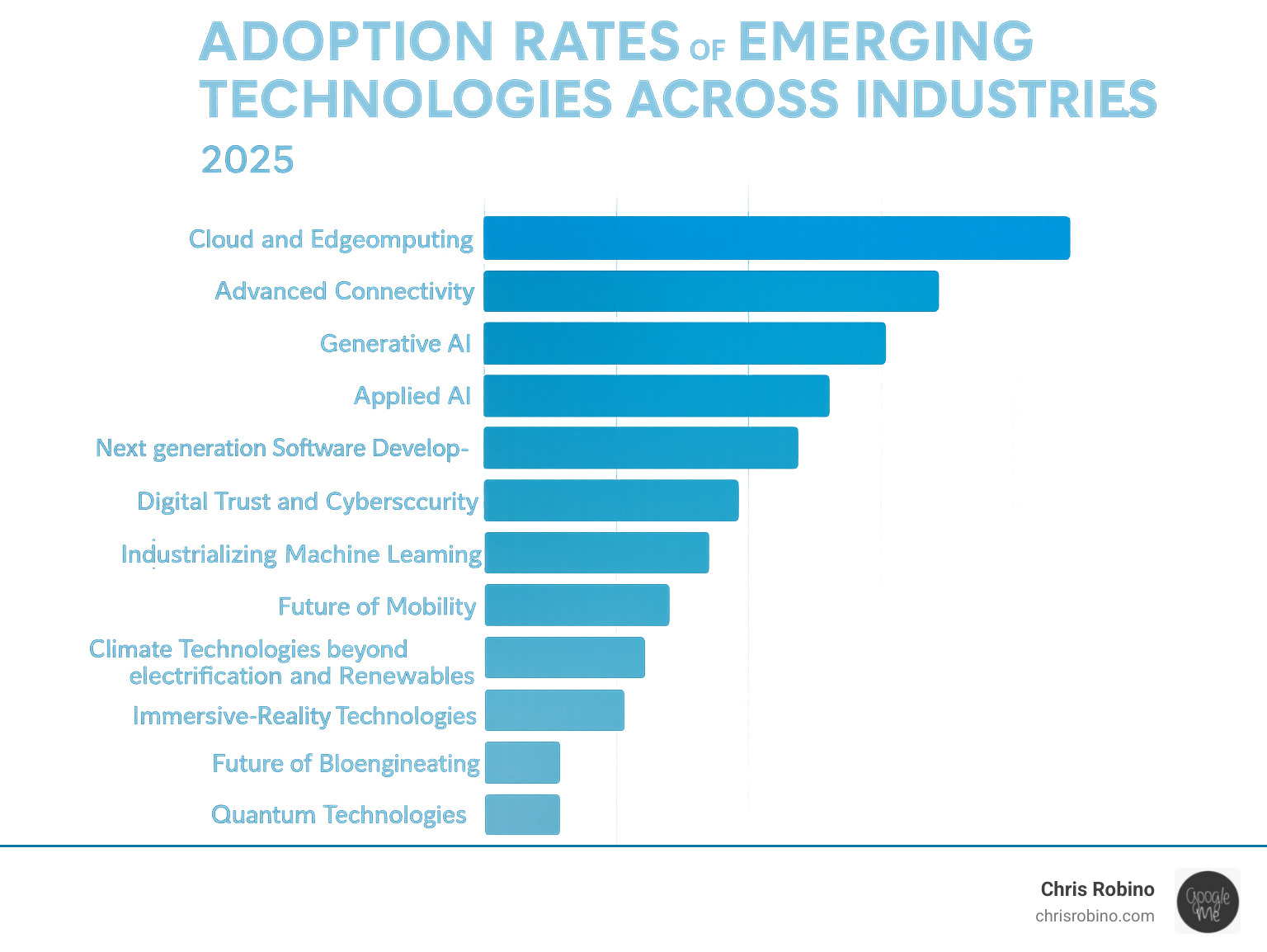
The data reveals which technologies are making the leap. Cloud and edge computing lead with 48% of organizations scaling or at full adoption. Advanced connectivity (37%) and generative AI (36%) follow, with GenAI’s rapid rise being particularly notable. Applied AI (35%), next-gen software development (31%), and digital trust (30%) form a foundational middle tier. Further down the curve, we see technologies like the future of bioengineering (18%) and quantum technologies (15%) just beginning their journey into the enterprise.
Benefits and Opportunities for Organizations
Organizations successfully integrating these technologies are seeing transformative results in process improvement, cost efficiency, and customer satisfaction. New product development is accelerating, with GenAI speeding up everything from drug findy to user interface design.
This creates a massive opportunity for large companies to align their SEO and content strategies with their innovation pipeline. By developing comprehensive content hubs around new products and the problems they solve, businesses can educate the market, build trust, and capture organic search traffic from day one. This proactive approach turns product launches into market-dominating events.
The competitive edge is undeniable, with digital technologies separating leaders from laggards. Entire industries are being reshaped, from insurance shifting to risk prevention to advertising facing disruption from AI-powered personal assistants.
The Skills Gap Challenge
Despite these opportunities, a significant skills gap remains. An analysis of 4.3 million job postings showed that fewer than half of candidates have the high-demand tech skills companies need. This makes upskilling and reskilling initiatives essential. The most successful organizations are building internal capabilities while these technologies are still emerging, giving them a sustainable advantage when widespread adoption begins.
Building a Future-Proof Strategy: Integrating Emerging Tech
Building a strategy around emerging tech insights isn’t about chasing trends. It’s about taking a long-term view and making smart bets that position your organization for the future. This requires an agile approach of course-correcting with intelligence as new information becomes available.
Strategic Emerging Tech Insights for Business Integration
A future-proof strategy starts with a clear plan of action.
- Build a dedicated emerging tech team. This is your organization’s radar, responsible for monitoring trends, running experiments, and identifying business applications.
- Foster a culture of experimentation. Encourage rapid prototyping and small-scale pilots. Fail fast, but learn from every attempt to understand what works in your specific context.
- Develop strategic partnerships. Collaborate with startups, research institutions, and technology vendors to expand your expertise and stay ahead of the curve.
- Focus on solving business problems. Identify core challenges first, then explore how emerging tech can provide a solution. This ensures real ROI.
- Build long-term SEO authority. Your tech team should work with marketing to create a cross-functional content strategy around key emerging topics. For large companies, building a moat of expert content establishes topical authority—crucial for dominating organic search in the future.
- Prioritize ethical implementation. Address data privacy, algorithmic bias, and societal impact from day one to build trust and ensure sustainable success.
Navigating Risks and Ethical Dilemmas
The promise of emerging tech comes with significant challenges. Cybersecurity vulnerabilities multiply as systems become more interconnected. Intellectual property questions arise from AI models trained on vast datasets.
For any large company focused on SEO, two risks are paramount. Harmful content generation (e.g., deepfakes, misinformation) and algorithmic bias can erode brand trust. In an era where leading search engines prioritize E-E-A-T (Experience, Expertise, Authoritativeness, Trustworthiness), deploying biased or unreliable AI can severely damage your reputation and search rankings. Ensuring safe, responsible, and unbiased use is therefore not just an ethical mandate—it’s a business imperative.
Frequently Asked Questions about Emerging Tech
What is the difference between emerging technology and disruptive technology?
An emerging technology is a promising newcomer—such as quantum computing—that is still in development or early adoption. A disruptive technology has already shifted the market paradigm, like the smartphone, creating entirely new categories. Today’s emerging tech is often tomorrow’s disruptive force.
How can I personally stay updated on emerging tech insights?
Staying current can feel overwhelming, but a few strategies work well. Follow reputable technology news outlets and subscribe to newsletters from independent research analysts. Join online communities where practitioners share practical insights. Most importantly, experiment with consumer-level tech yourself. Trying a non-invasive BCI headset or setting up a DePIN hotspot provides an intuition that reports alone cannot. Marketers should also follow blogs that track how search algorithms evolve alongside new technologies.
Which industry will be most impacted by emerging technologies in the next five years?
While the impact will be widespread, a few sectors are primed for massive change. Healthcare and life sciences stand to be transformed by AI-driven diagnostics, quantum simulations, and synthetic biology—making demonstrated expertise and trustworthiness essential for health-related SEO. Finance is being reshaped by decentralized finance and quantum-improved risk modeling. Manufacturing is evolving with robotics and 4D printing. Media and entertainment are entering a creative renaissance, with generative AI reducing content-production timelines from months to days. The key takeaway is that no industry will be untouched.
Conclusion: The 2020s Will Rewrite the Rules
We’re at the edge of an extraordinary era. The AI boom is just the warm-up act. The 2020s won’t just bring faster apps; we’re about to redefine reality itself with materials that reshape themselves, thought-powered typing, and programmable life forms.
The magic is in the convergence. It’s not just about one technology, but what happens when AI, quantum computing, and synthetic biology mature together. This is where breakthrough solutions and Google-sized businesses are born.
To thrive, you need a “polymath mindset”—the ability to connect dots across technology, biology, ethics, and business. For large companies, this means building marketing and SEO teams that understand technology deeply enough to spot second-order opportunities and build long-term digital dominance.
Leaders are already making their moves, investing in the future while others debate it. These technologies aren’t just business opportunities; they hold the potential to solve humanity’s biggest challenges, from hunger to disease.
The companies that will dominate the next decade are preparing for a world where the fundamental rules are being rewritten in real time. The most important skill won’t be knowing all the answers, but knowing how to ask the right questions.
The 2020s are rewriting the rules. The only question is whether you’ll be ready to write your chapter.
Explore how to build an Optimized Life and find practical strategies for thriving in this new era.