

Why Building Online Authority Is the Foundation of Digital Success
Building online authority is one of the most valuable things you can do to grow your presence online — whether you run a blog, a business, or a personal brand. For large companies, this process becomes even more critical as it involves managing vast digital footprints and ensuring that brand equity translates into search engine dominance. In an enterprise environment, authority is the shield that protects your market share from agile competitors and the engine that drives sustainable organic growth.
Here is a quick overview of how to build it at scale:
- Define your niche — focus on specific topic areas where your brand has a competitive advantage instead of covering everything.
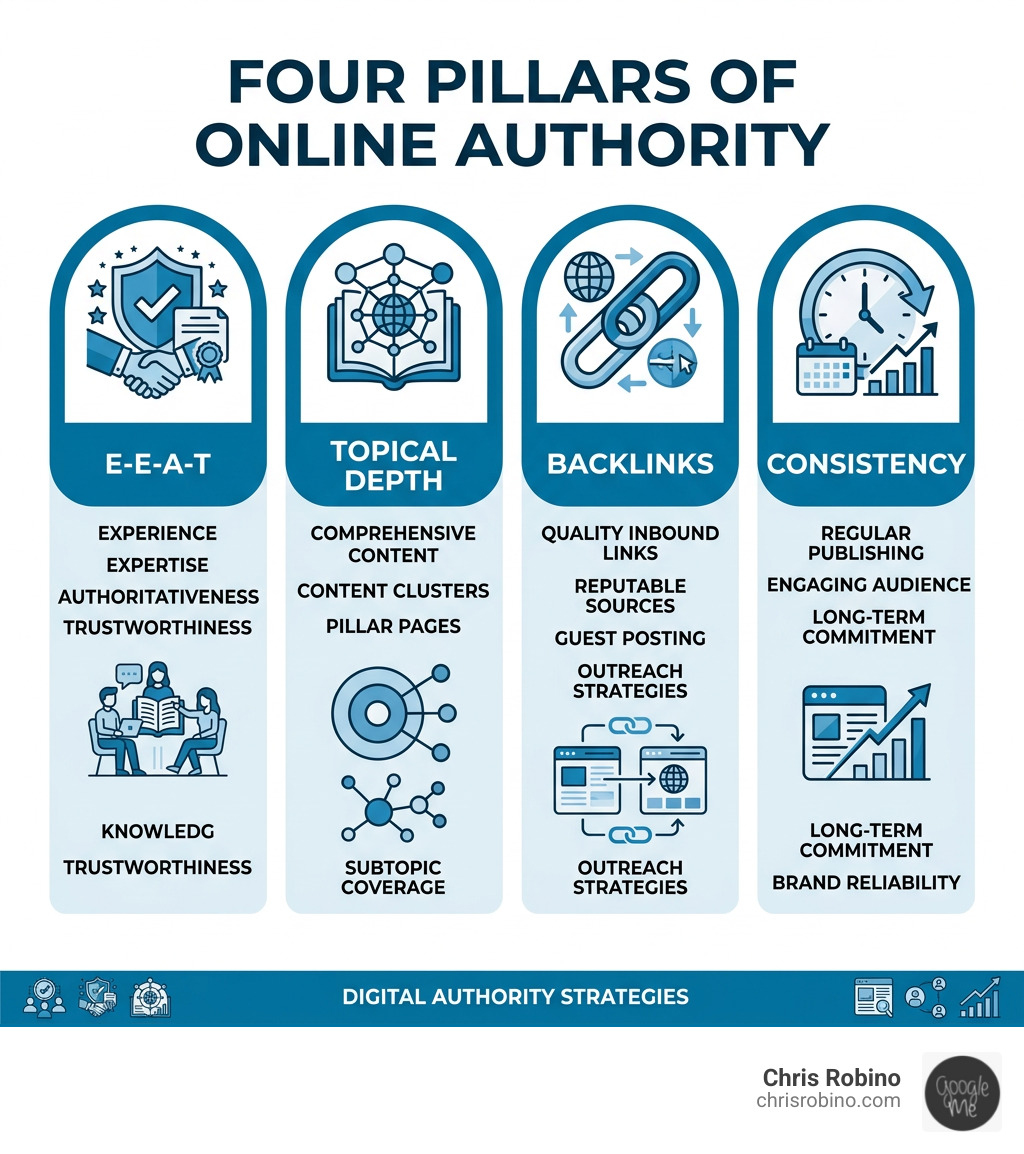
- Create content clusters — build pillar pages supported by in-depth subtopic articles to dominate entire semantic fields.
- Demonstrate E-E-A-T — show Experience, Expertise, Authoritativeness, and Trustworthiness in every piece, leveraging your internal subject matter experts.
- Earn quality backlinks — get reputable sites to link to your content through high-level PR, guest posting, and strategic outreach.
- Build social proof — collect reviews, mentions, and endorsements (77% of shoppers actively seek out sites with ratings and reviews).
- Stay consistent — publish regularly and engage your audience over the long term to maintain your “freshness” signals.
- Track and adjust — use tools like Google Search Console to measure branded searches, impressions, and ranking patterns across thousands of pages.
The digital landscape is crowded, and for large organizations, the stakes are higher. Google makes roughly nine algorithm changes every single day. That means the sites that survive — and thrive — are the ones that have built genuine trust and credibility with both readers and search engines. For an enterprise, this means moving beyond basic keyword optimization and focusing on technical infrastructure that supports massive amounts of content.
Authority is not about being famous. It is about being the most reliable, useful source on your topic. Search engines are increasingly good at telling the difference between shallow content and deep expertise. Large companies often struggle with “content bloat,” where thousands of low-value pages dilute their overall authority. The key to success is pruning the weak and doubling down on the high-performing assets that demonstrate true leadership.
The good news? Authority is buildable. Even established sites can revitalize their standing through focused, well-structured content strategies that align with modern search intent. By treating your website as a living digital ecosystem, you can ensure that every new page adds to your cumulative authority rather than just taking up space.
I’m Chris Robino, a digital strategy and AI search expert with over two decades of experience helping businesses — from startups to global enterprises — improve their search performance and build lasting building online authority strategies. In the sections ahead, I’ll walk you through the specific frameworks required to scale these efforts effectively.
Key Building online authority vocabulary:
Strategic Frameworks for Building Online Authority
To succeed in the modern digital landscape, we must move beyond the “publish and pray” method. Building online authority requires a deliberate framework that balances what search engines want with what human readers need. For large companies, this involves a sophisticated understanding of how different metrics influence visibility. We often see two primary metrics discussed: Domain Authority and Topical Authority.
Domain Authority is a metric used by industry-standard analysis tools to predict how well a website will rank based on its backlink profile and age. While useful for benchmarking against competitors, it isn’t something Google uses directly. On the other hand, Topical Authority is the perceived depth of your expertise on a specific subject. For large organizations, prioritizing topical authority is the most effective route to maintaining market leadership. Why? Because it allows you to own the entire conversation around a product category, making it difficult for smaller competitors to gain a foothold.

Mastering E-E-A-T for Building Online Authority
Google’s Search Quality Rater Guidelines emphasize a concept known as E-E-A-T: Experience, Expertise, Authoritativeness, and Trustworthiness. For large companies, E-E-A-T is often about leveraging the collective knowledge of the organization. This isn’t just a buzzword; it’s the yardstick by which your content is measured.
- Experience: Does the content reflect first-hand knowledge? Large companies can excel here by sharing proprietary data, case studies, and internal research that no one else has access to.
- Expertise: Are you highlighting the credentials of your team? Enterprise content should be attributed to real people with verifiable professional backgrounds.
- Authoritativeness: Is your brand recognized as a leader? This is built through consistent high-quality output and mentions from other reputable industry leaders.
- Trustworthiness: Is the site secure, transparent, and accurate? For large sites, this includes maintaining technical health, clear privacy policies, and accurate contact information.
Improving your search engine rankings starts with reinforcing these pillars. We recommend implementing structured data (Schema markup) to help search engines clearly identify the authors and the organization behind the content. This technical layer of authority is essential for large-scale sites.
Developing Topical Depth Through Content Clusters
One of the most effective on-site factors for building online authority is the use of content clusters. Instead of writing isolated blog posts, we organize content into “Pillar” and “Cluster” pages. For an enterprise, this might mean having a pillar page for each major service line or product category.
By using an “Entity Mapping” approach, we ensure that our site covers all the semantic associations Google expects to see. For example, if we are writing a tech content marketing ultimate guide, we shouldn’t just talk about “writing.” We should also cover “information retrieval,” “lead magnets,” and “technical SEO.” This comprehensive coverage signals to search engines that your site is a definitive resource.
| Feature | Pillar Page | Cluster Content |
|---|---|---|
| Scope | Broad (The “What” and “Why”) | Narrow (The “How-To”) |
| Keyword Type | Short-tail (High volume) | Long-tail (High intent) |
| Internal Linking | Links to all cluster pages | Links back to the pillar page |
| Length | Usually 2,500+ words | 1,000 – 1,500 words |
Earning Credibility via Backlinks and Social Proof
Off-site signals are the “street cred” of the internet. While you can control what you say about yourself, authority is truly cemented when others vouch for you. Statistics show that 77% of shoppers seek out websites with ratings and reviews before making a decision. For large companies, this means integrating customer feedback loops into the digital experience.
To earn high-quality backlinks at scale, we focus on creating “citable” assets—original data reports, unique infographics, or provocative thought leadership. Following a B2B thought leadership content guide can help you craft pieces that industry peers naturally want to reference. In the enterprise space, this often involves collaborating with the PR department to ensure that media mentions include high-value links back to authoritative resource pages.
Long-Term Growth and Monetization Tactics
Building authority is a marathon, not a sprint. For large companies, maintaining momentum requires treating content production as a core business process. This means establishing a “content flywheel” where every piece of content serves multiple purposes—attracting search traffic, supporting sales enablement, and providing fuel for social media and email marketing. When these departments align, the cumulative effect on authority is exponential.
Consistency is the key to long-term success. It isn’t always flashy, but publishing high-quality content on a predictable schedule builds a habit of trust with your audience and search engines alike. Large organizations should utilize sophisticated content management workflows to reduce development time and ensure that quality standards are met across all business units. This allows the organization to focus on high-level strategy while maintaining a steady, authoritative output.
The Step-by-Step Process for Building Online Authority at Scale
If you are managing a large-scale site, the process requires a structured approach to handle the complexity. Follow this 90-day sprint to establish or revitalize your foundation:
- Month 1: Foundations & Technical Audit. Verify your site in Google Search Console. For large companies, this month should focus on identifying crawl errors, broken internal links, and duplicate content issues that may be draining your “crawl budget.”
- Month 2: The Cluster Build & Optimization. Identify 3-4 primary content pillars. Use Google Search Ranking Tips to find “easy win” keywords (those ranking in positions 4-30) and optimize your existing high-authority pages to push them into the top three results.
- Month 3: Distribution & Strategic Outreach. Start a coordinated guest posting and PR campaign. Use automated internal linking strategies to ensure that Google can easily discover and crawl your new depth. Focus on acquiring links from high-authority industry publications that align with your brand’s core expertise.
Borrowing Authority to Accelerate Brand Growth
For large companies entering a new market, “borrowing authority” is a powerful shortcut. You can accelerate your path to leadership by curating the wisdom of established experts and integrating it into your brand’s narrative. This is particularly effective for B2B organizations looking to establish themselves in emerging technology sectors.
We can apply this by:
- Conducting expert interviews: Feature industry luminaries on your blog or podcast to associate their expertise with your brand.
- Writing detailed case studies: Showcase how your solutions have solved complex problems for other high-authority brands.
- Creating “breakdown” content: Analyze industry trends or successful marketing campaigns, providing unique insights that add value to the original source.
By attributing these lessons to the original sources, you transfer their credibility to your platform. Over time, as you share your own proprietary data and results, you transition from a curator to a primary thought leader. For more on this, check out our SEO tips to improve organic rankings.
Sustainable Monetization and Performance Tracking
Once you have built authority, the goal is to convert that trust into revenue. For large companies, this must be done with a “value-first” mindset. Whether you are driving leads for a sales team, selling software subscriptions, or launching new product lines, transparency and user experience are non-negotiable. A poor user experience on a high-authority site can quickly erode years of brand building.
At ChrisRobino.com, we prioritize tracking metrics that actually matter for enterprise growth. Don’t just look at “vanity metrics” like total page views. Instead, track:
- Branded Search Volume: Are more people searching for your company by name? This is a direct indicator of growing authority.
- Referring Domain Quality: Are you gaining links from sites with high trust scores in your specific industry?
- Content Attribution: Which authoritative pieces are actually contributing to the bottom line and driving conversions?
Building an authority site is a realistic and necessary goal for any large organization. By providing immense value, demonstrating clear expertise, and maintaining a consistent technical and editorial standard, you can secure your place at the top of the search results. If you’re ready to scale your influence, explore more info about consultant content marketing to see how we can help you dominate your niche.