

Why Enterprise Technical SEO Is the Foundation of Scalable Search Success
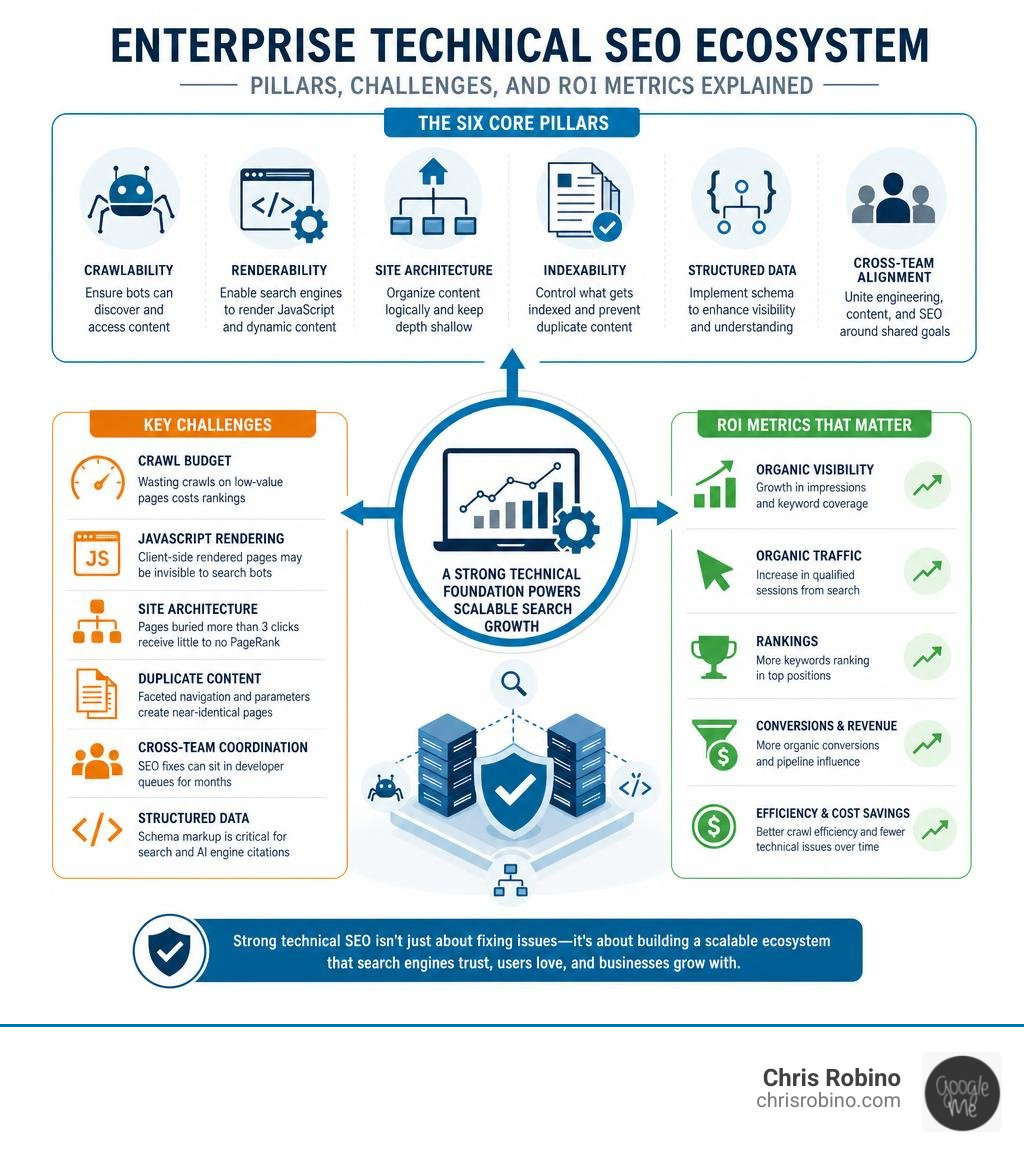
Enterprise technical SEO is the infrastructure layer that determines whether search engines can crawl, render, index, and rank your site at scale — across thousands or even millions of pages.
Here is what you need to know at a glance:
| Challenge | What It Means at Enterprise Scale |
|---|---|
| Crawl budget | Search engines allocate a finite number of crawls per domain — wasting it on low-value pages costs rankings |
| JavaScript rendering | Client-side rendered pages may be invisible to search bots without server-side rendering |
| Site architecture | Pages buried more than 3 clicks from the homepage receive little to no PageRank |
| Duplicate content | Faceted navigation and parameter URLs can generate millions of near-identical pages |
| Cross-team coordination | SEO fixes can sit in developer queues for months while rankings quietly erode |
| Structured data | Schema markup is now critical for both traditional search and AI engine citations |
The stakes here are not small. Consider this: a crawl misconfiguration that is a minor annoyance on a 500-page site becomes a serious visibility problem across 50,000 pages. A JavaScript rendering issue that a startup fixes in a day can sit in an enterprise development queue for months — silently draining rankings and revenue the entire time.
And with 68% of online experiences starting with a search engine, and the number one Google result capturing 32% of all clicks, the cost of getting your technical foundation wrong is measured in real lost revenue.
This is not just an IT problem or a marketing problem. It is an organizational problem — one that sits at the intersection of engineering, content, product, and executive decision-making.
I’m Chris Robino, a Digital Strategy Leader and AI & Search Expert with over two decades of experience helping organizations — from emerging tech startups to large enterprises — build the technical foundations that drive sustainable organic growth through enterprise technical SEO. In the sections ahead, I will walk you through exactly how to build, govern, and scale a technical SEO program that moves the needle on revenue.
Scaling Search Infrastructure with Enterprise Technical SEO

When we talk about managing a website with tens of thousands, or even millions, of URLs, we are no longer just doing marketing. We are engaged in systems engineering. Search engines do not have infinite resources, and they will not struggle through a bloated, unoptimized digital landscape just to find your high-value content.
At this level, enterprise technical SEO acts as the blueprint for your digital infrastructure. It ensures that every server response, rendering pathway, and database query is designed to make discovery effortless for both traditional web crawlers and modern AI search models.
The Core Pillars of Enterprise Technical SEO
To successfully scale search infrastructure, we must focus on four core pillars:
- Crawl Efficiency: Minimizing wasteful paths so search bots prioritize your most important, revenue-generating pages.
- Rendering Strategy: Ensuring your content is immediately readable in raw HTML, rather than relying on delayed client-side execution.
- Information Architecture: Structuring directories and internal links so search engines can easily map your site’s topical authority.
- Structured Data and Entity Modeling: Providing explicit, machine-readable context (JSON-LD) to secure rich snippets and AI search citations.
These pillars are not independent tasks; they are interconnected systems. If one pillar fails—for instance, if your rendering strategy hides your structured data behind client-side scripts—the entire search infrastructure suffers.
Overcoming Common Enterprise Technical SEO Challenges
The biggest roadblocks in large organizations rarely stem from a lack of SEO knowledge. Instead, they are born from technical debt, legacy content management systems (CMS), and deep organizational silos.
Legacy enterprise platforms like Adobe Experience Manager or Sitecore often accumulate years of custom configurations, resulting in “migration residue” and broken redirect chains. Additionally, faceted navigation on large e-commerce or directory sites can generate millions of duplicate parameter URLs, creating massive crawl traps.
To start clean, we must systematically eliminate this debt. For practical steps on identifying and resolving these backend bottlenecks, you can read our resource on SEO Tips to Improve Organic Rankings. Furthermore, establishing specialized frameworks can help you build custom roadmaps to bypass legacy CMS limitations and bypass development queues.
Crawl Budget and Indexation at Scale
Search engines assign a finite “crawl budget” to every domain. Since Google’s shift to dynamic crawl budgeting, this allocation fluctuates daily based on your server response times, content freshness, and overall technical health. If your server takes too long to respond, search bots will simply leave, leaving new or updated content unindexed.
To protect this critical resource, we must:
- Optimize our
robots.txtfile to block low-value parameters (e.g., using rules likeDisallow: /*?*&to prevent crawling infinite filter combinations). - Keep XML sitemaps clean, ensuring they only contain indexable, canonical URLs.
- Leverage real-time log file analysis to monitor exactly how search engines and AI bots interact with our server.
Using advanced monitoring tools allows us to visualize bot traffic patterns without manual database exports. For a broader look at how indexation fits into search visibility, explore The Ultimate Guide to Search Engine Ranking Tips.
JavaScript Rendering and Site Architecture
Modern enterprise websites are heavily reliant on JavaScript frameworks like React, Angular, and Next.js. While these frameworks deliver dynamic, app-like user experiences, they often default to client-side rendering (CSR). This is a major hazard for search engines, which must execute a two-stage process: crawling the raw HTML first, and then queuing the page for rendering once resources become available. This delay can leave your content invisible to search engines for days or weeks.
The solution is implementing Server-Side Rendering (SSR) or Static Site Generation (SSG) for all commercial, revenue-driving pages. Any content that influences a buying decision should exist in clean HTML at first render.
Additionally, our site architecture must maintain a flat click depth. If a high-value product page sits more than three clicks away from the homepage, it is starved of internal link equity. By combining automated template-level linking, structured breadcrumbs, and clear HTML navigation, we keep our most valuable pages highly accessible. Learn more about optimizing these signals in our guide on Google Search Ranking Tips.
Elevating Your Digital Infrastructure to Drive Real Revenue

At the enterprise level, technical SEO is not a cost center—it is a revenue driver. However, to unlock its full financial potential, we must bridge the gap between technical execution and business strategy.
Coordinating Cross-Functional Teams and Governance
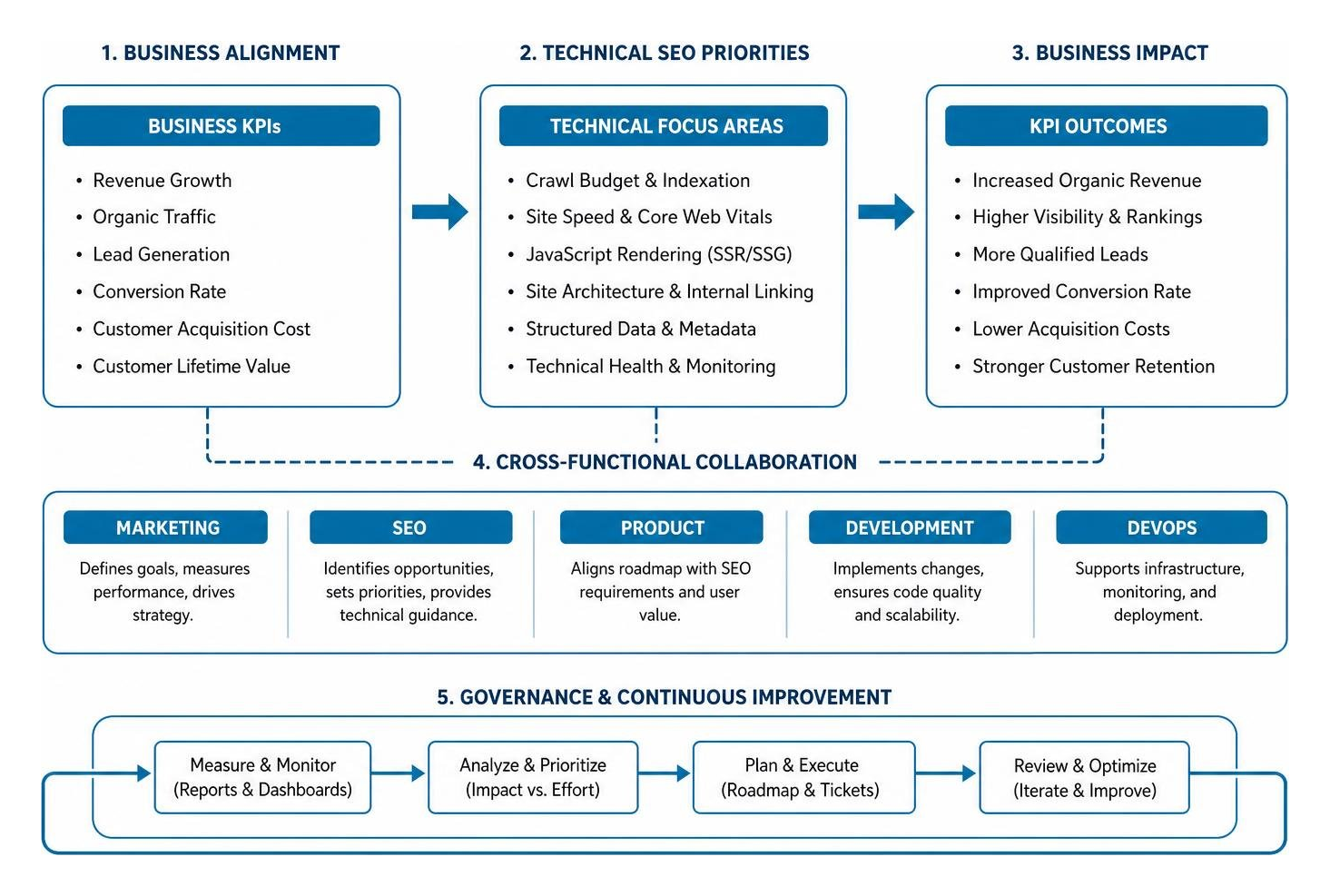
The most brilliant technical audit is worthless if it sits in a spreadsheet. In large organizations, implementing SEO recommendations requires coordination across marketing, product, development, and DevOps.
To bridge this implementation gap, we must integrate SEO requirements directly into existing Agile developer workflows. Rather than handing developers a massive, unprioritized PDF, we should translate our findings into clear, actionable Jira tickets complete with business impact scores.
Creating an internal SEO governance model—including playbooks and automated staging-environment QA checks—ensures that new code deployments do not accidentally introduce regressions like rogue noindex tags. For strategies on scaling this coordination, consult the Enterprise SEO Guide: Strategies for Scalable Search Success . If you are looking to partner with an outside team to help run this governance, make sure you know How to Spot a Professional SEO Firm and Avoid the Snake Oil to protect your investment.
Proving ROI and Measuring Success
To secure the budget and developer resources required for enterprise technical SEO, we must speak the language of the C-suite. Executives do not buy into vanity metrics like “crawled pages” or raw keyword rankings. They care about pipeline, customer acquisition cost (CAC), and organic revenue growth.
When we present our results, we must connect technical improvements directly to financial outcomes. For example, showing how resolving a JavaScript rendering issue on key landing pages directly led to a rise in demo requests or e-commerce transactions.
To understand the difference in capabilities required to manage these metrics at scale, consider how enterprise-grade platforms compare to standard, small-business SEO tools:
| Feature | Standard SEO Tools | Enterprise SEO Platforms |
|---|---|---|
| Crawl Limits | Often capped at 10,000 to 100,000 URLs | Built for scale (10M+ URLs with no caps) |
| Log Analysis | None or highly manual file uploads | Real-time server log integration |
| API Connectors | Limited to basic Google Search Console | Deep integrations with GSC, GA4, Jira, and BI tools |
| Team Collaboration | Single-user or seat-capped licenses | Multi-department workspaces with custom permissions |
By leveraging enterprise-level data, we can prove that data-driven organizations experience 81% higher revenue growth compared to the industry average. Furthermore, organic search leads boast a 14.6% close rate compared to just 1.7% for outbound leads, making technical optimization one of the highest-ROI investments available.
For a deeper dive into measuring these high-impact metrics, explore our Search Engine Rankings Ultimate Guide 2025. Specialized technical infrastructure work is what ultimately drives exponential organic growth.
If you are ready to stop reacting to technical errors and start building a proactive, scalable search infrastructure that drives measurable business pipeline, let’s talk. Explore our tailored strategy sessions and consulting services at Chris Robino Consulting to turn your digital infrastructure into a sustainable revenue engine.