

Why AI Training for Executives Is Critical for Business Growth
AI training for executives is non-technical, strategic education designed to help business leaders evaluate artificial intelligence opportunities, lead organizational change, and manage enterprise risk without writing code.
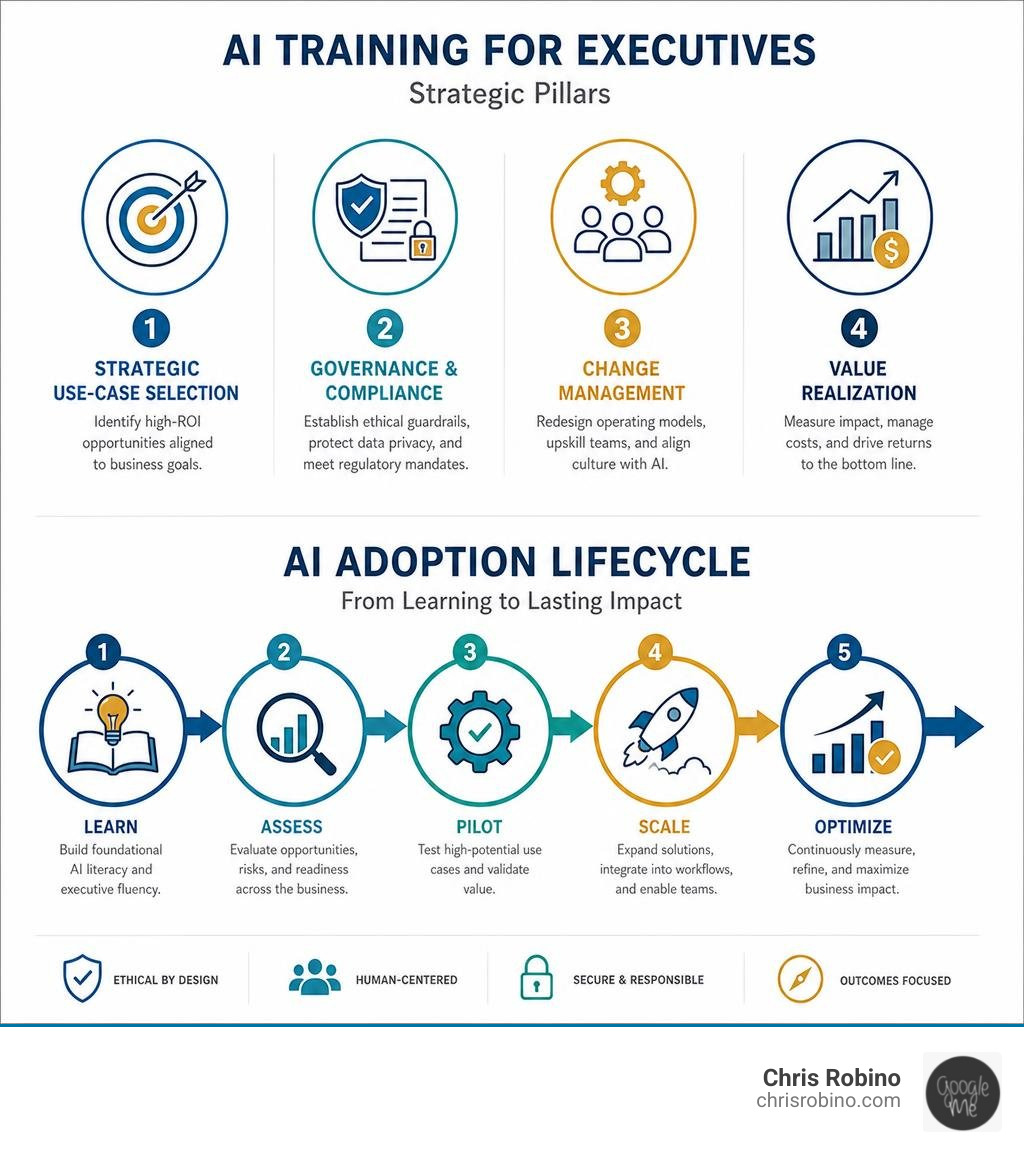
Instead of teaching programming or data science mechanics, top-tier executive training focuses on four practical decision-making pillars:
- Strategic Use-Case Selection: Pinpoint high-ROI business problems fit for machine learning, generative models, or autonomous agentic systems.
- Governance and Compliance: Establish ethical guardrails, manage data privacy, and navigate legal mandates like the EU AI Act.
- Change Management: Redesign operating models, upskill cross-functional teams, and align workforce culture with automated workflows.
- Value Realization: Calculate total cost of ownership, track token economics, and tie technology investments directly to the bottom line.
Most business leaders do not need to build algorithms. However, with corporate recruiters ranking AI fluency as the fastest-growing professional skill, executives must know how to separate real capabilities from vendor hype.
I’m Chris Robino, a digital strategy leader and AI search advisor with over two decades of experience guiding enterprises through technology transformations and modern AI training for executives. Below, we will cut through the clutter to compare the top programs, essential frameworks, and tactical roadmaps you need to lead your organization forward.
Know your AI training for executives terms:
Evaluating Modern AI Training for Executives

As we enter August 2026, artificial intelligence is no longer an experimental side project. It is transforming core business models across every sector. According to corporate surveys, 64% of Fortune 500 leaders expect AI to dramatically boost overall productivity. Yet, 76% of executives still feel uncertain about how to safely integrate these systems into everyday business operations.
Pitching complex tech investments without concrete knowledge is like asking for a blank check for a road trip without choosing a destination. You might get a polite nod, but you are far more likely to face boardroom skepticism.
Modern executive education directly solves this dilemma. Leading programs meet executives where they are, offering flexible delivery models that fit packed schedules:
- Intensive In-Person Immersions: Multi-day retreats on university campuses focused on cohort networking, case studies, and hands-on workshops.
- Blended Executive Tracks: Extended multi-month programs requiring 3 to 5 hours per week of asynchronous learning paired with live expert masterclasses.
- On-Demand Strategic Sprints: Self-paced micro-courses spanning 5 to 10 hours designed for rapid functional literacy.
Tuition typically ranges from $1,850 for short virtual bootcamps to upwards of $24,500 for immersive multi-week academy tracks.
Comparing Top Formats in AI Training for Executives
Finding the right learning experience depends on your time budget, strategic priorities, and organizational goals. Here is how key executive training models compare:
| Program Model | Format & Duration | Estimated Investment | Core Strategic Focus |
|---|---|---|---|
| Executive Immersion Academy | 10-day full-time in-person immersion | $23,500 – $24,500 | Multi-modal architectures, automation workflows, organizational governance, and enterprise strategy |
| Intensive Leadership Cohort | 3 days on-campus (8.5 hrs/day) | $6,500 | Agentic AI systems, competitive differentiation, organizational design, and data ethics |
| Blended Senior Executive Track | 6–7 months blended (online + 5 days residency) | Premium tier | Collective intelligence, product design, systems scaling, and board-ready roadmaps |
| Cross-Functional Business Sprint | 4 days live online or in-person | $10,550 | Generative AI economics, cross-functional application (finance, marketing, HR), and ethical risk guardrails |
| Modular Technical Transformation | 21 weeks across 3 modular courses | Tiered modular pricing | Machine learning pattern recognition, robotics, and the human transition curve |
| Self-Paced Strategic Foundations | 25 hours self-paced | Subscription tier | Classical ML fluency, autonomous multi-agent systems, build vs. buy evaluations, and 90-day sprints |
Strategic Leadership Competencies in AI Training for Executives

Executive education in artificial intelligence is not about writing Python scripts or training neural nets from scratch. It is about managerial judgment.
When leaders understand what algorithmic systems can and cannot do, they can spot untapped opportunities, guide cross-functional teams, and align business units around a unified vision. Exploring our AI-driven innovation complete guide provides a clear foundation for turning these concepts into practical growth levers.
Key competencies developed in executive training include:
- Chief AI Officer (CAIO) Readiness: Navigating C-suite responsibilities to coordinate enterprise data infrastructure, manage technology risk, and steer AI investments.
- Synthetic Prototyping and Fast Validation: Running synthetic customer interviews and rapid prototyping to test product ideas in hours rather than months.
- Cross-Departmental Alignment: Breaking down operational silos so IT, HR, marketing, legal, and finance work in sync. For a structured approach to change management, review our AI adoption strategies complete guide.
- Human-Centric Culture Shifts: Guiding employees through workforce transformations by turning apprehension into confident, AI-assisted productivity.
Technical Demystification: Agentic AI, RAG, and Tool Calling
Modern leadership requires enough technical fluency to challenge vendor pitches and steer strategic conversations. You do not need to build large language models, but you must understand how modern AI infrastructure fits together.
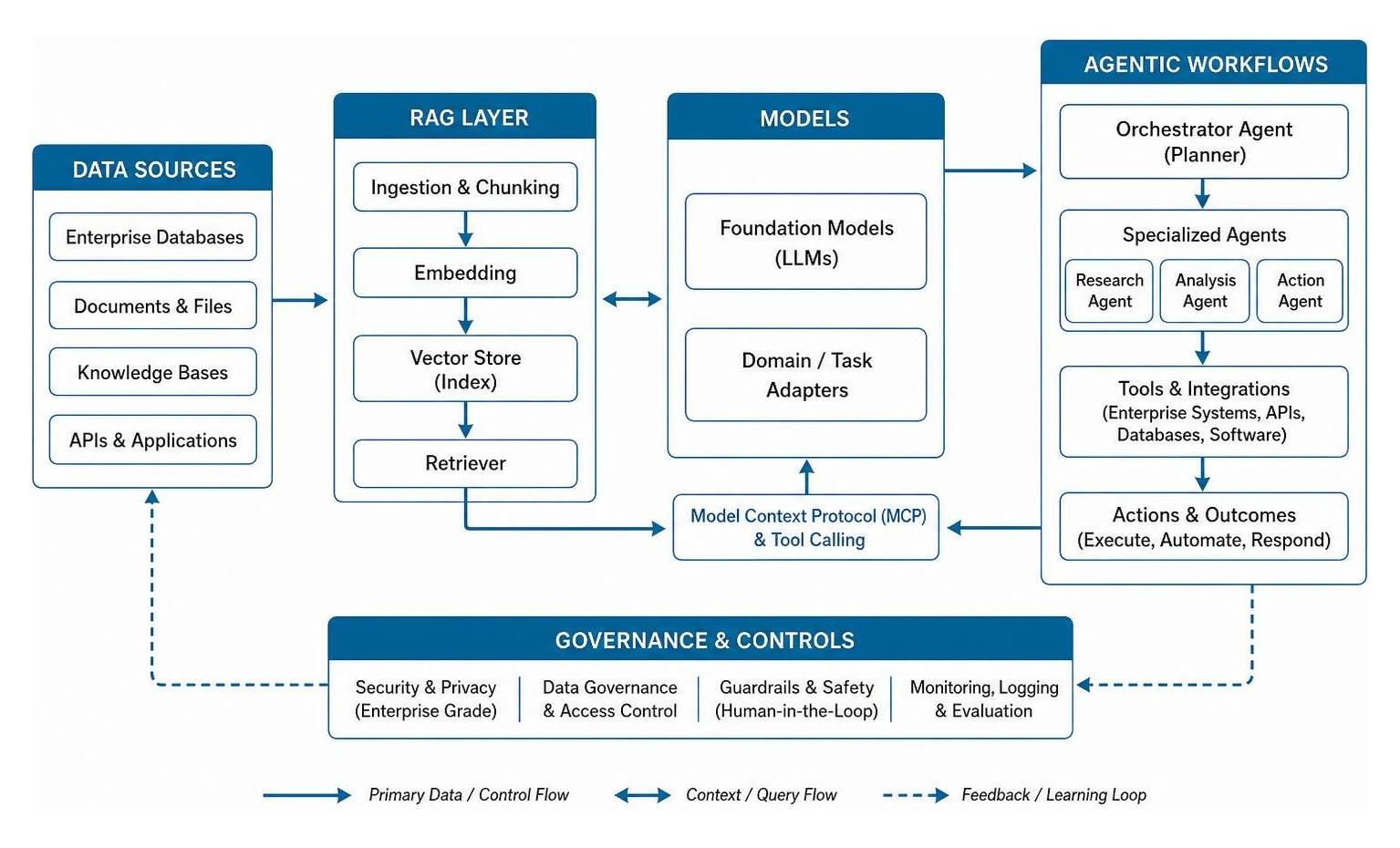
We focus on helping leaders master several essential concepts:
- Retrieval-Augmented Generation (RAG): Connecting generative AI models to secure internal company databases. This allows systems to provide precise, private, and up-to-date answers without retraining the underlying model.
- Autonomous Agentic AI: Moving beyond simple question-and-answer chatbots. Multi-agent systems can plan complex steps, run specialized software, and execute multi-stage workflows autonomously. To see where these capabilities are headed, check out from AI to autonomous systems whats next in tech trends.
- Model Context Protocol (MCP) and Tool Calling: Standard protocols that let AI agents interact directly with legacy databases, external APIs, and enterprise software.
- Spotting “Agent Washing”: Recognizing when a vendor is simply wrapping basic automation in trendy buzzwords rather than delivering true adaptive reasoning.
- Data-Centric Decision Making: Utilizing AI-powered analytics to uncover subtle behavioral patterns, optimize pricing, and streamline complex supply chains.
Strategic AI Implementation and Organizational Transformation
Transforming an enterprise with artificial intelligence requires moving past random micro-experiments and building an integrated organizational system. Real transformation happens when technology, corporate governance, and talent development work together seamlessly.
Ethical Governance, Algorithmic Bias, and Compliance
Deploying automated systems without rigorous governance introduces major operational, legal, and reputational risks. Unchecked models can display algorithmic bias, leak sensitive customer records, or hallucinate inaccurate outputs.
Leading enterprise programs emphasize proactive compliance and risk management:
- Global Regulatory Alignment: Preparing internal systems for strict legislative frameworks such as the European Union AI Act and emerging global data mandates. For detailed regulatory guidance, see our analysis on AI regulatory compliance.
- Ethical Guardrails by Design: Building transparent, fair, and accountable AI architectures from the start. We explore core principles in our guide on ethical AI development.
- Systemic Risk Mitigation: Creating automated guardrails, monitoring token usage, and establishing clear human-in-the-loop validation checkpoints for high-stakes decisions.
Measuring ROI and Executing 90-Day Tactical Roadmaps
Long, rigid 18-month technology transformation plans often fail because AI capabilities evolve so rapidly. Instead, high-performing executive teams work in focused 90-day execution cycles that deliver measurable business value quickly.
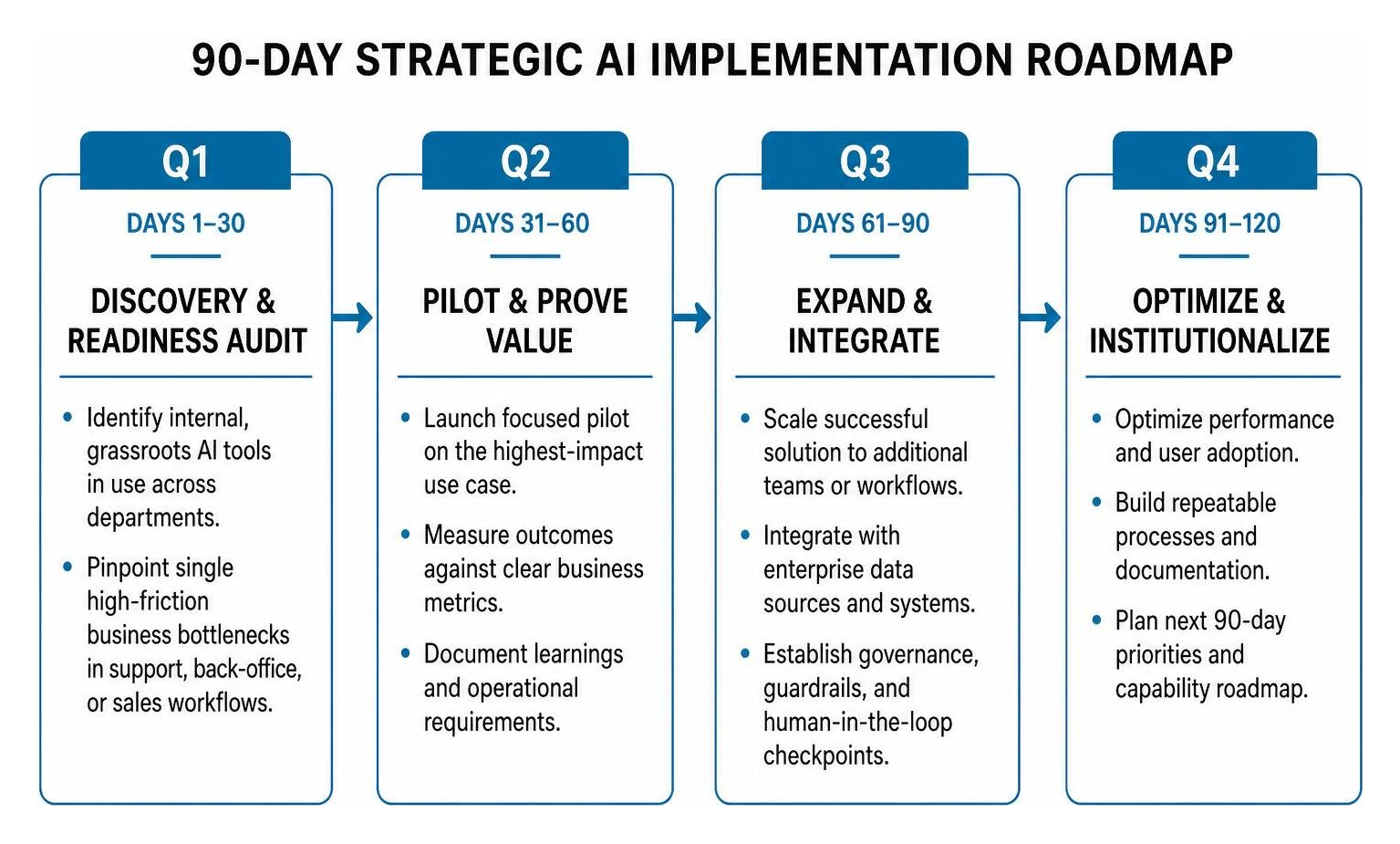
Here is a proven 90-day milestone roadmap for executive teams:
Days 1–30 (Discovery and Readiness Audit):
- Identify internal, grassroots AI tools already being used across departments.
- Pinpoint single high-friction business bottlenecks in customer support, back-office administration, or sales workflows.
- Review corporate data security, API policies, and vendor permissions.
Days 31–60 (Micro-Pilot and Prototyping):
- Run structured build vs. buy vs. partner evaluations for your target use case.
- Deploy a controlled proof-of-concept using RAG or specialized multi-agent workflows.
- Test outputs against established accuracy, bias, and performance benchmarks. Review our tactical frameworks on AI implementation strategies for execution best practices.
Days 61–90 (Measurement, Governance, and Scale):
- Track operational KPIs, compute expenses, and hard cost savings to confirm positive ROI.
- Codify formal enterprise governance policies, data security guardrails, and role permissions.
- Present verified results to executive stakeholders to secure expansion funding. To refine your ongoing plan, explore our AI strategy consulting ultimate guide.
If your leadership team wants tailored support designing custom frameworks or navigating complex rollouts, explore our emerging tech advisory and project solutions.
Conclusion
Artificial intelligence is creating a clear divide in the corporate landscape between leaders prepared to harness automated systems and those who risk falling behind. Gaining strategic literacy allows executives to evaluate technical vendor claims, establish protective ethical governance, and lead confident workforce transformations.
For enterprise executives, winning organic search visibility in an AI-assisted world follows these same strategic principles: clear intent, high-value data, and authoritative positioning across complex search channels. Investing in ongoing leadership education ensures your organization moves deliberately from initial experimentation to scalable, long-term competitive advantage.