

Why SEO for Internal Linking Is the Most Underrated Ranking Factor in 2026
SEO for internal linking is the practice of strategically connecting pages within your own website to help search engines crawl and index your content, distribute page authority, and guide users to the information they need.
Quick answer — what internal linking does for SEO:
- Helps Google discover pages by giving Googlebot a crawl path through your site
- Passes PageRank from high-authority pages to pages that need a rankings boost
- Signals topical authority by grouping related content into clusters
- Reduces orphan pages — pages with zero inbound links that Google may never find
- Improves user experience by connecting readers to relevant next steps
- Supports AI search visibility — well-structured sites earn citations in Google AI Overviews even without top-10 rankings
Most websites obsess over keywords and backlinks. Internal linking sits quietly in the background — and that is exactly why it is so powerful for the sites that get it right.
Consider this: a page with zero internal links pointing to it is essentially invisible to Google’s crawler. Yet a page with just three contextual links from related content can outrank a competitor with stronger external authority. That gap is not an accident. It is architecture.
The numbers reinforce the urgency. As of 2026, only 38% of pages cited in Google AI Overviews rank in the top 10 organically for the same query — down from 76% earlier in 2025. The sites earning those AI citations are not always the most authoritative domains. They are the most structurally coherent ones.
And the problem is widespread. An audit across thousands of websites found that 62% had at least one orphan page — a page receiving no internal links at all. That is more than half of all audited sites quietly leaking ranking potential every day.
I’m Chris Robino, a digital strategy leader with over two decades of experience helping companies from early-stage startups to established enterprises improve their search visibility through intelligent SEO systems — including SEO for internal linking as a core growth lever. In this guide, I’ll walk you through exactly how to build, audit, and scale an internal linking strategy that works for both Google and AI-driven search in 2026.
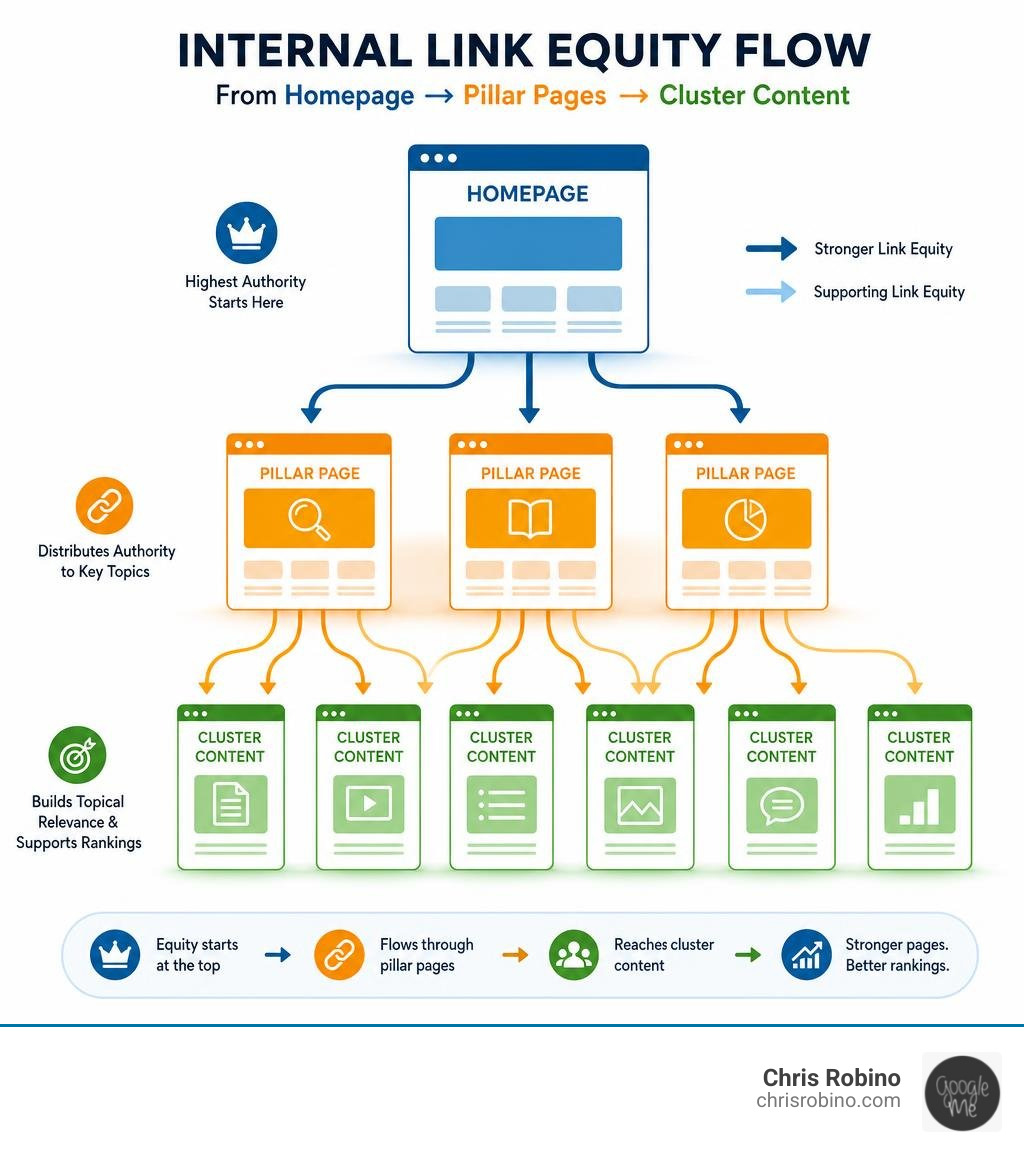
Mastering SEO for Internal Linking: The Architectural Blueprint
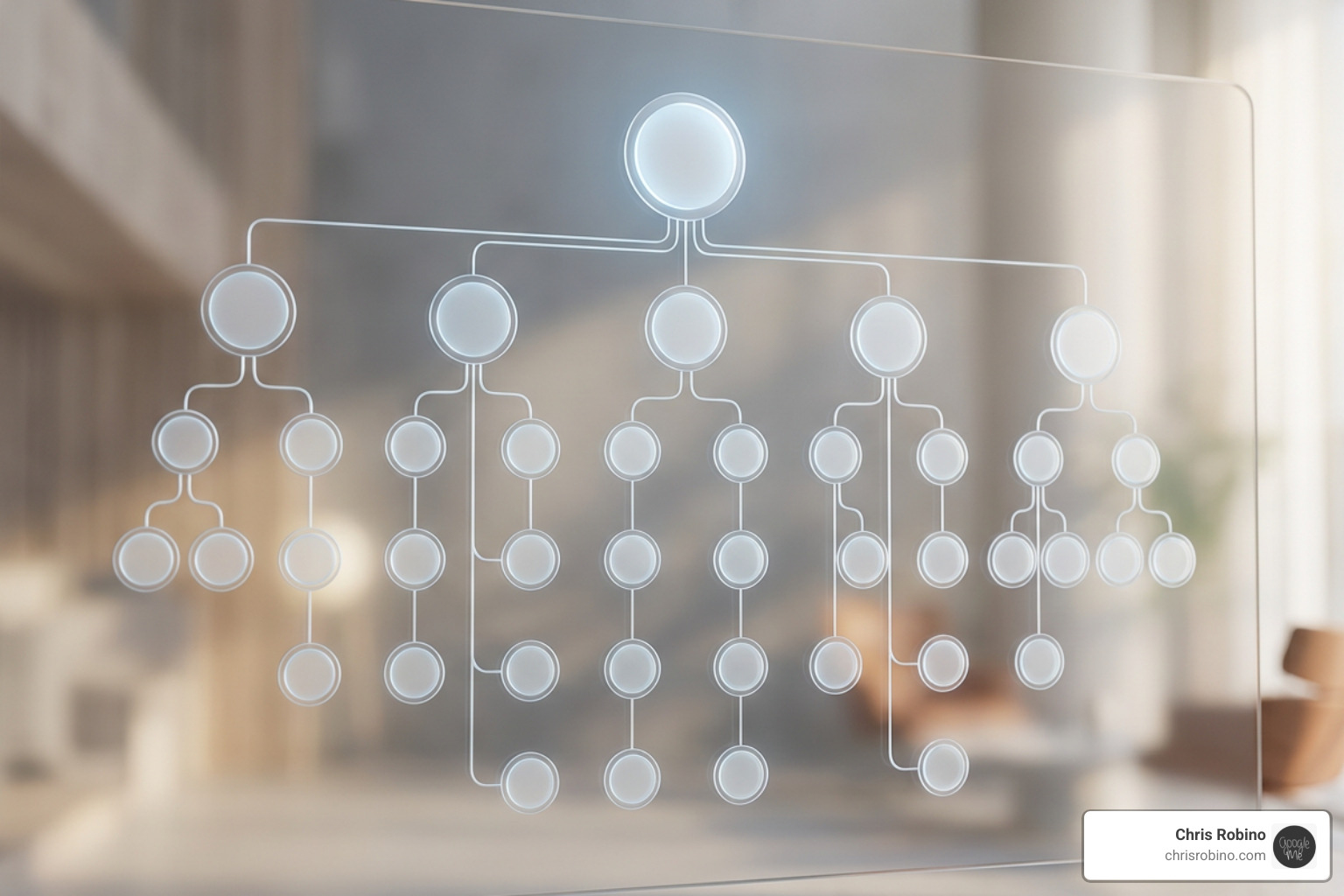
To build a website that search engines love and AI engines cite, we must view our site not as a flat list of articles, but as a structured database. Site architecture is the foundation of crawl efficiency and PageRank flow. When we design our site hierarchy logically, we make it effortless for search engine crawlers to discover our content, understand which pages are most important, and index our entire catalog.
Internal vs. External Links: The Core Differences
Before we dive into the technical execution, let us clarify the fundamental distinction between internal and external hyperlinks. While both are critical to a comprehensive SEO strategy, they serve entirely different purposes in our digital ecosystem.
| Feature | Internal Links | External Links |
|---|---|---|
| Domain Target | Points to pages on the same domain. | Points to pages on a different domain. |
| Primary Purpose | Establishes site structure, distributes PageRank, and aids user navigation. | Cites sources, provides external context, or builds referral authority. |
| Control | You have 100% control over placement, anchor text, and targets. | You only control outgoing links; incoming external links (backlinks) require outreach. |
| Crawl Impact | Directly guides crawlers through your own site architecture. | Directs crawlers away from your site to other web properties. |
Understanding this distinction helps us allocate our resources effectively. While external backlinks build our domain’s overall authority, internal links are the pipes that distribute that authority to our most critical commercial and informational pages. To see how these elements fit into a broader organic growth campaign, explore our SEO Tips to Improve Organic Rankings.
Why SEO for Internal Linking Drives PageRank and Crawlability
When Googlebot visits our website, it has a limited “crawl budget”—the number of pages it will crawl and index within a given timeframe. If our site structure is disorganized, Googlebot will waste this budget on unimportant or duplicate URLs, leaving our high-value content unindexed.
This is where PageRank comes in. PageRank remains the mathematical backbone of Google’s ranking algorithm, and it flows through hyperlinks. The homepage typically holds the highest authority because it receives the most external backlinks. As links branch out from the homepage, they pass a portion of this authority (often called “link equity” or “link juice”) to deeper pages.
The math behind this decay is stark:
- Click Depth 1 (direct homepage links) inherits approximately 0.15 to 0.25 PageRank.
- Click Depth 2 inherits approximately 0.05 to 0.10 PageRank.
- Click Depth 3 inherits approximately 0.02 to 0.04 PageRank.
- Click Depth 4 or deeper inherits less than 0.01 PageRank, receiving 70% less crawl frequency.
To maximize crawlability, we must also design our links around Google’s Reasonable Surfer Model (patent US 7,716,225). This model dictates that Google does not treat all links on a page equally. A link placed contextually within the body copy is far more likely to be clicked by a human than a link buried in the footer. Consequently, Google weights contextual body links significantly higher than navigational or footer links.
To keep your pages visible and crawling efficiently, we recommend checking out our comprehensive Google Search Ranking Tips.
Topic Clusters and the Hub-and-Spoke Model
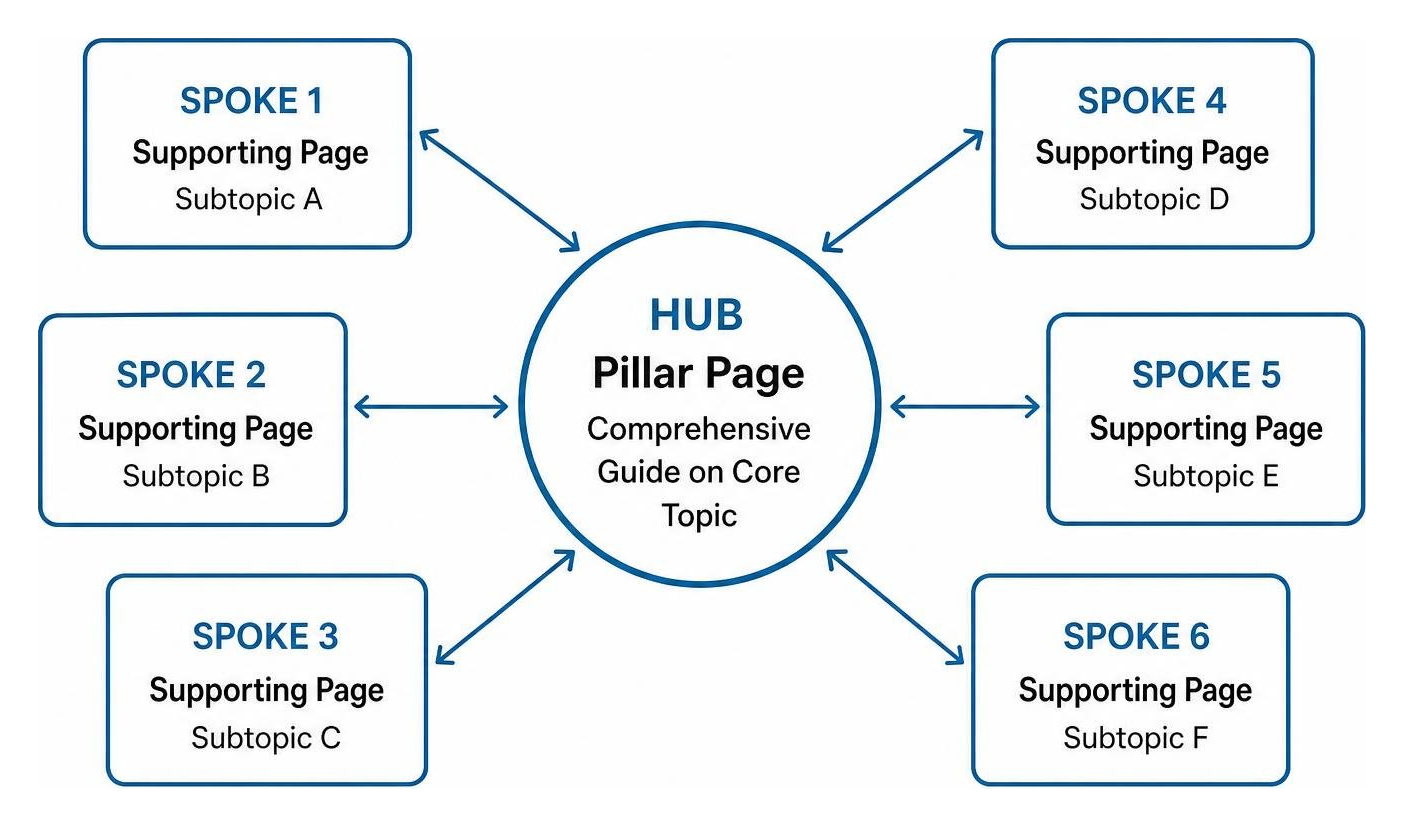
The gold standard for modern site architecture is the hub-and-spoke model (also known as a topic cluster). This model organizes our content into tight, semantically related neighborhoods.
Instead of publishing disconnected articles, we create:
- A Pillar Page (Hub): A comprehensive, long-form guide (typically 3,500+ words) covering a broad topic in detail.
- Supporting Pages (Spokes): Narrower, highly specific articles (1,500 to 2,500 words) that answer distinct sub-questions.
To make this architecture work, we implement bidirectional linking. Every supporting spoke page must link back up to the main pillar page, and the pillar page must link down to every supporting spoke. Furthermore, sibling spoke pages should link sideways to each other where contextually relevant.
This structure is highly rewarded by modern search engines and AI engines alike. AI search platforms like Perplexity and ChatGPT Search do not just look for keyword matches; they map the relationships between entities to evaluate topical depth. In fact, modern data shows that topical authority explains 17% of AI citation variance, while domain authority explains less than 4%.
By grouping our content into clean, bidirectionally linked clusters, we signal deep expertise to both search engine crawlers and generative AI models. For a deeper dive into organizing your content for maximum search engine performance, read our Search Engine Rankings Ultimate Guide 2025.
Best Practices for Anchor Text in SEO for Internal Linking
Anchor text—the clickable text that masks a hyperlink—is the primary signal we use to tell search engines what the destination page is about. Writing descriptive, entity-rich anchor text is a non-negotiable requirement for modern SEO.
To avoid over-optimization penalties while maintaining clear semantic signals, we recommend following a balanced anchor text distribution formula:
- Partial Match (40–50%): Using natural phrases that contain variations of the target keyword (e.g., “learn how to build an internal linking strategy”).
- Semantic Variation (20–30%): Using synonyms or related concepts (e.g., “optimizing site architecture”).
- Exact Match (10–15%): Using the precise target keyword (e.g., “SEO for internal linking“).
- Branded (5–10%): Incorporating our brand name (e.g., “Chris Robino digital strategy”).
- Generic (<10%): Simple directional phrases, used sparingly (e.g., “view the guide”).
Key Anchor Text Best Practices:
- Keep anchors brief, ideally between 2 to 5 words.
- Never use generic text like “click here” or “read more” for internal links, as they pass zero topical context.
- Avoid anchor text cannibalization. Ensure that a unique anchor text phrase does not point to multiple different URLs, which confuses search engine indexers.
Auditing and Automating Your Link Graph at Scale
As our websites grow, maintaining a pristine internal link structure manually becomes nearly impossible. Minor editorial oversights accumulate into major technical issues that actively suppress our search rankings.
To keep our link graph healthy, we must perform regular audits to identify and resolve these common internal linking errors:
- Orphan Pages: Pages with zero inbound internal links. They receive no PageRank and are virtually invisible to Googlebot.
- Broken Internal Links (404s): Links pointing to deleted or moved pages. They waste crawl budget and frustrate users.
- Redirect Chains and Loops: Internal links pointing to redirected URLs. We must update these links to point directly to the final secure HTTPS destination page to preserve crawl efficiency.
- Excessive Click Depth: Crucial pages buried 4 or more clicks away from the homepage. We must keep all important content within 3 clicks or fewer.
- Link Dilution: Overloading pages with too many outbound links. Keep editorial internal links per page between 30 and 60 to prevent diluting the PageRank passed to each target.
For small sites (under 200 pages), manual linking and routine audits are highly effective. For enterprise sites with thousands of URLs, we can leverage rule-based automation engines and natural language processing (NLP) tools to suggest contextually relevant internal links. However, we must always maintain human guardrails to ensure editorial quality.
To learn how to separate genuine, high-performing SEO strategies from low-quality automated shortcuts, read our guide on How to Spot a Professional SEO Firm and Avoid the Snake Oil.
Conclusion: Stop Clicking in Circles and Start Scaling
At ChrisRobino.com, we specialize in helping businesses navigate the intersection of emerging technology, digital media, and search engine optimization. We understand that SEO for internal linking is not just a technical checklist—it is the digital framework that dictates how search engines, AI models, and human users perceive your brand’s authority.
By moving away from random linking patterns and embracing a structured, bidirectional topic cluster architecture, you can unlock hidden ranking potential, maximize your crawl budget, and secure valuable citations in the AI search landscape of 2026.
If you are ready to stop clicking in circles and start building a high-performing site architecture that scales, explore The Ultimate Guide to Search Engine Ranking Tips or reach out to us today to streamline your digital strategy.