

Why AI in Content Creation Is Changing the Work
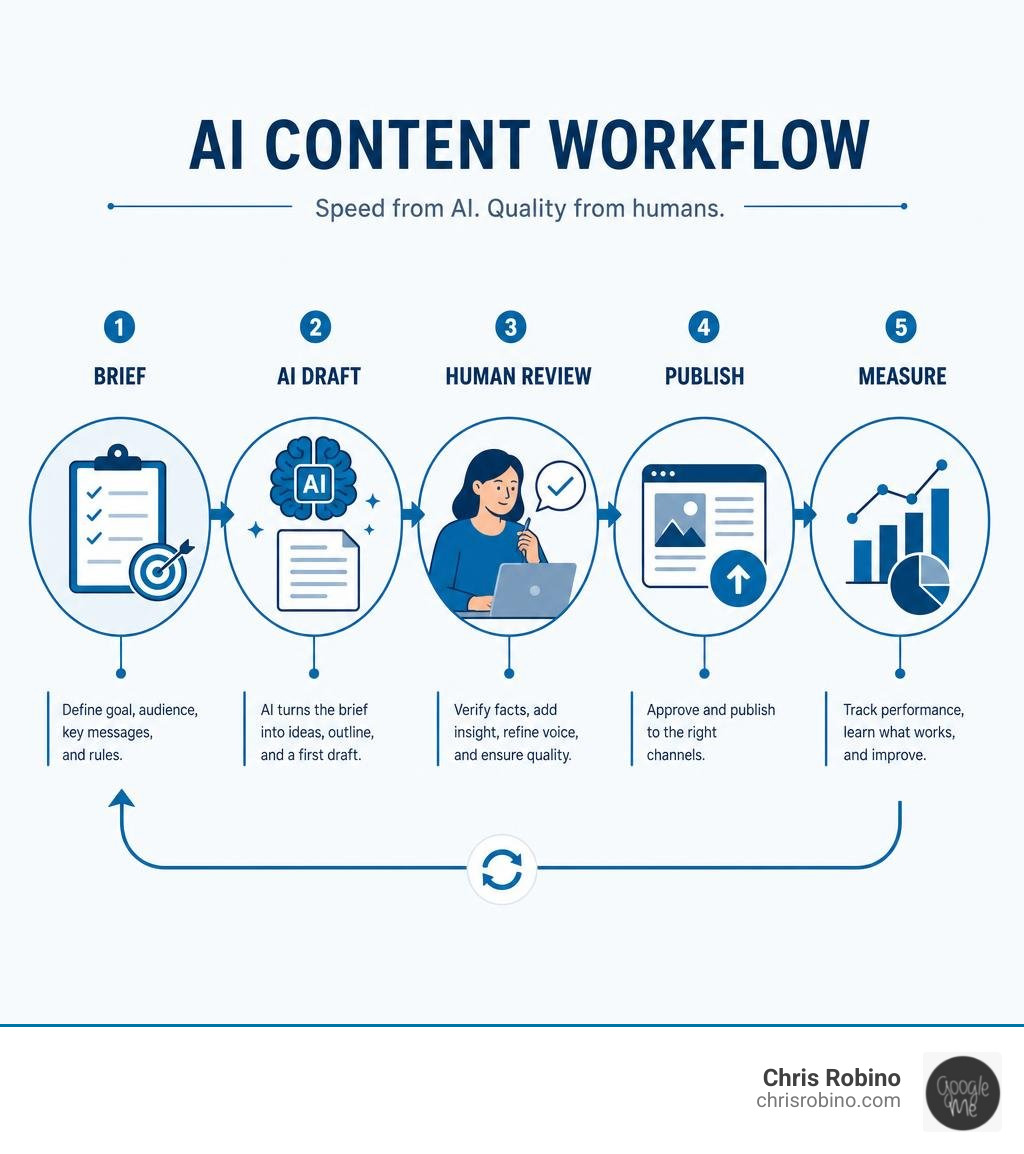
AI in content creation helps teams plan, draft, edit, repurpose, and optimize content faster. The best use is not to publish raw AI output. It is to let AI handle repeatable early work, while people add expertise, facts, brand voice, and final judgment.
For a practical start:
- Use AI to turn a brief into topic ideas, an outline, and several headline options.
- Give it clear audience, brand, source, and format rules before it writes.
- Ask a human expert or editor to verify claims, add original insight, and approve the final piece.
This matters because content demand keeps rising across search, social, email, video, and sales channels. More than 75% of marketers now use AI tools to some degree, while teams report cutting content-planning time by as much as half. A typical 500-word blog post can take roughly four hours without AI, so the real opportunity is removing slow, repetitive work – not removing human creativity.
AI systems generate language by recognizing patterns in large amounts of data and predicting useful next words based on your prompt and context. They can be remarkably helpful, but they can also invent facts, flatten a distinct voice, and repeat ideas already common online. That is why a hybrid workflow wins: AI provides speed; people provide meaning and accountability.
I’m Chris Robino, a digital strategy leader and AI and search expert with more than two decades of experience helping organizations improve visibility, workflows, and measurable growth. In this guide, I will show how to use AI in content creation as a governed creative partner rather than an unsupervised publishing machine.
AI in content creation terms explained:
Introduction: The New Era of Automated Creativity
The rapid expansion of artificial intelligence is fundamentally redefining commercial publishing. Creative professionals no longer face the intimidating blank page in isolation; instead, they collaborate with generative models that accelerate production velocity across every digital channel. The overall AI market is projected to reach an impressive $356 billion by 2030, underscoring how deeply automated systems are embedding themselves into modern enterprise operations.
While around 19% of businesses use automated systems to generate material directly, high-performing marketing teams recognize that speed without direction is a liability. Major conversational platforms recorded roughly 5.24 billion monthly visits as of mid-2025, proving that generative interfaces are now ubiquitous. Yet, manual content production remains an exhausting operational bottleneck.
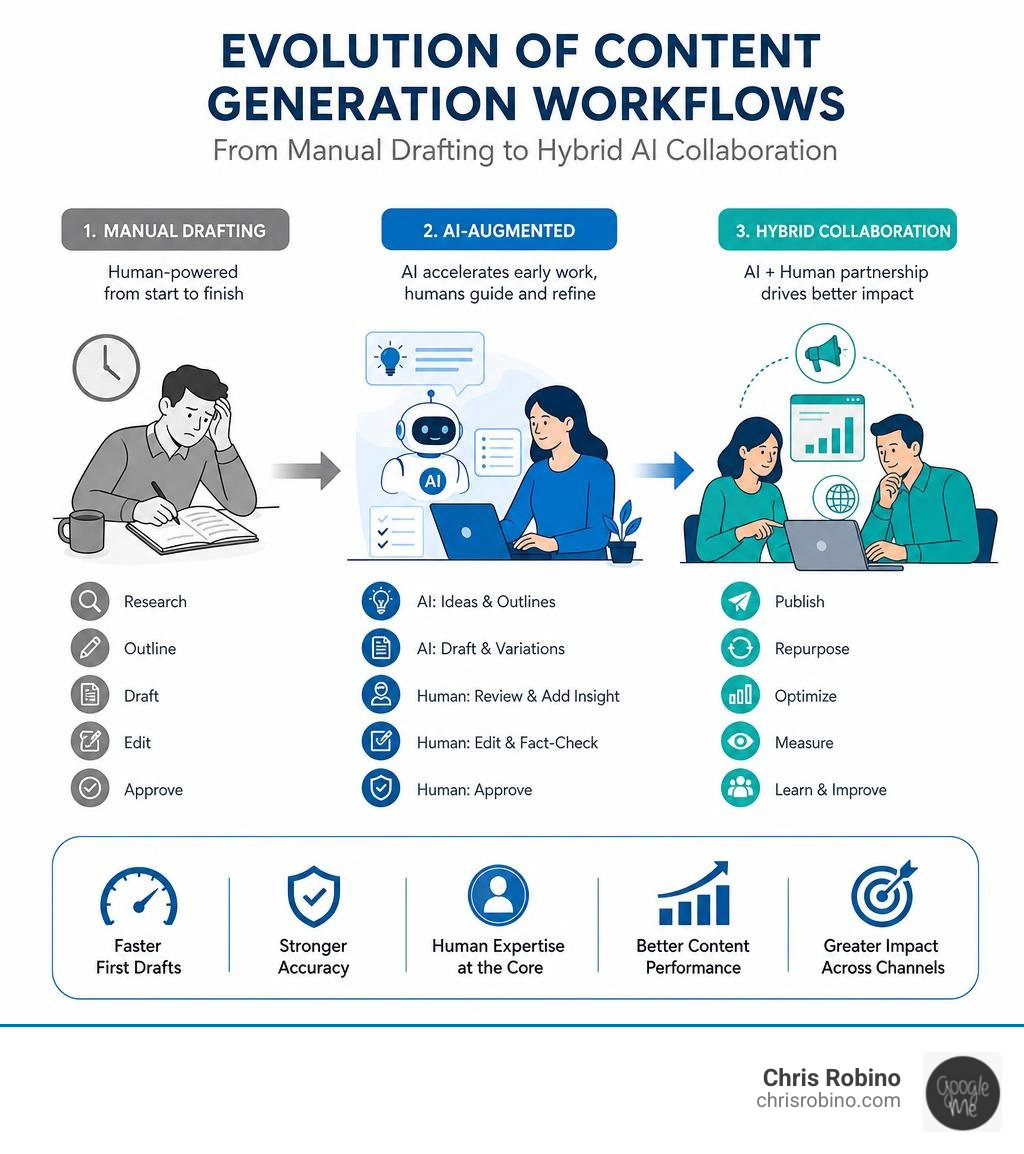
When enterprise organizations rely exclusively on manual authoring, developing competitive editorial pipelines strains internal budgets. Producing a single asset manually often requires hours of research, drafting, and cross-team alignment. Automated writing assistants eliminate early-stage ideation bottlenecks by rapidly synthesizing source materials, formatting multi-channel variations, and adapting to modern conversational search queries.
Transforming Workflows with AI in Content Creation
Transforming traditional editorial operations requires shifting from disconnected, one-off prompts to structured, multi-agent automated pipelines. When organizations implement an integrated AI-driven content strategy, production velocity scales efficiently while editorial control remains firmly in human hands.

| Workflow Metric | Traditional Manual Drafting | Hybrid Human-AI Content Workflow |
|---|---|---|
| Production Speed | 4–6 hours per long-form asset | 45–90 minutes per verified asset |
| Planning & Outlining | Manual SERP audits and brief creation | 50% reduction via automated ideation |
| Unit Production Cost | High per-article freelance overhead | Predictable operational spend |
| Multi-Channel Repurposing | Slower manual segment rewriting | Instant multi-format transformation |
| Editorial Oversight | Subjective peer-review loops | Programmatic scoring with human sign-off |
Systematic prompt versioning ensures that every creative iteration builds upon validated messaging frameworks. Rather than treating artificial intelligence as a disconnected sandbox, progressive teams embed structured assistants directly into their content production pipelines to manage repetitive tasks, enforce voice standards, and streamline cross-channel repurposing.
Core Mechanics of AI in Content Creation and Large Language Models
At their technical foundation, large language models (LLMs) operate through deep learning architectures trained on vast textual datasets. Rather than possessing human consciousness or original intentionality, these systems execute statistical token prediction—calculating the most contextually relevant sequence of words based on input prompts, system parameters, and surrounding context windows.
Modern foundation models support multimodal synthesis, processing text, structural layouts, and numerical data simultaneously. Enterprise systems leverage these architectures through deep CMS integrations, such as AI-assisted content generation capabilities embedded directly into rich-text authoring fields. These integrations allow editors to generate initial section drafts, reformat complex tables, and adjust reading levels without manual context switching.
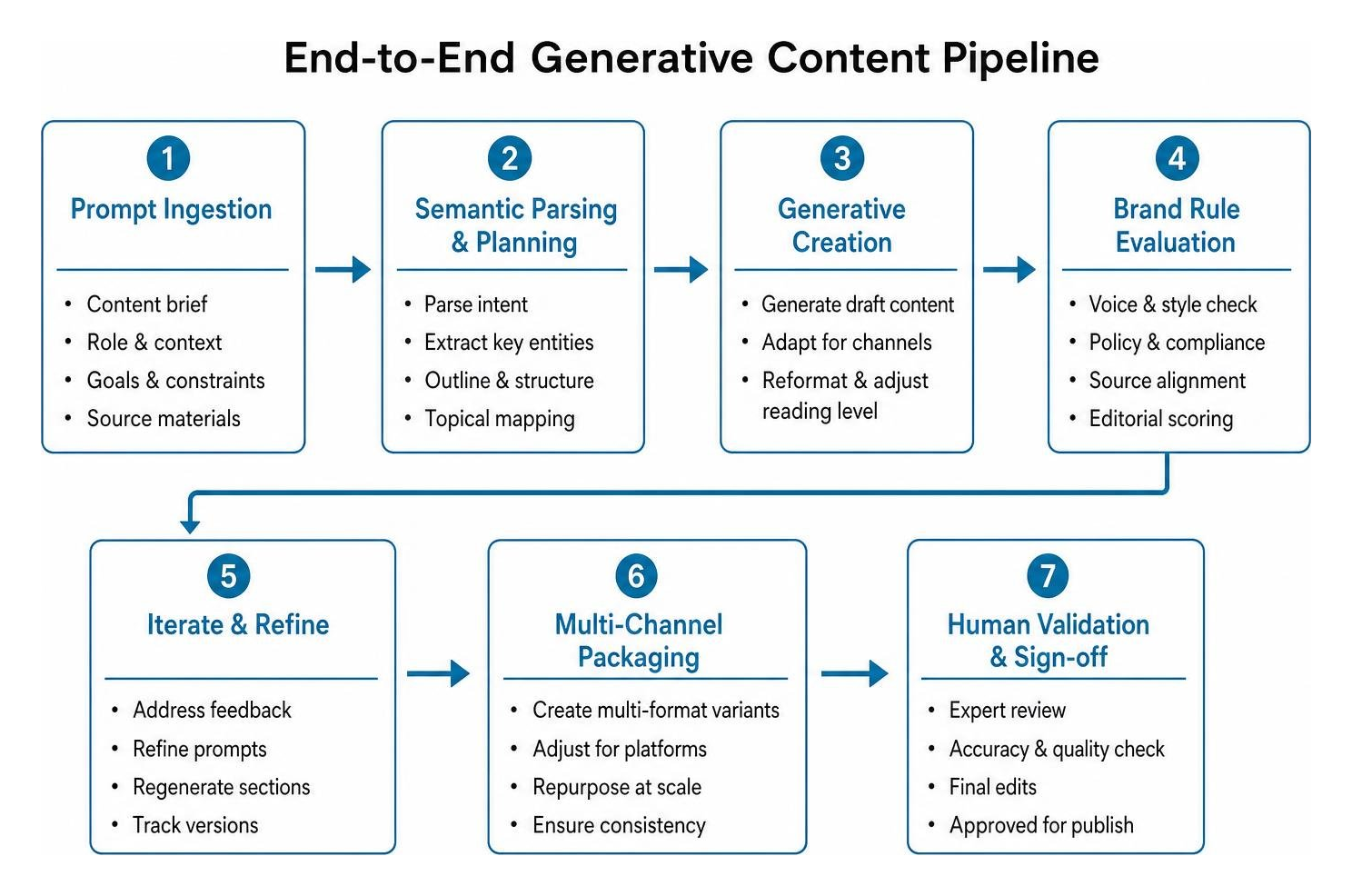
Structured training curriculums—such as Google’s popular content creation modules on Coursera, which have engaged over 224,000 learners—reinforce that producing high-value generative AI content depends heavily on prompt engineering rigor. Supplying models with explicit role definitions, strict exclusion criteria, and verifiable source documents prevents ambiguous outputs and ensures precise semantic alignment.
Accelerating Output: Benefits and Limits of AI in Content Creation
Integrating automated assistance into publishing operations yields substantial efficiency gains. Content marketing teams routinely achieve a 50% planning time reduction by using automated assistants to extract semantic entities, generate structured outlines, and map out topical hierarchies before writing begins.
Automated writing tools deliver exceptional value across several standardized formats:
- High-volume e-commerce product descriptions tailored to specific customer personas
- Multi-channel social media teasers and promotional email variations derived from anchor assets
- Technical documentation summaries, glossary definitions, and conversational FAQ modules
- Comparative ad copy variants generated for multivariate campaign testing
Recent empirical evaluations demonstrate that output quality varies dramatically based on contextual configuration. While automatic content creation for busy humans eliminates production paralysis, unguided automation introduces serious risks:
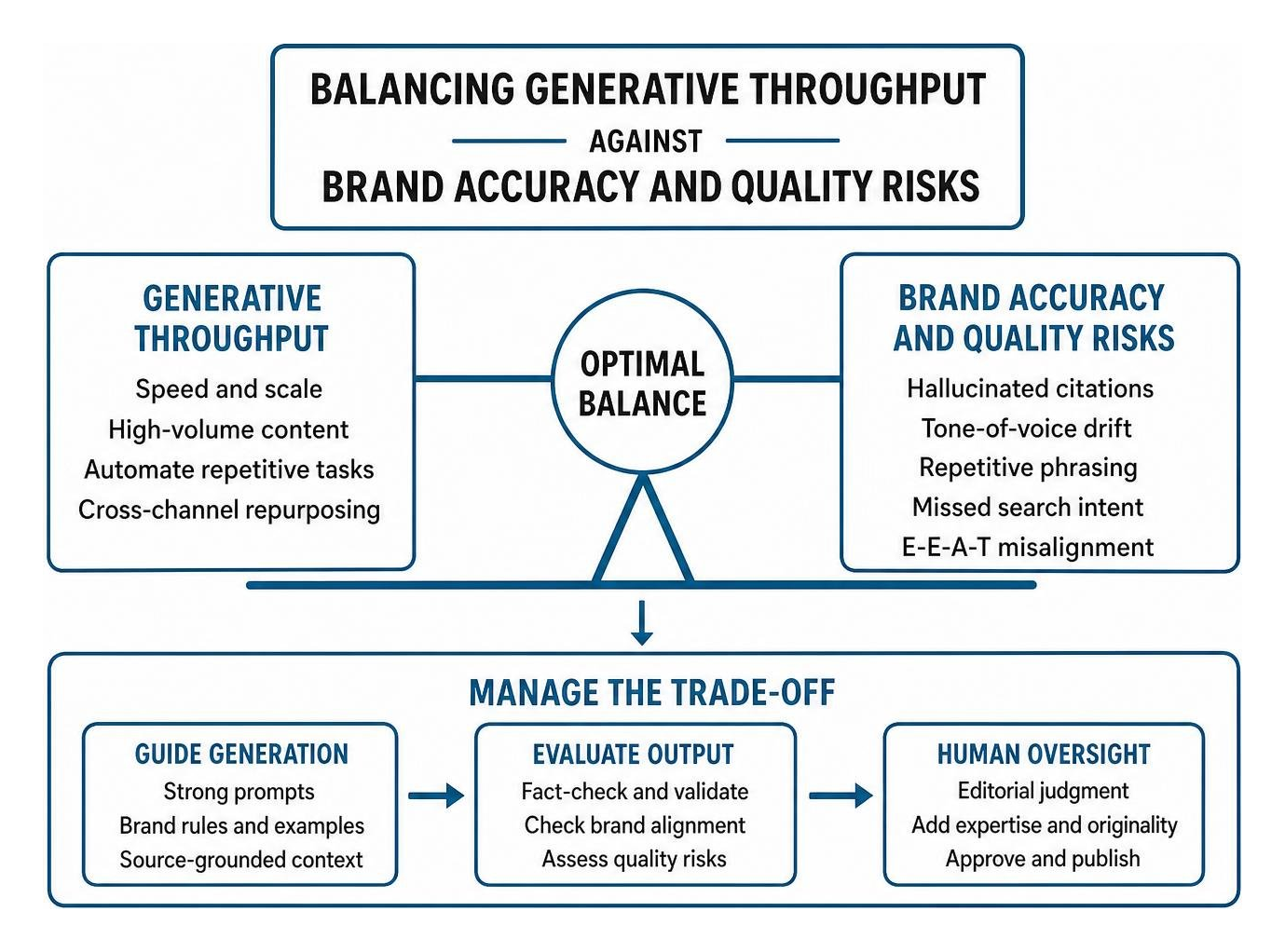
Unchecked outputs frequently suffer from hallucinated citations, tone-of-voice drift, and repetitive phrasing that fails to fulfill specific search intent. To establish organic visibility, enterprise content must align with modern Generative Engine Optimization principles. Search and answer engines evaluate depth, factual accuracy, and demonstrated Experience, Expertise, Authoritativeness, and Trustworthiness (E-E-A-T). Pure algorithmic summaries devoid of original perspective fail these quality checks and struggle to capture nuanced cultural contexts.
Balancing Human Editorial Oversight with Automated Production
Achieving consistent quality at enterprise scale requires combining automated speed with dedicated human editorial judgment. Automated systems generate viable structural foundations, but experienced subject matter experts provide the analytical rigor, proprietary case studies, and storytelling authenticity that build lasting audience trust.
Using AI-powered automation allows editorial teams to produce multiple creative variants simultaneously. Instead of debating hypothetical messaging angles, editors can review five distinct introductory hooks, evaluate them against target audience profiles, and refine the strongest option.
To reduce editorial friction, organizations must implement standardized review protocols:
- Source Verification: Manually confirm every data point, statistic, and external reference against primary sources.
- Voice Calibration: Review syntax and pacing to eliminate generic language and ensure alignment with brand guidelines.
- Value Injection: Incorporate first-hand corporate experience, proprietary data, and practitioner insights that algorithms cannot synthesize.
Strategic Implementation, Ethics, and Governance for Long-Term Value
Deploying automated writing tools across enterprise environments requires strict governance frameworks. Without centralized oversight, decentralized teams risk publishing inconsistent, legally vulnerable, or off-brand material.

Successful organizations implement comprehensive AI implementation strategies that translate brand style guides into programmatic rules. By defining explicit guidelines for acceptable vocabulary, sentence structures, and compliance requirements directly within authoring workflows, businesses maintain strict corporate tone consistency across every published deliverable.
Navigating Copyright, Watermarking, and AI Ethics
As generative technologies mature, intellectual property, copyright compliance, and algorithmic transparency have become central operational concerns. Major model providers increasingly implement technical guardrails, including explicit refusals to clone specific author styles to protect individual creators and minimize legal liabilities. Content teams must avoid naming individual authors in generation prompts, relying instead on descriptive stylistic traits such as cadence, vocabulary complexity, and analytical framing.
At the same time, provenance tracking is evolving rapidly through technical protocols like C2PA metadata standards and invisible text watermarking standards. These cryptographic signatures indicate whether text was generated or processed by machine learning models.
Maintaining corporate integrity requires consulting our practical guide to ethical AI development to establish clear internal guardrails. Organizations must ensure total AI regulatory compliance by using ethically sourced training datasets, maintaining layered transparency policies, and openly disclosing synthetic media assets where required by law.
Building Scalable Enterprise Frameworks and Next Steps
Building a scalable content ecosystem requires embedding automated intelligence directly into your broader technological stack. Modern content architectures route drafting tasks through specialized language models, apply automated pre-publication quality gates, and feed live audience engagement metrics back into prompt templates to continuously improve performance.
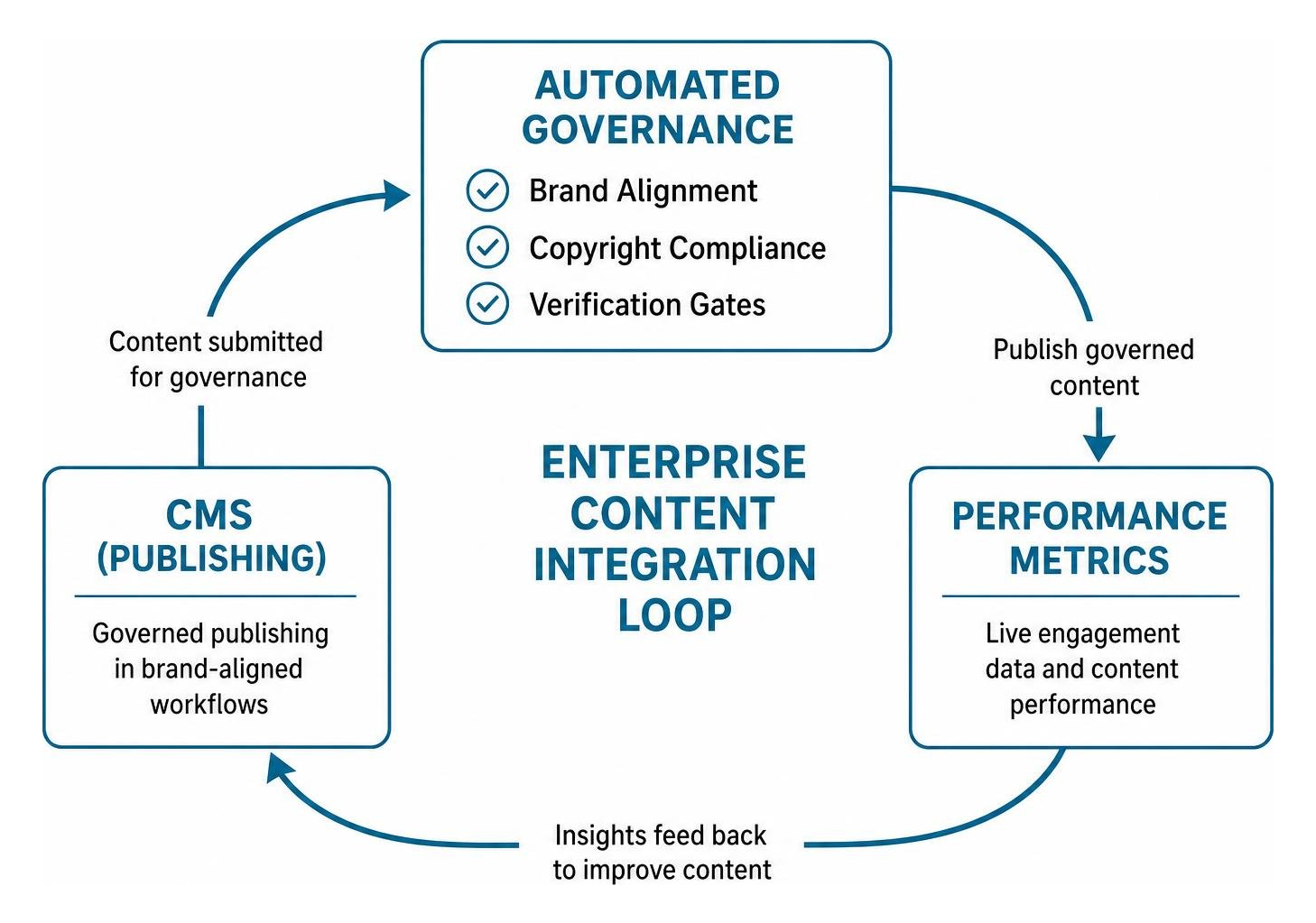
Treating brand parameters as executable code rather than static PDF documents ensures that every asset remains on-brand by default. As search engines and answer engines increasingly prioritize authoritative, well-structured content, large enterprises must modernize their digital infrastructure to maintain high search visibility and organic reach.
At ChrisRobino.com, we help forward-thinking organizations navigate emerging technologies, build governed production workflows, and execute high-impact digital initiatives. Explore how our technology innovation consulting firm can help your enterprise design scalable AI content architectures that drive sustainable, long-term growth.