Mastering automatic content creation Workflows
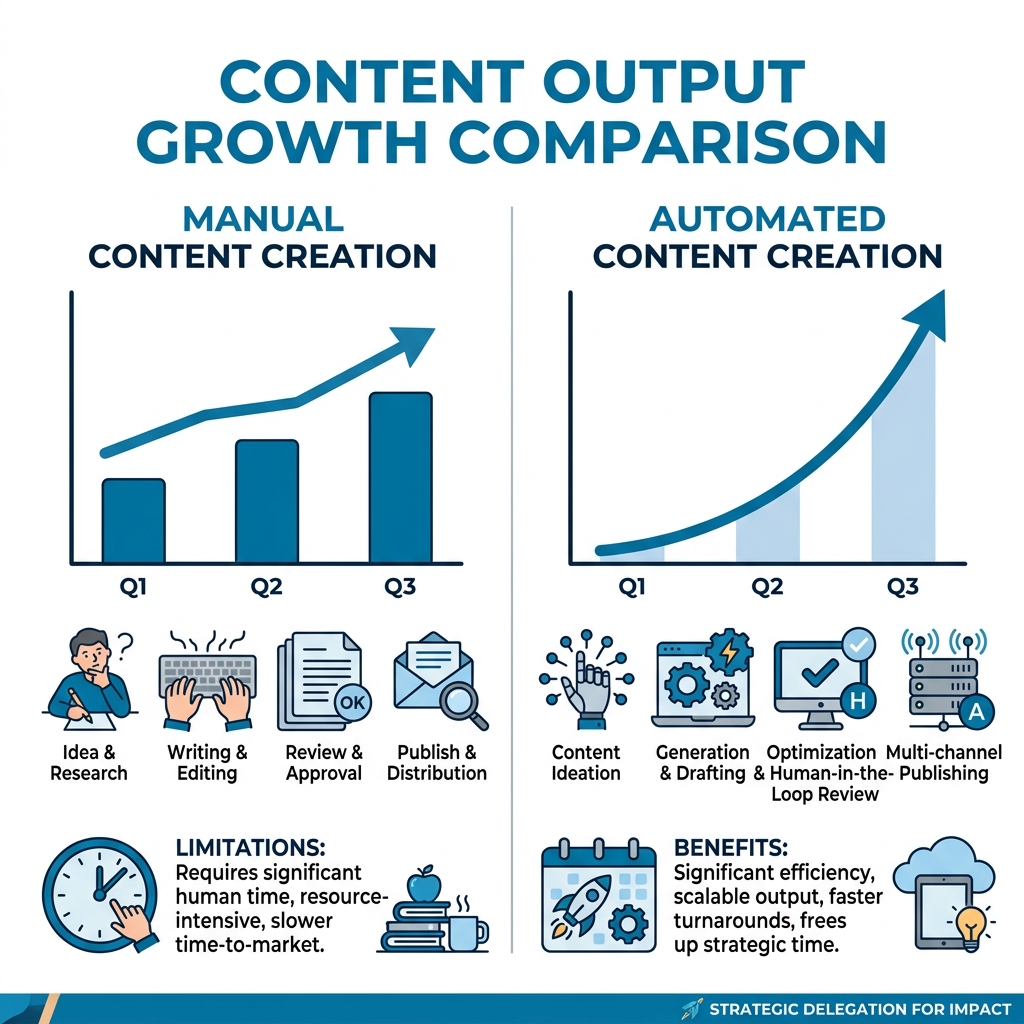
To move beyond simple prompt-and-response interactions with AI, we must look at automatic content creation as a series of connected gears. In a manual world, you are the motor turning every single gear. In an automated world, we build a “content factory” where Natural Language Processing (NLP) and Machine Learning (ML) handle the heavy lifting of drafting and formatting, while you act as the creative director. For large companies, this shift is essential to maintain enterprise-level content velocity without sacrificing the strategic oversight required for brand safety.
The shift to an automated workflow isn’t just about speed; it is about scalability. When you automate the repetitive admin side of content, like resizing images for different social platforms or generating meta descriptions, you reduce manual work and create more room for strategic review. This allows a single creator or a small marketing team to support the output of a much larger department, ensuring that the brand remains visible across all digital touchpoints. For large-scale SEO, this means being able to target thousands of long-tail keywords simultaneously through programmatic structures while still aligning with search quality guidance from sources like Google Search Central.

| Manual Content Production | AI-Automated Workflow |
|---|---|
| Brainstorming: 1-2 hours of staring at a blank page | Ideation: 5 minutes using an AI idea bank |
| Drafting: 4+ hours for a 1,500-word article | Drafting: 15 minutes for an AI-generated scaffold |
| Formatting: 1 hour for various social platforms | Formatting: Instant via automated “If-This-Then-That” flows |
| Publishing: 30 minutes of manual uploads | Publishing: Scheduled automatically via API nodes |
| Total Time: ~7 hours per piece | Total Time: ~45 minutes (including human review) |
Building an AI-Driven Content Strategy
A successful strategy starts long before the first word is written. For large organizations, we use AI to build topical authority, the perceived expertise your brand has in a specific niche. Instead of picking random topics, we use AI to identify content clusters. A content cluster consists of a pillar page, a high-level overview, linked to multiple cluster pages, which cover detailed sub-topics. This internal linking strategy is one of the most effective SEO tactics for large companies because it signals to search engines the depth and breadth of your knowledge.
By using AI to analyze search patterns and long-tail trends, we can build a reusable idea bank. This ensures that every piece of content we create serves a larger AI-driven content strategy. Tools can pull related keywords directly from Google’s autocomplete and People Also Ask sections, allowing us to build semantic maps that tell search engines exactly what we are experts in. For enterprise SEO, this means moving away from isolated keyword targeting and toward entity-based optimization, where the goal is to own the broader conversation around a specific industry topic.
Setting Up Your automatic content creation Pipeline
Once the strategy is set, we need the plumbing. An effective pipeline consists of Triggers and Actions. For example, a trigger could be adding a new topic to a centralized Google Sheet or a project management tool like Airtable. This kicks off an action where an AI agent drafts an outline based on existing high-ranking competitors, followed by another action that generates a featured image and meta data.
We recommend using tools that allow for approval gates. This is particularly critical for large companies with strict legal and compliance requirements. This means the AI does not just post to your blog immediately; instead, it sends a notification to a human editor to review the draft. This human-in-the-loop approach ensures that while the production is automated, the final quality check remains human. You can deploy custom AI agents to handle these end-to-end cycles, moving from a raw idea to a polished draft in seconds while maintaining full control over the output.
By leveraging AI-powered automation, you can connect your CMS, social media schedulers, and email marketing tools into one cohesive system. This reduces the context switching that often leads to burnout and ensures that your SEO efforts are integrated across all channels. For large companies, this integration allows for better data attribution and a clearer understanding of how automated content contributes to the bottom line.
Repurposing for Multi-Platform Scale
The biggest secret to high-volume output is repurposing. You should never create a piece of content for just one platform. Automatic content creation allows us to take one hero piece, like a long-form blog post or a whitepaper, and slice it into:
- 3 LinkedIn posts tailored for executive thought leadership
- 5 X posts focusing on key statistics
- 2 email snippets for newsletter distribution
- 1 script for a short-form video or internal briefing
Automation tools can monitor your RSS feed. The moment a new article goes live, the system can automatically generate a summary and schedule it across your social channels. For those looking to expand into visual media, AI video generation can turn text scripts into video avatars or narrated clips, allowing you to move from TikTok to LinkedIn without ever picking up a camera. This multi-channel approach is vital for large companies looking to maximize the ROI of every single piece of content they produce.
Ensuring Quality and Ethics in Automated Content
While the speed of automatic content creation is intoxicating, we must guard against the “robotic” trap. Google’s algorithms, particularly those following the E-E-A-T (Experience, Expertise, Authoritativeness, and Trustworthiness) guidelines, value original content with first-hand experience. For large companies, the risk of publishing generic AI content is high; if your content looks like a generic AI dump, your rankings will eventually suffer, and your brand reputation could be damaged.

Essential Human-in-the-Loop Checkpoints:
- Fact-Checking: AI can “hallucinate” or use outdated data. Always verify statistics, quotes, and technical specifications against primary sources.
- Brand Voice Alignment: Does the AI sound like your brand? Use specific brand guidelines and style sheets to “tune” the AI’s tone to match your corporate identity.
- Cultural Nuance: AI often misses sarcasm, local slang, or cultural sensitivities that are vital for global brands operating in multiple regions.
- Original Insight: Add a personal anecdote, a case study, or a unique opinion that an AI wouldn’t know. This is the “Experience” part of E-E-A-T.
Maintaining Authenticity in automatic content creation
Authenticity is the only thing AI cannot fake perfectly. We use AI to build the “scaffolding”—the structure, the research, and the rough draft. But the “cladding”—the final layer that the audience sees—must be influenced by your unique perspective. For large companies, this often involves integrating insights from Subject Matter Experts (SMEs) into the automated workflow.
To maintain a high standard of workflow efficiency, we suggest batching your editing. Let the AI generate five drafts on Monday, then spend Tuesday morning adding your “personal touch” to all five. This preserves your creative energy while maintaining a consistent publishing rhythm. For large teams, this can be scaled by having AI handle the initial research and drafting, while senior editors focus exclusively on high-level strategy and voice refinement.
Avoiding Common Automation Pitfalls
The most dangerous mistake is “set-and-forget.” Over-automation leads to a brand that feels lifeless and disconnected. If your audience realizes they are talking to a bot that never interacts back, they will stop engaging. In the context of SEO for large companies, over-automation can also lead to “content cannibalization,” where multiple automated pages compete for the same keywords, confusing search engines and diluting your authority.
Another pitfall is “blind trust.” Relying on AI for 100% of your output without a review layer can lead to plagiarism issues or repetitive phrasing that detectors easily flag. We must use AI implementation strategies that prioritize quality over pure volume. 10 high-quality, AI-assisted posts that provide genuine value will always outperform 100 low-quality, fully automated ones in the long run. Large companies must also be wary of “SEO drift,” where automated systems slowly move away from the core brand mission in pursuit of traffic.
The Future of Autonomous Systems with Chris Robino
As we look toward 2025 and 2026, the trend is moving from simple “tools” to “autonomous systems.” We are seeing the rise of AI agents that don’t just write; they research, optimize, and even respond to comments. At ChrisRobino.com, we focus on helping professionals navigate these emerging tech trends to ensure that automation remains a “strategic delegation” rather than a replacement for human ingenuity. For large enterprises, this means building custom AI ecosystems that are proprietary and secure.
Whether you are using an AI content generator to get over writer’s block or building a complex multi-platform engine, the goal is the same: to protect your sanity while scaling your impact. Automation is not a sign of laziness; it is a sign of strategic maturity. By clearing the admin clutter, you free your brain for the “big ideas” that actually build a brand. If you’re ready to dive deeper into how technology is reshaping the media landscape, explore more content projects and see how we’re putting these theories into practice every day.