

Why Fan Engagement Strategies Define Modern Brand Success
Fan engagement strategies are the systems, tactics, and technologies that turn casual spectators into loyal, revenue-generating brand advocates. In the modern digital landscape, these strategies are no longer optional; they are the primary driver of long-term sustainability for sports teams, entertainment franchises, and global brands. To succeed, organizations must view engagement not as a series of isolated events, but as a continuous lifecycle of discovery, participation, and advocacy.
Top fan engagement strategies at a glance:
- Personalize the experience — Use data and AI to deliver content fans actually care about.
- Gamify participation — Polls, predictions, leaderboards, and rewards drive repeat behavior.
- Go digital and mobile-first — Apps, second-screen content, and push notifications keep fans connected 24/7.
- Build community, not just audience — Forums, watch parties, and fan clubs create belonging.
- Measure what matters — Track retention, lifetime value, and participation rates, not just follower counts.
- Use immersive tech — AR, VR, and live streaming close the gap between home and stadium experiences.
- Optimize for Discovery — Implement enterprise-level SEO to ensure fans find your content first.
The numbers tell a compelling story. Highly engaged fans attend games at a 67% higher rate and spend 175% more per game than passive followers. Meanwhile, social media efforts from sports teams drive roughly 11% year-over-year B2C revenue growth. This isn’t a soft metric — it’s a direct line to your bottom line. However, for large companies, the challenge lies in scale. How do you maintain a personal connection with millions of fans across different time zones and platforms?
Yet despite the clear upside, half of sports organizations report struggling to understand how fans actually consume content digitally. The gap between knowing engagement matters and knowing how to engineer it is exactly where most brands lose ground. This engineering requires a blend of high-level digital transformation and robust search visibility.
I’m Chris Robino, a digital strategy and AI search expert with over two decades of experience helping organizations close that gap — and fan engagement strategies sit at the intersection of everything I specialize in: data-driven personalization, AI-powered content systems, and scalable digital growth. Let’s dig into the specific strategies that move the needle.
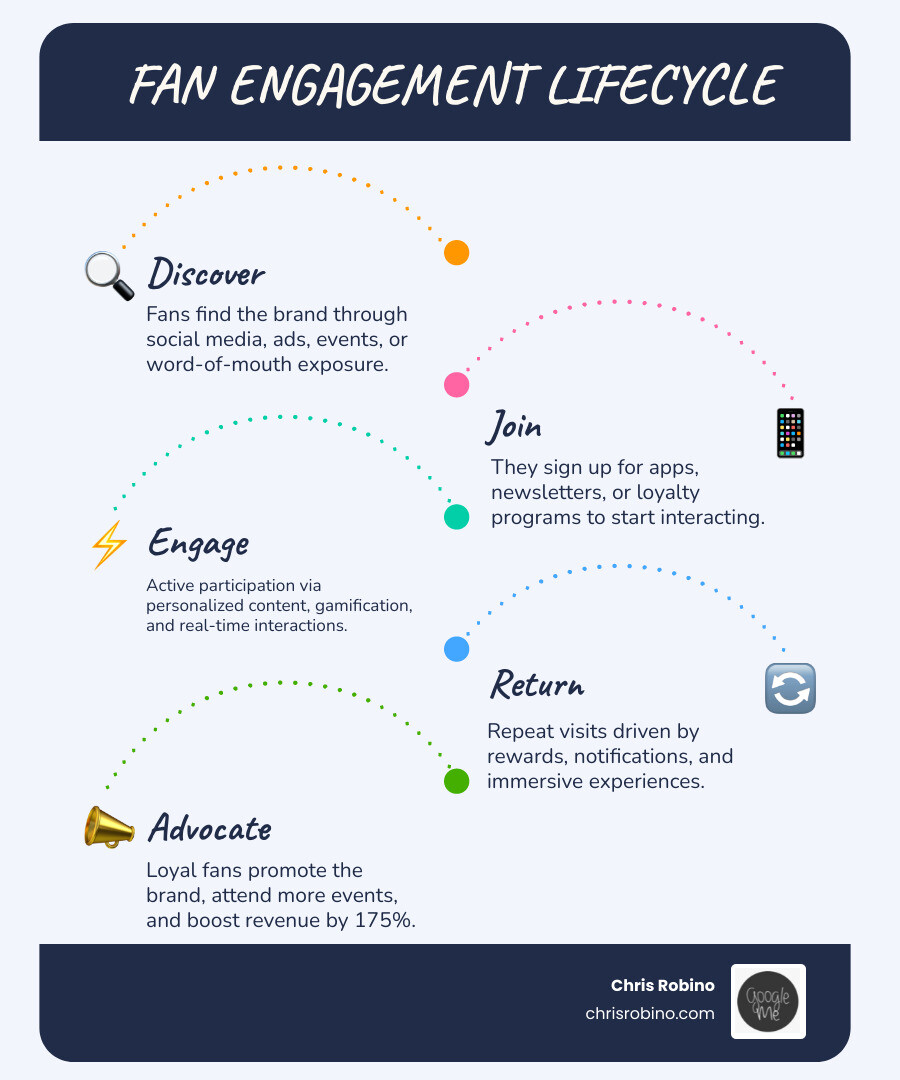
Simple Fan engagement strategies word guide:
Core Fan Engagement Strategies for the Digital Era
In April 2026, the boundary between the physical stadium and the digital world has all but vanished. To build a brand that fans are truly obsessed with, we must move beyond the “broadcast” mindset. Modern fan engagement strategies require a two-way street where the fan isn’t just a viewer, but an active participant in the team’s narrative.
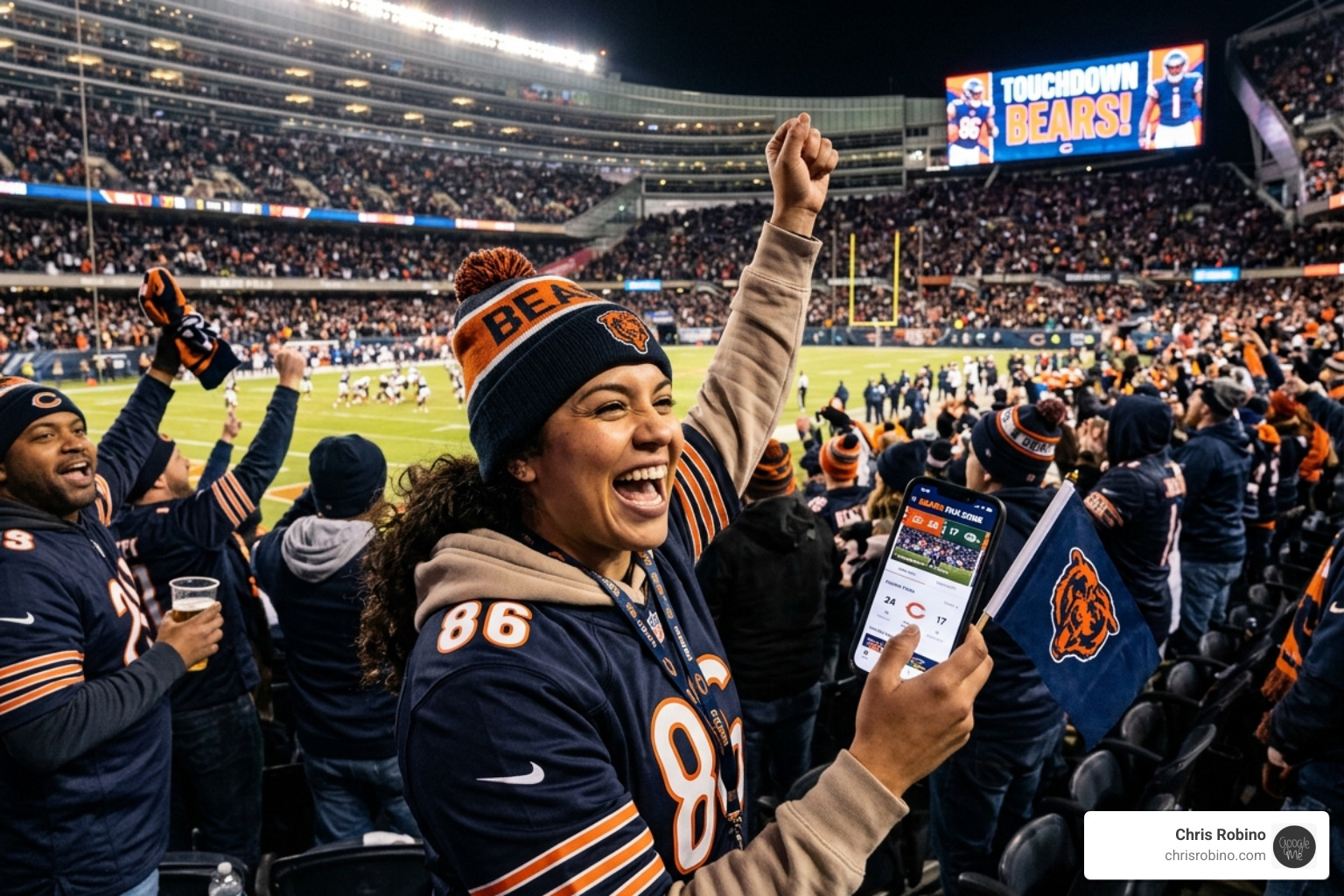
Digital transformation is no longer a luxury; it is the infrastructure of fandom. Today, 77% of Gen Z and 75% of Millennials prefer to watch sports outside of live event venues. This shift means your digital presence is the primary stadium for the majority of your fanbase. We achieve this by focusing on real-time interaction that spans before, during, and after the game.
Enterprise SEO: The Foundation of Digital Discovery
For large companies, fan engagement begins long before a user downloads an app or buys a ticket. It starts at the point of discovery. SEO strategies that perform well for large companies focus on scalability and technical excellence. When managing a domain with millions of pages, organizations must prioritize:
- Programmatic SEO: Using data-driven templates to generate high-quality, optimized pages for every player, match, and historical event. This ensures that when a fan searches for a specific stat, your brand is the first result.
- Technical Infrastructure: Large sites often suffer from “crawl budget” issues. Optimizing site architecture, improving server response times, and utilizing advanced XML sitemap management are critical for ensuring search engines index your most valuable engagement assets.
- Topical Authority and Content Hubs: By clustering content around core themes—such as “Match Day Guides” or “Player Behind-the-Scenes”—large brands can signal deep expertise to search engines, dominating the SERPs for high-intent keywords.
- E-E-A-T (Experience, Expertise, Authoritativeness, and Trustworthiness): Large companies must leverage their official status to provide authoritative content that AI-driven search engines prioritize. This includes verified athlete insights and official team data.
Building a community involves moving fans along a specific “avidity spectrum.” We want to transition them from a casual “Audience” (those who just see content) to “Users” (those who take an action) and finally to a “Community” (those who repeatedly participate and identify with the brand). This transition is the core of our Audience Development Media Ultimate Guide.
Leveraging AI and Data for Personalized Fan Engagement Strategies
If you treat your fans like anonymous clicks, they will eventually stop clicking. In 2026, personalization is the “north star” of marketing. By creating a Single Fan Profile, we unify data from ticketing, merchandise, social media, and app usage to understand exactly what each individual wants.
AI is the engine that makes this possible at scale. We use AI content creation tools to democratize high-quality video production, allowing even smaller organizations to deliver personalized highlights or “hype videos.” For example, if a fan consistently votes for a specific player in polls, our AI systems can automatically serve them merchandise offers or behind-the-scenes clips featuring that athlete.
By leveraging these Audience Engagement Strategies, we ensure that every notification feels like a value-add rather than an interruption.
Gamification and Interactive Rewards Systems
Why do fans keep coming back to fantasy sports? Because they have “skin in the game.” We can replicate this feeling through gamification. The gamification market is predicted to hit over $78 billion by 2030, and for good reason: it builds habits.
By integrating live polls, quizzes, and prediction games into the match-day experience, we give fans something to do, not just something to watch. These interactions should be tied to a digital rewards wallet where fans earn points, badges, or exclusive digital collectibles (NFTs) for their participation.
| Feature | Traditional Loyalty | Digital Gamification |
|---|---|---|
| Action | Making a purchase | Participating in polls/quizzes |
| Reward | Discount codes | XP, badges, exclusive access |
| Frequency | Occasional | Daily/Real-time |
| Goal | Transactional | Habit formation & Community |
These Audience Development Tactics transform the fan experience from a passive one-off event into a continuous cycle of engagement and reward.
Immersive Technology: AR, VR, and the Second Screen
Technology is the bridge that brings the stadium into the fan’s pocket. In a recent study, AR technology was ranked as the #1 tech for sports over the next few years. Whether it’s “parachuting” sponsored digital prizes onto fans via their phone cameras or providing 360-degree VR views of the court, immersive tech creates “wow” moments that drive obsession.
The “second screen” experience is also vital. Most fans watch games with a smartphone in hand. We leverage this by providing real-time stats, alternate camera angles, and community chat rooms. This keeps the fan within our ecosystem rather than losing them to general social media platforms.
Measuring Success and Future-Proofing Your Brand
Without clear measurement, fan engagement strategies are just expensive experiments. We must move beyond “vanity metrics” like likes and follows and focus on data that correlates with revenue, long-term retention, and organic visibility.

Essential KPIs for Modern Fan Engagement Strategies
To understand if our strategies are working, we track specific Key Performance Indicators (KPIs). These metrics help us see the “retention uplift”—the percentage increase in fans who stay active after we launch a new feature. For large companies, these KPIs must also include search performance metrics to ensure the top of the funnel remains full.
- DAU/MAU Ratio: This measures how many of your monthly active users engage with your platform on a daily basis. It’s the ultimate “habit” metric.
- Churn Rate: The percentage of fans who stop interacting with your digital platforms over a specific period.
- Share of Voice (SoV): An SEO-centric metric that measures how much of the digital conversation and search results your brand owns compared to the total market.
- Organic Conversion Rate: The percentage of fans who find your brand through search engines and subsequently take a high-value action, such as signing up for a newsletter or purchasing merchandise.
- Sentiment Analysis: Using AI to “listen” to fan comments and determine if the brand perception is positive, negative, or neutral.
- CLV (Customer Lifetime Value): The total revenue we expect from a fan over the entire duration of their relationship with the brand.
Emerging Trends: NFTs, Esports, and AI Content
As we look toward the future, several trends are poised to redefine fandom. NFTs and Blockchain are moving beyond speculation and becoming functional tools for digital ownership, such as “lifetime” digital tickets or unique collectibles that offer real-world perks.
Esports and Fantasy Leagues continue to grow, with over 62 million people participating in fantasy sports in North America alone. Integrating these into traditional sports brands allows us to capture younger audiences who crave interactive, competitive environments. Finally, AI content creation will continue to evolve, allowing for automated highlight reels and real-time personalized commentary. Understanding these shifts is key to a successful sports fan engagement strategy that turns fans into daily active users.
Large companies must also stay ahead of AI-driven search changes. As search engines evolve into answer engines, providing structured, data-rich content becomes the primary way to maintain visibility. This requires a constant audit of technical SEO health and a commitment to high-quality, original content production.
Conclusion: Building a Sustainable Fan Community
Making fans obsessed with your brand isn’t about a single viral post or a flashy halftime show. It’s about engineering a system where every touchpoint—digital or physical—adds value to the fan’s life. By focusing on personalization, gamification, and immersive technology, and supporting these efforts with robust enterprise SEO strategies, we build a community that stays loyal through winning streaks and losing seasons alike.
For large organizations, the key to success is scalability. You must be able to deliver a personalized experience to a global audience while maintaining the technical infrastructure that keeps your brand visible in an increasingly crowded digital marketplace. This requires a holistic approach that blends creative engagement with rigorous data science and search optimization.
At ChrisRobino.com, we specialize in helping organizations navigate this complex intersection of tech and media. Whether you are a professional league or a growing brand, the goal remains the same: turn your audience into a family.
Ready to transform your digital presence and drive sustainable growth? Get to work with Chris Robino and let’s build the future of your brand together.