

Why Search Visibility Matters in Modern SEO
Search visibility is the estimated share of organic attention and clicks your website earns across a defined set of search queries. Improve it by tracking a focused keyword set, prioritizing pages close to top positions, matching each page to search intent, strengthening internal links and relevant backlinks, and earning space in SERP features such as AI Overviews, People Also Ask, images, and local results.
A #1 ranking still matters, but it no longer tells the whole story. Rich results can push standard blue links down the page, and AI answers may satisfy a search without a click. That makes visibility a broader measure of whether people can find and recognize your brand across the search journey.
For large organizations, the useful question is not simply, “What do we rank for?” It is:
- Which high-value topics do we own?
- Where are other industry players taking attention or citations?
- Which pages are one strong update away from greater reach?
- Is that reach producing qualified visits, leads, and revenue?
Search visibility should be measured over time and evaluated across industry segments, not judged as an isolated standalone score. A score near 35% to 45% is a strong non-branded benchmark in many keyword sets, while the right target depends on your market, query mix, location, and the SERP features present.
I am Chris Robino, a digital strategy leader with more than two decades of experience helping startups and enterprises improve search visibility through SEO, AI-driven systems, and data-backed growth planning. This checklist breaks down the practical work that turns scattered search performance into durable brand authority.
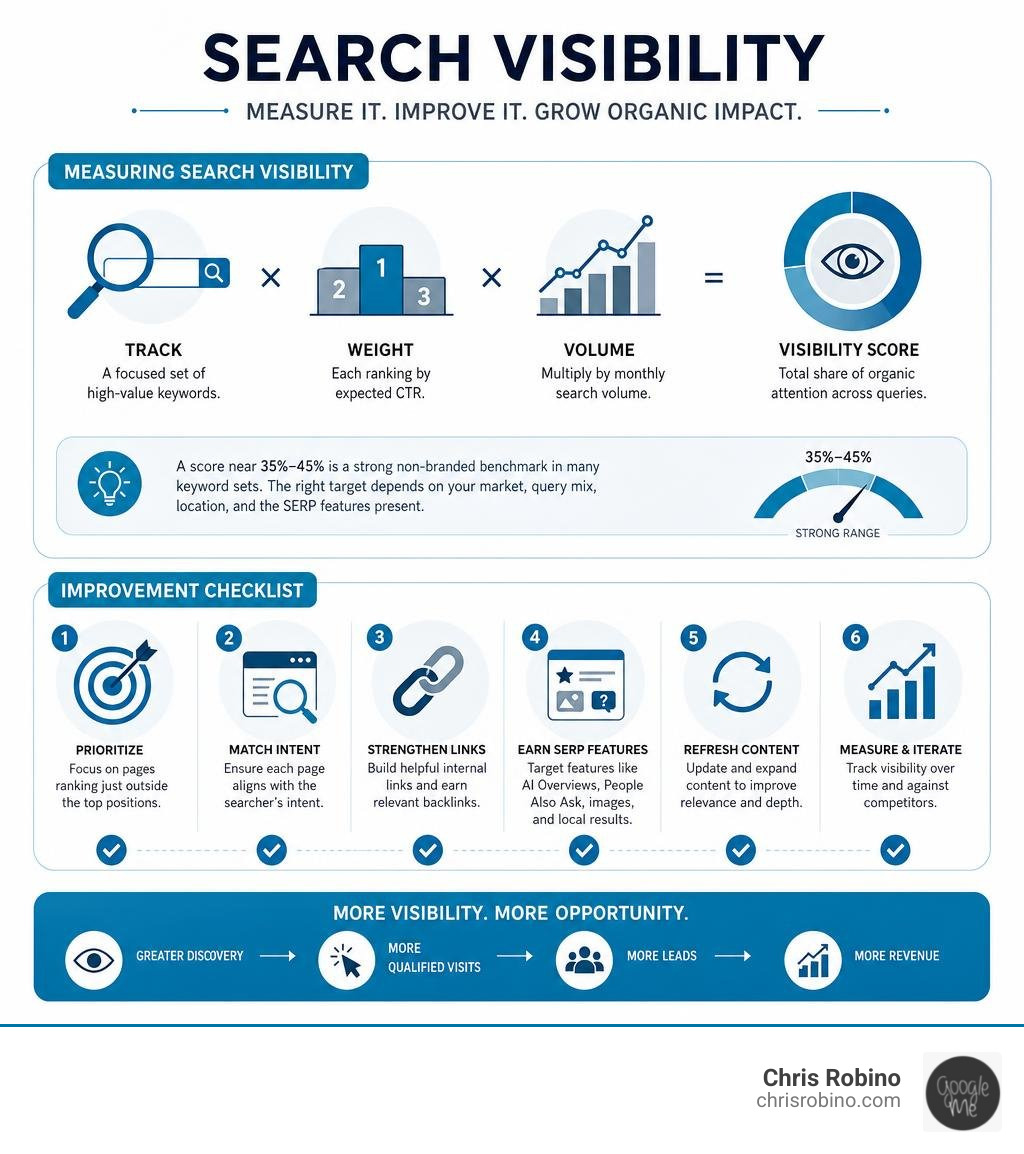
How Search Visibility is Calculated Across Keywords
To understand visibility metrics, we must look at how modern algorithms calculate organic reach. Standalone search engine rankings show your position in a list, but visibility calculates the actual probability of capturing user attention.
Standard enterprise tracking models determine visibility by weighting keyword rankings against expected click-through rate (CTR) curves and query search volume. Under standard visibility scoring models, achieving a 100% visibility score means owning every single ranking position across all tracked queries—an outcome that is virtually impossible for non-branded terms. Realistically, landing between 35% and 45% reflects industry-leading ownership, mirroring the historical CTR ceiling of top organic placements.
The mathematical relationship between rankings and visibility is non-linear:
| Organic Position | Typical CTR Share | Visibility Impact | Strategic Focus |
|---|---|---|---|
| Position 1 | ~35% – 45% | Maximum capture | Defend with content freshness and schema |
| Position 2–3 | ~15% – 20% | High capture | Primary optimization targets for quick wins |
| Position 4–10 | ~2% – 8% | Moderate capture | Enhance topical depth and internal link equity |
| Position 11–20 | < 1% – 2% | Minimal capture | High striking-distance opportunity for clusters |
| Position 21+ | < 0.5% | Negligible capture | Require structural overhauls or intent realignment |
Moving a keyword from position 3 to position 1 delivers an exponential traffic lift, whereas jumping from position 95 to 60 produces virtually zero real-world impact. We focus resources on high striking-distance keywords (positions 2 through 12) where small gains yield significant visibility improvements.
Traditional SERPs vs AI Answer Engines
The search landscape is experiencing a massive platform shift. Traditional search engine optimization focuses on ranking ten blue links, whereas modern discovery requires visibility across generative AI models and conversational engines. Large language models (LLMs) synthesize information differently than classic indexers.
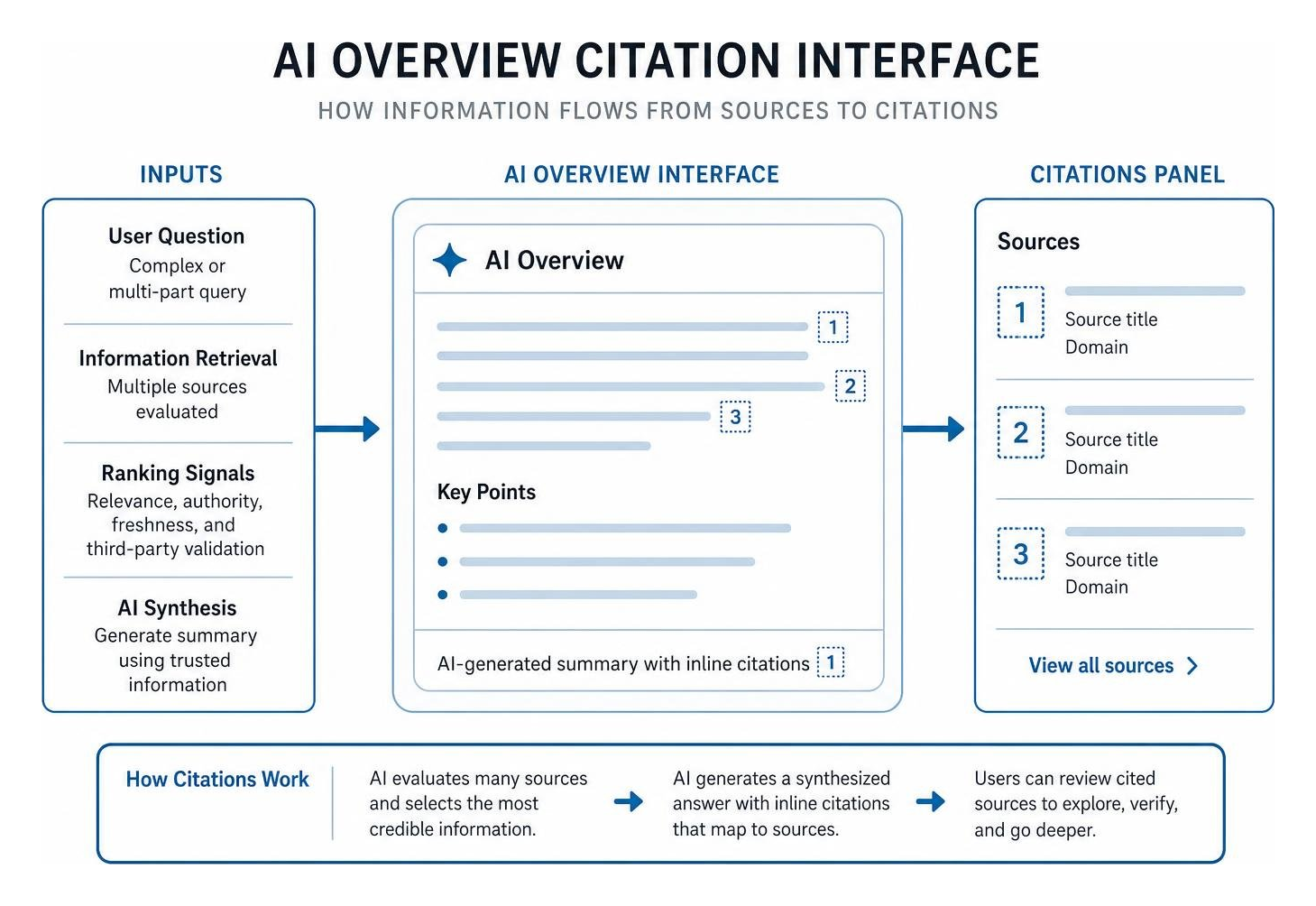
Generative engines prioritize direct answers, entity relationships, and structured facts. When users ask complex questions, automated systems and AI Overviews generate synthesized summaries. As we explore in our guide on generative engine optimization, success in AI discovery is measured through brand citations, prompt share of voice (SOV), and sentiment rather than purely position metrics.
AI engines rely heavily on third-party validation: research reveals that brands are 6.5 times more likely to be cited by AI systems through authoritative third-party coverage, reviews, and editorial mentions than through their own direct domains. Managing discovery requires ensuring enterprise brand assets are structured for direct retrieval by machine agents.
Essential Optimization Strategies for Modern SERPs
Maximizing an enterprise search footprint requires technical precision and robust content architecture. When crawling large sites, search engine bots must navigate clear site hierarchies without wasting crawl budget on duplicate parameters, unindexed scripts, or faceted navigation bloat.
Building a rock-solid technical SEO strategy ensures every high-value landing page is properly indexed, renders seamlessly on mobile devices, and communicates its subject matter clearly via structured data schemas. Enterprise visibility relies on establishing topical depth, preserving technical hygiene, resolving rendering bottlenecks, and optimizing for dynamic multi-modal search formats across global domains.
Optimizing Content Architecture to Boost Search Visibility
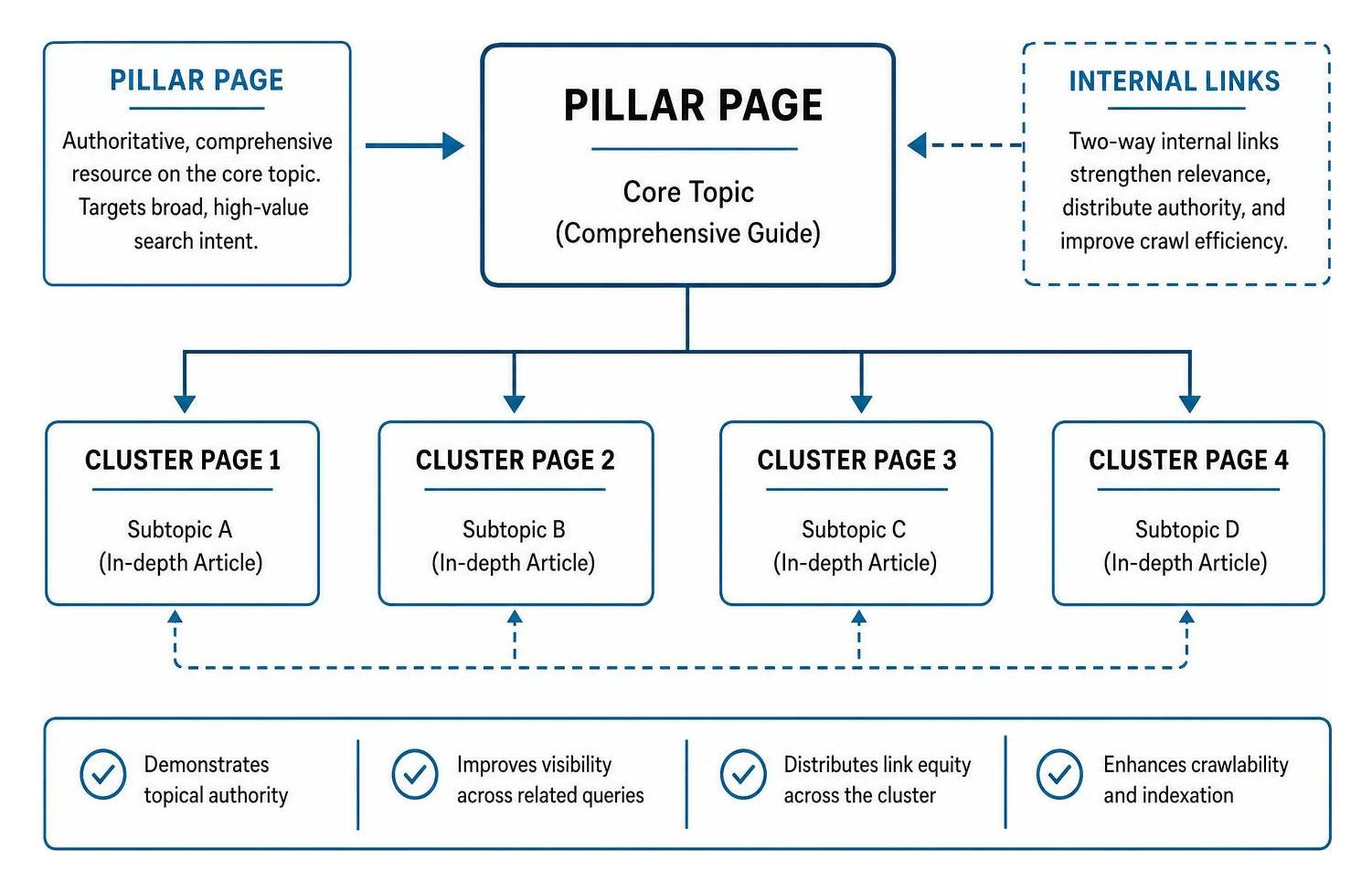
A piecemeal approach to content creation dilutes organic authority. Enterprise organizations succeed by structuring content into organized topical clusters consisting of an authoritative pillar page supported by specialized cluster assets. This architecture demonstrates unambiguous topical authority to search evaluators and simplifies crawling across complex enterprise taxonomies.
Strategic internal linking acts as the circulatory system of a website, distributing backlink equity from high-authority pages directly to conversion-focused assets and newly launched topic initiatives.
When structuring content for competitive enterprise markets, we follow core optimization principles:
- Search Intent Precision: Align every URL precisely with user intent, cleanly separating top-of-funnel educational resources from commercial comparison and transactional product listings.
- Keyword Difficulty Targeting: Balance highly competitive core head terms with low-difficulty supporting phrases (0–29% difficulty) to capture immediate organic share while building long-term category dominance.
- Topical Freshness and Maintenance: Regularly audit and refresh decaying statistics, outdated workflows, and legacy comparison frameworks to preserve algorithmic trust across critical landing pages.
- Contextual Link Anchors: Use descriptive, keyword-rich anchor text within body copy to pass relevant topical signals and guide crawler exploration across related subtopics.
Securing Rich SERP Features and Knowledge Real Estate
Traditional organic listings now share screen space with diverse SERP features. Dominating modern search requires winning multi-format real estate across the results page.

Consider how frequently search engines integrate rich features into standard search results:
- Image Packs: Appear on 65.53% of search result pages.
- People Also Ask (PAA): Present on 34.53% of SERPs.
- Knowledge Panels: Displayed on 23.56% of search queries.
- Local Packs: Integrated across 17.42% of local-intent searches.
- AI Overviews: Present on 14.49% of desktop search pages.
- Popular Products: Occupy 13.25% of commercial search queries.
- Top Stories: Feature on 4.96% of news-related queries.
- Recipes: Display on 1.71% of culinary searches.
- Featured Snippets: Claim 1.24% of search results.
To capture these positions, we apply the Bottom Line Up Front (BLUF) formatting technique—providing direct, 40- to 60-word answers immediately beneath clear H2 and H3 question headings. We reinforce this with targeted schema markup (FAQPage, Article, Product, LocalBusiness, and VideoObject), descriptive alt text on original visual media, and optimized product feeds.
Building Authority Before Search Demand Exists
Traditional SEO workflows rely heavily on keyword volume metrics. However, keyword search volume is inherently a lagging indicator—it records user behavior only after a topic has become mainstream and highly competitive.
Building durable search equity requires establishing early authority while entities and categories are still emerging. By monitoring trend analytics and validating organic discussions on community platforms, industry forums, and video channels, enterprise teams can define emerging concepts before mass keyword demand manifests.
Securing early editorial mentions and distributing foundational research builds a lasting online presence for authority. When AI models and search engines ingest this foundational coverage, they cite our brands as the default category references, creating an organic moat that cannot be easily duplicated.
Maintaining Performance and Building Sustainable Authority
Sustaining high search performance at scale demands continuous governance, cross-functional alignment, and proactive technical monitoring. Enterprise websites frequently encounter visibility declines caused by content decay, unintentional keyword cannibalization during rapid multi-team publishing cycles, or broad algorithmic updates.
We protect enterprise search equity through a systematic maintenance framework:
- Longitudinal Position Tracking: Monitor visibility scores across curated non-branded keyword sets rather than obsessing over individual daily rank movements.
- Content Pruning and Consolidation: Merge thin, overlapping pages to eliminate cannibalization, consolidate external backlink equity, and direct crawl attention toward core URLs.
- Decay Audits and Historical Optimization: Pinpoint pages experiencing traffic erosion over rolling 6-month windows, systematically updating their factual references, structured data, and structural layouts.
- Cross-Channel Attribution Modeling: Connect search visibility metrics directly to commercial conversions, assisted pipeline revenue, customer acquisition costs, and growing branded search demand.
- Faceted Navigation and Indexation Audits: Regularly inspect parameter handling, canonical tags, and robots directives on large-scale catalogs to prevent crawl dilution and index bloat.
- Entity and Schema Validation: Periodically validate structured data across international localized domains to ensure search engine evaluators extract clear entity relationships without syntax degradation.
For an extensive strategic roadmap on scaling organic performance, explore the ultimate guide to search engine ranking tips. By combining technical excellence, intent-driven content architecture, and multi-format SERP optimization, we build compounding brand visibility that consistently drives enterprise growth across both traditional search engines and emerging AI-driven discovery environments.