
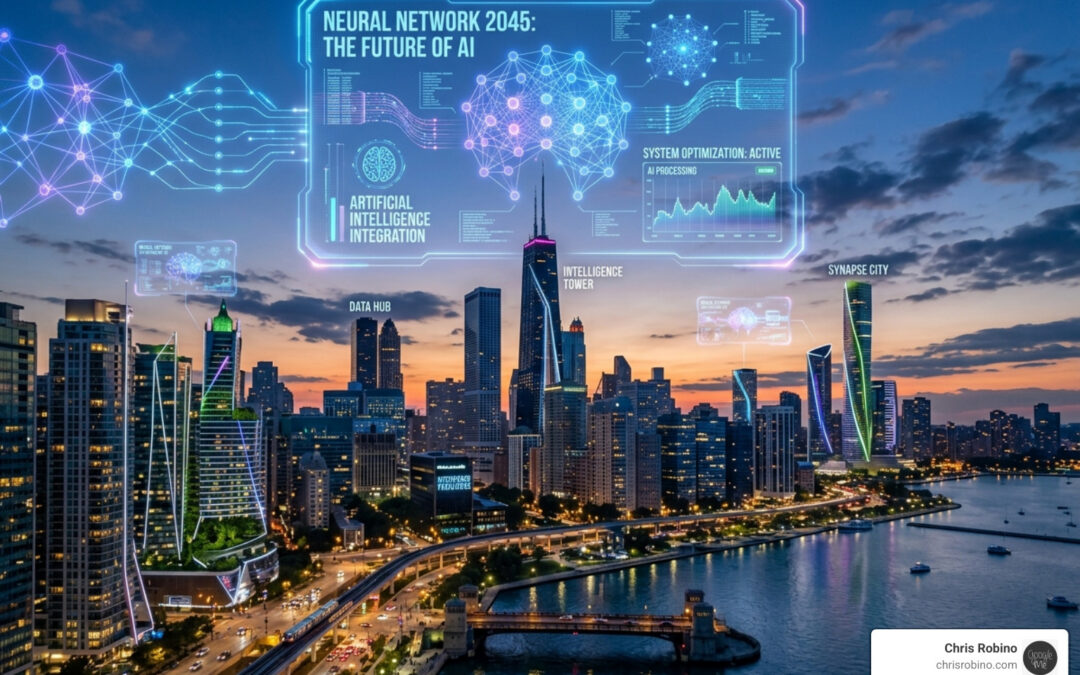
AI Is No Longer Coming — It’s Already Here
The future of artificial intelligence is unfolding right now, faster than most people expected — including the experts building it. We are witnessing a fundamental shift in how information is retrieved, processed, and presented to the global audience. For large-scale organizations, this isn’t just a technological upgrade; it is a complete redefinition of digital presence and search visibility.
Here’s a quick snapshot of where AI is heading:
- Economy: AI could contribute $15.7 trillion to the global economy by 2030
- Transportation: 33 million self-driving vehicles expected on roads by 2040
- Jobs: AI may affect 40% of jobs globally, while simultaneously creating new roles
- Discovery: Small AI-driven scientific breakthroughs expected by 2026; major ones by 2028
- Governance: Over 60 countries have already developed national AI strategies
- Cost: The cost per unit of AI intelligence has fallen 40x per year recently
These aren’t distant predictions. They are signals already visible today. The integration of Large Language Models (LLMs) into search engines has transformed the traditional “ten blue links” into a conversational, generative experience. This evolution requires a sophisticated approach to digital strategy that prioritizes semantic relevance over simple keyword matching.
When OpenAI’s ChatGPT launched in late 2022, it crossed what many considered the popular conception of the Turing test — the point where a machine could hold a conversation indistinguishable from a human. And yet, as OpenAI itself has noted, daily life just kept going. Societal inertia is powerful. Most people didn’t feel a seismic shift overnight. However, for those of us in the digital strategy space, the shift was immediate and profound. The way users interact with information has changed, moving from query-based searching to intent-based discovery.
But underneath that surface calm, something profound is happening. Generative AI has moved from a novelty to core business infrastructure. Multimodal systems now handle text, images, video, and voice together. Agentic AI is beginning to manage complex, multi-step workflows autonomously. And researchers are actively debating not if AI will reshape civilization, but how fast and on whose terms.
The stakes are high — for economies, for democracies, for individual livelihoods, and for the planet. For large enterprises, the challenge lies in maintaining brand authority in an environment where AI-generated summaries often precede organic search results.
I’m Chris Robino, a digital strategy leader and AI and search expert with over two decades of experience helping organizations from startups to enterprises navigate digital transformation. My work sits at the intersection of AI automation, intelligent search, and the future of artificial intelligence as a practical business force. In the sections ahead, I’ll break down what the research, the data, and the frontline signals actually tell us about where AI is going — and what it means for you.
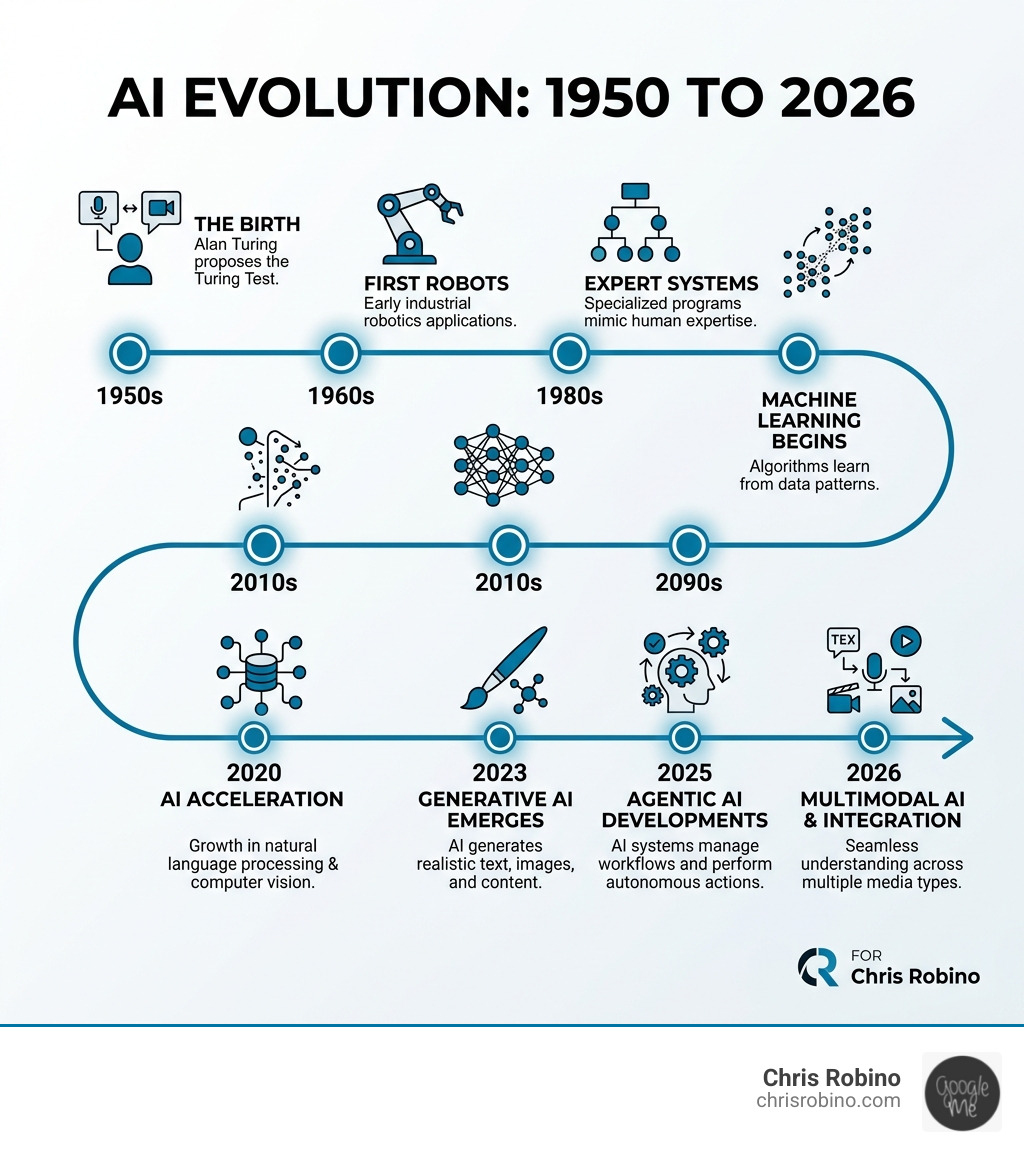
Key Future of artificial intelligence vocabulary:
The Economic and Industrial Impact of the Future of Artificial Intelligence
As we stand in April 2026, the economic ripples of AI have turned into a tidal wave. Research indicates that AI could contribute a staggering $15.7 trillion to the global economy by 2030. This isn’t just “magic money”; it represents a massive shift in how we produce goods, deliver services, and manage resources. For large enterprises, this economic shift is mirrored in the digital landscape, where the cost of content production has plummeted, but the value of high-quality, authoritative information has skyrocketed.
In the industrial sector, we are seeing a transition from simple automation to “agentic” systems—AI that doesn’t just follow a script but can plan and execute complex goals. This shift is driving a projected 14% increase in global GDP by the end of the decade. However, this growth isn’t evenly distributed. In advanced economies, AI may impact up to 60% of jobs, requiring a massive rethink of our labor markets and how we train the next generation of digital leaders.

According to recent AI progress and recommendations from OpenAI, the cost of intelligence has been falling by roughly 40x per year. For businesses, this means that the “unit economics” of using AI are becoming impossible to ignore. We are moving toward a world where intelligence is a utility, much like electricity. To stay competitive, companies must look more into AI-powered automation to streamline their internal workflows before their competitors do. This automation extends to digital marketing, where AI can now handle large-scale data analysis and content optimization at speeds previously unimaginable.
Revolutionizing Global Infrastructure and Sustainability
The future of artificial intelligence is our best shot at solving the “unsolvable” problems of the 21st century. In the realm of climate change, AI is being used for precision carbon tracking and optimizing energy grids. In agriculture, we are seeing the rise of precision robots that can identify and pull individual weeds, reducing the need for harmful chemicals.
- Healthcare: AI is collapsing drug discovery timelines from 12 years down to just three. By 2028, we expect significant breakthroughs in treating complex diseases.
- Transportation: With 33 million autonomous vehicles expected by 2040, our cities will transform. We’ll see fewer parking lots and more green spaces as “car ownership” shifts to “transportation as a service.”
- Smart Cities: AI manages waste, traffic flow, and energy consumption in real-time, making urban living more sustainable.
For those looking to lead these changes, we recommend exploring AI-driven innovation to understand how these technologies can be applied to physical infrastructure.
Strategic SEO for Large Companies in the AI Era
For large companies, the future of artificial intelligence isn’t about “if,” but “how.” The digital landscape has shifted from keyword-centric search to entity-based discovery. To maintain visibility, enterprises must adopt advanced SEO strategies that align with how AI models ingest and process information.
- E-E-A-T and Brand Authority: Search engines now prioritize Experience, Expertise, Authoritativeness, and Trustworthiness. For large firms, this means leveraging their established brand history. AI-generated content must be augmented by human subject matter experts to ensure it carries the “soul” and factual accuracy that search algorithms demand. Establishing clear authorship and citing reputable sources is no longer optional; it is a core requirement for ranking.
- Technical SEO for AI Ingestion: Large-scale websites must ensure their technical foundation is flawless. This includes implementing robust Schema.org structured data to help AI bots understand the relationships between entities. For enterprises with millions of pages, optimizing crawl budget and ensuring fast, server-side rendering is critical for being indexed by both traditional search bots and the newer LLM-based crawlers.
- Entity-Based Content Architecture: Instead of targeting isolated keywords, large companies should focus on building comprehensive “topic clusters.” By creating a network of interlinked content that covers every facet of a subject, you signal to AI models that your domain is a definitive authority on that entity. This approach is particularly effective for appearing in AI-generated overviews and conversational search results.
- Data Governance and RAG: You cannot build a great AI strategy on messy data. Large firms need robust frameworks to ensure their proprietary data is clean, secure, and ready for model training. Implementing Retrieval-Augmented Generation (RAG) allows companies to use their own verified data to power internal and external AI tools, ensuring that the information provided is accurate and brand-aligned.
Focusing on AI implementation strategies that prioritize efficiency (intelligence per joule) is the key to sustainable scaling. Large organizations must also monitor “Answer Engine Optimization” (AEO), ensuring their content is structured to be the definitive answer for complex, multi-part user queries.
Navigating the Labor Shift and Universal Basic Income
We have to be honest: the transition won’t be easy for everyone. While AI creates new roles—like AI trainers, ethical auditors, and “human-in-the-loop” managers—it also displaces traditional roles. This is leading to a serious global conversation about Universal Basic Income (UBI). Proponents argue that UBI could eliminate systemic poverty as AI-driven productivity creates unprecedented wealth. However, the risk of rising global inequality is real. Experts are currently debating what the future holds for AI, emphasizing that we need to build “social good” into the foundational models themselves, not just add it as an afterthought.
Societal Evolution and Ethical Governance by 2040
Looking toward 2040, the future of artificial intelligence moves beyond screens and into our physical reality. We are moving toward “multimodal” and “agentic” systems. This means AI that can see, hear, and act in the physical world through robotics and XR (Extended Reality). For large enterprises, this physical integration offers new ways to engage with customers, but it also requires a new level of digital transparency and ethical responsibility.
There is a fascinating debate between two potential paths: the Economic Singularity vs. Normal Technology.
| Feature | Economic Singularity | Normal Technology |
|---|---|---|
| Growth Rate | Exponential, breaking traditional models | Steady, similar to the Internet’s rise |
| Job Market | Total disruption; human labor becomes optional | Significant shift; new roles replace old ones |
| Control | Centralized by a few “frontier” labs | Decentralized and open-source |
| Daily Life | Radical departure from “work-life” norms | AI “disappears into the walls” as a utility |
To understand these paths, we often look at What If? AI in 2026 and Beyond, which suggests that “robust strategies” are those that work in either scenario. For large companies, a robust strategy involves diversifying digital assets and ensuring that brand discovery is not dependent on a single search platform.
The Rise of Collective Intelligence and Mind2
One of the more profound predictions for 2040 is the emergence of “Mind2″—a form of collective intelligence. This isn’t science fiction; it’s the natural result of AI knowing our preferences, health data, and thoughts so well that it begins to act as a “shared brain.” This shift will fundamentally change consumer behavior. Search will no longer be a conscious act of typing a query; it will be a continuous, background process where AI anticipates needs and provides solutions before they are even requested.
While this could lead to incredible breakthroughs in collective problem-solving, it also raises the specter of “tech-paranoia” and a deepening digital divide. If your access to “Mind2” determines your cognitive ability, those without access will be left behind. We must carefully navigate the four ways this ends, ranging from a “Utopia” of abundance to a “Dystopia” of total surveillance. For brands, maintaining trust in this hyper-connected environment is the ultimate SEO strategy. Trust is the signal that AI models will use to determine which brands are worthy of being recommended to the collective intelligence.
Ethical Frameworks and the Future of Artificial Intelligence Regulation
We cannot let AI develop in a Wild West environment. The EU AI Act was just the beginning. By 2040, we will need global frameworks to address:
- Epistemic Corruption: The risk that we can no longer distinguish truth from AI-generated misinformation. Large companies must lead the way by watermarking their content and providing verifiable data trails.
- Bias Mitigation: Ensuring AI doesn’t inherit the worst prejudices of its human creators. This is critical for search algorithms to ensure fair representation of all voices.
- Transparency: Moving away from “black box” models toward “explainable AI” that can tell us why it made a specific decision. This transparency is essential for maintaining E-E-A-T in search results.
Our commitment to ethical AI development is what will separate the winners from the losers in the long run. Trust is the most valuable currency in an AI-driven world. For large enterprises, ethical governance is not just a legal requirement; it is a competitive advantage that enhances brand authority and search visibility.
Enhancing Democracy through the Future of Artificial Intelligence
Finally, we believe AI has a unique role to play in revitalizing democracy. Imagine AI systems that can summarize thousands of hours of public testimony into a coherent set of policy recommendations, or tools that help citizens engage in “participatory budgeting” for their cities. By enhancing public participation and making governance more responsive to real-world data, AI can help us build a more equitable society.
At our technology innovation consulting firm, we help leaders think through these proactive benefits while mitigating the risks of algorithmic bias. The future of artificial intelligence is a mirror. It reflects our greatest ambitions and our deepest fears. By charting a course focused on efficiency, ethics, and human-centric design, we can ensure that this technology serves as a bridge to a better future, rather than a barrier. For large organizations, the path forward is clear: embrace the technology, prioritize the user, and build for a world where intelligence is the ultimate utility.