
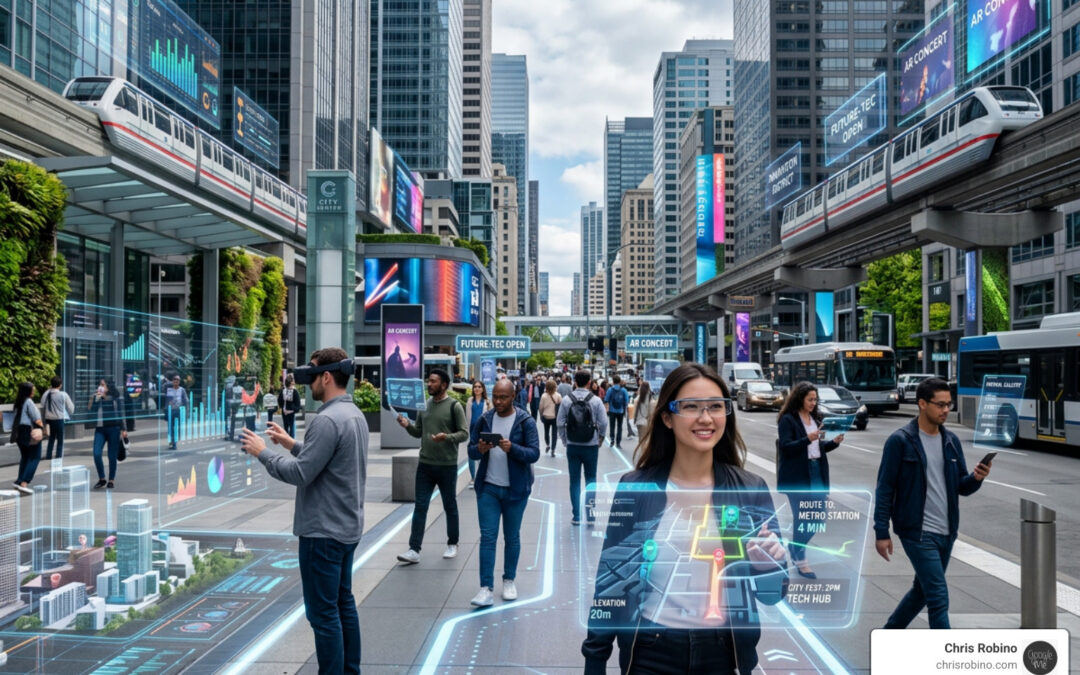
Why the Future of Immersive Experiences Matters Right Now
The future of immersive experiences is already reshaping how we work, learn, shop, and connect — and it’s moving faster than most organizations realize. For large companies, this shift necessitates a fundamental evolution in digital strategy. It is no longer enough to optimize for a 2D screen; the next frontier of search and discovery is spatial, and the SEO strategies that perform well for large companies must adapt to this three-dimensional reality.
Here’s a quick snapshot of what’s coming:
| Trend | What It Means |
|---|---|
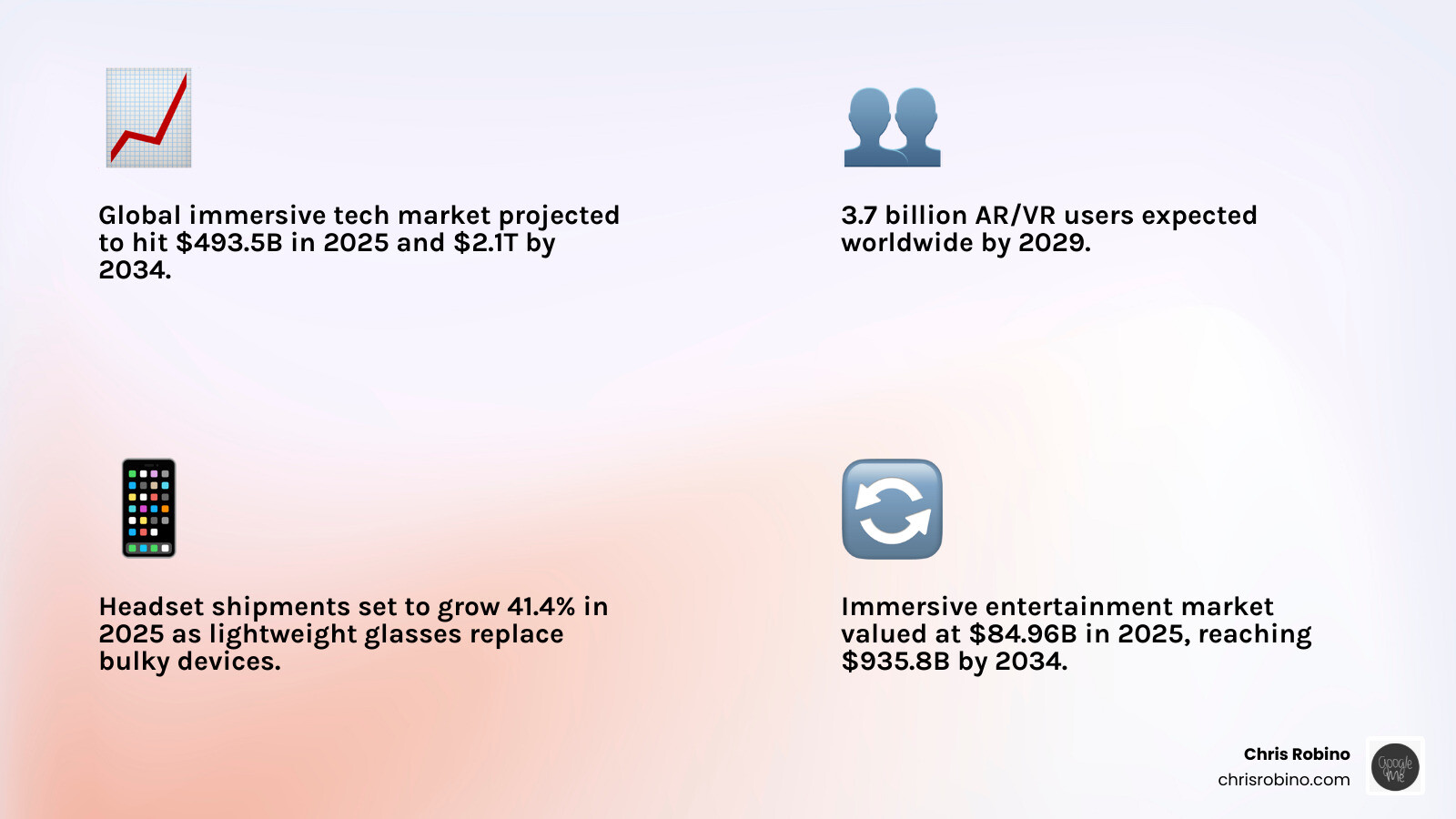
| Market growth | Global immersive tech hits $493.5B in 2025, projected to reach $2.1T by 2034 |
| User adoption | 3.7 billion AR/VR users worldwide by 2029 |
| Hardware shift | Headset shipments growing 41.4% in 2025; lightweight glasses replacing bulky devices |
| AI integration | Real-time personalization and emotionally responsive content |
| Industry spread | Education, healthcare, retail, and enterprise all transforming |
| New success metric | Return on Experience (ROE) replacing traditional ROI |
This isn’t science fiction. It’s infrastructure being built right now. For a highly innovative technology firm, the challenge lies in maintaining visibility across these new platforms. Large-scale organizations often struggle with the inertia of legacy systems, but the immersive entertainment market alone is valued at $84.96 billion in 2025 and is on track to hit $935.8 billion by 2034. At the same time, spatial computing — the technology that makes computing spatial, contextual, and ambient — is projected to reach $620.2 billion by 2032.
The shift is happening across every industry. Surgeons are overlaying patient data during procedures. Retailers are letting customers virtually try on products before buying. First responders are training in VR simulations and completing tasks 29% faster as a result. To capture this traffic, large companies must implement SEO strategies that prioritize visual search and entity-based indexing. When a user “looks” at a product through AR glasses, the metadata must be perfectly structured for the search engine to recognize and serve the correct information.
The question isn’t whether immersive experiences will change your world. It’s whether you’ll be ready when they do.
I’m Chris Robino, a Digital Strategy Leader and AI & Search Expert with over two decades of experience helping organizations navigate technology-driven transformation — and the future of immersive experiences sits squarely at the intersection of the trends I’ve tracked and advised on throughout my career. In this guide, I’ll break down exactly where this space is headed and what it means for your business, specifically focusing on how large enterprises can scale their digital presence in this new era.
Future of immersive experiences vocab explained:
The Future of Immersive Experiences: Market Growth and Technological Convergence
We are witnessing a monumental shift in how digital information interacts with the physical world. The global market for immersive technologies has reached a staggering $493.5 billion in 2025, but that is just the beginning. Experts project this market to explode to over $2.1 trillion by 2034, representing an extraordinary 18x increase over just a decade.
This growth isn’t just about better video games. It’s about the rise of spatial computing as a fundamental piece of our daily infrastructure. As we track Augmented Reality Trends, we see that the industry is moving from “spectacle” to “utility.” For large companies, this utility must be backed by robust SEO strategies. Large-scale SEO requires a focus on technical excellence, particularly in how 3D assets are indexed. If your enterprise is deploying thousands of AR models, each one needs optimized schema markup to ensure it appears in visual search results.
With an expected compound annual growth rate (CAGR) of 23.4% in the entertainment sector alone, the AR/VR Business landscape is becoming a primary driver of economic value. We are moving toward a world where digital overlays are as common as electricity—invisible, essential, and everywhere. For large companies, the strategy must involve “Visual SEO,” where images and 3D objects are optimized with the same rigor as traditional text-based content.
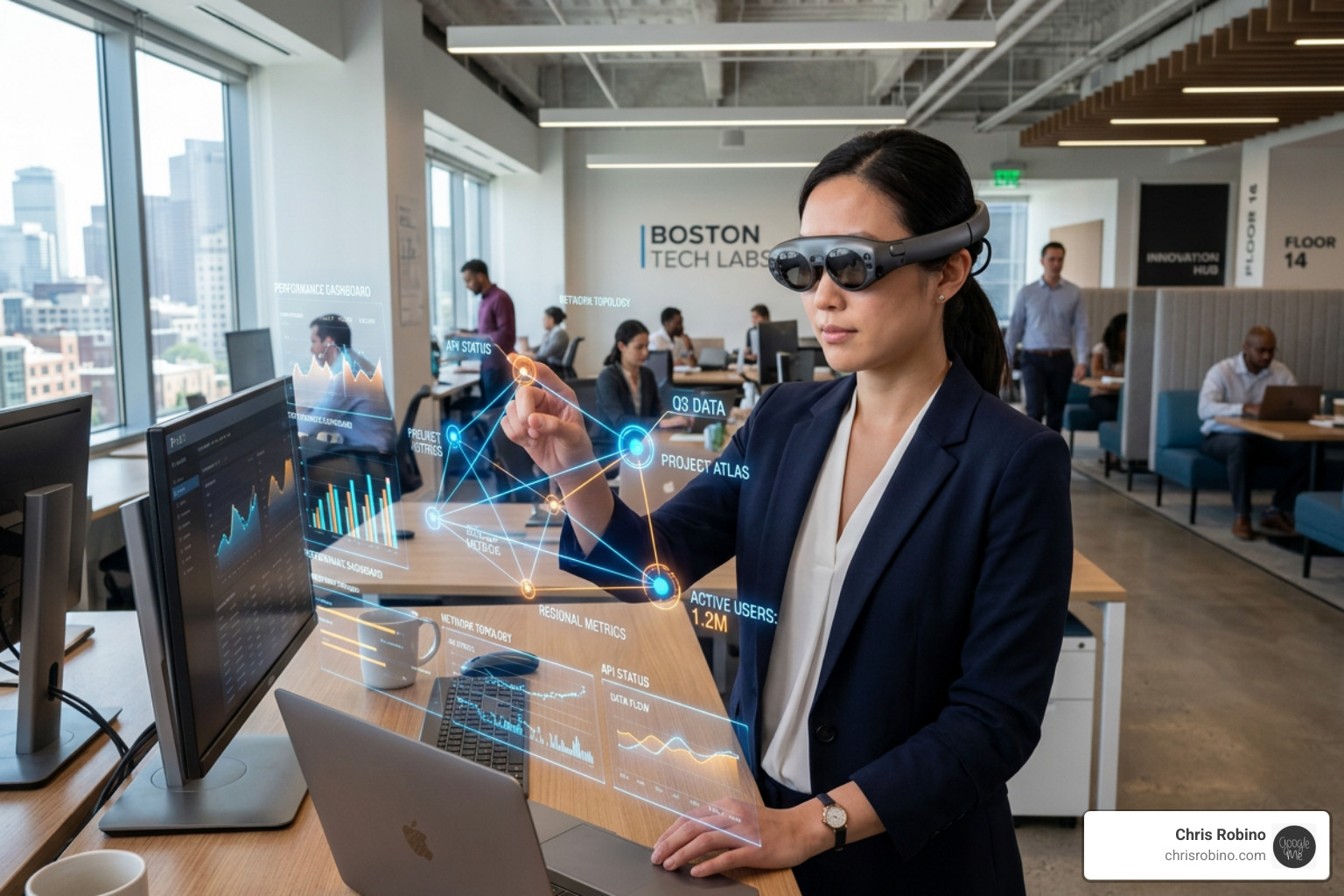
How AI and Spatial Computing Define the Future of Immersive Experiences
The “magic” behind the future of immersive experiences is the convergence of Generative AI and spatial computing. By 2029, we expect 3.7 billion users by 2029—over one-third of the global population—to be interacting with these technologies. For large companies, AI is the engine that allows for scalable SEO. Automated content generation and real-time metadata updates are essential when managing a global digital footprint.
AI acts as the “brain” of the experience, providing real-time personalization that was previously impossible. Imagine a virtual training module that senses your frustration through eye-tracking and automatically simplifies the task, or a retail app that suggests furniture based on the actual layout of your living room. This is the essence of adaptive content. From an SEO perspective, this means optimizing for “intent” rather than just “keywords.” Large companies must understand the user’s context—where they are, what they are looking at, and what they need in that exact moment.
Key technologies driving this include:
- Environmental Mapping: Devices that understand the 3D geometry of your room, allowing digital objects to “sit” on your real-world couch. SEO for this involves “Spatial Indexing,” ensuring your digital assets are recognized as physical entities by search algorithms.
- Spatial Audio: Soundscapes that change as you move, providing emotional cues. Large companies can use audio-based SEO to capture voice-activated searches within immersive environments.
- Emotionally Responsive AI: Systems that analyze behavioral analytics to curate unique journeys. This data provides invaluable insights for large-scale SEO audits, helping firms understand which immersive touchpoints drive the most engagement.
Learning to build for this world is the next great frontier for creators. If you’re wondering where to start, our guide From Zero to AR Hero: Your Guide to Content Creation offers a roadmap for mastering these spatial tools.
Hardware Evolution: From Bulky Headsets to Assisted Reality Glasses
For years, the biggest barrier to the future of immersive experiences was the hardware. Fortunately, the hardware is finally “growing up.” Global AR/VR headset shipments are anticipated to grow 41.4% in 2025 as new mixed reality devices hit the market. For large companies, this means a wider audience and a greater need for cross-platform SEO strategies. Your content must be discoverable whether the user is on a high-end VR headset or lightweight AR glasses.
Several “invisible enablers” are making this possible:
- 5G and Edge Computing: These allow the heavy processing to happen in the cloud, making the glasses themselves lighter. For large companies, this reduces the technical barriers to entry for high-fidelity immersive content.
- Latency Reduction: To avoid motion sickness, the “motion-to-photon” latency must be below 20 milliseconds. This technical requirement mirrors the “Core Web Vitals” in traditional SEO—performance is a ranking factor.
- Optical Breakthroughs: New pancake lenses and micro-OLED displays provide incredible clarity. High-resolution visuals are essential for “Visual Search” optimization, as search engines can better identify clear, high-quality 3D models.
Developing an Augmented Reality Strategy: The New Interface for Innovation requires understanding these hardware shifts. By 2030, we expect hardware to become interchangeable, shifting the focus entirely to the software and the value it provides. Large companies that invest in platform-agnostic SEO today will be the leaders of tomorrow.
Multisensory Integration and the Role of Haptics
To feel truly “present” in a digital world, sight and sound aren’t enough. We need to touch. This is where haptic devices come in. We are moving beyond simple vibration to wearable vests, gloves, and even seats that provide synchronized feedback. For large companies, haptics represent a new data point for user engagement, which can be used to refine SEO strategies based on physical interaction levels.
We are also seeing the rise of advanced VR camera technology that captures 180° stereoscopic video. Unlike 360° video, 180° video provides a much sharper and more realistic sense of depth. This is quickly becoming the new standard for immersive storytelling. For large enterprises, optimizing video content for these formats is a key SEO strategy, as search engines increasingly prioritize immersive video results in their “Experience”-focused algorithms.
Impact Across Industries and Overcoming Adoption Barriers
The future of immersive experiences is moving from “pilots to plumbing.” This means the technology is becoming a dependable, invisible part of how business gets done. It is estimated that an estimated 88% of medium-sized businesses will be using or testing AR by the end of 2025. For large companies, the scale is even greater, requiring sophisticated SEO strategies to manage vast libraries of immersive content across multiple regions and languages.
However, as we scale, we must look beyond traditional ROI. We are seeing a move toward Return on Experience (ROE). This metric measures how an experience impacts consumer connection, dwell time, and long-term loyalty. For large companies, ROE is a critical component of their SEO strategy, as high engagement signals to search engines that the content is authoritative and valuable.
Revolutionizing Education, Healthcare, and Retail
The practical applications of immersion are already delivering massive results, and each requires a tailored SEO approach for large-scale deployment:
- Education and Training: Immersive learning is highly effective. One retail giant saw a 70% improvement in employees’ test scores after switching to VR training. For large companies, the SEO strategy here involves internal “Knowledge Graph” optimization, ensuring that training modules are easily discoverable by employees across the globe.
- Retail: The “try-before-you-buy” model is being perfected. Incorporating AR can boost conversion rates by 90% or more for certain products. Large retailers must use “Product Schema” for AR to ensure their 3D models appear directly in search results, increasing consumer decision-making confidence by 80%.
- Community and Events: In places like Pittsburgh, Pennsylvania Immersive events are being used to help citizens imagine new possibilities. For large companies sponsoring these events, “Local SEO” for immersive experiences is vital to drive physical and virtual attendance.
Navigating Challenges in the Future of Immersive Experiences
Despite the excitement, we have hurdles to clear. While the market has reached an impressive $493.5 billion, several “honest challenges” remain for large companies:
- Data Privacy and Security: Immersive devices collect spatial and physiological data. Large companies must ensure their SEO and data collection strategies are transparent and compliant with global privacy laws to maintain user trust.
- Content Fragmentation: We need better standardization. For large companies, a successful SEO strategy involves using open standards (like USDZ or glTF) to ensure immersive assets work across all platforms and are easily indexed by search engines.
- Motion Sickness and Comfort: Designers must prioritize comfort. In the world of SEO, “User Experience” (UX) is a ranking factor. If an immersive experience causes discomfort, it will lead to high bounce rates, negatively impacting the brand’s search authority.
- High Costs: While costs are dropping, large companies must focus on “Scalable SEO” to ensure their investment in immersive tech reaches the widest possible audience, maximizing the return on every dollar spent.
As we look toward The Future of XR: What Will the Industry Look Like in 2030?, the focus will shift from the “spectacle” of the tech to its reliability as embedded infrastructure. Large companies that master the intersection of immersive tech and enterprise SEO will be the ones that dominate the next decade of digital commerce.
Conclusion: Preparing for a Seamlessly Integrated World
The future of immersive experiences is not about replacing the real world; it’s about enhancing it. We are entering an era where technology is human-centric, designed to amplify our connections. For large companies, the path forward is clear: start building fluency in spatial SEO and immersive content governance now. Whether it’s through upcycling physical spaces for immersive events or investing in Return on Experience (ROE) metrics, the time to prepare is today.
At the technology-innovation-consulting-firm of Chris Robino, we help businesses navigate these complex shifts. We believe the real promise of the XR market isn’t just in the “wow” factor—it’s in the safety, efficiency, and human connection that these tools make possible. The revolution is quiet, but it is inevitable. The ones who pay attention to the SEO strategies that perform well for large companies today are the ones who will lead the immersive world of tomorrow.