

What Technology Marketing Consulting Actually Does (And Why It Matters in 2026)
Technology marketing consulting sits at the intersection of two worlds that often struggle to communicate: complex technical products and the buyers who need them. In the rapidly evolving landscape of 2026, this role has shifted from simple lead generation to the orchestration of complex digital ecosystems that prioritize authority, technical precision, and buyer trust.
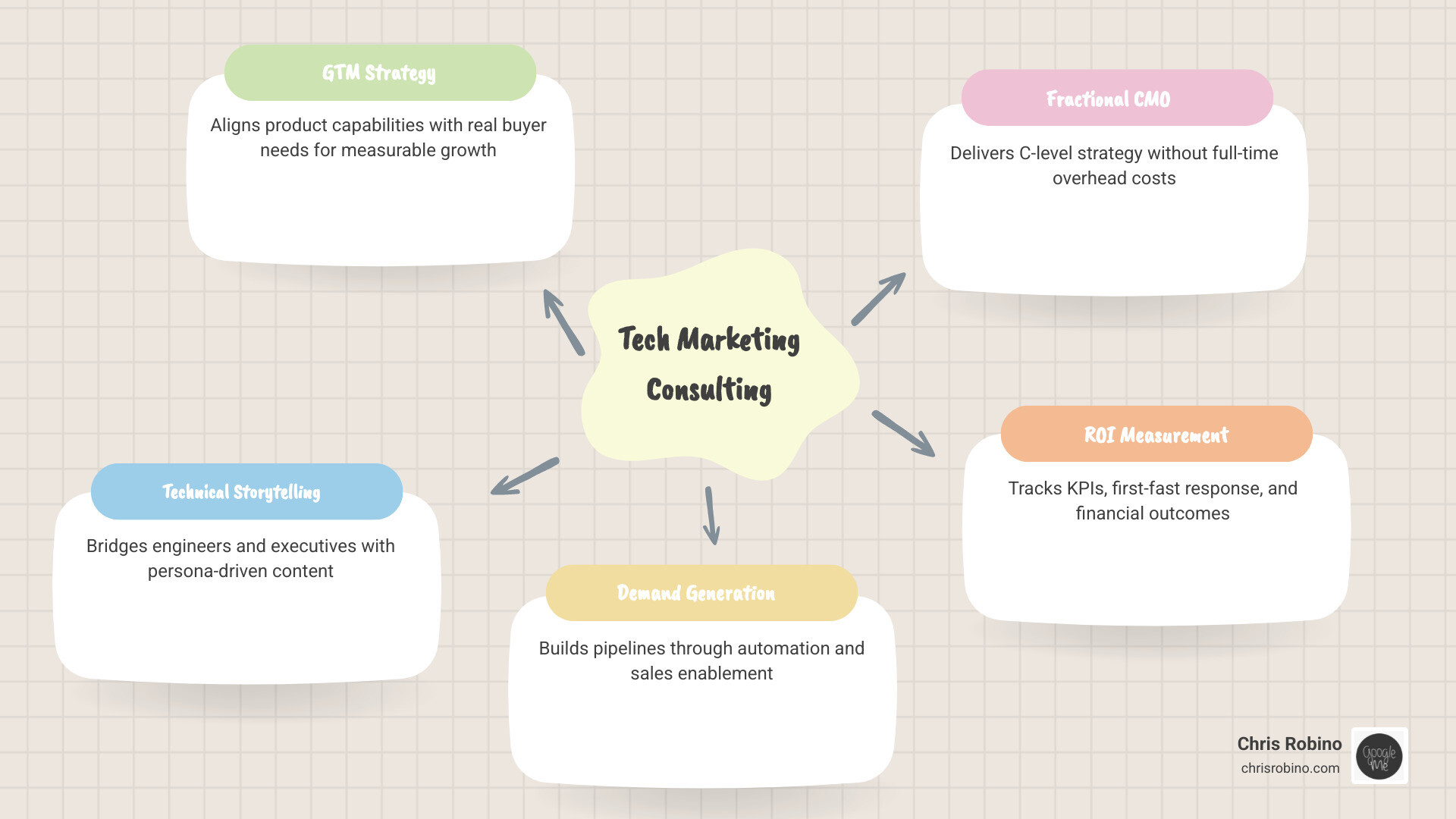
Here’s a quick breakdown of what it covers:
| What It Is | What It Does |
|---|---|
| Specialized marketing strategy for tech companies | Translates technical products into clear, compelling value propositions |
| Go-to-market (GTM) planning | Aligns product capabilities with real buyer needs |
| Technical storytelling | Bridges the gap between engineers and executive decision-makers |
| Demand generation and sales enablement | Builds pipelines and accelerates revenue growth |
| Fractional CMO leadership | Delivers C-level strategy without full-time overhead |
Most tech companies build great products and then struggle to explain them. The messaging is too technical for the CFO, too vague for the developer, and too generic for anyone in between. That’s the core problem technology marketing consultants are hired to solve. By the time a product reaches the enterprise level, the marketing must be as robust as the code itself.
In 2026, this challenge has intensified. Buyers are more skeptical, AI has raised the bar for content quality, and the number of competing tools in any given category has exploded. Generic marketing no longer cuts through. Precision does. Furthermore, the shift toward AI-driven search experiences means that technology marketing is no longer just about being found; it is about being cited as a primary source of truth. This requires a fundamental shift in how technical organizations approach their digital footprint, moving from keyword-centric tactics to entity-based authority.
I’m Chris Robino, a digital strategy leader and AI and search expert with over two decades of experience helping organizations — from early-stage startups to established enterprises — use technology marketing consulting strategies to drive measurable growth. I’ve seen what separates the firms that scale from the ones that stall, and in this guide I’ll share the most actionable advice available for navigating the complexities of modern technical growth.
For a deeper dive into the fundamentals, check out our Technology Marketing Consultant Complete Guide.
The Strategic Value of Technology Marketing Consulting

The primary role of a technology marketing consultant is to provide a high-level Go-To-Market (GTM) strategy that aligns product capabilities with market demand. Many tech firms suffer from “feature-itis,” where the focus remains entirely on what the product does rather than what it solves. A consultant brings an outside-in perspective, identifying the specific customer acquisition channels that yield the highest lifetime value (LTV).
Bridging the Technical Gap with Technology Marketing Consulting
One of the biggest hurdles in tech marketing is the gap between the engineers who build the product and the executives who approve the purchase. Technology marketing consulting bridges this gap through technical storytelling. This means creating persona-driven content that speaks to technical users while also addressing business outcomes. Consultants help organizations build communities around technical products so documentation, APIs, and trial experiences also function as marketing assets. By focusing on the user experience through Business and Technology Consulting, technical users can become internal champions.
Scaling Through Technology Marketing Consulting
Scaling a technology company requires a dependable lead-to-cash engine. Consultants help implement automation systems that streamline demand generation and sales enablement. In 2026, this includes the use of AI for lead scoring and predictive analytics so sales teams spend more time on accounts most likely to convert. For companies looking to improve these systems, our Digital Marketing Strategy Advice offers a clear roadmap.
SEO Strategies for Large Technology Companies
For large technology companies, SEO performs best when it is treated as an operational system rather than a content side project. Success depends on coordination across marketing, product, engineering, and analytics teams. In 2026, enterprise SEO is defined by five core pillars:
- Build Topic Authority and Semantic Universes: Large companies win by moving beyond keywords into topic clusters. By organizing content into “Topic Universes” tied to core products and use cases, you signal to search engines that your domain is the definitive authority on a subject. This involves mapping out every possible question a buyer might have and answering it with depth that exceeds the competition.
- Prioritize Technical Accuracy and E-E-A-T: Enterprise buyers expect precise, useful content. High-performing strategies involve a “Technical Review Board” process where subject matter experts (SMEs) vet every piece of content. This ensures that documentation, implementation guides, and white papers meet the high standards of Experience, Expertise, Authoritativeness, and Trustworthiness (E-E-A-T) required to rank in technical niches.
- Strengthen Technical SEO Foundations at Scale: As websites grow to thousands or millions of pages, crawl efficiency becomes paramount. Large-scale tech sites must prioritize Edge SEO and server-side rendering to ensure that search bots can easily index JavaScript-heavy applications. Governance is required to prevent duplicate content, manage complex internal linking structures, and maintain a clean site architecture that passes Core Web Vitals 2.0 metrics.
- Use First-Party Data for Revenue Attribution: Search performance improves when companies connect SEO insights with CRM and product usage data. Instead of measuring success by traffic, large companies should measure by “Product-Qualified Leads” (PQLs) and pipeline influence. This allows teams to focus on high-intent topics that actually drive revenue rather than vanity metrics.
- Global Visibility and Centralized Governance: For organizations operating across multiple regions, SEO works best when templates and taxonomies are standardized. Using a centralized governance model allows for local relevance through localized content hubs while maintaining a unified global brand authority. This includes rigorous management of hreflang tags and regional site speed optimization.
- SEO Governance and AI Integration: In 2026, large companies must integrate AI into their SEO workflows to manage content at scale. This doesn’t mean generating low-quality text, but rather using AI for automated meta-data generation, internal link suggestions, and monitoring for content decay. This ensures the digital footprint remains fresh and authoritative without massive manual overhead.
For more on high-level planning and execution, see our Tech Industry Consultant Guide 2026.
The Fractional CMO Advantage
For many mid-market and scaling tech firms, hiring a full-time C-level marketing executive is cost-prohibitive. This is where the Fractional CMO model provides a distinct advantage. A technology marketing consultant acting as a Fractional CMO delivers high-level strategy and specialized expertise without the overhead of a full-time executive salary. Learn more about this model in our Technology Marketing Consultant Complete Guide.
Trends Shaping the 2026 Tech Landscape
To stay ahead, consultants are currently focusing on several trends shaping the market:
- Agentic AI Transformation: Moving beyond simple chatbots to AI systems that can perform tasks and support decision-making. Marketing must adapt as search experiences and buyer research continue to evolve.
- Sustainability Marketing: As ESG criteria become more important in enterprise procurement, tech companies need to clearly communicate operational efficiency.
- Quantum-Ready Security Positioning: Security-focused firms are already positioning their offerings as ready for next-generation cryptographic and compliance demands to strengthen long-term market relevance.
- Trust Frameworks: Trust now depends on transparency, capability, and reliability. Marketing a credible trust architecture is often as important as describing the product itself.
Measuring Success and ROI

The hallmark of professional technology marketing consulting is a focus on measurable business outcomes. Success is not measured in likes, but in pipeline, revenue influence, and conversion efficiency.
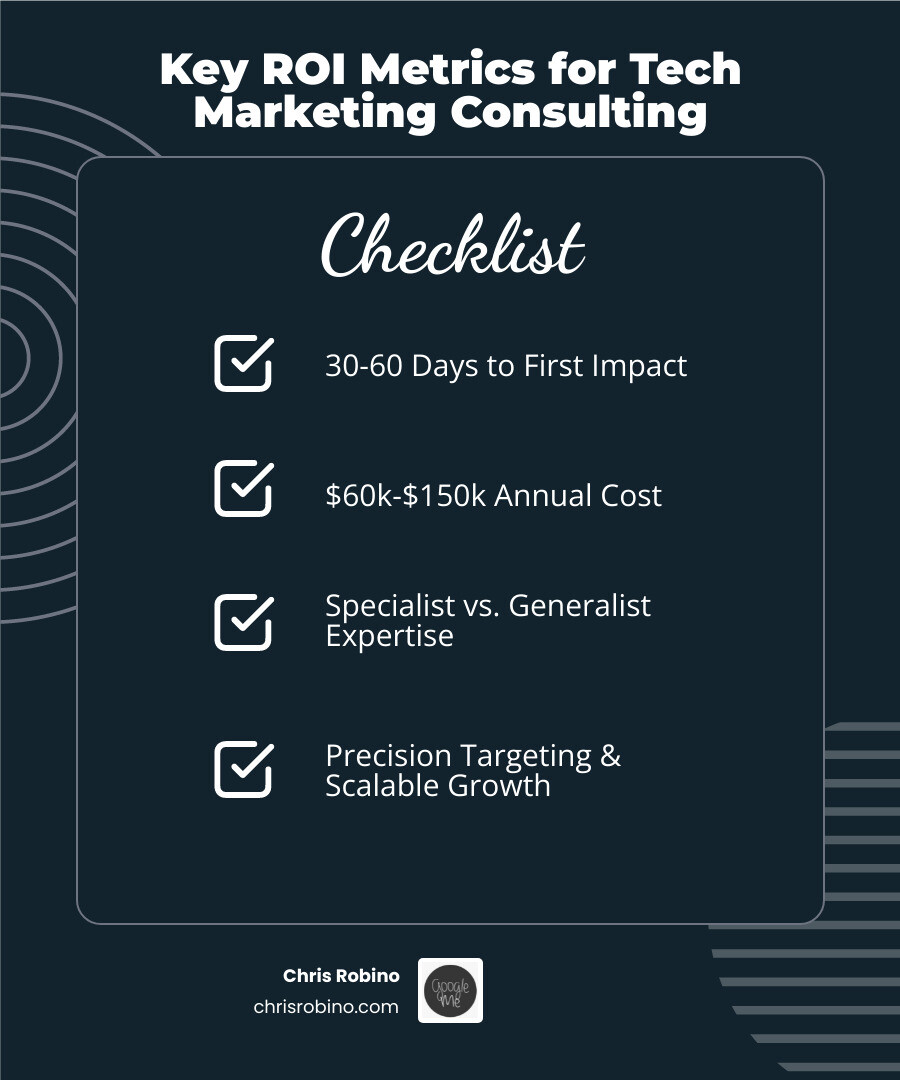
| Metric | In-House Team (Average) | Fractional Consultant (Average) |
|---|---|---|
| Annual Cost | $250k – $400k+ | $60k – $150k |
| Time to Impact | 3-6 Months | 30-60 Days |
| Specialized Tech Knowledge | Generalist | Specialist |
| Scalability | Fixed | High |
By using real-time analytics, consultants provide visibility into the funnel and allow faster optimization. This is especially useful for companies focused on improving technical product marketing and strategic pipeline generation.
Conclusion: Choosing the Right Partner for 2026
Selecting a technology marketing consultant is a high-stakes decision. The right partner must possess “industry fluency”—the ability to understand the nuances of your specific niche, whether it’s SaaS, Cybersecurity, or Cloud Infrastructure.
Chris Robino offers a unique blend of technical depth and strategic marketing prowess, helping companies navigate the complexities of the modern digital landscape. By centralizing these insights into a single portal, we provide streamlined communication and direct access to the expertise needed to turn strategy into action. As we move through 2026, the companies that succeed will be those that treat marketing not as a cost center, but as a sophisticated engine for growth and technical authority.
For those looking to scale their technical influence and market share, the path forward involves a commitment to technical storytelling, enterprise-grade SEO, and the strategic agility that only an experienced consultant can provide. Explore our Technology Marketing Consultant Complete Guide to start your journey toward market domination.