

Why Digital Transformation Media Matters Now
Digital transformation media is the shift from legacy, single-channel media operations to digital-first systems that help organizations create, manage, distribute, measure, and improve content across connected platforms.
It changes more than the technology stack. It changes how media companies work, how audiences find content, and how revenue is earned.
| Traditional media model | Digital-first media model |
|---|---|
| Fixed schedules and limited channels | On-demand, multi-platform publishing |
| Separate editorial, sales, and technology teams | Connected workflows and shared audience data |
| Broad, one-way distribution | Personalized, interactive audience experiences |
| Slow reporting cycles | Real-time performance insight and testing |
For publishers, broadcasters, entertainment brands, and enterprise media teams, the pressure is clear: audiences now expect relevant content on the devices and platforms they already use. The COVID-19 pandemic accelerated this move, turning digital operations from a future project into a core requirement for continuity and growth.
The opportunity is substantial, but technology alone is not a strategy. Cloud platforms, AI, automation, and analytics can speed production and personalize experiences. They can also create new risks around misinformation, privacy, bias, copyright, and trust. Strong transformation connects technology to clear audience needs, useful workflows, capable teams, and responsible governance.
I am Chris Robino, a digital strategy leader and AI and search expert with more than two decades of experience helping organizations improve digital visibility, workflows, and measurable growth. In this guide to digital transformation media, I will break down the industry shifts, practical frameworks, and emerging technologies shaping what comes next.
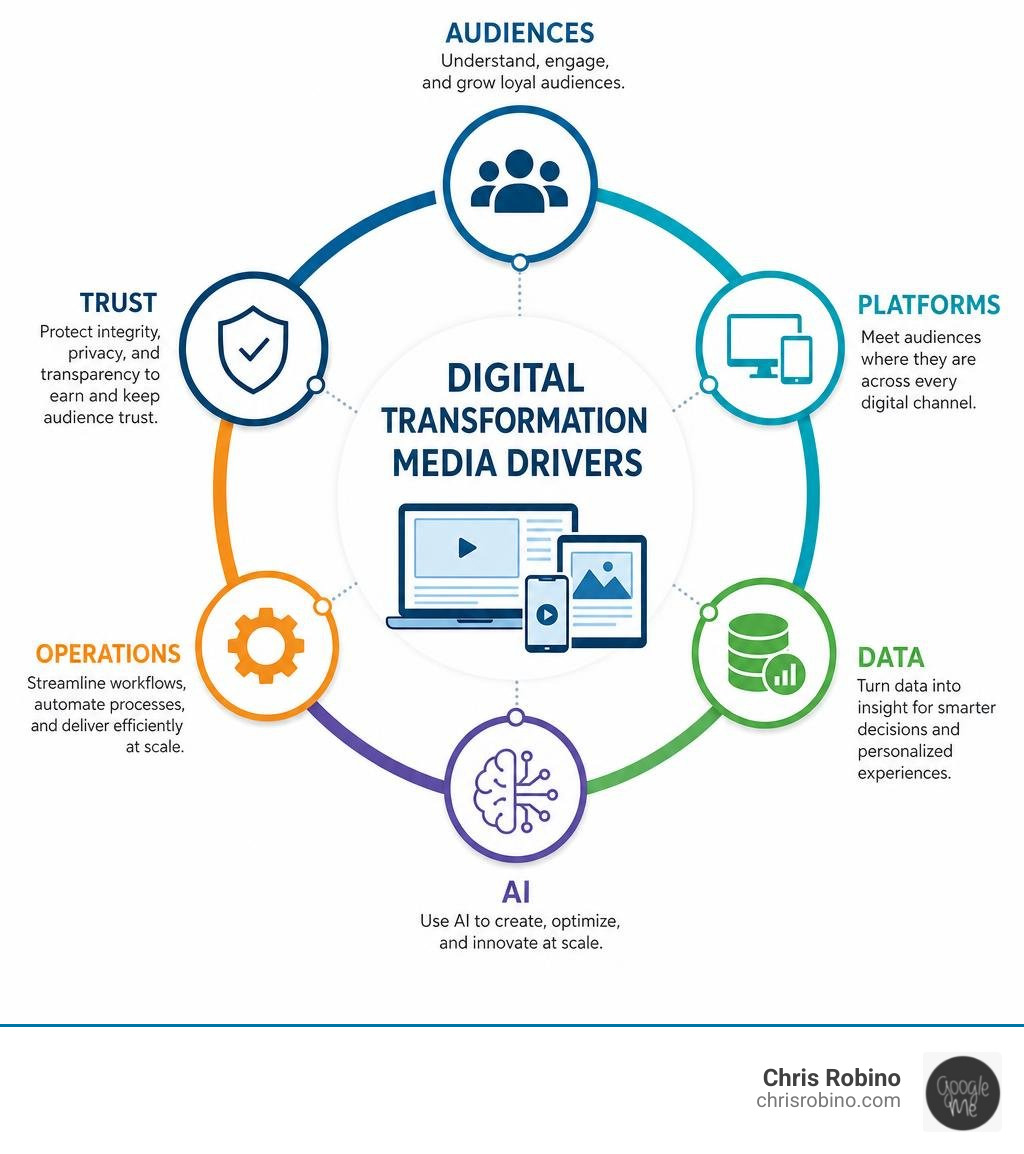
Evolution of Content Creation, Distribution, and Consumption
The media ecosystem has experienced a profound structural shift over the past decade. Traditional publishing and broadcast models relied on centralized single-channel production with clear gatekeepers. Today, we operate in a decentralized, democratized ecosystem where content moves fluidly across channels.

The rise of streaming platforms, user-generated content, and omni-channel publishing architectures has dismantled historical distribution barriers. Independent creators now publish directly to global audiences using standard mobile technology, forcing enterprise media houses to rethink their distribution strategies.
To capture attention in an era of audience fragmentation, digital media networks deploy algorithmic feeds that deliver highly personalized content recommendations based on individual interaction history. Moving beyond passive consumption, modern media platforms foster active audience participation through real-time commenting, live chats, interactive polls, and user co-creation.
Developing an effective multi-platform strategy requires balancing direct-to-consumer monetization models—such as digital subscriptions, pay-per-use access, and integrated e-commerce—with customized distribution across social and search ecosystems. Media executives looking for actionable implementation roadmaps can explore our Guide to digital transformation in media. Furthermore, academic Research on human-AI interaction in media demonstrates that user-centered interface design plays a vital moderating role in facilitating organizational adaptation and elevating user engagement during digital transitions.
The Role of AI, Automation, and Data Analytics in Digital Transformation Media
Integrating artificial intelligence, automated processing, and real-time data analytics across the end-to-end media value chain fundamentally alters how content is generated and distributed.

Automated journalism tools now routinely generate standardized structured updates, such as financial earnings summaries or local sports coverage, freeing editorial teams to focus on investigative, nuanced narrative work. Simultaneously, automated metadata enrichment and AI-driven tagging ingest vast physical and digital archives, turning static static video libraries into searchable asset databases.
Predictive analytics and audience telemetry give editorial desks real-time feedback regarding story velocity, topic interest, and audience retention, driving smarter content investment decisions. Generative AI technology serves as a key amplifier across these operations; as highlighted in peer-reviewed Research on generative AI technology in the media industry, GAI technology significantly moderates and accelerates the direct positive impact of corporate digital innovation on overall digital transformation.
To implement these advanced tools without creating operational friction, media brands can leverage our Media tech integration blueprint to seamlessly connect legacy production suites with cloud engines, powering intelligent content recommendation engines that deliver tailored media experiences.
Core Frameworks, AI, and ROI Measurement
Building a Successful Framework for Digital Transformation Media
Executing digital transformation media initiatives requires shifting from rigid, legacy linear broadcast workflows toward modular, agile frameworks built on cloud-native software architecture.
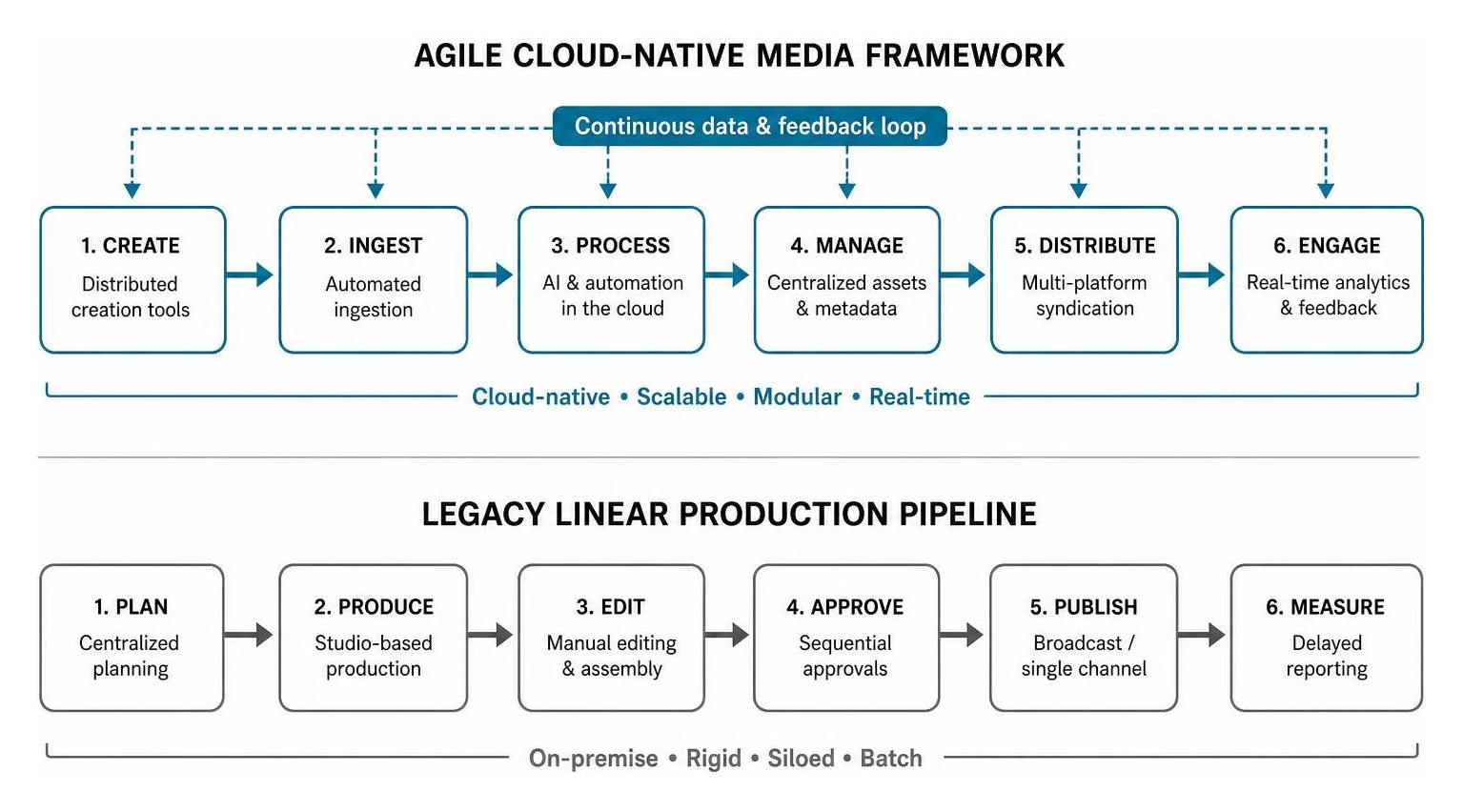
| Operational Domain | Legacy Linear Workflow | Cloud-Native Digital Framework |
|---|---|---|
| Infrastructure | On-premise servers and hardware switchers | Elastic cloud platforms and microservices |
| Data Architecture | Siloed department databases | Centralized data lakes with real-time telemetry |
| Content Delivery | Fixed broadcast schedules | Dynamic multi-platform automated syndication |
| Team Structure | Isolated editorial, tech, and sales units | Cross-functional agile product and content squads |
Achieving enterprise alignment requires a clear execution strategy that bridges creative editorial desks and engineering divisions. Establishing cross-functional innovation squads ensures that technical system architecture directly serves content creation goals.
To structure this organizational evolution, media firms can draw from academic insights in the Study on media digital transformation models, which presents hierarchical frameworks designed to address structural bottlenecks. For practical technical architecture strategies, our Media technology solutions guide outlines step-by-step methodologies to maintain long-term stability and platform scalability.
Measuring ROI and Overcoming Organizational Resistance
Industry market studies from IDC project global digital transformation spending to approach $4 trillion, yet over 70% of enterprise digital transformation initiatives fail to realize their target business value. In the media sector, failure rarely stems from software limitations; instead, it is driven by user friction and cultural inertia post-rollout.
To track return on investment accurately, we advocate moving away from isolated project scorecards to evaluate a holistic business portfolio:
- Time-to-Value Acceleration: Speed of launching new digital channels and content formats.
- Workflow Proficiency & Speed: Reductions in asset discovery time and automated tagging velocity.
- Audience Retention & Yield: Growth in recurring subscriber lifetime value (LTV) and engagement rates.
- Operational Cost Savings: Lower infrastructure overhead achieved by shifting off-premises server hardware to the cloud.
Deploying a Digital Adoption Platform (DAP) directly inside live production environments addresses user adoption barriers. Industry benchmarks demonstrate that organizations investing in a DAP achieve a 64% faster time-to-value for enterprise software rollouts, a 37% lift in user proficiency within three months, and a 67% lift in overall value realization.
Overcoming cultural friction demands empathetic leadership that acknowledges operational ambiguity and frames software adoption around continuous learning rather than rigid directives. Media executives seeking change management methodologies can consult our Insights on corporate digital transformation as well as our practical playbook on How to accelerate digital transformation.
Cultural Leadership, Governance, and Future Trends
Ethical Governance, Data Privacy, and Misinformation Risks
As automated tools and generative models proliferate, establishing robust governance frameworks is essential to preserve editorial trust and regulatory compliance.
Media organizations face complex challenges, including algorithmic bias in content recommendation engines, deepfake manipulation, and intellectual property disputes regarding training data copyrights. To protect brand equity, publishers must construct rigorous verification workflows:
- Provenance Tracking & Watermarking: Embedding cryptographic metadata into published assets to verify original content authenticity.
- Human-in-the-Loop Fact Checking: Mandatory editorial review phases for all AI-generated or AI-assisted reporting.
- Privacy Regulation Compliance: Aligning audience analytics platforms with global regulations such as GDPR and CCPA to safeguard reader personal data.
- Algorithmic Transparency Audits: Regularly testing content distribution algorithms for systemic bias or echo-chamber effects.
Maintaining rigorous standards safeguards public trust while protecting the bottom line. For an in-depth breakdown of institutional governance and public trust mechanisms, explore our perspective on Understanding digital transformation in media.
Future Trends: Cloud Newsrooms, the Metaverse, and AI-Native Media
Looking forward, the future of digital transformation media is being defined by cloud-native news production, spatial computing environments, and AI-native organizational structures.
Major media brands are already decentralizing broadcast operations. A prominent real-world implementation is detailed in this Case study on cloud-based AI news production, which examines how a national broadcasting network successfully migrated live news production into a centralized cloud platform integrated with AI speech-to-text and automated face recognition metadata capabilities.
Simultaneously, media organizations are preparing for immersive narrative delivery. Projections show the global metaverse market growing from $146.6 billion in 2024 to $1.1 trillion by 2030, with the entertainment segment expanding rapidly. As interactive spatial environments evolve, traditional news storytelling is transitioning into spatial live experiences.
Finally, media companies are evolving from simply layering AI onto legacy software toward establishing fully AI-native business models. Strategic implementations show how breaking down cross-functional silos across enterprise divisions helps build a prioritized pipeline of over 90 AI-enabled growth opportunities.
To future-proof your organization, align your technology strategy with our comprehensive review of Digital media trends and growth strategies. Ready to build an agile, cloud-first media organization? Explore our core portal for Digital Transformation for Media to discover tailored solutions designed to drive long-term digital growth.