

Digital Media Growth Is Reshaping How the World Consumes Content
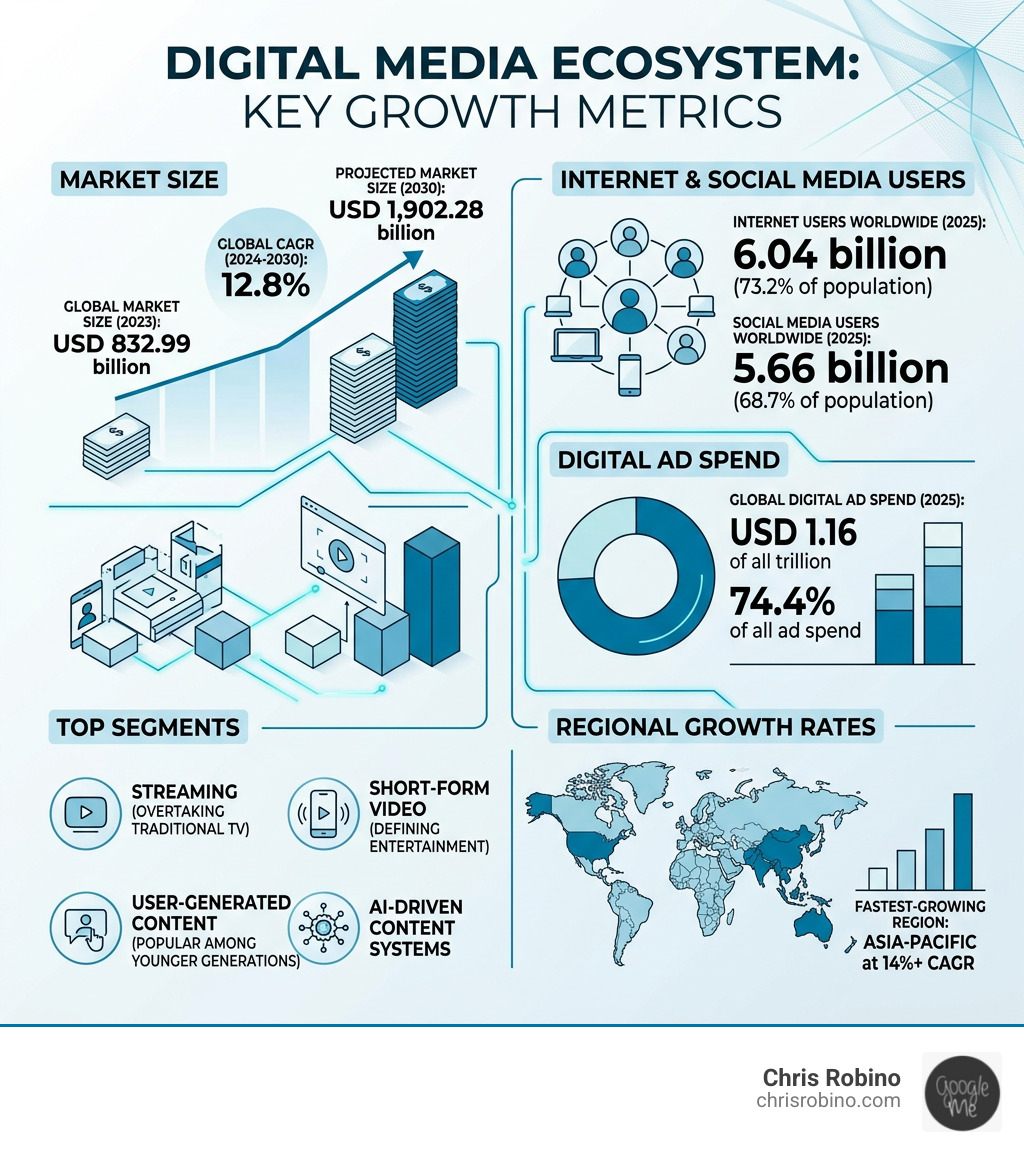
Digital media growth is one of the most significant economic and cultural forces of our time. Here’s a quick snapshot of where things stand:
| Metric | Figure |
|---|---|
| Global market size (2023) | USD 832.99 billion |
| Projected market size (2030) | USD 1,902.28 billion |
| Global CAGR (2024-2030) | 12.8% |
| Internet users worldwide (2025) | 6.04 billion (73.2% of population) |
| Social media users worldwide (2025) | 5.66 billion (68.7% of population) |
| Global digital ad spend (2025) | USD 1.16 trillion (74.4% of all ad spend) |
| Fastest-growing region | Asia-Pacific at 14%+ CAGR |
The numbers tell a clear story. Digital media is not slowing down.
More than 6 billion people now access the internet. Streaming has overtaken traditional pay TV. Short-form video platforms have redefined entertainment. And AI is changing how content gets made, distributed, and monetized — faster than most organizations are prepared for.
Consumers are spending an average of six hours a day on media and entertainment. Younger generations are spending over half that time on social platforms and user-generated content — and far less on traditional TV. The center of gravity for media has shifted, and it keeps moving.
For tech-savvy professionals and enterprise teams, keeping up with these shifts is not optional. The organizations that understand where digital media is heading are the ones capturing audience attention and advertising dollars.
I’m Chris Robino, a digital strategy leader with over two decades of experience helping businesses navigate digital media growth — from search and AI-driven content systems to enterprise-scale audience development. The trends covered in this guide are ones I work with directly every day.
Essential digital media growth terms:
Global Digital Media Growth: Market Size and Projections
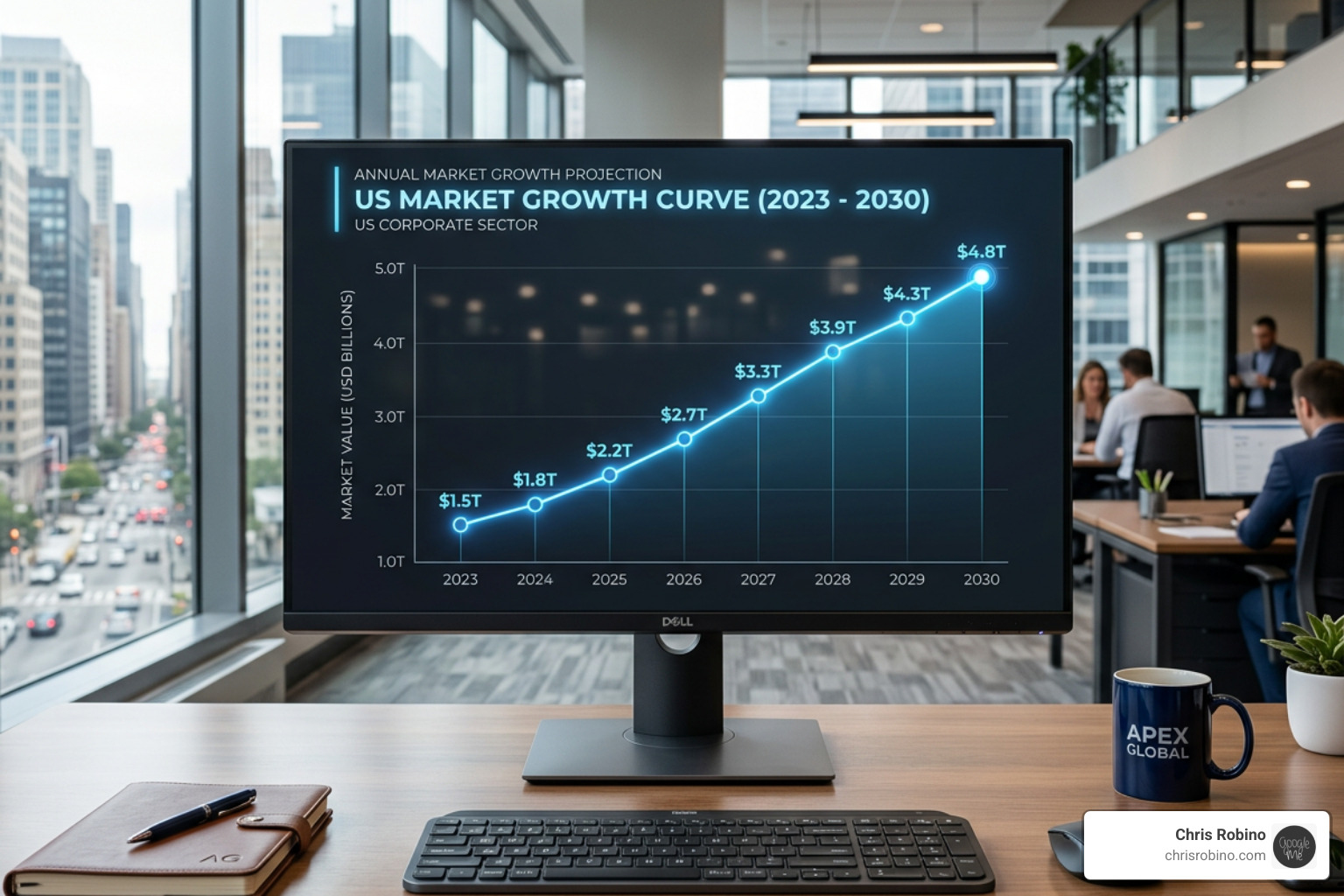
The global digital media growth trajectory is nothing short of staggering. We are currently witnessing a market that was valued at USD 832.99 billion in 2023 and is on a fast track to hit nearly USD 2 trillion by 2030. This expansion is fueled by a Compound Annual Growth Rate (CAGR) of 12.8%.
When we break this down by region, we see a fascinating tug-of-war between established giants and emerging powerhouses. North America currently holds the lion’s share, accounting for over 37% of global revenue in 2023. This dominance is driven by high internet penetration (over 90% in the U.S.) and a mature technological infrastructure that supports everything from high-end gaming to seamless 4K streaming.
However, if you want to see where the “explosive” growth is happening, look to the East. The Asia-Pacific region is projected to grow at a CAGR of over 14% through 2030. Within that region, India is the standout, with a projected growth rate exceeding 16%. This is largely due to massive revisions in internet adoption data; for example, India recently surpassed the 1 billion internet user milestone, while China’s adoption rate has climbed to 91.6%.
Comparative Regional Revenue Growth (2022–2027 Projections)
| Region | 2022 Revenue (USD) | 2027 Projected Revenue (USD) | CAGR |
|---|---|---|---|
| United States | $104.3 Billion | $195.8 Billion | 8.0% |
| China | $67.3 Billion | $145.4 Billion | 8.2% |
| Europe | $96.5 Billion | $128.3 Billion | 7.4% |
As we explore in our Global Media Industry Analysis, the shift from analog to digital is complete, but the shift from “basic digital” to “immersive digital” is just beginning.
The Role of AI in Accelerating Digital Media Growth
If 2023 was the year of AI experimentation, 2025 is the year of AI integration. We’ve seen generative AI move from a novelty to a core operational engine. In 2024 alone, investment in generative AI businesses reached over USD 56 billion.
For media companies, AI is no longer just about “efficiency”—it’s about creative disruption. We are seeing AI tools used to personalize content at a scale previously thought impossible. AI personalization can lower customer acquisition costs by up to 50% while simultaneously raising revenues by 5–15%.
Platforms are leading the charge here. YouTube AI creator tools are helping creators brainstorm, edit, and dub content into multiple languages instantly, while Meta AI integration is making social feeds more interactive and ad-targeting more precise. At Chris Robino, we view this as a cornerstone of Digital Transformation for Media, where the goal is to use AI to augment human creativity rather than replace it.
Short-Form Video and Creator Economy Dynamics
The “TikTok-ification” of media is essentially complete. Short-form video is now the primary way younger generations discover everything from news to new products. Gen Z spends roughly 54% more time on social platforms and user-generated content (UGC) than they do on traditional TV and movies.
This shift has created a massive surge in social media video ad growth. Brands are moving away from polished, high-budget commercials toward authentic, creator-led content. This isn’t just a trend; it’s a structural change in how celebrity and influence work. The “parasocial relationships” fans have with creators are often more influential than traditional star power.
We detailed these shifts in our Media Industry Trends 2024 report, noting that the “center of gravity” for entertainment has moved to the smartphone. In fact, the smartphone platform held the largest market share in 2023, driven by the sheer accessibility of platforms like Instagram Reels and TikTok.
Navigating Advertising Shifts and Shoppable Media
Advertising is undergoing a trillion-dollar makeover. Global ad spend is projected to reach USD 1.16 trillion in 2025, with a staggering 74.4% of that flowing through digital channels.
One of the most exciting developments is the rise of retail media and shoppable content. Why just watch a video when you can buy the shoes the creator is wearing with two taps? Social media advertising spend is expected to hit USD 277 billion in 2025, growing at 13.6% year-over-year.
However, it’s not all easy sailing. Traditional broadcasters are struggling, leading to a surge in adtech innovations designed to “save TV.” This includes outcome-based measurement tools that track exactly what a consumer does after seeing an ad. For those looking to stay ahead, understanding Digital Content Monetization is key to balancing user experience with revenue.
Consumer Behavior and Subscription Fatigue
We’ve hit a wall with “too many apps.” In the U.S., nearly 60% of consumers canceled at least one streaming service in 2024, often citing price hikes or content fragmentation. This “subscription fatigue” is driving the industry back toward super aggregation and bundles.
Providers are responding by offering ad-supported tiers, which are often priced around $9–$10 per month. Interestingly, more than half of SVOD (Subscription Video on Demand) subscribers now have at least one ad-supported service. It turns out consumers are willing to watch a few minutes of ads if it means saving $100 a year.
For a deeper look at how to retain these flighty audiences, check out our Media Industry Trends Ultimate Guide.
Emerging Technologies and Interactive Content
While video is the current king (holding over 37% market share), interactive and immersive content is the fastest-growing segment. AR and VR are projected to grow at a CAGR of 17.35%.
This isn’t just for gaming. We are seeing immersive tools used in medical training, retail “virtual try-ons,” and interactive educational platforms. As hardware prices fall and 5G speeds become the global standard, the barrier to entry for high-quality interactive media is vanishing. Our New Tech Media Strategies Guide explores how enterprises can leverage these “faster futures” without falling victim to the hype cycle.
Scaling Digital Media Growth Through Enterprise SEO
At the heart of all this digital media growth is a simple question: How do you get found?
For large companies, the answer lies in sophisticated, large-scale SEO and semantic search strategies. As search engines evolve to prioritize AI-generated summaries, the old way of “keyword stuffing” is dead. Today, you must build content authority and trust through a multi-layered approach:
- Semantic Search and Entity Mapping: Moving beyond keywords to understand the relationships between topics. Large enterprises must map their content to “entities” that search engines recognize, ensuring they own the conversation around their core business pillars.
- Technical SEO at Scale: Managing millions of URLs requires automated auditing and a robust internal linking architecture. For enterprise sites, crawl budget optimization is critical—ensuring search engines prioritize your most valuable, revenue-generating pages.
- E-E-A-T and Content Integrity: With the rise of AI-generated content, search engines are doubling down on Experience, Expertise, Authoritativeness, and Trustworthiness. Large brands must leverage their internal experts to create “human-first” content that AI cannot easily replicate.
- Programmatic SEO for Long-Tail Capture: Using data-driven templates to create high-quality, localized, or category-specific pages. This allows large companies to capture specific user intent across a vast array of search queries without manual content creation for every single page.
- AI-Search Optimization: As search engines transition to generative models, the goal is to become the “source of truth.” This requires structured data and clear, authoritative answers that AI systems can easily cite.
We specialize in helping brands navigate this transition. By focusing on semantic SEO—understanding the intent behind a user’s query rather than just the words—we help brands capture a larger share of the 6 billion people now online. This involves a mix of high-quality content production, technical SEO, and proactive PR to ensure your brand is the one AI systems cite as an authority.
To learn more about our specific approach to building long-term traffic, visit our Audience Development Media Ultimate Guide.
Strategic Trends Shaping the Media Landscape
As we look toward the end of 2025, several strategic “macro” trends are defining the winners and losers in the digital media space:
- Market Consolidation: Expect more mergers. Traditional media moguls are setting the stage for “deal mania” as they attempt to compete with the massive content budgets of tech giants like Amazon and Apple (who are spending upwards of $126 billion on content annually).
- Regulatory Challenges: GDPR, DMCA, and new AI-specific regulations are making content distribution more complex. Data privacy is a top concern for 42% of industry leaders.
- The “Quality” Pivot: With AI making it easy to flood the internet with mediocre content, there is a renewed premium on high-quality, human-led journalism and entertainment.
- FAST Growth: Free Ad-supported Streaming TV (FAST) channels are exploding. In the U.S. alone, there are now over 1,900 FAST channels, offering a “lean-back” experience that mimics traditional cable but for the digital age.
For a comprehensive roadmap of the year ahead, our Media Industry Guide 2025 provides the data-backed insights you need to thrive.
Digital media growth isn’t just a set of statistics; it’s a fundamental rewrite of the human experience. Whether you’re a creator, an advertiser, or an enterprise leader, the goal remains the same: connect with your audience where they are—which, increasingly, is everywhere at once.
If you’re ready to scale your digital presence and master these trends, we’re here to help you turn these insights into a strategic advantage. Let’s get to work.