

The Conversational AI Trends Redefining How Businesses Operate
Conversational AI trends are moving fast — and in 2025, they matter more than ever for any business competing on customer experience.
Here’s a quick snapshot of the most important trends shaping the space right now:
- Agentic AI — autonomous systems that plan, decide, and execute multi-step tasks with minimal human input
- Emotional intelligence — AI that detects frustration, hesitation, or satisfaction and adjusts responses in real time
- Multimodal interactions — combining voice, text, images, and video in a single conversation
- Hyper-personalization — AI that adapts tone, recommendations, and content based on individual history
- Proactive engagement — AI that initiates conversations based on triggers like cart abandonment or inactivity
- RAG (Retrieval-Augmented Generation) — grounding AI responses in real company data to reduce hallucinations
- No-code development — enabling non-technical teams to build and deploy AI agents faster
The numbers back the urgency. The conversational AI market is valued at $14.29 billion in 2025, growing at a 23.7% CAGR toward $41.39 billion by 2030. Nearly 78% of companies have already integrated conversational AI into at least one core operational area.
This isn’t a future technology. It’s already running in contact centers, clinics, banks, and retail platforms — right now.
Ten years ago, a chatbot was a clunky pop-up with five scripted replies. Today, those same interfaces troubleshoot problems, process orders, detect emotions, and hand off to humans — seamlessly. The shift from reactive scripts to autonomous, context-aware agents is the defining story of this era.
I’m Chris Robino, a digital strategy leader with over two decades of experience helping companies leverage AI, SEO, and intelligent search to drive measurable growth. I’ve guided organizations through the full arc of conversational AI trends — from early chatbot deployments to today’s agentic, multimodal systems. In the sections below, I’ll break down exactly what’s happening, why it matters, and what smart businesses are doing about it.
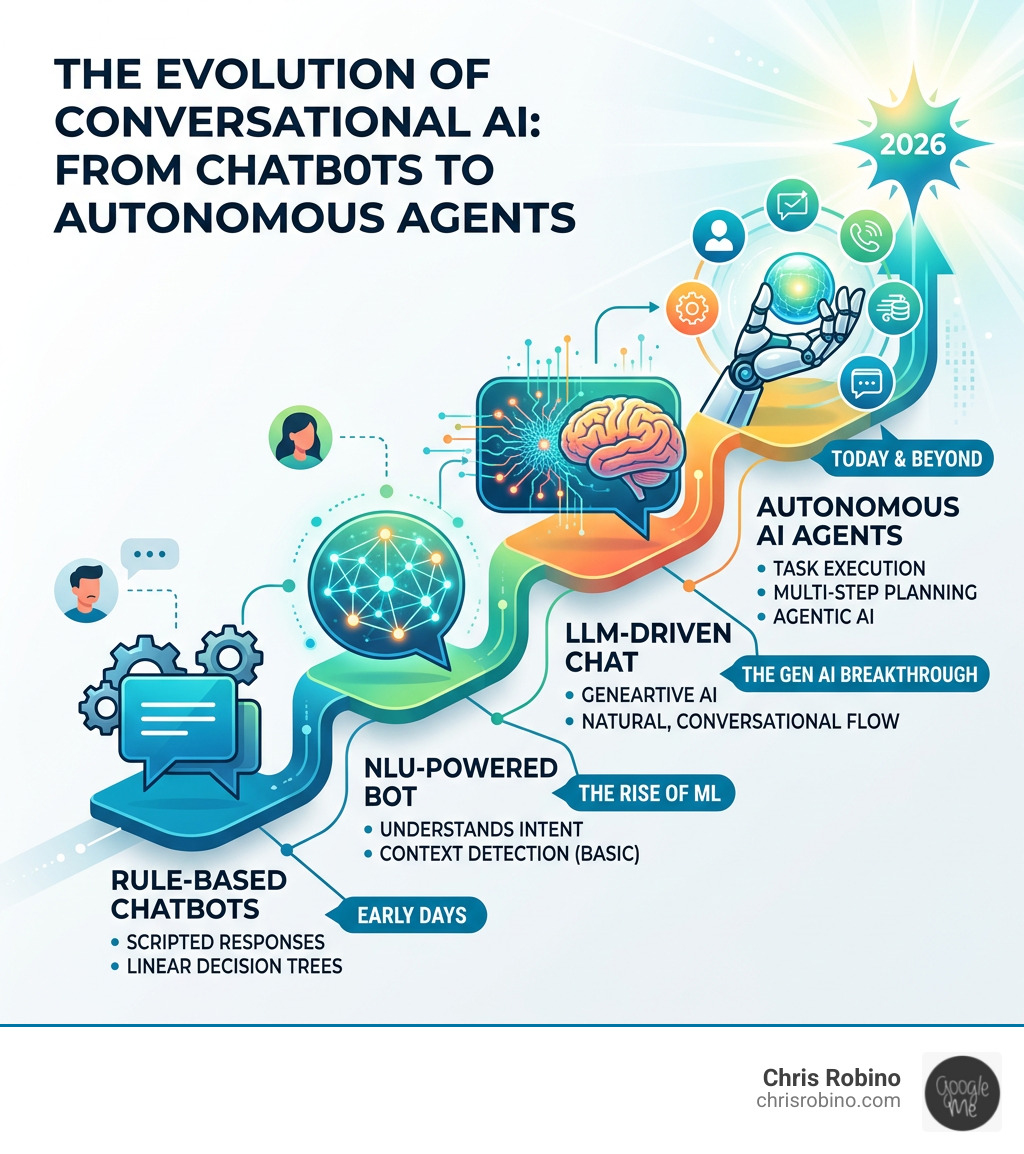
Quick Conversational AI trends terms:
Top Conversational AI Market Trends Reshaping the Enterprise
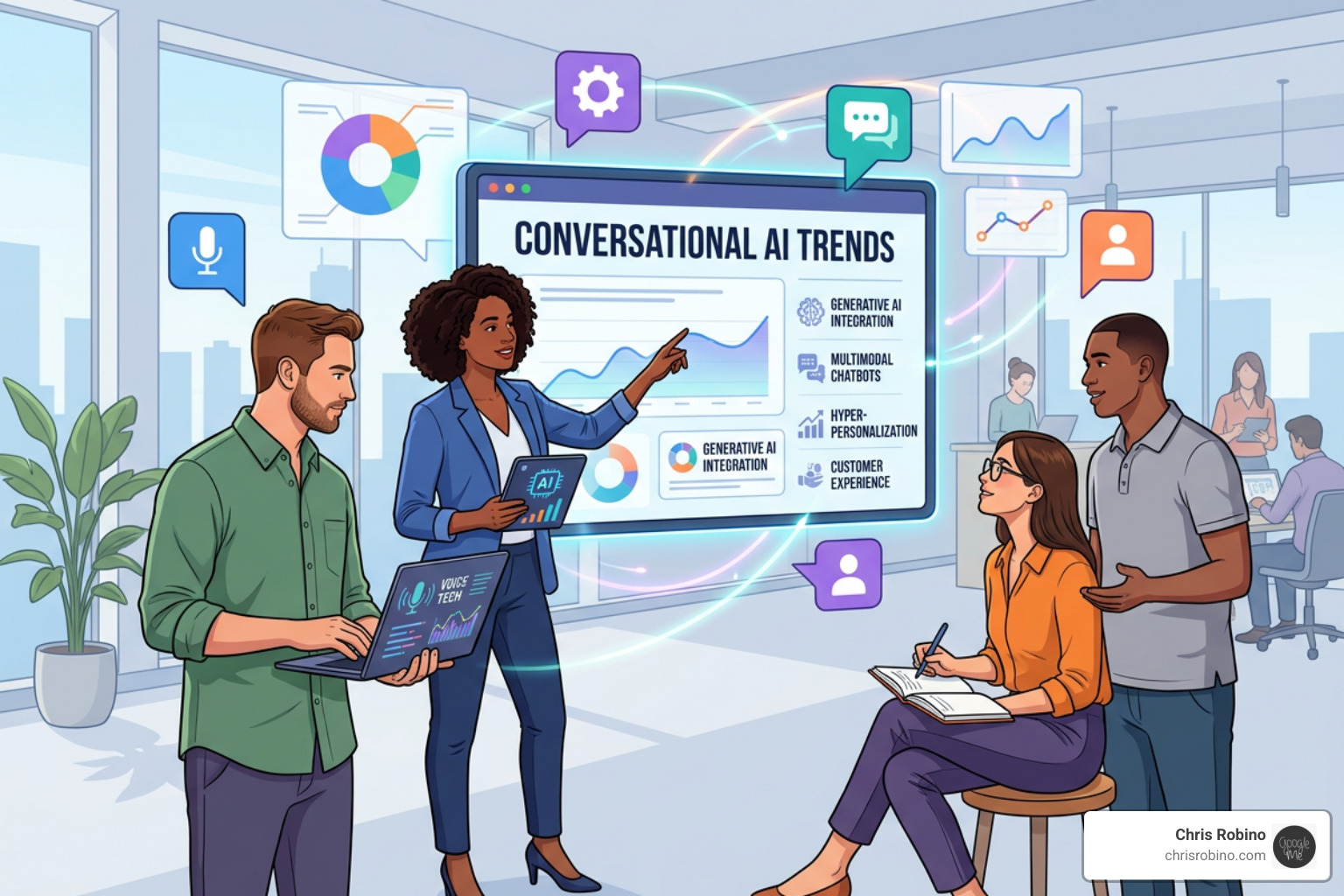
As we look toward 2026, the primary shift in Conversational AI trends is the move from “talking” to “doing.” For years, we were satisfied if a chatbot could point us to an FAQ link. Now, the conversational AI market is projected to reach $14.29 billion in 2025, and that growth is fueled by systems that actually execute workflows.
We are seeing a massive surge in enterprise AI spending, which has reached approximately $391 billion globally. This investment isn’t just about adding a chat bubble to a website; it’s about AI-driven innovation that fundamentally changes how departments like HR, IT, and sales operate.
Modern systems are becoming “agentic,” meaning they have the autonomy to use tools, access databases, and complete multi-step processes without a human holding their hand at every click. This transition is essential because consumer expectations have skyrocketed. We no longer want to wait for a human agent; we want an intelligent system that already knows our history and can solve our problem in seconds.
The Rise of Agentic AI and Autonomous Systems in Conversational AI Trends
The most significant evolution we’re tracking is the rise of Agentic AI. Unlike traditional chatbots that follow a rigid “if-then” script, autonomous agents can plan and execute complex tasks. Imagine an AI that doesn’t just tell you your flight is delayed, but automatically looks up alternative flights, checks your calendar, and asks if you’d like to rebook—all while updating your hotel reservation.
This is why industry analysts predict 40% of enterprise apps will integrate task-specific AI agents by 2026, a massive jump from less than 5% today. These systems are becoming the “digital coworkers” of the modern office. In the enterprise sector, AI-driven automation is already generating hundreds of millions in contract value for leading tech providers, with projections suggesting some of these specialized software products will reach $1 billion in value by the end of 2026.
Emotional Intelligence and Multimodal Interfaces
We’ve all had the experience of yelling “representative” at a phone tree. The next generation of Conversational AI trends aims to fix that through emotional intelligence (EI). By using advanced sentiment analysis, AI can now detect frustration, sarcasm, or hesitation in a user’s voice or text.
The market for emotional AI is expected to grow from $19.5 billion to over $37.1 billion by 2026. When an AI senses a customer is upset, it can automatically soften its tone or prioritize a handoff to a human specialist. This “empathy at scale” is critical for maintaining brand loyalty in automated environments.
Furthermore, interactions are no longer limited to text. Multimodal interfaces allow us to switch between voice, images, and video seamlessly. A customer can take a photo of a broken part, upload it to a chat, and have the AI identify the component and order a replacement via voice command. This strategy is a core part of a modern AI-driven content strategy, where the goal is to meet the user wherever they are, on any device.
Proactive Engagement, AEO, and Enterprise SEO Strategies
We are moving away from reactive support toward proactive engagement. Instead of waiting for a customer to complain, AI systems analyze real-time data to anticipate needs. Research shows that 65% of consumers favor receiving proactive offers that cater to their specific needs.
This shift is also changing the face of SEO for large companies. We are seeing the rise of Answer Engine Optimization (AEO). For large-scale enterprises, SEO strategies that perform well now focus on:
- Scalable Technical SEO: Using AI to automate the deployment of structured data (Schema) across millions of pages, ensuring conversational agents can accurately index and cite your content.
- Entity-Based Architecture: Moving beyond keywords to build ‘topic clusters’ that establish brand authority in the eyes of Large Language Models.
- Information Gain: Prioritizing the publication of unique, proprietary data that AI models cannot find elsewhere, making your site the ‘source of truth.’
Using AI-powered analytics helps us understand how these “answer engines” perceive our data, ensuring our clients remain visible even in a zero-click search environment.
Industry-Specific Conversational AI Trends in Healthcare and Finance
While general-purpose AI is impressive, the real ROI is happening in specialized sectors.
- Healthcare: Voice AI is projected to reach $33.74 billion by 2030 in the voice assistant market alone. In healthcare, these agents handle clinical triage, appointment scheduling, and patient follow-ups, potentially saving the U.S. healthcare economy $150 billion annually by 2026.
- Finance (BFSI): The banking and finance sector captures roughly 23% of the chatbot market. Nearly half of U.S. banks plan to integrate generative AI into their customer-facing bots to handle everything from fraud alerts to complex loan applications.
For these high-stakes industries, generic solutions won’t cut it. We specialize in AI strategy consulting to help organizations build “grounded” systems that comply with strict regulatory standards while delivering human-level precision.
Overcoming Adoption Challenges and Future Outlook
Despite the excitement, the road to full AI integration has hurdles. According to recent industry reports, inaccuracy remains the top risk organizations are working to mitigate. We’ve all heard of “hallucinations”—where an AI confidently states a fact that is entirely made up. In a business context, this isn’t just a quirk; it’s a liability.
To solve this, we use Retrieval-Augmented Generation (RAG). Instead of the AI relying on its general training, RAG forces the model to look at a company’s specific, verified documents before answering. This ensures that when a customer asks about a refund policy, the AI provides the actual policy, not a guess. This focus on ethical AI development is what separates the leaders from the laggards in 2026.
Navigating Governance, Ethics, and Integration
Adopting Conversational AI trends requires more than just good software; it requires a robust governance framework. IAPP reports that over 50% of organizations now involve privacy, legal, and security teams in their AI oversight. This is a shift from treating AI as a “tech project” to treating it as a core business function.
Key challenges include:
- Data Privacy: 40% of organizations have already experienced an AI-related privacy breach.
- Bias Mitigation: Roughly 63% of consumers worry about bias in AI decision-making.
- Legacy Integration: 22% of IT leaders report that their most valuable data is trapped in old systems that can’t easily talk to modern AI.
We help businesses navigate these complexities through AI regulatory compliance strategies, ensuring that innovation doesn’t come at the cost of security or trust.
Strategic Implementation and the Road to 2030
As we look toward 2030, the barrier to entry is falling. No-code and low-code platforms are democratizing AI, allowing marketing and support teams to build their own agents without needing a degree in data science. The market for these platforms is growing at a 27.7% CAGR, as 84% of enterprises now use them to speed up deployment.
For large companies, the future of search success lies in Automated Content Governance. With sites containing tens of thousands of pages, manual SEO is no longer viable. High-performing organizations are integrating AI to handle real-time technical health checks and automated internal linking. This programmatic approach to SEO allows enterprises to maintain a dominant presence while adapting to the rapid evolution of conversational search.
However, technology is only 20% of the battle. As experts often advise, 70% of a successful AI deployment is about people and processes—upskilling your team and redesigning workflows to work with AI, not against it.
| Feature | Traditional Chatbots | Autonomous AI Agents |
|---|---|---|
| Logic | Rule-based (If/Then) | Generative & Reasoning |
| Capability | Answers questions | Executes tasks/workflows |
| Context | Session-based | Long-term memory & RAG |
| Interaction | Text/Buttons | Multimodal (Voice/Image) |
| Initiative | Reactive | Proactive |
To stay ahead, businesses should follow a clear AI adoption strategy. Start with high-volume, low-complexity tasks where the ROI is easily measurable—like password resets or order tracking—and then scale to more complex, agentic workflows.
The future belongs to those who view conversational AI not as a replacement for human connection, but as a powerful extension of it. Whether you are looking for an emerging tech consultant or a full-scale implementation partner, the time to act is now. By 2026, these “trends” will simply be the standard way the world does business.