

Why AI-Driven Content Marketing Is Changing Business Success
An AI driven content strategy uses artificial intelligence to automate, optimize, and scale content creation, research, and distribution while maintaining human oversight for quality and brand voice.
Core Components:
- Market Research: AI analyzes consumer behavior and identifies content gaps.
- Content Creation: AI assists with ideation, writing, and optimization.
- Personalization: Dynamic content delivery based on audience data.
- Performance Tracking: Real-time analytics and ROI measurement.
- SEO Integration: Automated keyword research and topical authority building.
Marketing executives believe AI will revolutionize their industry, with 80% expecting major changes within three years. Content creation is the number one use case for AI in marketing because it delivers measurable results while reducing costs.
However, many professionals face scattered information, overwhelming tool options, and constant pressure to stay competitive.
The shift isn’t just about efficiency; it’s about survival. Companies using AI-driven approaches see 13x higher ROI with strategic content creation. Content marketing itself costs 62% less than traditional marketing while generating three times as many leads.
Yet implementation remains challenging. Teams struggle with integration, training, and maintaining the human touch that separates great content from generic output.
I’m Chris Robino, a Digital Strategy Leader with over two decades of experience helping organizations steer complex technological changes. I develop comprehensive AI driven content strategy frameworks for enterprises, focusing on integrating AI systems that lift performance while maintaining strategic human oversight.
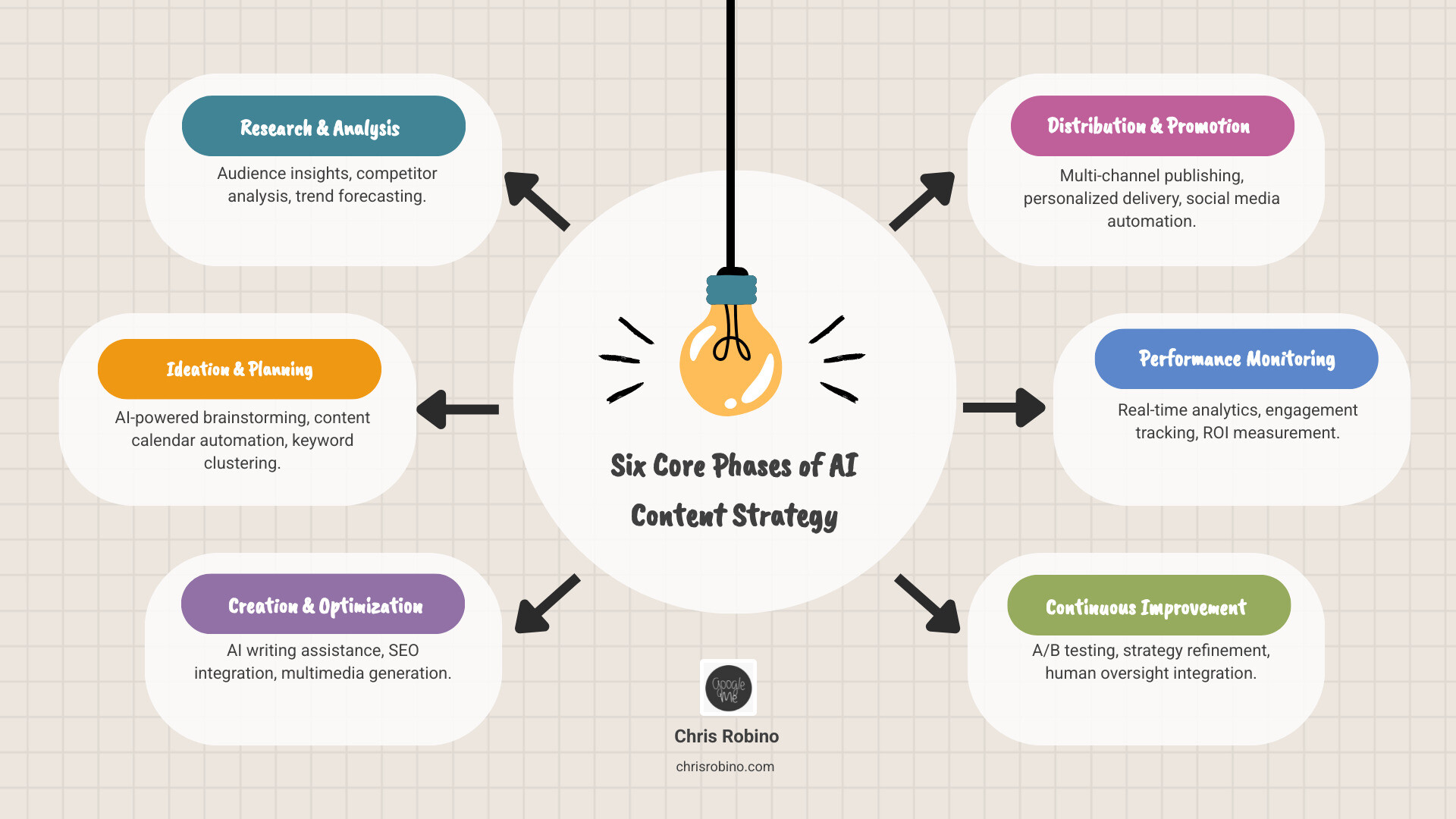
Understanding the Core Components of an AI-Powered Strategy

An AI driven content strategy acts as a research team, creative assistant, and data analyst working around the clock. AI transforms messy information into clear, actionable insights that help you connect with your audience. Instead of guessing what customers want, AI analyzes social media, reviews, and forums to understand what truly matters to them.
Research shows that marketing is where AI delivers the most value because it excels at understanding customer needs, matching solutions to problems, and persuasive communication.
For large companies, this creates incredible opportunities. You can deliver personalized experiences to thousands of customers, spot trends before competitors, and optimize your content marketing ROI with unprecedented precision.
From Data to Decisions: AI in Market and Audience Research
AI has revolutionized market research, allowing you to understand audience concerns, interests, and behaviors in real time.
- Unstructured data analysis is where AI shines. It processes images, videos, social conversations, and reviews to reveal patterns humans would miss, telling you not just what people buy, but why.
- Consumer behavior becomes an open book. AI tracks content interactions to show what makes users pause, click, and convert, offering a window into their decision-making process.
- Identifying content gaps is nearly automatic. AI analyzes competitor content, spots industry gaps, and suggests topics to position you as a thought leader. This insight is invaluable for businesses seeking Digital Strategy Advice.
- Trend forecasting moves from guessing to data-driven prediction. AI spots emerging topics early, giving you a head start on creating relevant content.
- Building customer avatars becomes highly sophisticated, creating rich profiles with interests, pain points, and the specific language your audience uses.
Personalization at Scale: The Enterprise Advantage
Hyper-personalization is a competitive necessity, and AI makes it possible to treat each customer as an individual, even at a massive scale.
- Dynamic content delivery adapts in real time. Your website can adjust its messaging for a first-time visitor versus a returning customer, or email campaigns can shift based on engagement.
- Customer journey mapping becomes precise. AI predicts a customer’s stage in the buying process and serves the right content to move them forward, eliminating generic approaches.
- Real-time adjustments keep your strategy fresh. If AI notices certain topics resonating, it can automatically prioritize similar content across channels.
- Lead scoring becomes more accurate. AI considers hundreds of behavioral signals, not just basic criteria, to identify your most promising prospects.
For enterprises, this translates into AI-Driven Business Solutions that deliver measurable results. You’re not just creating more content; you’re creating smarter content that works harder for your business. These capabilities are available now, and smart companies are using them to pull ahead.
Building Your AI Driven Content Strategy: A Step-by-Step Framework
An effective AI driven content strategy transforms content marketing by replacing gut feelings with strategies backed by real-time data and intelligent automation. The difference between traditional and AI-augmented workflows is striking. AI helps accomplish in days what once took weeks, processing vast data to enable hyper-personalization at scale.
| Feature | Traditional Content Workflow | AI-Augmented Content Workflow |
|---|---|---|
| Time to Market | Weeks to months (manual research, drafting) | Days to weeks (AI-assisted research, rapid drafting) |
| Data Usage | Limited, often anecdotal or small surveys | Vast, real-time, structured & unstructured data analysis |
| Personalization | Broad segmentation, manual customization | Hyper-personalization, dynamic content delivery |
| Workflow | Siloed, sequential tasks | Integrated, automated, collaborative workflows |
| SEO Integration | Manual keyword research, basic optimization | AI-powered keyword clustering, internal linking, topical authority |
| Scalability | Resource-intensive, difficult to scale | Highly scalable, efficient content production |
| ROI Measurement | Lagging indicators, post-campaign analysis | Predictive analytics, real-time ROI tracking |
| Human Role | Core creator, strategist, executor | Strategist, editor, prompt engineer, quality controller |
This framework helps steer modern content complexities while maintaining quality and authenticity. It’s about working smarter and ensuring every piece of content serves a strategic purpose, guiding all our Content Projects to deliver measurable results.
Step 1: Ideation and Research Amplified by AI
Great content starts with knowing what your audience wants. AI revolutionizes this process by analyzing massive data sets to uncover topics and opportunities in a fraction of the time it would take humans. AI can surface emerging trends, niche topics, and content gaps by analyzing search patterns, social media, and industry publications.
AI-powered keyword research goes beyond search volume. AI tools examine search patterns, identify semantic relationships, and predict keyword popularity. The real magic is keyword clustering, where AI organizes thousands of keywords into logical groups to build content pillars and establish topical authority.
AI also validates content ideas by analyzing search engine results pages (SERPs) to determine what content format performs best for specific keywords. This insight helps create briefs that are more likely to succeed in Search Engine Rankings.
Step 2: Streamlining Content Creation and Automation

AI writing assistants are AI’s most popular marketing application. They generate first drafts of blog posts, marketing copy, and social media content quickly, amplifying human creativity by handling the initial heavy lifting.
A major efficiency gain comes from content repurposing. A single whitepaper can be transformed into dozens of derivative pieces like blog posts, social media updates, and video scripts. AI ensures consistency while adapting the tone for each platform.
Visual content generation is also sophisticated. AI can create custom images and videos that align with brand guidelines. For video, AI can generate scripts, animated explainers, and even avatar-based presentations.
Marketing automation becomes more powerful with AI. Email campaigns can be personalized based on content preferences and past behavior, with send times optimized for engagement. Social media scheduling adapts to audience activity and trending topics.
The key is maintaining human oversight. AI handles repetitive tasks, while humans focus on strategy, editing, and ensuring an authentic brand voice. This collaborative approach exemplifies our Advanced Tech Solutions for Media Projects.
Step 3: Integrating AI for Advanced SEO
Modern SEO requires understanding search intent, building topical authority, and creating comprehensive content.
AI-driven SEO tools analyze search results to understand what Google considers high-quality content. They provide real-time optimization suggestions for content structure, keyword usage, and internal linking, strengthening relevance naturally.
Topical authority mapping becomes manageable with AI. It identifies content gaps in your library and suggests new pieces to strengthen your expertise, recommending internal links to connect related content.
Understanding search intent is crucial for large companies. AI analyzes the types of content that rank well for target keywords, helping you create content that matches what searchers want.
Regarding Google’s stance on AI content, their position is practical. They focus on quality, helpfulness, and E-E-A-T (Experience, Expertise, Authoritativeness, Trustworthiness), regardless of creation method. Google penalizes spammy, low-quality content, not AI use itself. The focus remains on creating valuable, accurate content that helps your audience.
Automating technical SEO tasks frees up time for strategic planning and quality improvement, helping large companies build sustainable organic traffic.
The Human-AI Partnership: Best Practices for Implementation

The most effective AI driven content strategy requires a thoughtful partnership between humans and AI. We must harness AI’s computational power while maintaining the human touch that makes content resonate. Think of it as pairing a brilliant research assistant with your team’s strategic vision and emotional intelligence.
Smart implementation starts small. Perfect one process, like keyword research, and then expand to other areas after seeing measurable results.
Team training is critical. The saying holds true: “a person’s job will not be taken by AI, but by a person who knows how to use AI.” Invest in your people, teaching them to think strategically about AI integration.
Brand alignment is the North Star. Every AI-generated piece needs human review to ensure it reflects your brand’s voice and values. AI can’t understand your company’s soul—that’s where humans come in. This collaborative approach drives real Innovation in Media Companies.
Will AI Replace Content Creators? Evolving Roles and Responsibilities
AI isn’t coming for your job; it’s coming for the boring parts. AI excels at repetitive tasks like data analysis and first drafts but struggles with uniquely human elements like strategic thinking, nuanced context, and emotional connection.
Our roles are evolving into content strategists, AI prompt engineers, and quality controllers. We understand that behind every search query is a real person with a real problem.
Human creativity becomes more valuable in an AI-saturated world. Your unique perspective and ability to tell a compelling story will differentiate your content.
Prompt engineering—crafting precise instructions for AI—is a core skill, but human editing is equally important for adding nuance, brand voice, and fact-checking.
Your personal brand is your competitive advantage. Audiences crave authenticity and trust, wanting to know there’s a real human behind the insights.
Ethical AI: Responsible Implementation in Marketing
With AI power comes responsibility. We are stewards of trust, accuracy, and fairness.
- Data privacy: Handle all customer data with care, following regulations like GDPR and maintaining transparency.
- Algorithmic bias: Regularly audit AI outputs, diversify data sources, and maintain human oversight to combat bias.
- Transparency with audiences: Be upfront about using AI and ensure AI-assisted content meets the same quality standards as human-created work.
- Avoiding misinformation: Fact-checking is more important than ever. Verify claims and maintain editorial standards that prioritize accuracy over speed.
- AI usage policy: Create clear guidelines for your team on AI use, content review, and handling sensitive topics.
Measuring Success: How to Track Performance and ROI
An AI driven content strategy is highly measurable, helping prove its value with precise, real-time data.
- Conversion tracking: AI analyzes the entire customer journey to show which content nurtures leads over time.
- Engagement metrics: AI provides richer stories, showing which sections kept readers engaged and how content influenced their next actions.
- Content performance analytics: AI spots subtle correlations between topics, publishing times, and audience segments that drive the highest ROI.
- Calculating cost savings: Quantify efficiency gains from AI handling time-intensive tasks like research and initial drafting.
- Attributing revenue: AI’s ability to track complex customer journeys makes it easier to attribute sales to specific content.
The predictive power of AI allows you to forecast which content will perform best, keeping you aligned with Media Industry Trends 2024. Real-time ROI calculations enable mid-campaign adjustments, turning content marketing into a precise, data-driven discipline.
Frequently Asked Questions about AI in Content Strategy
Implementing AI in your content strategy can feel overwhelming. The landscape is changing fast, and it’s hard to separate the hype from what works. Here are answers to the most common questions from marketing leaders.
How does an AI driven content strategy improve SEO for large companies?
For large companies, an AI driven content strategy provides scale without chaos. Managing SEO for dozens of product lines is a challenge, with complex keyword research and internal linking.
AI changes this by processing massive amounts of search data to find keyword opportunities and understand complex search intent across business areas. It excels at building comprehensive content clusters around core topics, creating strategically connected content that builds topical authority. AI can also suggest internal links, ensuring thousands of pages work together.
Large companies also benefit from AI’s ability to adapt quickly to changes in Google’s algorithm. When Google introduces new features like AI Overviews, AI tools help you pivot your strategy instantly to target long-tail, conversational queries.
What are the biggest challenges when adopting an AI driven content strategy?
The most common challenges are manageable with proper planning.
- Lack of proper training: Teams need education and skill development to use AI tools effectively. Simply buying the tools isn’t enough.
- Integration headaches: New AI tools must integrate with your existing CMS, CRM, and marketing platforms, which can require technical support.
- Brand voice consistency: AI-generated content can feel robotic. Human editors are essential to add your brand’s authentic voice and personality.
- Team resistance: People may worry about their jobs. Communicate transparently how AI improves their work, handling tedious tasks so they can focus on strategy and creativity.
- Budget and data security: Quality AI tools require investment, and you need robust policies for data privacy and usage.
Can Google detect AI-generated content, and does it matter?
Google’s primary concern is quality and helpfulness, not the method of creation. Their official stance focuses on E-E-A-T principles: Experience, Expertise, Authoritativeness, and Trustworthiness.
While AI detection tools exist, they are often unreliable. More importantly, Google’s algorithms are designed to reward content that helps users, not punish AI use. Google penalizes low-quality, spammy, or unhelpful content, regardless of its origin. If you use AI to churn out generic articles without human oversight, you risk penalties.
The key is human oversight and refinement. Use AI for research, drafting, and optimization, but always have humans fact-check, add unique insights, and ensure the content reflects your brand’s voice. This approach creates high-quality content that connects with your audience and performs well in search.
Conclusion: Optimizing Your Future with AI
The future of marketing is here, powered by artificial intelligence. An AI driven content strategy is no longer just an advantage but an essential tool for survival in the digital landscape.
As we’ve explored, AI transforms every aspect of content marketing, from audience understanding and personalization to SEO and performance measurement. Crucially, AI doesn’t replace human creativity; it amplifies it.
The most successful companies understand this partnership. They use AI for analytical and repetitive tasks, freeing their human talent to focus on strategic thinking, creative storytelling, and building genuine audience connections.
Continuous learning is key. The AI landscape changes rapidly, and leaders who accept experimentation and team training will stay ahead. For large enterprises, the strategic advantage of AI is immense, offering the ability to analyze vast datasets and personalize content at scale.
However, the importance of human-led strategy cannot be overstated. Humans provide the vision, ethics, and emotional intelligence to turn data into meaningful connections. The companies that win will master this balance.
Navigating these changes requires expert guidance. The landscape is complex, but the opportunities are immense for those who approach AI implementation strategically. Chris Robino offers insights and consulting to help you build robust, future-proof strategies that harness AI’s power without losing the human touch that makes your brand unique. Explore how to optimize your life and work and find how the right approach to AI can transform your entire business trajectory.