

Why Understanding How Consultancies Help with Digital Product Innovation Gives Your Business a Real Edge
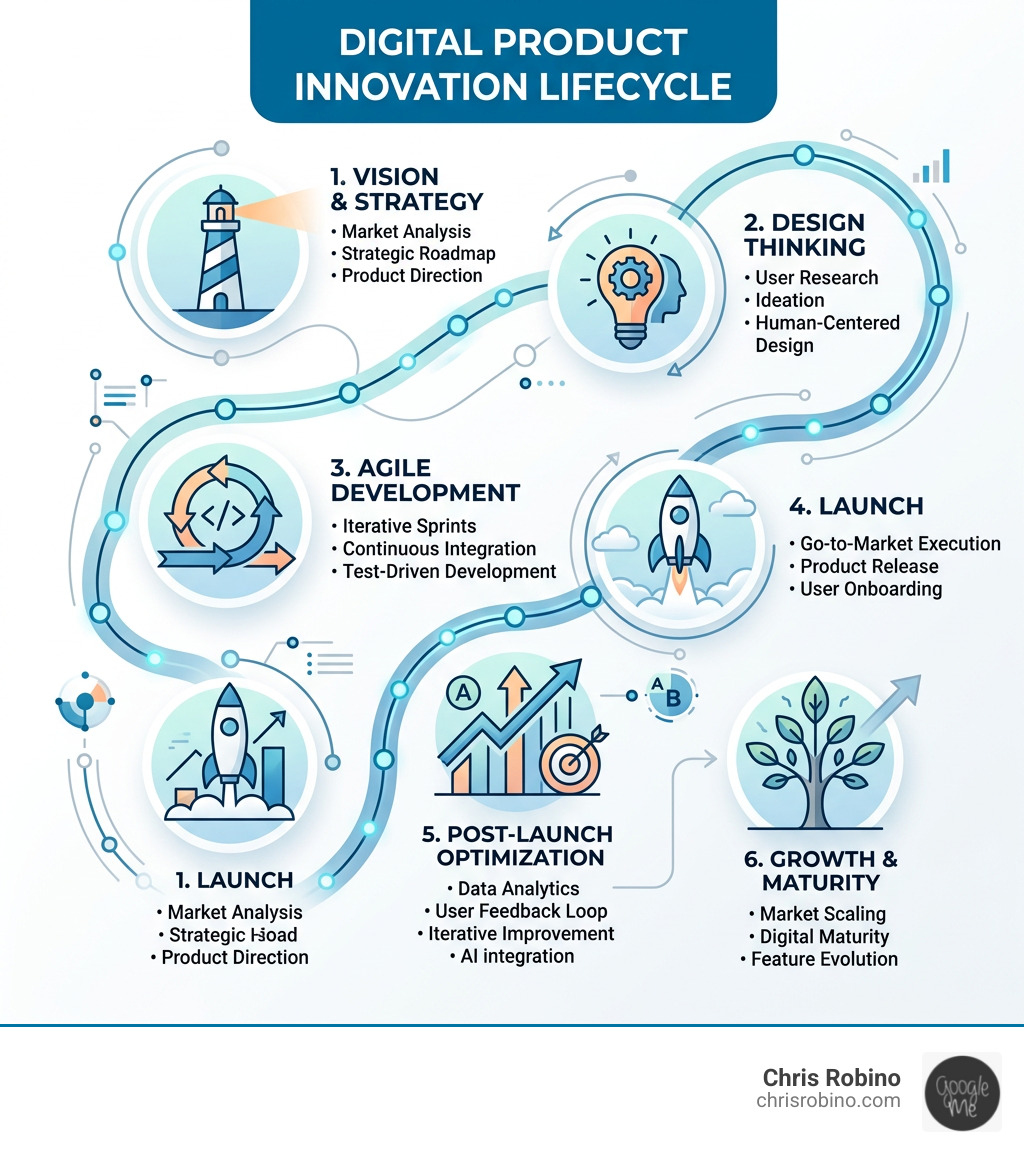
How consultancies help with digital product innovation comes down to a few core capabilities most internal teams simply don’t have on their own:
- Strategy and visioning – Defining a clear, market-led product direction before a single line of code is written
- Design thinking – Using structured, human-centered methods to build products users actually want
- Agile development – Delivering in fast, testable cycles that reduce risk and waste
- Digital maturity assessment – Diagnosing where your organization is today and mapping a realistic path forward
- Post-launch optimization – Using data, AI, and user feedback to keep improving after release
- Cross-functional integration – Aligning marketing, product, and engineering into one coherent growth system
The stakes are high. By 2026, an estimated $3.4 trillion will be spent on digital transformation technologies and services globally. Yet only 30% of digital transformations succeed. The gap between those that win and those that don’t often comes down to one thing: the right expertise, applied at the right time.
Most organizations don’t lack ambition. They lack the specialized skills, proven frameworks, and outside perspective needed to turn a product idea into measurable business growth. That’s exactly where consultancies come in.
And the cost of getting it wrong is steep. Research shows 67% of customers cite a bad digital experience as a reason they stop using a product, and 90% of users have abandoned an app due to poor performance. These aren’t just UX statistics — they’re revenue leaks.
I’m Chris Robino, a digital strategy leader with over two decades of experience guiding organizations — from startups to enterprises — through the complexities of digital transformation and product-led growth, and I’ve seen how consultancies help with digital product innovation turn stalled roadmaps into real competitive advantages. In the sections ahead, I’ll walk you through exactly how that process works, what to look for in a partner, and how to avoid the most common and costly mistakes.
Basic how consultancies help with digital product innovation vocab:
How Consultancies Help with Digital Product Innovation Across the Lifecycle
Digital product innovation isn’t just about having a “cool idea” for an app. It is a rigorous process of developing or refining a solution to effectively serve a market need. We see many companies struggle because they treat innovation as a one-off project rather than a continuous lifecycle.
Consultancies provide the “connective tissue” between a raw idea and a high-performing digital asset. They help businesses navigate the end-to-end journey, from initial concept to full-scale launch and optimization. This is critical because digital products are characterized by rapidity, malleability, and “generativity”—meaning they change quickly and can lead to unprompted innovations that internal teams often miss.
One of the biggest hurdles we address is technical debt. When internal teams rush to meet aggressive deadlines, they often accumulate messy code or architectural flaws. A consultancy acts as a stabilizer, ensuring that while the product moves fast, it remains scalable. This focus on quality leads to massive productivity gains; in fact, investing in custom software to automate tasks can improve productivity by 20-30% on average.

Bridging the Gap: How Consultancies Help with Digital Product Innovation Strategy
The strategy phase is where the “Digital Gold” is discovered. Most businesses begin by identifying a problem, but they often lack the finesse to turn that insight into a market-ready product. We use a process called Visioning to craft a clear, insight-driven future for the product.
This involves three critical lenses:
- Desirability: Do users actually want this? We use deep user research to ground every decision in real human needs.
- Viability: Does this align with business goals? We look at digital innovation consulting frameworks to ensure the product can generate revenue or reduce costs.
- Feasibility: Can we actually build it? We perform technical audits of existing systems to ensure the roadmap is realistic.
By creating a Future State Journey Map, we help stakeholders visualize how the product will fit into the user’s life months or even years down the line. This prevents the “vague roadmap” syndrome that plagues many corporate innovation labs.
Implementing Design Thinking and Agile Methodologies
To move from vision to reality, we rely on the six stages of design thinking:
- Empathize: We get into the shoes of the user through interviews and observation.
- Define: We pinpoint the exact problem we are solving.
- Ideate: We brainstorm creative, “outside the box” solutions.
- Prototype: We build low-fidelity versions to test concepts quickly.
- Test: We put prototypes in front of users to see what breaks.
- Implement: We move the winning ideas into full development.
This human-centered approach ensures we aren’t just building a product that “works,” but one that users love. We pair this with Agile backlog management. Instead of a rigid, year-long plan, we work in short “sprints.” This allows us to pivot if user feedback suggests a better direction, significantly reducing the risk of launching a product that misses the mark.
Scaling Success: How Consultancies Help with Digital Product Innovation Post-Launch
The job isn’t over once the product hits the App Store or the web. In fact, that’s just the beginning. Successful digital innovation requires continuous improvisation. We help companies move from a “project” mentality to a “product” mentality, where the software is never truly “finished.”
Using data analytics and user feedback loops, we identify areas for improvement. For example, research shows that companies with a clear strategy are 31% more likely to succeed in their digital goals. We set up analytics tools from day one to monitor performance, which helps in churn reduction. If data shows users are dropping off at a specific screen, we can fix it in the next sprint rather than waiting for a major version update. This proactive support ensures that “Version Two” is driven by real-world usage rather than guesswork.
Navigating the Path to Digital Maturity and Market Dominance
Not every company is at the same stage of their digital journey. Some are “analog-native” businesses trying to modernize, while others are digital-first companies trying to enter new markets. We use a digital maturity assessment to score where a company stands across its systems, processes, and team skills.
This assessment often reveals a gap in “generative capacity”—the ability of a firm to continue innovating after the initial consultant leaves. We don’t just build the product; we help build the internal skills needed to maintain it. This often involves training staff on new tools or methodologies, tapping into the $165.3 billion workplace training market.
| Feature | In-House Development | Consultancy-Led Innovation |
|---|---|---|
| Perspective | Internal/Biased | Objective/External |
| Speed | Limited by internal cycles | Rapid/Sprint-based |
| Skill Access | Fixed talent pool | Access to specialized experts |
| Risk | High (sunk costs) | Managed (iterative testing) |
| Strategy | Often tactical | Holistic and tech-strategy focused |
Integrating Marketing, Product, and Engineering for Growth
One of the most unique ways how consultancies help with digital product innovation is by breaking down the “silos” between departments. Customers don’t experience your marketing and your product as separate things; they experience them as one connected journey.
We design unified growth systems that integrate:
- Product Strategy: What we are building.
- Modern Marketing: How we attract and retain users.
- Data & AI: How we personalize the experience.
For example, a consultancy might help a life sciences company revamp its e-commerce capabilities, identifying that simple improvements in information architecture could unlock between $18M and $49M in revenue. By bringing marketing into product decisions early, we ensure the product has “growth hooks” built-in from the start. This is the heart of AI-driven innovation, where data planning allows for more effective machine learning models that can predict user needs before they even arise.
Enterprise SEO Strategies for Large-Scale Innovation
For large companies, SEO is not merely a marketing tactic; it is a core component of digital product infrastructure. Consultancies help these organizations implement Technical SEO at Scale, ensuring that enterprise-level platforms with millions of pages remain crawlable and indexable. This involves optimizing server-side rendering for JavaScript-heavy frameworks and managing complex URL taxonomies that often plague large-scale migrations.
Another high-performing strategy is Programmatic SEO. By leveraging internal data sets, large companies can generate thousands of high-quality, search-optimized landing pages that address specific user intents at scale. Furthermore, consultancies bridge the gap between SEO and Product Engineering by integrating search visibility into the “Definition of Done” within agile sprints. This ensures that new features are built with schema markup, optimized metadata, and proper internal linking from day one, preventing the common pitfall of launching a product that remains invisible to search engines.
Avoiding Common Pitfalls in Digital Product Development
Innovation is risky. Only 30% of digital transformations are successful, and the reasons for failure are often predictable. Common pitfalls include:
- Rushed Launches: Pushing a product to market before it’s ready, leading to the 90% app abandonment rate due to poor performance.
- Disconnected Processes: When engineering builds something that marketing can’t sell, or that doesn’t solve the user’s actual problem.
- Resource Constraints: Trying to do too much with a small, overworked internal team.
Consultancies help avoid these by providing a “digital SWOT” analysis. We identify the technical debt and resource gaps early so they don’t derail the project later. We also implement structured, rapid feedback loops to ensure the product stays aligned with market trends.
Selecting the Right Partner for Your Innovation Journey
Choosing a partner is about more than just finding someone who can write code. You need a partner who understands the intersection of technology, business strategy, and human behavior.
When evaluating a consultancy, look for:
- Strategic Alignment: Do they understand your long-term business goals?
- Scalability: Can they help you grow from a pilot program to an enterprise-wide solution?
- Digital Maturity: Do they have a proven framework for assessing and improving your current capabilities?
At ChrisRobino.com, we specialize in helping businesses navigate these exact challenges. Whether you are looking for an Emerging Technology Consulting Guide or need a hands-on partner to drive your next big innovation, we provide the expertise to turn your vision into a scalable reality.
Successful digital product innovation requires a visionary leader within your company and an experienced external partner to guide the way. Don’t leave your digital future to chance. If you’re ready to unlock your “Digital Gold,” let’s start a conversation at our Technology Innovation Consulting Firm.
Key Takeaways for SEO Success in Large Companies:
- Prioritize Technical SEO at Scale: In large organizations, technical debt often hinders search performance. Ensure your consultancy audits site architecture, crawl budget, and page speed as part of the innovation process.
- Implement Programmatic SEO: Use your product’s data to create dynamic, search-optimized pages that capture long-tail intent across thousands of variations.
- Integrate SEO into the Product Lifecycle: Search visibility should be a requirement in the agile development process, not a post-launch checklist item. Ensure engineering and marketing are aligned on SEO goals from the start.