

Why Innovation is the New Currency for Business Survival
Business innovation strategies are no longer optional—they’re essential for survival. These structured approaches help organizations create sustainable competitive advantages by deliberately changing products, processes, or business models. For a primer on how organizations structure and govern innovation programs, see an overview of innovation management.
Quick Overview: Core Business Innovation Strategies
- Product Innovation: Creating new or improved products/services.
- Process Innovation: Streamlining operations to reduce costs and boost efficiency.
- Business Model Innovation: Reimagining how your company creates and captures value.
- Disruptive Innovation: Challenging existing markets with game-changing solutions.
The urgency is real. While 84% of executives believe their future success depends on innovation, the gap between innovators and laggards is widening. Innovative companies are nearly 40% more likely to outperform their peers in revenue growth and market share. In a landscape of demanding customers, companies that can’t keep pace risk becoming obsolete.
Innovation isn’t just about massive breakthroughs. Even incremental improvements can transform your business when executed strategically. Combining different innovation types can lead to a 10% higher value added for firms.
For large enterprises, innovation increasingly includes search-led growth—using enterprise SEO and on-site findability as systematic channels to capture demand, inform product roadmaps, and scale revenue efficiently.
I’m Chris Robino, a Digital Strategy Leader and AI & Search Expert. For over two decades, I’ve helped organizations implement effective business innovation strategies that drive measurable growth, maximize ROI, and build a sustainable competitive advantage.
This guide will walk you through proven frameworks for developing innovation strategies that work—from choosing your path to building a culture that sustains long-term change.
A Blueprint for Effective Business Innovation Strategies
To stay relevant, you need a solid plan. A well-defined business innovation strategy is your roadmap for adapting and growing, systematically turning the right ideas into real value for your customers and your bottom line.
The Four Pillars of Innovation: Choosing Your Strategic Path
Innovation isn’t one-size-fits-all. Understanding the different types helps you choose the right approach for your business.

-
Product innovation involves creating new products or improving existing ones to better meet customer needs. The evolution of a leading smartphone, with its regular updates and feature enhancements, is a classic example of how even small updates can improve user experience.
-
Process innovation optimizes how you operate by implementing new technologies or methods to streamline workflows and cut costs. Using AI to manage your supply chain or automating data processing are examples that deliver value through efficiency. For more on this, see AI-Driven Business Solutions.
-
Business model innovation fundamentally rethinks how your company creates, delivers, and captures value. A prime example is the shift from mailing DVDs to a streaming subscription model, which redefined an entire industry.
-
Disruptive innovation reshapes markets with solutions that are often more convenient, affordable, or accessible. These innovations typically appeal to a niche market at first before displacing established players, much like rideshare companies transformed transportation.
Incremental improvements can accumulate into significant advantages. The key is being strategic about which types of innovation you pursue.
The Strategic Benefits: How Innovation Fuels Growth and Competitive Advantage
Innovation delivers tangible results that directly impact your success:
- Competitive Edge: Differentiate yourself in a crowded market with unique products, superior services, or more efficient processes.
- Increased Efficiency: Process improvements translate directly into cost savings, better operational performance, and improved profit margins.
- Stronger Customer Relationships: Solving real problems for customers leads to greater satisfaction, loyalty, and positive word-of-mouth.
- Higher Profitability: The combination of competitive advantage, efficiency, and customer loyalty directly boosts your bottom line.
- Market Adaptability: Instead of just reacting to trends, you actively shape them, strengthening your market position and resilience. For more on building connected systems, explore Digital Ecosystem Development.
Enterprise SEO: A high-impact growth lever for large companies
For large organizations, search is a durable, compounding channel. Treat search engine optimization as a product to open up scalable demand capture and customer insight.
- Technical excellence at scale: optimize crawl budget, Core Web Vitals, JS rendering, faceted navigation, and internal linking automation.
- Programmatic SEO: template-driven pages with strict quality guardrails, canonicalization, and deduplication.
- Content operations: editorial playbooks, modular content components, and human-in-the-loop AI for velocity with quality.
- Structured data and knowledge graphs: schema markup for rich results and entity-based visibility.
- Intent intelligence: keyword clustering, SERP feature analysis, and zero-click strategies that inform product/UX.
- International SEO: hreflang, localization, and country-specific content to win regional markets.
- Governance and measurement: SEO sprints aligned with product roadmaps, experimentation frameworks, and executive dashboards tied to revenue.
Building Your Innovation Engine: A 5-Stage Implementation Framework
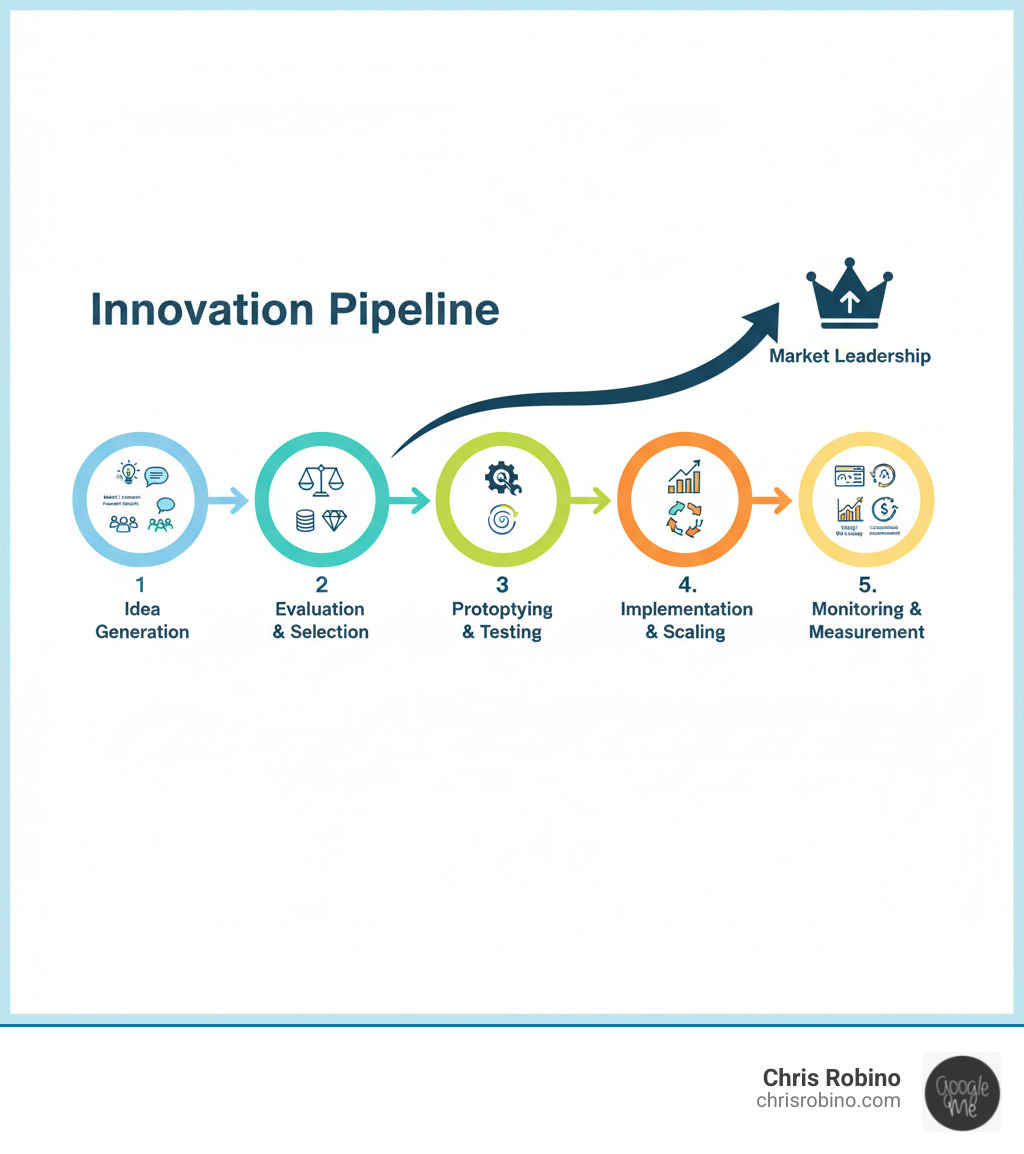
Effective business innovation strategies require a structured, continuous cycle.
- Stage 1: Strategic Alignment: Align your innovation efforts with your broader business strategy. Ensure every initiative supports your long-term goals and secure leadership buy-in.
- Stage 2: Opportunity Identification: Actively seek areas for innovation by analyzing market research, customer pain points, and emerging trends. Listen to customers and employees—they often see opportunities you might miss. Stay current with Technology Trends for Business.
- Stage 3: Ideation & Prototyping: Generate a wide range of ideas and evaluate them based on feasibility and value. Develop the most promising concepts into small-scale prototypes to gather feedback and refine your designs quickly.
- Stage 4: Implementation & Scaling: Develop a detailed action plan, allocate resources, and integrate the proven innovation into your existing systems. Scale it thoughtfully across the organization.
- Stage 5: Measurement & Iteration: Establish clear KPIs to monitor performance, such as customer satisfaction and ROI. Use data-driven insights to continuously refine your approach and keep your innovation efforts agile.
The Human Element: How to Foster a Culture of Continuous Innovation
Innovation is ultimately about people. Creating the right environment is critical for success.

- Empower Your Team: Your employees on the front lines often have the best ideas. Actively listen to their feedback and create an environment of psychological safety, where people feel safe to experiment, take risks, and learn from failure.
- Lead by Example: Leadership must demonstrate commitment by allocating resources, providing time for creative development, and actively participating in the innovation process.
- Reward and Recognize: Celebrate innovative contributions, whether through formal programs or informal acknowledgment, to motivate your team and reinforce desired behaviors.
- Accept an Entrepreneurial Mindset: Encourage everyone to think like an owner—identifying problems and taking initiative to solve them. This transforms employees into active innovators. Learn more about cultivating this drive in The Soul of an Entrepreneur.
Sustaining Momentum and Turning Innovation into Reality
Innovation isn’t a one-time project; it’s an ongoing commitment that requires measurement, refinement, and nurturing. Successful companies build systems to track progress and tackle obstacles head-on.
Key Metrics for Measuring Your Business Innovation Strategies
As the saying goes, “If you can’t measure it, you can’t improve it.” Tracking the right Key Performance Indicators (KPIs) is essential for understanding the impact of your business innovation strategies.
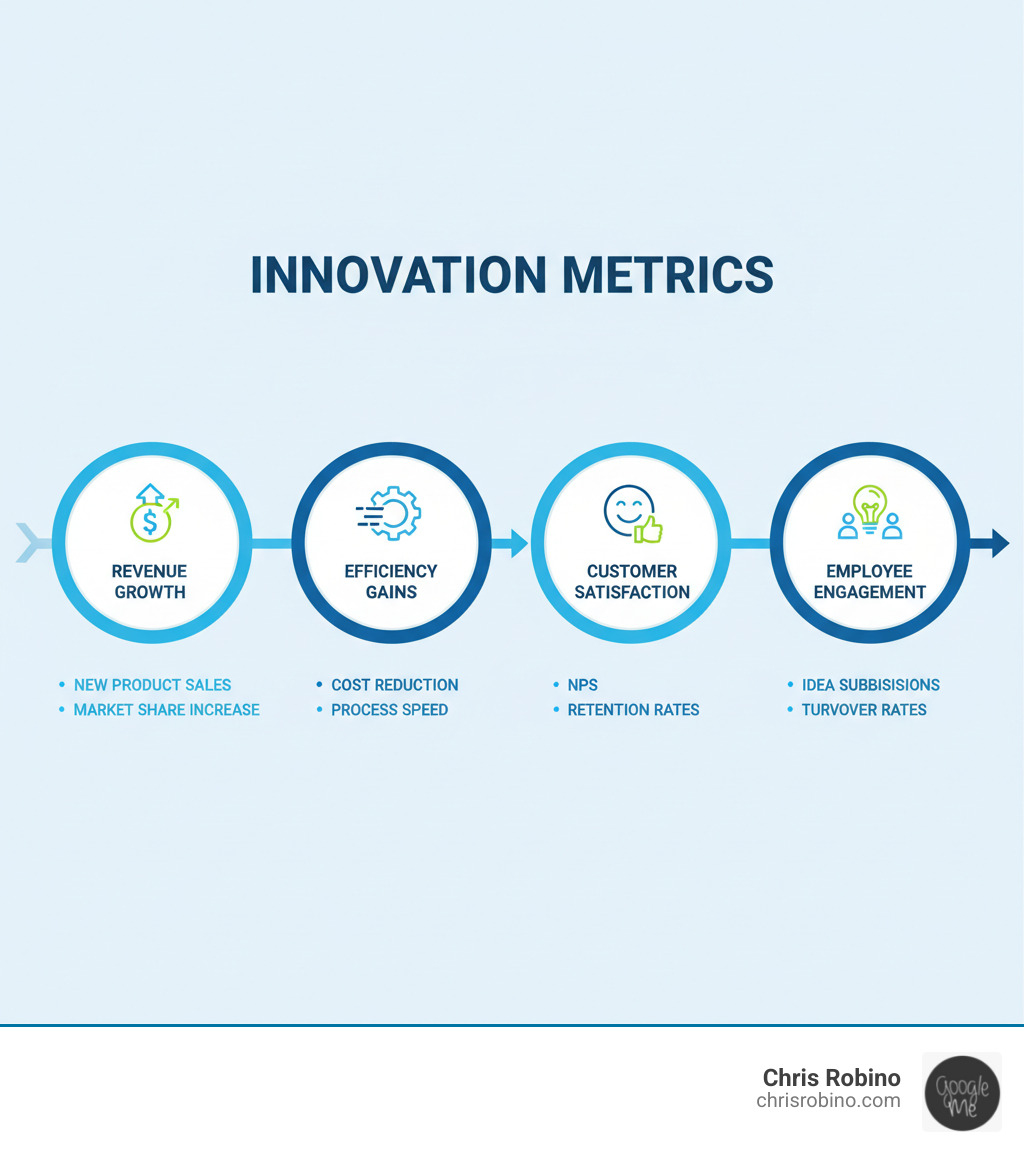
Focus on a balanced set of metrics:
- Financial Metrics: Track revenue growth from new products and changes in market share. Calculate the Return on Investment (ROI) by comparing innovation costs against revenue generated or cost savings. Combining innovation types can yield a 10% higher value added.
- Operational Metrics: Measure efficiency gains like cost reductions, time savings, and a faster time to market. These improvements free up resources for future initiatives.
- Customer Metrics: Monitor customer satisfaction scores (like CSAT or NPS) and retention rates to see if your innovations are truly solving problems and building loyalty.
- Internal Metrics: Keep an eye on employee retention and engagement. A positive innovation culture energizes your team and reduces turnover.
Regularly evaluating these metrics creates a feedback loop for continuous improvement. A data-driven approach, often supported by methods like Agile Tech Consulting, allows you to adapt quickly and optimize your innovation engine.
Overcoming Problems and Partnering for Transformative Growth
Implementing business innovation strategies is rarely a smooth ride. Anticipating and addressing common roadblocks is key to success.
Common challenges include:
- Financial Constraints: Innovation requires investment, which can be a hurdle, especially for smaller businesses.
- Resistance to Change: Introducing new processes can trigger pushback from employees accustomed to established routines.
- Lack of Focus: Without a clear strategy, teams can waste resources chasing ideas that don’t align with business goals.
So how do you overcome these challenges? Sometimes, the answer is to look for outside help.
Expert guidance from a technology innovation consulting firm can accelerate your journey. External specialists provide proven frameworks and fresh perspectives, helping you avoid common pitfalls. They can also help you with strategic planning, defining clear objectives, and exploring financing options to ease the financial burden.
By implementing control mechanisms and continuously monitoring progress, you can stay on track and adapt as needed. This adaptive approach maximizes your chances of success.
The journey to becoming an innovation-driven organization is continuous. By embracing a structured approach, fostering a supportive culture, and leveraging expert guidance, you can open up transformative growth.
If you’re ready to turn your vision into reality, partner with a Technology Innovation Consulting Firm. Sometimes, the smartest innovation is knowing when to bring in the right expertise.