
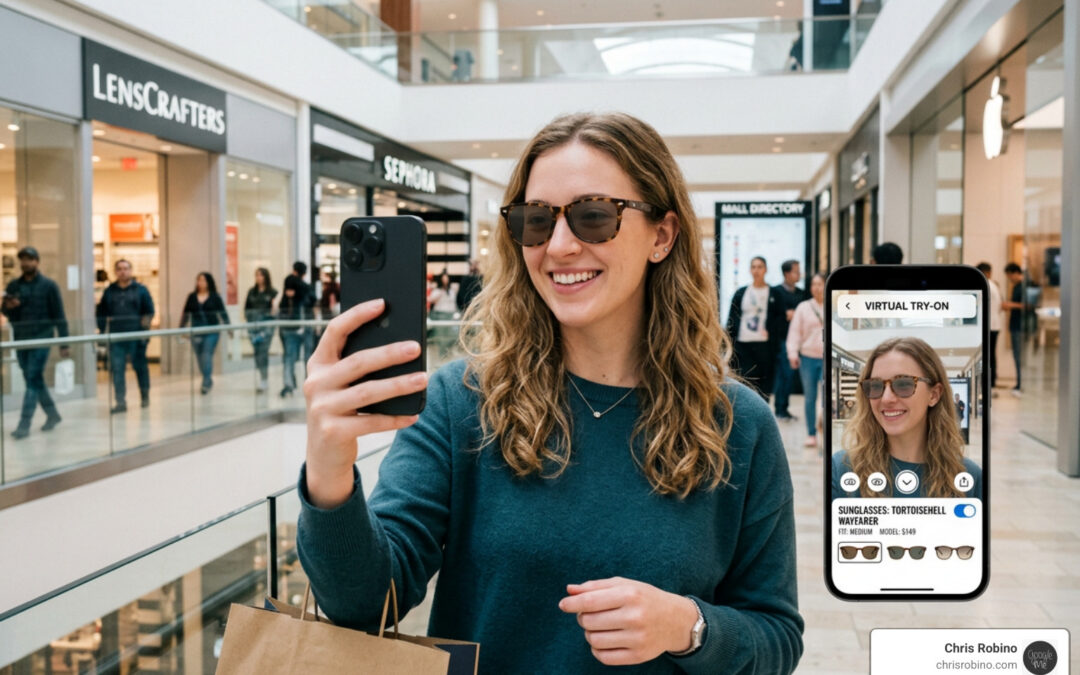
Why AR in Retail Is Changing How People Shop
AR in retail is the use of augmented reality technology to overlay digital content — like 3D product models, virtual try-ons, or product information — onto the real world through a smartphone, tablet, or wearable device. For large-scale enterprises, this technology is also a vital SEO strategy, enhancing user engagement signals that search engines reward.
Here’s a quick overview of what it means and why it matters:
| What | How It Works | Why It Matters |
|---|---|---|
| Virtual try-ons | Overlay clothes, glasses, or makeup on your face or body via camera | Reduces returns, boosts confidence |
| Furniture visualization | Place 3D furniture models in your real room | Helps buyers commit before purchasing |
| In-store navigation | AR markers guide shoppers to products | Reduces frustration, saves time |
| Product info overlays | Point camera at product to see specs and reviews | Speeds up purchase decisions |
| Employee training | AR simulations train staff in real environments | Cuts training time by up to 40% |
Shopping has always been about seeing before you buy. The problem? Online retail made that harder. AR solves it. This isn’t just a user experience upgrade; it’s a strategic move for large companies to dominate search results by providing the high-value, interactive content that modern algorithms prioritize.
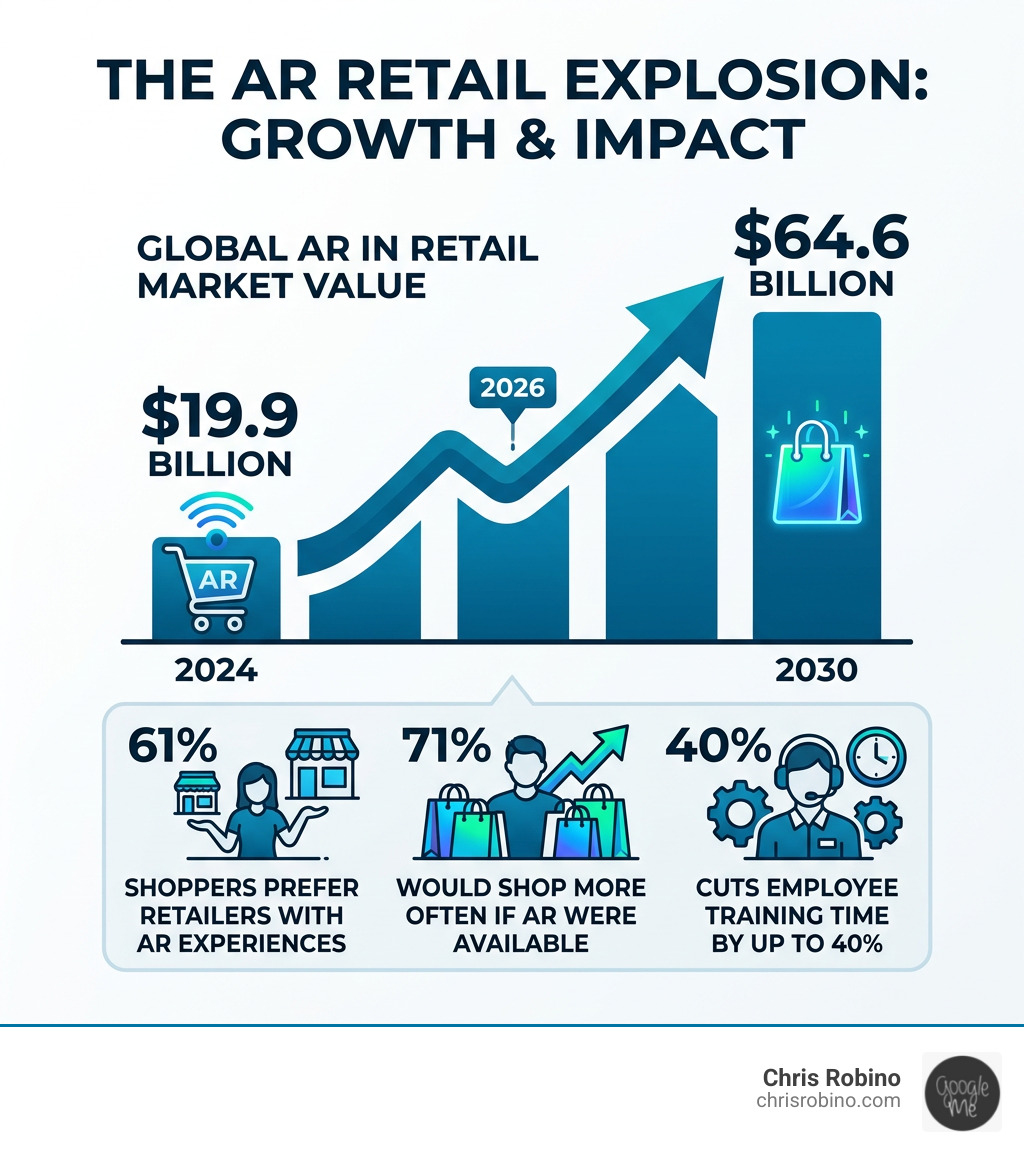
The numbers tell the story clearly. The global AR-in-retail market stood at $19.9 billion in 2024 and is projected to hit $64.6 billion by 2030. Meanwhile, 61% of shoppers already prefer retailers that offer AR experiences, and 71% say they’d shop more often if AR were available.
This isn’t a niche experiment. It’s becoming a baseline consumer expectation — especially for younger shoppers who grew up with immersive digital experiences. I’m Chris Robino, a digital strategy leader with over two decades of experience helping organizations navigate technology transformation, including the growing role of AR in retail and immersive commerce. In the guide below, I’ll walk you through everything you need to know — from core concepts to real-world implementation.
Related content about AR in retail:
The Strategic Value of AR in retail
In the hyper-competitive world of modern commerce, “good enough” is no longer the standard. Retailers are facing a double-edged sword: rising customer expectations and a physical-digital divide that often leads to abandoned carts. Implementing AR in retail isn’t just about adding a “cool” feature; it’s a strategic move to solve these fundamental friction points.
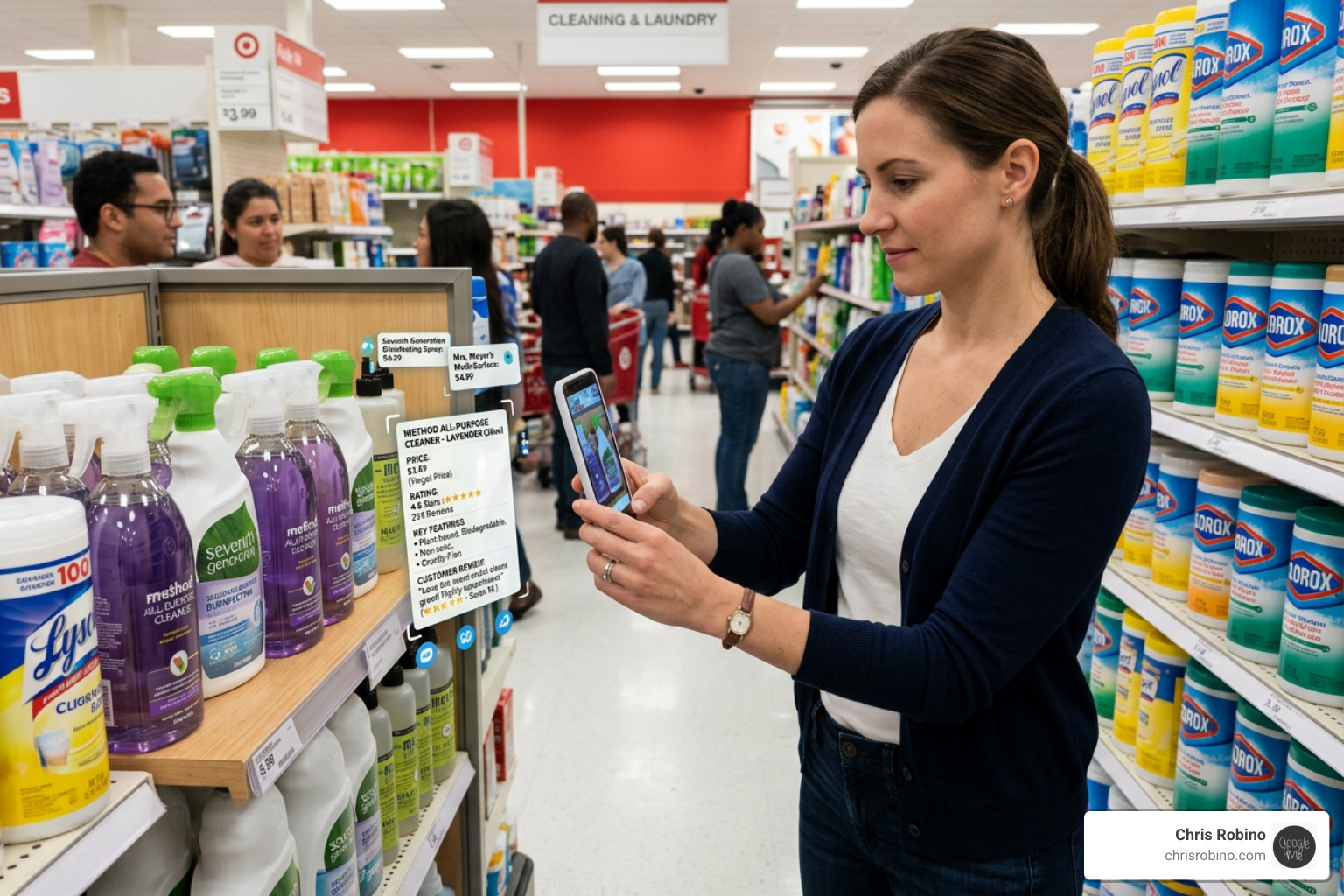
By integrating AR, we can provide customers with a level of personalization that was previously impossible. Imagine a shopper standing in a furniture aisle, looking at a sofa. With a simple scan of their phone, they can see that exact sofa in five different fabrics not currently on the floor, read real-time reviews from other buyers, and even see if it fits through their specific front door dimensions.
AR as a Pillar of Enterprise SEO Strategy
For large companies, AR in retail is a high-performing SEO strategy. By integrating immersive 3D content, retailers optimize for visual search trends and significantly increase ‘dwell time’—a key metric search engines use to gauge content quality. This interactive depth reduces bounce rates and builds the kind of brand authority that earns high-quality backlinks, ensuring that the digital storefront remains visible in an increasingly crowded search landscape. This technology generates high-quality data insights. Unlike a static web page, an AR experience tells us exactly how a customer interacts with a product—which features they zoom in on, which colors they toggle between, and how long they spend “trying on” an item.
| Traditional Retail Friction Point | AR Solution |
|---|---|
| “Will this fit in my room?” | 3D Spatial Visualization |
| “Does this color suit my skin tone?” | Virtual Makeup/Clothing Try-on |
| “I can’t find anyone to help me.” | AR Shopping Assistants & Info Overlays |
| “The item I want is out of stock.” | Virtual Showrooms & Endless Aisle AR |
| “I’m worried about the return process.” | Increased Purchase Confidence via Visualization |
Defining AR, VR, and WebAR for Modern Commerce
To build a successful Augmented Reality Strategy, we must first understand the technical landscape. While often grouped together, AR, VR, and WebAR offer very different experiences:
- Augmented Reality (AR): This technology fuzes digital information with the physical world. It doesn’t replace your surroundings; it enhances them. Most shoppers access this through their smartphones or specialized wearables.
- Virtual Reality (VR): VR requires a head-mounted display (HMD) to immerse the user in a completely digital environment. While great for virtual store tours, it requires more hardware and effort from the consumer.
- WebAR: This is the “low-friction” hero of retail. It allows users to access AR experiences directly through a mobile web browser without downloading a dedicated app. For instance, Saatchi Art saw a 70% increase in sales by allowing users to view 1.4 million artworks on their walls via WebAR.
Academic research, such as the Scientific research on retail value creation through augmented reality, highlights the importance of “task-technology fit.” This means the AR tool must actually help the customer perform a specific task—like evaluating a product’s size or quality—to be perceived as valuable. Interestingly, the impact of AR is often stronger for consumers with high e-commerce knowledge but can be weaker for those who are already “tech-fatigued” by complex interfaces.
How AR in retail Drives Engagement and Reduces Returns
One of the biggest headaches for retailers is the “return culture.” According to research from Mintel, 49% of UK online shoppers have returned items in the past year, a figure that jumps to 60% for those aged 16-34. Returns are expensive, logistically difficult, and environmentally damaging.
AR in retail acts as a powerful preventative measure. When a consumer can virtually “place” a product in their home or on their body, their confidence in the product’s quality and fit increases significantly. In fact, 56% of consumers report that AR increases their confidence in a purchase.
The results are measurable. For example, brands using Shopify AR have seen return rates drop by 5% while simultaneously boosting order conversions by 40%. When shoppers interact with AR, they are 66% more likely to convert because the “unknowns” of the purchase have been removed. You can stay ahead of these shifts by following the latest Augmented Reality Trends.
High-Impact Use Cases: Virtual Try-Ons and Spatial Visualization
The most successful applications of AR in retail fall into a few high-impact categories:
- Virtual Fitting Rooms & Try-Ons: Brands like Gucci and ASOS allow users to see how sneakers or clothes look on them. Warby Parker revolutionized the eyewear industry by letting shoppers upload a selfie to virtually try on frames.
- Spatial Visualization: This is the “IKEA Effect.” Using Ikea’s AR app, customers can place to-scale furniture in their living rooms. This solves the “will it fit?” dilemma instantly.
- Beauty and Color Matching: The Dulux Visualizer app lets homeowners see how a paint color looks on their actual walls before buying a single gallon. Similarly, Sephora uses AR for makeup tutorials and virtual “makeovers.”
- Complex Product Visualization: For items like heavy-duty dog kennels or custom furniture, AR allows shoppers to see 3D models next to their pets or in their offices. Oakywood saw a 250% increase in sales of key products by implementing these 3D models.
To dive deeper into how data from these interactions can be harnessed, explore our Retail Insights Platform.
Implementing AR in Retail: From Pilot to Scale
Moving from a vision to a functional AR rollout requires a disciplined approach. We recommend starting with a pilot program focused on your “high-return” or “high-consideration” items. This phase is critical for gathering the initial data needed to justify a full-scale deployment across the enterprise.
The implementation process generally follows four steps:
- Define Objectives: Are you trying to reduce returns, increase time-on-site, or drive foot traffic to physical stores?
- Choose Your Tech: Decide between a native app (better performance) or WebAR (easier access). Consider if you need LiDAR technology for high-accuracy spatial mapping.
- Content Development: This is the most intensive part. You need high-quality 3D models of your products. Tools like ARKit and ARCore make this easier, but the assets must be optimized for mobile performance.
- Pilot and Test: Launch with a small segment of your catalog. Gather user feedback and measure metrics like conversion lift and engagement time before scaling.
Technical SEO and Performance Optimization
To maintain SEO performance at scale, large retailers must optimize their AR assets. This involves using compressed file formats like USDZ and GLB, served via CDNs to protect page load speeds—a critical Core Web Vital. Furthermore, implementing Schema.org structured data for 3D media allows search engines to enhance listings with ‘View in 3D’ buttons, which can significantly boost organic click-through rates and drive more qualified traffic to product pages.
Bridging the Gap: Enhancing In-Store and Online Experiences with AR in retail
The true power of AR in retail lies in its ability to create a “convergent commerce” experience—where the digital and physical worlds blur. This is particularly important for Gen Z shoppers, who are twice as likely to use emerging media.
In-store, AR can solve the age-old problem of “wayfinding.” Retailers like Marks & Spencer have trialed apps like List & Go, which provides a digital path on the shopper’s screen to the items on their list.
Out-of-store, AR can bring physical marketing to life. Interactive packaging allows a customer to scan a QR code on a cereal box or a toy package to see the product “come to life” or access hidden games and content. This creates a lasting brand connection that goes far beyond the initial purchase. For more on how these technologies integrate into broader environments, see our work on Smart City Innovation.
Operational Excellence: Employee Training and Navigation
While much of the focus is on the customer, AR in retail offers massive internal benefits. Employee training is a prime example. AR training can slash training time by 40% and help new hires reach proficiency four times faster.
Instead of reading a manual, a new warehouse employee can wear an AR headset that overlays picking instructions directly onto their field of vision. In-store staff can use AR to see real-time inventory levels or “virtual” shelf layouts (planograms), ensuring the store always looks its best without constant supervision. This efficiency is a game-changer for retailers facing labor shortages and thin margins.
Measuring Success: Key Metrics and Market Projections
How do you know if your AR investment is paying off? We look at several key performance indicators (KPIs):
- Conversion Rate: Are users who interact with AR more likely to buy? (Target: 40-90% lift).
- Return Rate Reduction: Are returns for AR-enabled products lower than the store average? (Target: 25-40% reduction).
- Engagement Time: How long are users spending interacting with the 3D models?
- Customer Sentiment: Does the AR experience improve brand perception and “innovation” scores?
The future of the market is bright. With the AR-in-retail sector projected to reach $61.3 billion by 2031, this is no longer a “nice-to-have” trend. It is a fundamental shift in the retail interface.
At ChrisRobino.com, we specialize in helping businesses navigate these technology trends for business. Whether you are just starting your pilot or looking to scale a global AR deployment, the goal remains the same: creating a more personalized, efficient, and immersive shopping journey. The retail revolution is already here. By moving “beyond the mirror” and embracing augmented reality, we can build a future where shopping is not just a transaction, but an experience.