
Why Consumer Media Trends Define Marketing Success in 2026
Consumer media trends are reshaping how brands reach audiences, how people spend their time, and where ad dollars flow. For large companies, staying ahead of these shifts requires a sophisticated blend of traditional media planning and advanced SEO strategies that can scale across thousands of pages and multiple regions. Here’s a quick snapshot of the biggest shifts happening right now:
Key Consumer Media Trends for 2026:
| Trend | What It Means |
|---|---|
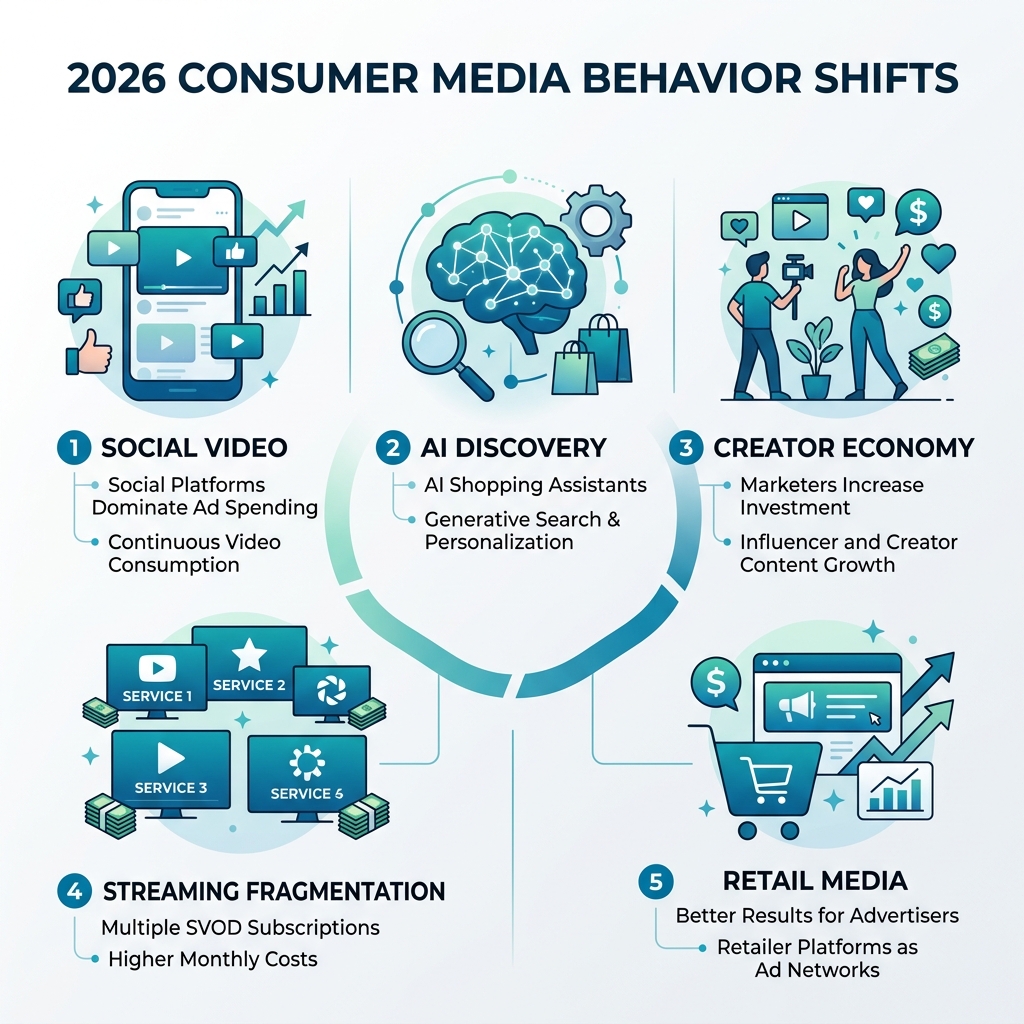
| Social video dominance | Social platforms now capture over half of U.S. ad spending |
| Pay TV decline | Cable/satellite TV dropped from 63% to 49% of U.S. households in 3 years |
| AI-driven discovery | 24% of AI users already use AI shopping assistants |
| Creator economy growth | Net 61% of marketers plan to increase creator content investment |
| Retail media surge | Retail Media Networks deliver 1.8x better results than standard digital ads |
| Enterprise SEO Scaling | Large firms are moving toward automated, data-driven SEO to maintain visibility |
| Experience priority | Travel is a top-3 spending priority for 42% of Americans |
The media landscape is no longer shifting gradually. It’s fragmenting fast. U.S. consumers average 6 hours of media and entertainment daily, but that time is scattered across social platforms, streaming services, podcasts, gaming, and audio — with no overall growth in sight. Brands and marketers who don’t understand where attention is going will keep spending in the wrong places. For large organizations, this fragmentation necessitates a robust SEO strategy that ensures brand visibility regardless of where the consumer starts their journey.
What makes this moment especially complex is the economic backdrop. Real wages rose just 0.8% while billionaire wealth grew 18%. The top 10% of earners drive 49% of U.S. consumer spending. At the same time, 75% of Americans say there’s a lack of connection in society, and 58% describe their stress as moderate to severe. These aren’t just social statistics — they directly shape what people watch, buy, and trust. Large companies must use SEO to capture high-intent traffic from these diverse economic segments, ensuring their content addresses specific pain points and financial realities.
And then there’s the technology layer: AI agents, generative search, synthetic data, and algorithmic interest graphs are rewriting the rules of discovery and personalization all at once. For enterprise-level players, this means moving beyond simple keyword targeting and into the realm of technical SEO and structured data that feeds these new AI engines.
I’m Chris Robino, a digital strategy and AI search expert with over two decades of experience helping organizations navigate complex shifts in consumer media trends — from emerging tech startups to established enterprises. In the sections ahead, I’ll break down exactly what’s changing, why it matters, and how to position your brand to move with it.
Key Consumer media trends vocabulary:
- broadcast consulting services
- communication and media consulting services
- social media branding consultant
The Evolution of Consumer media trends in a Fragmented Economy

As we look toward 2026, we see an economy that is no longer lifting all boats equally. The “K-shaped recovery” has become a permanent fixture in the consumer psyche. While the top 10% of earners own a staggering 93% of the stock market, many households are feeling the squeeze of stagnant real wages. This economic divide creates a two-speed media world: one where premium, ad-free experiences are reserved for the affluent, and another where ad-supported, free-to-access content dominates for everyone else. For large companies, SEO strategies must account for this by creating content that serves both high-end luxury seekers and value-conscious consumers through distinct, optimized funnels.
This fragmentation isn’t just about money; it’s about how content reaches us. We are moving from the “Social Graph” (seeing what our friends like) to the “Interest Graph” (seeing what powerful AI algorithms know we enjoy). This shift allows “random content” to go viral and monetize in ways we’ve never seen before.
| Feature | Social Graph (Old School) | Interest Graph (The New Wave) |
|---|---|---|
| Primary Driver | Personal connections/Friends | AI-driven content relevance |
| Discovery | What people you know share | What the algorithm predicts you’ll love |
| Monetization | Broad demographics | Niche, high-intent clusters |
| Reach | Limited by follower count | Infinite via viral potential |
How Economic Shifts and GLP-1 Drugs Redefine Consumer media trends
The “Treatonomics” phenomenon is a direct response to economic uncertainty. Consumers are increasingly willing to go into short-term debt—about 36% of them—for “little treats” or experiences that provide an emotional lift. Whether it’s a specialty coffee or a weekend getaway, these small luxuries are becoming non-negotiable for mental well-being.
However, a massive health disruptor is entering the fray: GLP-1 weight-loss drugs. With 1 in 8 Americans already using these medications, we are seeing a seismic shift in CPG (Consumer Packaged Goods) sales. These households account for 35% of food and beverage sales, yet users consume 40% fewer calories and spend roughly 6% less on groceries. For media planners and SEO specialists at large food companies, this means a total rethink of keyword strategy. Wellness, portion control, and nutrient density are the new search pillars. You can find more data on these shifts in our more info about media industry guide 2025.
The Rise of AI Agents and Generative Engine Optimization (GEO)
By 2026, the way we search for information will be unrecognizable. We are entering the era of “Search Everywhere.” Consumers are no longer just typing queries into a search bar; they are using voice assistants, visual search through camera lenses, and, most importantly, AI agents. For large companies, SEO is evolving into Generative Engine Optimization (GEO).
To stay visible, content must be machine-readable and structured so that AI models can easily digest and recommend it. This involves implementing advanced Schema markup, ensuring high site speed to facilitate rapid crawling, and creating authoritative “content hubs” that establish the brand as a definitive source. If your brand isn’t optimized for the “machine eye,” it won’t exist for the human consumer. Check out our more info about AI in broadcasting to see how these agents are changing the game.
Social Video Dominance and the Decline of Traditional Broadcasting
The statistics are jarring: cable and satellite TV subscriptions have plummeted to 49%, down from 63% just three years ago. Meanwhile, social video platforms like TikTok, YouTube, and Instagram Reels have become the new “living room.”
Gen Z spends 54% more time on social video than traditional TV. This isn’t just a change in screen size; it’s a change in business models. Large companies must integrate video SEO into their broader strategy, optimizing video titles, descriptions, and transcripts to capture search traffic within these platforms. Traditional studios are struggling with high churn rates—39% of SVOD (Subscription Video on Demand) users canceled a service in the last six months—while social platforms thrive on “free” user-generated content and superior AI-driven ad tech. To survive, traditional media must embrace ad-supported tiers and creator partnerships. For a deeper dive, read our thoughts on the more info about the future of broadcasting.
Strategic Frameworks for Navigating Future Consumer Media Trends
To win in this environment, marketers need more than just flashy creative; they need a framework built on trust and precision. Consumer media trends show that 95% of people say trust is critical to their purchase decisions. But trust is harder to earn than ever. We’ve moved past the era of broad-reach “shouting” and into an era of specific, community-led engagement. For large companies, this trust is often built through technical excellence and reliable information delivery, which are the hallmarks of a strong SEO presence.
Retail Media Networks (RMNs) are a key part of this new strategy. By using first-party shopper data, RMNs deliver nearly 3x better results for purchase intent than standard digital ads. They allow brands to meet the consumer at the point of sale with a message that is actually relevant. Integrating SEO with RMN data allows large companies to identify high-converting search terms and double down on them across both organic and paid channels.
Enterprise SEO: Scaling Search Success for Large Organizations
For large companies, SEO is a game of scale. Successful strategies include:
- Technical SEO at Scale: Managing crawl budgets and ensuring that millions of pages are indexed correctly. This requires automated tools to detect 404 errors, redirect loops, and duplicate content across global subdomains.
- Content Hubs and Internal Linking: Creating authoritative clusters of content that signal expertise to search engines. For a large firm, this means linking high-authority blog posts to product pages to pass “link equity” effectively.
- Global SEO and Localization: It is not enough to translate content; large companies must localize SEO strategies to account for regional search habits and local search engines.
- Data-Driven Keyword Research: Using AI to analyze vast amounts of search data to predict upcoming trends before they peak, allowing the brand to capture the “first-mover” advantage in organic search.
Building Brand Trust Through Authentic Connections and Micro-Communities
There is a profound “loneliness epidemic” in modern society, with 75% of Americans reporting a lack of connection. Brands that step into this gap by fostering genuine community will win. This means moving away from polished, corporate messaging and toward employee advocacy and micro-communities. People trust employees more than CEOs or influencers. By empowering your team to share their authentic stories, you build a human connection that algorithms can’t fake. Social listening is also evolving; it’s no longer just about crisis management. It’s about “ideation”—listening to the weird, niche conversations in micro-communities to find the next big product or campaign idea. We explore this further in our more info about media industry networking events.
Leveraging the Creator Economy and Individual Empires
The “Influencer” is dead; long live the “Individual Empire.” We are seeing creators move beyond simple brand deals to launch full-scale CPG businesses. These creators own the relationship with the audience, allowing them to bypass traditional retail barriers. For large brands, this means shifting from one-off “shoutouts” to long-term partnerships that focus on ROI and brand-building. Whether it’s through alternative sports like pickleball or “random” viral moments, the creator economy is where the new cultural capital resides. Learn more about how to capitalize on this in our more info about digital content monetization.
Adapting to Global Cultural Shifts and Future Consumer media trends
Finally, we must look at the macro cultural shifts. While we are more connected than ever, a “digital detox” movement is growing, particularly among Gen Alpha and Gen Z, who are seeking IRL (In Real Life) experiences like festivals and travel. We also cannot ignore the rise of Africa. With a staggering youth population and a massive surge in global talent, Africa is poised to be the next major cultural and economic engine. Brands that ignore these global shifts—or fail to embrace diversity and inclusion (valued by 65% of consumers)—will find themselves out of touch.
As we navigate these Consumer media trends, our goal at Chris Robino is to provide the clarity and strategic insight needed to thrive. Explore our more info about global media industry analysis and more info about digital transformation for media to stay ahead of the curve.
Ready to master the next wave of media? Contact us at ChrisRobino.com to start your digital transformation journey today.