

Why Your Content Strategy Needs an SEO Upgrade
For large companies, search is often the invisible engine behind revenue, brand visibility, and customer acquisition. Enterprise SEO is no longer a nice-to-have add-on; it’s core infrastructure. Organic search can drive a substantial share of high-intent traffic, and when executed at scale, SEO compounds over time in ways paid campaigns simply can’t match.
Yet most large organizations struggle to operationalize SEO. Multiple business units, legacy platforms, complex approval processes, and fragmented data make it difficult to move quickly and consistently. One team might optimize a product line while another launches a new site section with no SEO oversight at all. The result: missed opportunities, duplicated efforts, and rankings that erode against more agile competitors.
The answer is not a single tool or one-off project. Large enterprises need a structured, repeatable SEO strategy supported by the right mix of digital content creation tools, governance, and measurement. When these elements are aligned, SEO becomes a scalable capability rather than an isolated tactic.
I’m Chris Robino, and I’ve spent over two decades helping organizations from tech startups to global enterprises modernize their digital presence. My focus is on building search-driven strategies and implementing digital content creation tools that turn complex SEO requirements into clear, manageable workflows.
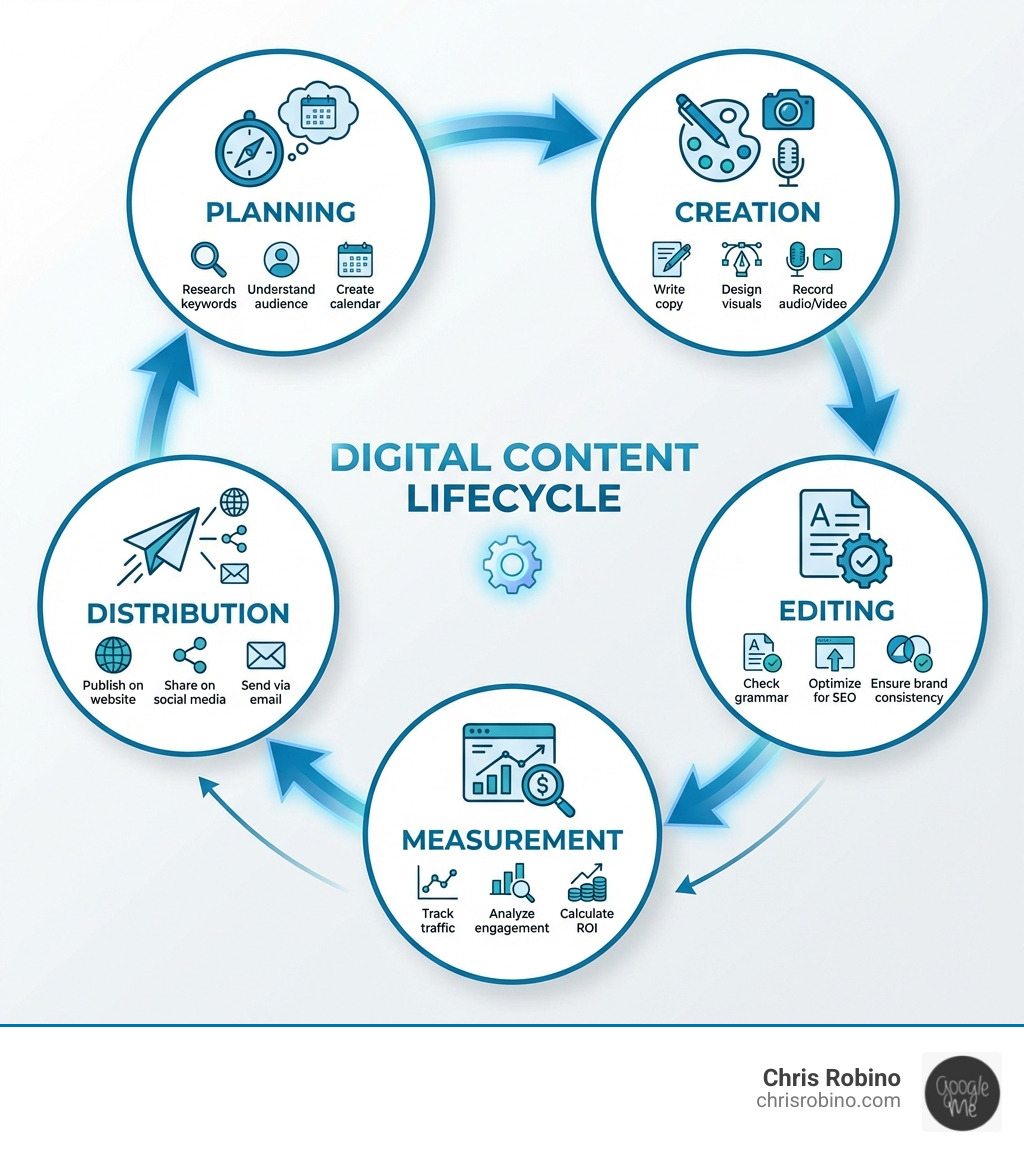
At the enterprise level, effective SEO strategies connect technical performance, content, brand, and analytics into one unified approach. Tools support this work, but strategy leads it. Modern organizations are using SEO to:
- Capture incremental demand across thousands of keywords and long-tail queries.
- Align messaging across regions, languages, and business units.
- Inform product and content decisions with real search data.
- Build defensible visibility that isn’t dependent on rising ad costs.
The evolution of digital content creation tools has made it far easier to coordinate SEO efforts across large teams. Cloud-based platforms now support shared workflows, governance, and analytics so that marketers, writers, designers, and developers can all execute consistently against the same search strategy. Companies that integrate SEO into their content workflows see significantly better long-term results than those treating it as an afterthought.
Enterprise SEO Strategies for Every Stage of the Content Lifecycle
Effective SEO for large companies is built into every phase of the content lifecycle—from research to measurement. The most successful organizations design processes and select digital content creation tools that reinforce these strategies at scale.

Stage 1: Research & Strategic Planning
For large companies, SEO research is less about finding one perfect keyword and more about mapping entire markets.
Build comprehensive keyword portfolios: Organize keywords by product line, customer segment, and buyer journey stage (awareness, consideration, decision, post‑purchase). This allows each business unit to see where it owns visibility and where gaps exist.
Use search data to inform content themes: Topic clusters built around core themes (e.g., specific solutions or industries) help structure large content libraries. Each cluster should have a primary, authoritative page supported by related articles and assets that target long‑tail queries.
Local and international SEO planning: If you operate in multiple regions or languages, plan for country‑ and language‑specific keyword sets early. This ensures that localization and translation workflows align with search intent in each market rather than simply converting existing copy.
Governance and editorial calendars: Implement shared editorial calendars that connect SEO priorities to campaigns and product launches. This coordination prevents content collisions (multiple teams chasing the same topic) and ensures priority pages are always supported with fresh, search‑aligned content.
Stage 2: SEO‑Driven Content Creation & Editing
Content is the main delivery vehicle for your SEO strategy. At scale, consistency is everything.
Search intent as a content brief: Every new asset should start with a clear understanding of the searcher’s intent—informational, navigational, commercial, or transactional. Content briefs should spell out primary and secondary keywords, audience segment, stage in the journey, and desired action.
On‑page optimization standards: Create simple, organization‑wide guidelines for title tags, meta descriptions, headings, internal links, and image alt text. With clear templates and examples, teams can execute optimizations without needing an SEO specialist on every project.
Quality and depth over volume: For large companies, the temptation is to publish as much as possible. High‑performing SEO strategies instead prioritize depth, expertise, and clarity. Long‑form guides, detailed solution pages, and authoritative resources tend to outperform thin, generic content.
Brand consistency and compliance: At the enterprise level, content must meet brand and legal standards as well as SEO requirements. Standardized review workflows, shared style guides, and checklists help teams balance accuracy, brand voice, and search performance.
Stage 3: Technical SEO and Experience
Technical SEO has outsized impact for large websites with complex architectures.

Crawl efficiency and information architecture: With thousands of URLs, it’s critical to design a logical structure that is easy for both users and search engines to navigate. Clear hierarchies, consistent URL patterns, and thoughtful internal linking improve discoverability and consolidate authority.
Performance and Core Web Vitals: Enterprise sites often rely on heavy scripts, tags, and integrations that slow pages down. Ongoing performance optimization—lazy loading, image compression, caching, and code cleanup—directly supports SEO and user experience.
Structured data and rich results: Implement schema markup for products, articles, events, FAQs, and other key content types. Structured data helps search engines understand your content at scale and can unlock richer search result features.
Technical debt management: Legacy systems and historical decisions often create SEO issues such as duplicate content, outdated redirects, or parameter‑driven URLs. Creating a recurring audit and remediation process keeps technical debt from undermining long‑term performance.
Stage 4: Distribution, Authority, and Visibility
Publishing optimized content is not the final step. Large companies must actively reinforce and distribute their content to build authority.
Internal promotion and cross‑linking: Use newsletters, internal portals, and collaboration tools to surface new priority pages to sales, support, and regional teams. Encourage thoughtful internal linking from high‑traffic sections of your site to new or strategic content.
Thought leadership and digital PR: Authoritative content created by subject‑matter experts can earn mentions and references across the web. Consistent, high‑quality contributions to industry conversations increase both brand authority and search visibility over time.
Channel alignment: Coordinate SEO content with paid search, social campaigns, and email programs so that core themes and landing pages are reinforced across channels. This unified approach multiplies the impact of your search investments.
Stage 5: Measurement, Reporting, and Continuous Improvement
Enterprise SEO is never “finished.” The most successful large companies treat it as an ongoing optimization program.
Define enterprise‑level SEO KPIs: Go beyond rankings and traffic. Track metrics such as organic‑sourced pipeline, influenced revenue, assisted conversions, and engagement by content type or business unit.
Dashboards for different stakeholders: Executives, marketing leaders, and content teams need different levels of detail. Build role‑specific dashboards so each group can see how their work connects to search outcomes.
Test, learn, and scale: Use controlled experiments—such as testing new templates, navigation structures, or content formats—on a limited set of pages. Successful approaches can then be rolled out across entire site sections.
Regular audits and content refreshes: Schedule periodic reviews of top‑performing and strategically important content. Refreshing data, expanding sections, and improving internal links helps maintain rankings and relevance over time.
Making Enterprise SEO Work: Governance, Tools, and Future Trends
Enterprise SEO is as much about organization and governance as it is about keywords and rankings. The right digital content creation tools and processes can make SEO a durable advantage rather than a fragile initiative.
Building an SEO Operating Model for Large Companies
To perform well at scale, SEO needs clear ownership and repeatable processes.
- Central strategy, distributed execution: A central SEO or digital excellence team sets standards, maintains shared resources, and defines priorities. Regional or business‑unit teams then execute within those guidelines, adapting to local markets where needed.
- Standardized playbooks and templates: Document common workflows: launching a new section, updating a product line, creating a resource hub, or migrating content. Provide templates for briefs, page structures, and review checklists so teams move quickly without reinventing the wheel.
- Cross‑functional collaboration: SEO outcomes depend on marketing, product, design, development, and analytics working together. Regular cross‑team reviews help align roadmaps, catch issues early, and ensure SEO requirements are built into projects from the start.
- Training and enablement: Non‑specialists—writers, campaign managers, regional marketers—should understand core SEO principles that apply to their work. Short, practical training sessions and easily accessible reference guides help maintain consistency.
Choosing and Using Digital Content Creation Tools for SEO
Tools should support your strategy, not define it. When evaluating platforms to support enterprise SEO and content creation, focus on:
- Scalability: Can the tool handle your content volume, languages, and number of users?
- Collaboration: Does it support shared workspaces, permissions, and comments so teams can coordinate in one place?
- Integration: Can it connect to your content management system, analytics, and marketing platforms to reduce manual work?
- Governance features: Look for version control, approval workflows, and audit trails to maintain quality and compliance across large teams.
Key capabilities to prioritize include real‑time collaboration, reusable content components, automated quality checks, and built‑in analytics or easy data exports. These make it easier to embed SEO checks into everyday work rather than relying on ad‑hoc reviews.
Future Trends Shaping Enterprise SEO
The landscape of search and digital content creation continues to evolve rapidly, and large organizations need to plan ahead.
AI‑enhanced workflows: AI is increasingly used to support keyword research, content ideation, drafting, and summarization. In enterprise settings, the most effective use of AI is as a productivity aid—helping teams move faster while human experts ensure accuracy, insight, and brand alignment.
Search beyond traditional results pages: Customers now discover content through a mix of search engines, on‑site search, voice interfaces, and platform‑specific feeds. Structuring your content, metadata, and technical foundations allows it to surface consistently wherever your audience is searching.
Rising expectations for expertise and trust: As automatically generated content becomes more common, signals of real expertise, experience, and accountability grow more important. Clear authorship, transparent sourcing, and consistent alignment with your organization’s values all contribute to long‑term search performance.
Content provenance and governance: Large companies increasingly need to demonstrate how content is created and modified—especially when AI is involved. Robust governance, documentation, and review processes help maintain trust with users and regulators while also supporting reliable search performance.
By treating SEO as a strategic, organization‑wide capability—supported by the right tools, clear governance, and a culture of continuous improvement—large companies can build durable visibility that compounds over time. The result is a search presence that not only attracts more visitors, but also aligns closely with business goals, customer needs, and the realities of modern digital marketing at scale.