

The Core Pillars of Future Business Tech
As we navigate April 2026, the foundational elements of digital infrastructure have shifted. We are no longer just “moving to the cloud”; we are orchestrating a complex web of autonomous systems and distributed intelligence. The “innovation flywheel” is spinning faster than ever—better technology leads to more data, which attracts more investment, further accelerating infrastructure development. This compression of the technology S-curve means that the distance between a “lab experiment” and “mainstream business tool” has shrunk from years to months. For large-scale enterprises, this acceleration demands a new approach to digital visibility. Search engines are no longer just indexing text; they are indexing the capabilities of these autonomous systems. Consequently, the intersection of future business tech and search visibility has become the primary battleground for market share.

At the heart of this shift is the move from General-Purpose AI to specialized, efficient models. While Large Language Models (LLMs) like GPT-4 defined the early 2020s, 2026 is the year of the Small Language Model (SLM). Gartner predicts that by 2027, organizations will use task-specific AI models three times more often than general-purpose LLMs. This shift is critical for SEO strategies that perform well for large companies. Large enterprises often struggle with “content bloat,” where thousands of pages compete for the same keywords. By deploying SLMs to audit and refine internal data structures, companies can ensure that their digital footprint is optimized for both human users and the AI-driven crawlers that now dominate the search landscape.
| Feature | Large Language Models (LLMs) | Small Language Models (SLMs) |
|---|---|---|
| Primary Use | General knowledge, creative writing | Task-specific, niche industry data |
| Compute Cost | High (Millions in monthly inference) | Low (Optimized for edge/local) |
| Training Data | The entire public internet | Curated, high-quality private data |
| Latency | Higher (Cloud-dependent) | Near-instant (Local execution) |
| Privacy | Data often leaves the perimeter | Can run entirely on-premises |
Agentic AI: Redesigning Workflows for Future Business Tech
The most significant evolution in future business tech is the rise of Agentic AI. Unlike standard chatbots that wait for a prompt, AI agents are goal-oriented. They don’t just “chat”; they do. An agent can be given a high-level goal—”Optimize our Q3 supply chain for cost”—and it will autonomously analyze vendors, negotiate prices, and update inventory logs, only asking for human approval at critical decision points. In the realm of enterprise SEO, these agents are being used to manage technical health at scale. For a company with a million-page website, manual auditing is impossible. Agentic AI can identify broken canonical tags, redirect loops, and schema errors in real-time, ensuring that the site remains perfectly crawlable.
However, moving from pilot to production remains a hurdle. While 38% of organizations are piloting agents, only 11% have them in full production. A sobering 40% of agentic AI projects are predicted to fail by 2027, largely because businesses try to automate broken, legacy processes. To succeed, we must engage in a total ai driven automation strategy that redesigns the workflow from the ground up. According to Gartner’s Top Strategic Technology Trends for 2026, these multiagent systems will become the “silicon workforce” that handles routine operations, allowing humans to focus on high-level strategy. This strategy must include a robust SEO component, as the visibility of these automated services determines their ultimate utility in a competitive market.
Physical AI and the Robotics Revolution
AI has finally found its “body.” In 2026, Physical AI is transforming the material world. We aren’t just talking about robotic arms bolted to a floor; we’re seeing humanoid robots and autonomous fleets capable of navigating unstructured environments like hospital hallways or busy retail floors. This physical presence creates a new data stream that large companies must leverage. For instance, a retail robot’s inventory data can be fed directly into local search results, providing real-time product availability to consumers—a cornerstone of modern SEO for large companies with physical footprints.
Amazon recently deployed its millionth robot, and the results are undeniable: DeepFleet AI systems have improved warehouse travel efficiency by 10%. For smaller businesses, “Robotics-as-a-Service” (RaaS) models have made this technology accessible without massive upfront capital. By integrating ai powered analytics, these machines don’t just move boxes—they predict maintenance needs and optimize routes in real-time. This isn’t just about replacing labor; it’s about achieving an operational impact that was physically impossible for humans alone. From an SEO perspective, the efficiency gains here allow companies to reinvest capital into high-quality content production and technical infrastructure, which are essential for maintaining search dominance.
Modern Infrastructure: Cloud, Edge, and HCI
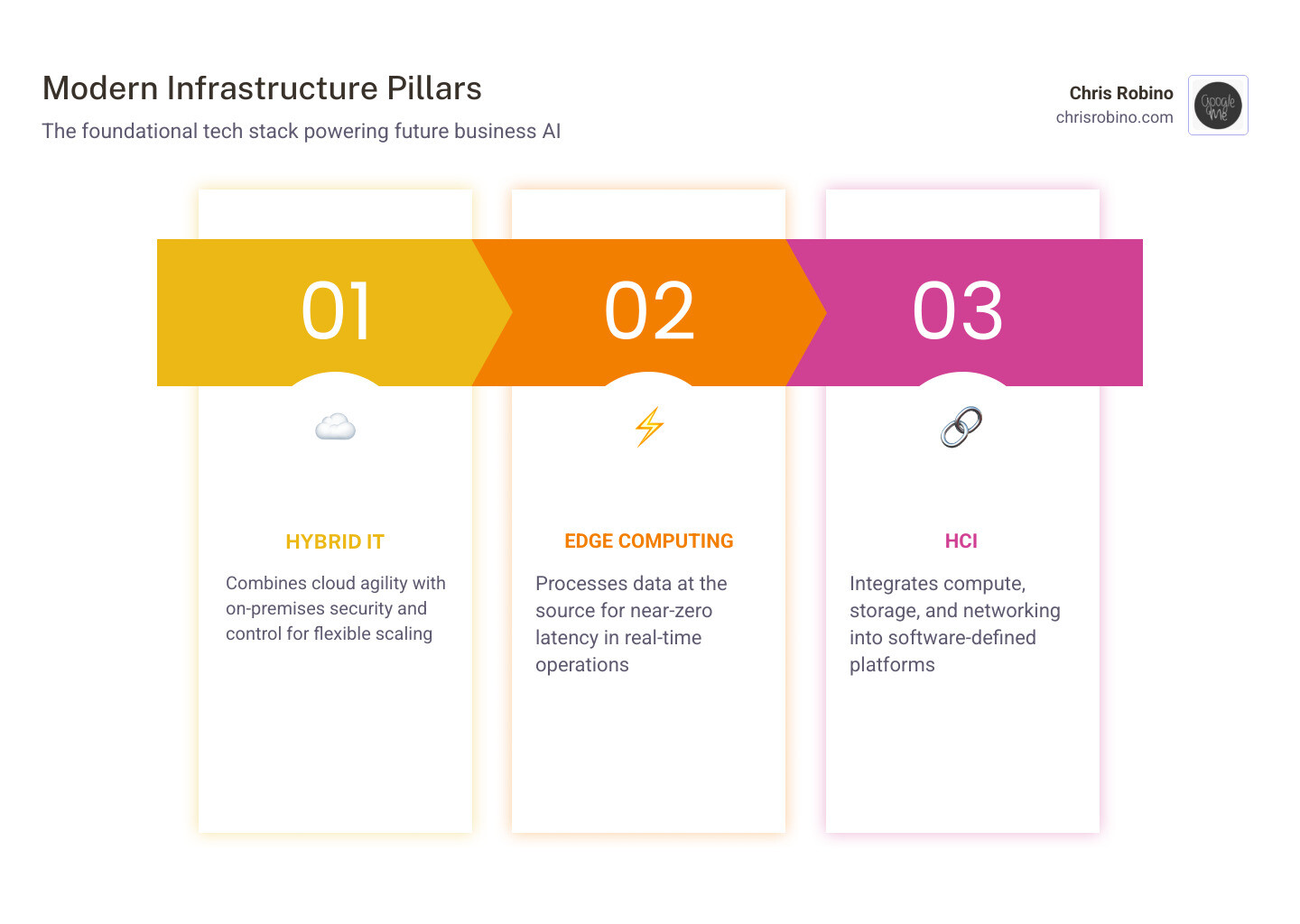
To power these AI “brains” and robotic “bodies,” the underlying skeleton of business—IT infrastructure—has had to evolve. Global cloud spending has hit a massive $1.3 trillion, but the trend isn’t just “all-in” on public cloud. Instead, we are seeing the dominance of Hybrid IT and Hyperconverged Infrastructure (HCI). For large companies, infrastructure speed is a direct ranking factor. Core Web Vitals and page load speeds are heavily influenced by how data is stored and served.
HCI integrates compute, storage, and networking into a single software-defined platform. This allows businesses to have the agility of the cloud with the security and “immediacy” of on-premises hardware. Meanwhile, Edge Computing is solving the latency problem. By processing data at the source—on the factory floor or inside a smart vehicle—businesses can act on technology trends for business without waiting for data to travel to a distant data center and back. This reduction in latency is vital for SEO, as search engines increasingly prioritize sites and services that provide near-instantaneous responses to user queries.
Navigating the 2026-2030 Transformation Landscape
Looking toward the end of the decade, the future business tech landscape becomes even more decentralized and sustainable. We are moving away from the “move fast and break things” era into an era of “move fast and sustain things.” This shift is particularly evident in how large companies manage their digital presence. SEO is no longer a siloed marketing function; it is a core component of the enterprise technology stack, requiring deep integration with data science and infrastructure teams.
SEO Strategies for Large Companies: The Enterprise Playbook
For large companies, SEO strategies must be built on scalability and technical precision. Unlike smaller sites, enterprise websites often deal with millions of URLs, complex internationalization, and legacy subdomains. To perform well, these organizations must focus on three critical pillars: Programmatic SEO, Technical Crawl Efficiency, and E-E-A-T (Experience, Expertise, Authoritativeness, and Trustworthiness) at scale.
Programmatic SEO involves using data-driven templates to create high-quality, useful pages for thousands of long-tail search queries. For a global logistics firm, this might mean creating optimized landing pages for every shipping route and port combination. The key is ensuring that these pages provide genuine value and are not merely “doorway pages,” which search engines now penalize heavily. By leveraging the SLMs mentioned earlier, large companies can generate unique, contextually relevant content for these pages that satisfies both user intent and search algorithms.
Technical Crawl Efficiency is the second pillar. Large sites often suffer from “crawl budget” issues, where search engine bots spend too much time on low-value pages (like filter parameters or old archives) and miss new, high-value content. Future-ready enterprises use advanced server-side rendering and edge SEO to deliver pre-rendered pages to bots, ensuring that every second of crawl time is spent on revenue-generating content. Furthermore, implementing a robust internal linking structure using AI-driven recommendations can help distribute “link equity” more effectively across a massive domain.
E-E-A-T at Scale requires a centralized approach to brand authority. For large companies, this means ensuring that every piece of content is associated with a verified expert and that the organization’s digital footprint reflects its real-world leadership. This is achieved through structured data (Schema.org) that clearly defines the relationships between authors, entities, and the corporation. In an era where AI-generated content is ubiquitous, search engines prioritize brands that can prove their human expertise and institutional history.
Sustainable and Quantum Computing Frontiers
As AI compute demands skyrocket, Sustainable Computing is no longer a PR move—it’s a financial necessity. Organizations are adopting “follow-the-sun” computing, where non-urgent AI training workloads are routed to data centers in regions currently producing excess renewable energy. This sustainability also impacts SEO; search engines have begun to factor in the carbon footprint of digital services, favoring companies that demonstrate environmental responsibility in their IT operations.
Simultaneously, Quantum Computing is stepping out of the theoretical realm. While we aren’t all using quantum laptops yet, hybrid classical-quantum systems are already being used for complex logistics optimization and drug discovery. These systems can process variables in seconds that would take traditional supercomputers years to solve. For large companies, quantum-enhanced data analysis will allow for a level of SEO precision previously thought impossible, such as predicting search trend shifts weeks before they occur based on global economic indicators.
In the realm of trust, Blockchain and Web3 are maturing. We’ve moved past the hype of digital collectibles into “trustless” systems for supply chain transparency and fractional real estate ownership. For a deeper look at this, check out our insights on the future of web3. These decentralized systems provide a new layer of verifiable data that can be used to bolster a company’s E-E-A-T, as blockchain-verified credentials become a standard for digital authority.
Strategic Infrastructure for Future Business Tech Scaling
Scaling these technologies isn’t without its “growing pains.” Infrastructure costs are the number one concern for CIOs in 2026. The “token economics” of running massive AI models can lead to monthly bills in the tens of millions if not managed correctly. This has given rise to FinOps—a discipline that treats cloud and AI usage as a strategic business investment rather than just a utility bill. For SEO, this means calculating the ROI of technical improvements not just in terms of traffic, but in terms of infrastructure efficiency and customer acquisition cost.
Cybersecurity has also entered a “machine-vs-machine” phase. With 81% of small businesses experiencing a breach in the last year—and AI-powered attacks involved in over 40% of cases—defensive AI is now mandatory. These systems use emerging tech insights to detect threats at machine speed, often neutralizing a breach before a human admin even sees the alert. As noted in Deloitte’s Tech Trends 2026, the goal is “preemptive cybersecurity,” where the system evolves as fast as the threats. For large companies, a security breach is an SEO disaster, leading to de-indexing and a total loss of consumer trust. Therefore, robust security is the ultimate foundation of any long-term search strategy.

Conclusion: Building an AI-Native Operating Model
The transition to future business tech isn’t just a software update; it’s a fundamental rewiring of how a company functions. Successful organizations in 2026 are “AI-native.” This means they don’t just have an “AI department”; they have redesigned their entire operating model around human-agent teams. This integration extends to their digital visibility strategies, where SEO is treated as a data science problem rather than a creative one. By focusing on technical excellence, programmatic scalability, and authoritative content, large companies can maintain their dominance in an increasingly crowded digital landscape.
Digital maturity is no longer measured by how much tech you own, but by how effectively your people collaborate with that tech. AI-powered automation is already driving 40% cost reductions for leaders in this space, and digital-first businesses report 40% better efficiency across the board. These efficiencies provide the necessary resources to stay ahead of the curve in search rankings and market relevance.
To avoid “pilot purgatory”—where projects go to die after a successful demo—leaders must have the courage to redesign processes and the discipline to tie every tech investment to a clear business outcome. Whether it is optimizing a global site for crawl efficiency or deploying autonomous robots to the retail floor, the goal remains the same: sustainable growth and clear market visibility. If you’re ready to move from experimentation to impact, our technology innovation consulting complete guide provides the roadmap you need to build a resilient, future-ready enterprise.
The future isn’t something that happens to us—it’s something we build. At ChrisRobino.com, we’re dedicated to helping you navigate these shifts with clarity and strategic foresight. Let’s get to work.