

What “Exclusive Meaning” Really Tells Us About Access, Power, and Value
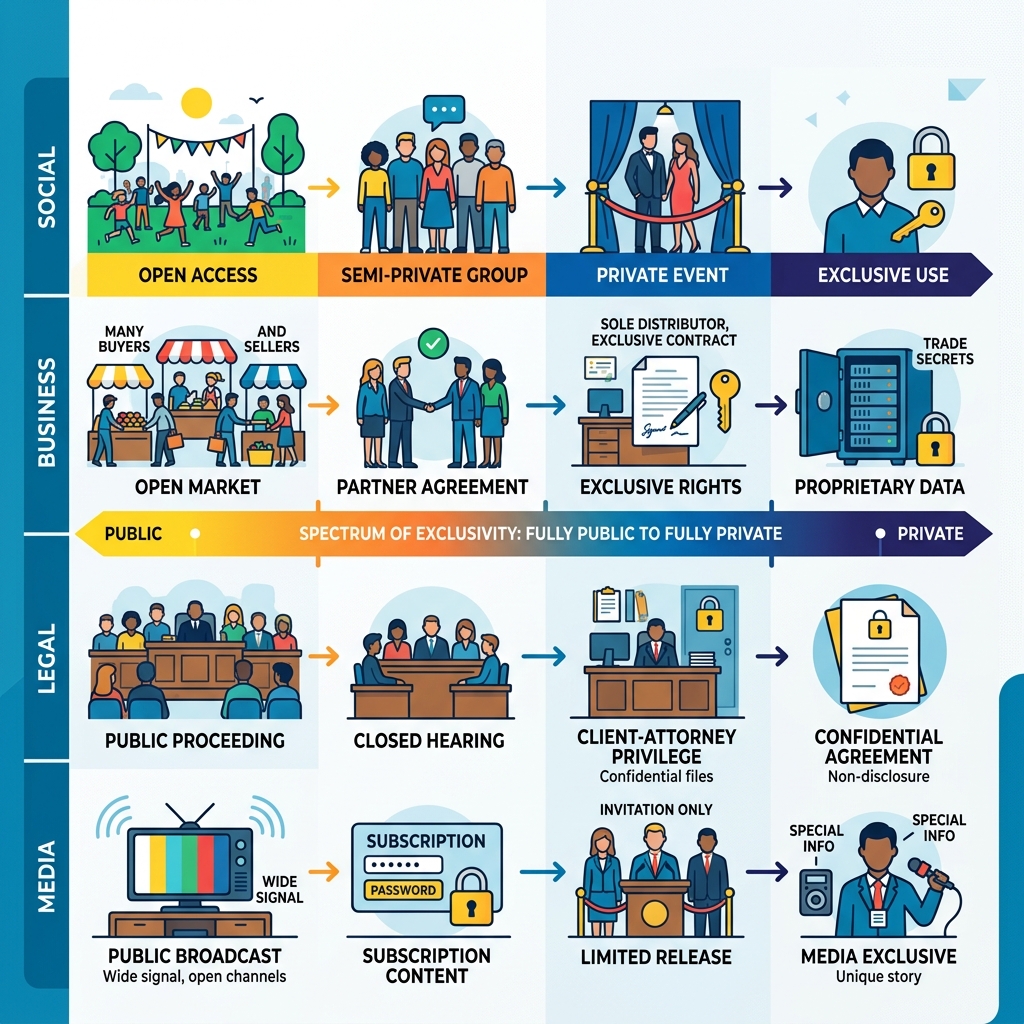
The exclusive meaning is broader than most people realize. At its core, exclusive describes something limited to one person, group, or purpose — and that limitation is exactly what gives it power. In the world of high-stakes business and digital strategy, exclusivity isn’t just a luxury; it’s a defensive moat. When we talk about exclusive access, we are talking about the control of resources, whether those resources are physical goods, legal rights, or digital information. This concept is the bedrock of value creation in modern markets.
Here is a quick breakdown of the main meanings:
| Context | What “Exclusive” Means |
|---|---|
| General adjective | Limited to one person or group; not shared |
| Luxury/social | High-end, restricted access, upper-class |
| Business/legal | Sole rights, sole supplier, sole ownership |
| Journalism (noun) | A story or interview no other outlet has |
| Pricing (“exclusive of”) | Not including (e.g., exclusive of tax) |
| Logic (“mutually exclusive”) | Two things that cannot both be true at once |
So when you hear “exclusive,” the meaning shifts depending on the context. A restaurant can be exclusive because it is hard to get into. A contract can be exclusive because only one party holds the rights. A news story can be an exclusive because only one outlet broke it.
What ties all these uses together is a single idea: access is restricted, and that restriction creates value. This is particularly true in the digital age, where information is abundant but ‘exclusive’ insight is rare.
Consider this — research shows that 17% of women and 8% of men reported being exclusive in a relationship while their partner was not. Even in personal life, the word carries weight precisely because not everyone is included.
That paradox is what makes “exclusive” such a loaded, fascinating word across business, media, law, and culture.
I’m Chris Robino, a digital strategy and AI search expert with over two decades of experience helping brands understand how concepts like exclusive meaning shape everything from content strategy to intellectual property and market positioning. In the sections ahead, I’ll break down every major context where “exclusive” matters — and how you can use that understanding strategically.
Decoding the exclusive meaning in Business and Media

To truly grasp the exclusive meaning, we have to look at how the word functions as both an adjective and a noun. Linguistically, the word traces back to the Medieval Latin exclūsīvus, appearing in English between 1400 and 1450. It is the active form of “exclude,” which literally means to shut others out.
In a business or social setting, calling something “exclusive” acts as a high-status descriptor. It suggests that a product, area, or group is fashionable, expensive, or restricted to a “select” patronage. For example, an estate agent might describe a new neighborhood as an “exclusive development of detached executive homes.” Here, the exclusive meaning implies that the barrier to entry (usually price or social standing) is high.
The word can also mean “snobbishly aloof.” We see this in social dynamics where groups resist outsiders to maintain a specific internal culture. Whether it’s an exclusive private club or an exclusive shop, the goal is to provide goods or services to a limited number of people, often the wealthy or those with specific credentials.
The exclusive meaning in Journalism and Digital Content
In media, “exclusive” often shifts from an adjective to a noun. When a news organization lands a “scoop”—a story, interview, or footage that no one else has—they call it “an exclusive.”
We see this constantly in digital distribution. A website might host exclusive video clips to drive subscriptions, or a journalist might secure an exclusive interview with a high-profile figure from their home. This creates a temporary monopoly on information. If you want that specific knowledge, you have to go to that specific source.
At ChrisRobino.com, we understand that content is a currency. To see how this works in practice, you can Access Exclusive Content to understand how unique positioning drives audience loyalty. In journalism, being the “exclusive” source isn’t just about being first; it’s about being the only one, which significantly boosts brand authority.
Legal and Commercial Rights: Patents and Sole Ownership
In the legal and commercial sectors, the exclusive meaning is tied to control and protection. When a company has “exclusive rights,” it means they are the only entity allowed to perform a specific action, such as distributing a product or using a trademark.
Consider these real-world statistics:
- Patent Ownership: For approximately $10,000 (the typical legal cost of a patent application), a patent owner secures 20 years of exclusive ownership of an idea.
- Licensing: A gambling firm might pay for a 12-year exclusive agreement for rights on an island, ensuring no competitors can set up shop nearby.
This type of exclusivity is foundational to intellectual property. It allows creators and businesses to recoup their investments by preventing others from “free-riding” on their innovations. We explore the mechanics of this in our guide on The ABCs of Digital: Understanding Identity, Rights, and Distribution. Whether it is a software license granting exclusive usage to a purchaser or a sole supplier agreement for a new jet engine, the legal weight of “exclusive” ensures that “unshared” really means unshared.
Mutually Exclusive vs. Exclusive Of: Logic and Pricing
We also encounter the exclusive meaning in more technical applications, specifically in logic and financial calculations.
- Mutually Exclusive: This is a logical term used when two things cannot happen or exist at the same time. For instance, in a coin toss, “heads” and “tails” are mutually exclusive. However, in social commentary, people often point out that certain traits are not mutually exclusive—such as “ethics and high performance” or “being rich and being a Socialist.”
- Exclusive Of: In pricing, this phrase is used to show what is not included in a total. If a hotel room is “£315 exclusive of VAT,” you need to be prepared to pay the tax on top of that base price. This is common in service charges and international trade.”
The Psychology and Strategy of Exclusivity
Why do we care so much about things being exclusive? There is a deep psychological pull toward things that are restricted. We tend to equate “limited access” with “high value.” You would think that excluding people is a negative trait, but in marketing, it’s a powerful tool. By being exclusive, resorts, restaurants, and clubs actually become more desirable to the general public.
Exclusivity often caters to a privileged minority. This creates a sense of “belonging” for those inside the circle and a “desire to join” for those outside it. It’s the “velvet rope” effect—the restriction itself is the product.
Nuanced Synonyms: Select, Sole, and Private
While “exclusive” is the most common term, it’s often confused with its synonyms. Understanding the subtle differences helps us use the right word for the right situation.
| Term | Nuance | Best Use Case |
|---|---|---|
| Exclusive | Emphasizes the act of shutting others out. | “An exclusive club.” |
| Select | Emphasizes the high quality or “chosen” nature. | “A select group of experts.” |
| Sole | Emphasizes being the only one, often in a legal sense. | “The sole survivor” or “sole owner.” |
| Private | Emphasizes that it is not for public knowledge or use. | “A private conversation.” |
The term “exclusive” is often considered the strongest because it implies an active prohibition of others. “Sole” is more neutral—it just means there is only one—whereas “exclusive” suggests there could be others, but they have been intentionally barred.
Applying the exclusive meaning to Modern SEO and Authority
In the modern digital landscape, the exclusive meaning has taken on a new life through Search Engine Optimization (SEO) and Artificial Intelligence. For large companies, SEO is no longer about chasing individual keywords; it is about establishing ‘Exclusive Topical Authority’ at scale. Enterprise SEO strategies require a focus on technical infrastructure and content systems that smaller competitors simply cannot replicate.
One of the most effective SEO strategies for large companies is Scalable Content Architecture. Large organizations often possess vast amounts of proprietary data. By transforming this ‘exclusive’ data into helpful, user-centric content—such as industry benchmarks, trend reports, or localized data sets—enterprises can create thousands of unique pages that provide value no one else can offer. This is the ultimate application of the exclusive meaning: providing information that is literally unavailable elsewhere.
Another critical strategy is Crawl Budget Management. For websites with millions of URLs, the ‘exclusive’ attention of search engine bots is a finite resource. Large companies must use advanced technical SEO to prune low-value pages, manage faceted navigation, and ensure that bots are directed toward the most important, high-revenue sections of the site. This involves a rigorous process of ‘exclusion’—intentionally hiding certain parts of the site from indexation to boost the visibility of others.
Furthermore, large-scale Internal Linking Strategies allow enterprises to leverage their massive domain authority. By creating ‘exclusive’ content hubs that link deeply into sub-categories, large brands can ensure that new pages inherit the trust and ranking power of the main domain almost instantly. This ‘velvet rope’ approach to link equity ensures that the most important content always stays at the top of search results.
Google and other AI-driven search engines are no longer just looking for keywords; they are looking for “Topic Clarity” and “Authority.” When we talk about “Authority Content,” we are talking about creating information that is so comprehensive and unique that it becomes the “exclusive” best answer for a user’s query. AI systems now use “embeddings” to measure how closely your content matches the user’s intent. If your content provides an exclusive insight that isn’t found elsewhere, AI Overviews are more likely to cite you as a primary source.
To build this kind of digital moat, you must focus on Authority Content: How to Build Credibility Through Content. This involves:
- Brand Mentions: Getting your name cited on reputable third-party sites.
- Topical Authority: Covering a subject so deeply that you become the “go-to” source.
- Zero-Click Optimization: Providing such clear, “exclusive” value that your brand is recognized even if the user doesn’t click through.”
Conclusion: Building Value Through Strategic Exclusion
At the end of the day, understanding the exclusive meaning is about understanding value. Whether you are protecting a patent for 20 years, breaking a news story that no one else has, or building a brand that only a certain “select” group can access, you are using the power of the “velvet rope.” For large enterprises, this means moving beyond generic marketing and toward a strategy of ‘Exclusive Dominance’—where your technical SEO, content depth, and brand authority create a barrier to entry that competitors cannot cross.
We believe that true value isn’t found in being everything to everyone. It’s found in standing for something specific and protecting that space. As we discuss in The Worth of Value, the most successful strategies often involve a level of strategic exclusion—deciding who you are not for so that you can be everything to the people you are for. This clarity is what allows large companies to maintain their market position even in rapidly changing digital environments.
If you are looking to refine your digital presence or protect your intellectual property in an AI-driven world, we invite you to Access Content Monetization Strategies to see how we apply these concepts to real-world business growth. Exclusivity isn’t just about being “posh”—it’s about being irreplaceable.