

Why Social Media Industry Trends Matter More Than Ever
For large organizations, understanding social media industry trends is no longer just a marketing advantage—it’s a core enterprise SEO strategy. As platforms evolve from simple networking tools into sophisticated discovery and shopping engines, they heavily influence how your brand is found, evaluated, and trusted online.
Algorithms now prioritize relevance, engagement quality, and authority over raw follower counts. At the same time, search engines increasingly factor social signals, brand mentions, and user behavior into how they rank enterprise sites. This convergence means that enterprise SEO and social media performance are tightly connected.
For large companies managing multiple brands, regions, and product lines, winning in search requires:
- Coordinated content and technical SEO across corporate sites, blogs, and social channels
- Data-driven insights into how audiences search, scroll, and shop
- Systems and governance that keep messaging aligned at scale
The pages that perform best in search for big brands now tend to be those that:
- Anticipate platform and algorithm changes
- Integrate social proof and authentic content
- Align content calendars with search intent and seasonal demand
In this guide, we’ll explore the top social media industry trends and show how they translate into SEO strategies that perform well for large companies—from AI-enhanced content operations to social-first search behavior and multi-channel measurement.
Well-executed enterprise SEO today depends on:
- Aligning content with social media industry trends and audience behavior
- Structuring sites and content so both users and algorithms can quickly understand your value
- Building durable authority through consistent signals across search, social, and owned channels
The sections below break down how each major trend can support a scalable, defensible SEO program for large organizations.
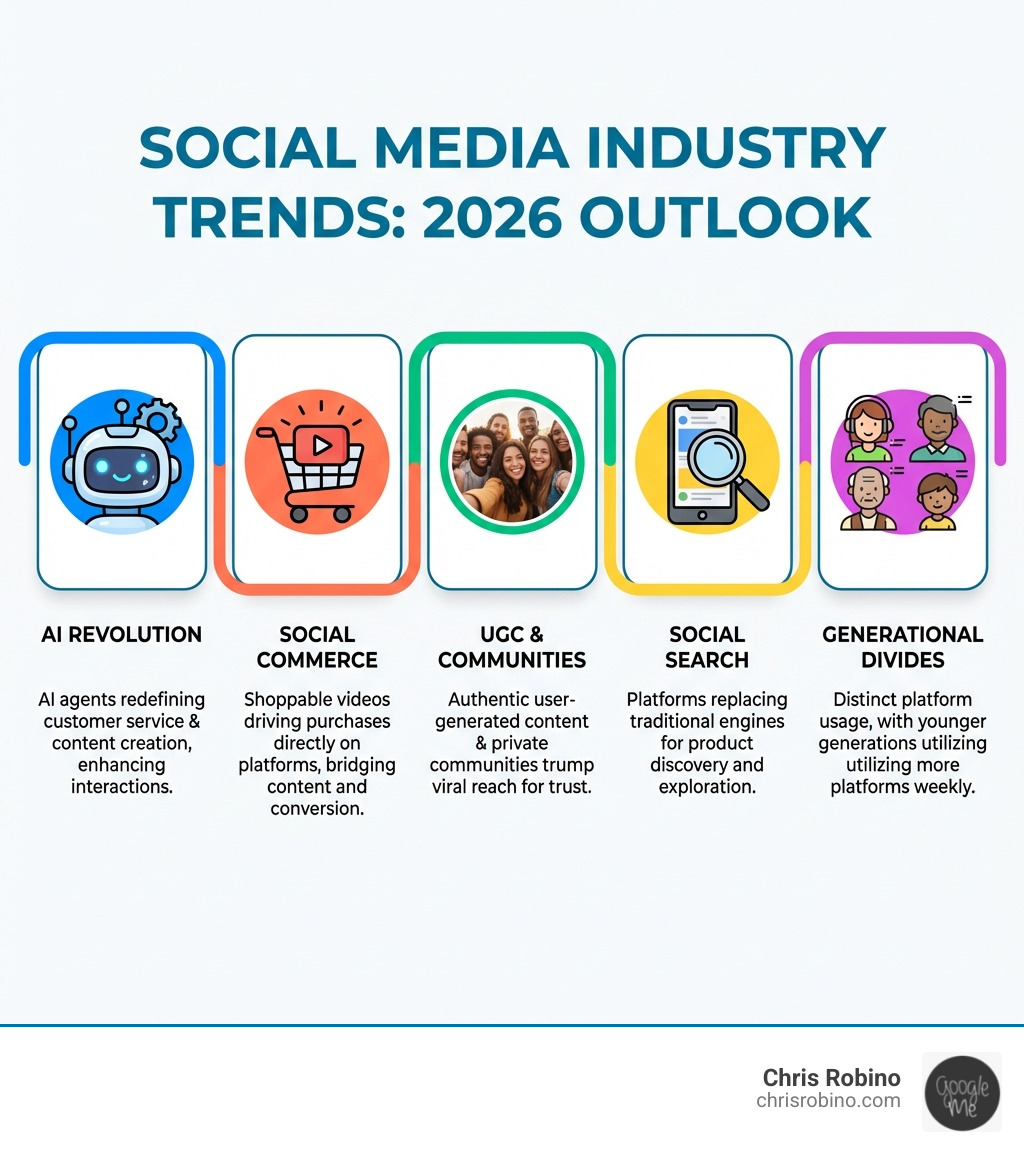
The Top 5 Social Media Industry Trends Shaping 2026
The social media landscape is evolving at a dizzying pace. For 2026, five pivotal social media industry trends will redefine how brands engage, sell, and build loyalty—and they have direct implications for enterprise SEO strategies.
1. The AI Revolution: From Content Creation to Enterprise-Scale Optimization
Artificial Intelligence (AI) is now the backbone of social media and enterprise marketing, reshaping both content and customer service. For large companies, AI is particularly powerful when used to support, not replace, robust SEO fundamentals. According to recent studies, 97% of marketing leaders believe marketers must know how to use AI.

Effective enterprise SEO applications of AI include:
- Keyword and intent clustering at scale: Using AI to group thousands of queries by intent and funnel stage so large sites can map content systematically to what users actually search for.
- Content gap analysis: Identifying topics competitors rank for but your brand does not, then prioritizing high-impact content for corporate blogs, resource centers, and product pages.
- Metadata and on-page optimization: Drafting and testing SEO titles, meta descriptions, and schema markup variations across thousands of URLs while maintaining brand voice.
- Localized SEO at scale: Supporting region-specific keyword research, translations, and cultural adaptation for multi-market brands.
Ethical use remains essential. Large brands need clear AI governance for:
- Disclosing AI involvement where appropriate
- Establishing review processes so human experts approve or refine AI-assisted content
- Avoiding thin, generic copy that can damage rankings and brand trust
The most successful enterprise SEO programs treat AI as an accelerator for strategy, research, and production—while keeping humans in charge of judgment, nuance, and accountability.
2. Short-Form Video, Social Commerce, and Search Visibility
Short-form video dominates attention on platforms like TikTok, Instagram Reels, and YouTube Shorts. For large companies, its role in SEO is indirect but powerful. For instance, studies show that 89% of people say watching a video has convinced them to buy a product.
Short-form video and social commerce influence enterprise SEO in several ways:
- Brand search growth: Viral or high-performing videos drive spikes in branded queries, which can signal relevance and authority to search engines.
- SERP real estate: Video content often appears in search results. Well-optimized video titles, descriptions, and transcripts can help your content surface across both video and web search.
- Metadata reuse: Keywords and hooks that perform well in short-form social content can be repurposed in page titles, headings, and FAQ sections on your main site.
- On-site video hubs: Embedding curated video libraries on category or solution pages can improve engagement metrics (time on page, scroll depth) that correlate with strong organic performance.
For social commerce, large companies can support SEO by:
- Maintaining consistent product data across social shops and the primary website (names, descriptions, pricing), reinforcing clear entity signals
- Linking from social profiles and content to strategic landing pages that are optimized for organic search and conversions
- Capturing and reusing social insights (questions in comments, objections raised in DMs) to improve product copy, comparison pages, and support content
The key is integration: social content drives awareness and demand, while the website captures that demand through search-optimized, conversion-focused pages.
3. Authenticity, UGC, and Enterprise Authority Signals
In a digital world saturated with content, authenticity has become the most valuable asset. For large brands, this directly ties into building E-E-A-T (Experience, Expertise, Authoritativeness, Trustworthiness) signals that support strong rankings. Studies indicate that consumers are 2.4 times more likely to view user-generated content as authentic compared to brand-created content.

Enterprise SEO gains from authenticity and UGC include:
- Review and rating visibility: Aggregated ratings, testimonials, and case studies can be marked up with structured data, improving rich result eligibility in search.
- Social proof on key pages: Embedding curated UGC, quotes, or case highlights on product, solution, and pricing pages can increase conversion and reduce bounce rates.
- Content sourced from real questions: Mining community discussions and customer conversations to create FAQ hubs, knowledge base content, and long-form guides that directly address searcher pain points.
- Expert perspectives: Featuring named subject-matter experts (with bios and authored pages) strengthens topical authority and signals real-world experience.
Private or niche communities (such as specialized groups or forums) also help enterprise SEO when they are:
- Used to validate content topics before major investments
- A source of language and terminology your audience actually uses, which you can mirror in headings, copy, and schema
- Connected back to your main site via educational resources, documentation, and event recaps
For large organizations, the shift is from broadcasting polished messages to orchestrating authentic proof and dialogue—then structuring and surfacing that proof in ways search engines can understand.
4. Social Search and Performance-Driven Enterprise SEO
Social media platforms are rapidly becoming findy and search engines in their own right. Users don’t just search on traditional engines; they look for products, tutorials, and reviews directly on social platforms.
For large companies, this means search strategy must be truly cross-channel:
- Optimize for social search: Incorporate keywords, hashtags, and natural-language phrases into profile bios, captions, and video descriptions that mirror how people search.
- Align content with multi-platform intent: If a query is popular on social (e.g., “how to use [product] for [job]”), there is often parallel search demand. Create coordinated assets: short-form videos, long-form guides, and support articles.
- Use performance data from social to inform SEO: High-engagement topics and formats can guide which themes deserve full landing pages, pillar content, or expanded FAQs on your website.
At the same time, organic reach declines on some platforms make paid promotion an important complement. For enterprise SEO, this is less about ranking directly and more about:
- Accelerating data collection on new content and offers
- Boosting visibility of thought leadership or resource content you want associated with key topics
- Seeding brand familiarity so that users are more likely to click organic listings when they later search
A mature enterprise program connects:
- Social listening and platform analytics
- Web analytics and search console data
- First-party CRM and conversion tracking
…to build a unified view of which topics, formats, and channels move the needle. This performance-driven feedback loop allows large organizations to prioritize SEO investments with the highest long-term impact.
5. Generational Divides, Platform Choices, and Enterprise Content Architecture
An effective social and SEO strategy for large companies requires a nuanced understanding of who uses which platforms—and how that maps to your site architecture and content plans.
Different generations and demographics rely on different platforms for:
- Inspiration and findy
- Peer recommendations
- Deep research and comparison
Enterprise SEO can capitalize on these patterns by:
- Mapping platforms to funnel stages: For example, younger audiences might find brands on short-form video platforms, then search for “[brand] reviews” or “[brand] vs [alternative]” on traditional search. Ensure robust comparison pages, reviews, and explainer content exist and are optimized.
- Structuring content by audience segment: Create hubs or navigation paths oriented to key segments (e.g., by industry, role, or use case) that reflect how different groups research.
- Local and regional nuance: Platform preferences and search behavior vary by market. Large organizations should localize not only language but also examples, case studies, and FAQs to match regional expectations.
Understanding these divides also influences internal linking and site hierarchy:
- Top-level navigation should reflect the primary ways your best customers find and evaluate you
- Supporting content (guides, calculators, demos, webinars) should be tightly interlinked with core product or solution pages
- Social profiles and content should point back to the most relevant section of your site for each segment, reinforcing clear topical clusters
In combination, this creates a coherent ecosystem in which social activity feeds findy, and your web properties are structured to capture and convert that interest through strong organic visibility.
Conclusion: Navigating the Future of Social Media and Enterprise SEO
The social media industry trends shaping 2026 point toward a digital environment where discovery, trust, and purchase decisions are distributed across many platforms—but still anchored by how well your primary site performs in search.
For large companies, winning in this environment requires:
- Treating AI as an accelerator for research, planning, and optimization—while maintaining human oversight and clear standards
- Using short-form video and social commerce to spark demand and feed branded search growth
- Turning authenticity, UGC, and expert voices into structured, search-friendly authority signals
- Integrating social search insights with traditional SEO, so your content answers real questions across channels
- Designing site architecture and content for how different generations and segments actually research and buy
The organizations that thrive will be those that move beyond siloed social and SEO efforts and instead build integrated, data-driven programs. That means shared goals, shared measurement, and shared insights across brand, content, paid media, and technical teams.
The fundamentals remain the same: understand your audience, offer real value, make it easy to find and understand your solutions, and prove your credibility. What’s changing is the scale, the speed, and the number of touchpoints where those fundamentals must show up consistently.
By aligning enterprise SEO with the most important social media industry trends, large companies can transform search from a reactive channel into a strategic growth engine—one that compounds over time and supports durable competitive advantage.