

Why Business Model Innovation Is Your Next Competitive Edge
For large companies, business model innovation and enterprise-level SEO strategy increasingly go hand in hand. As organizations rethink how they create, deliver, and capture value, they must also ensure that customers can easily find that value online at scale.
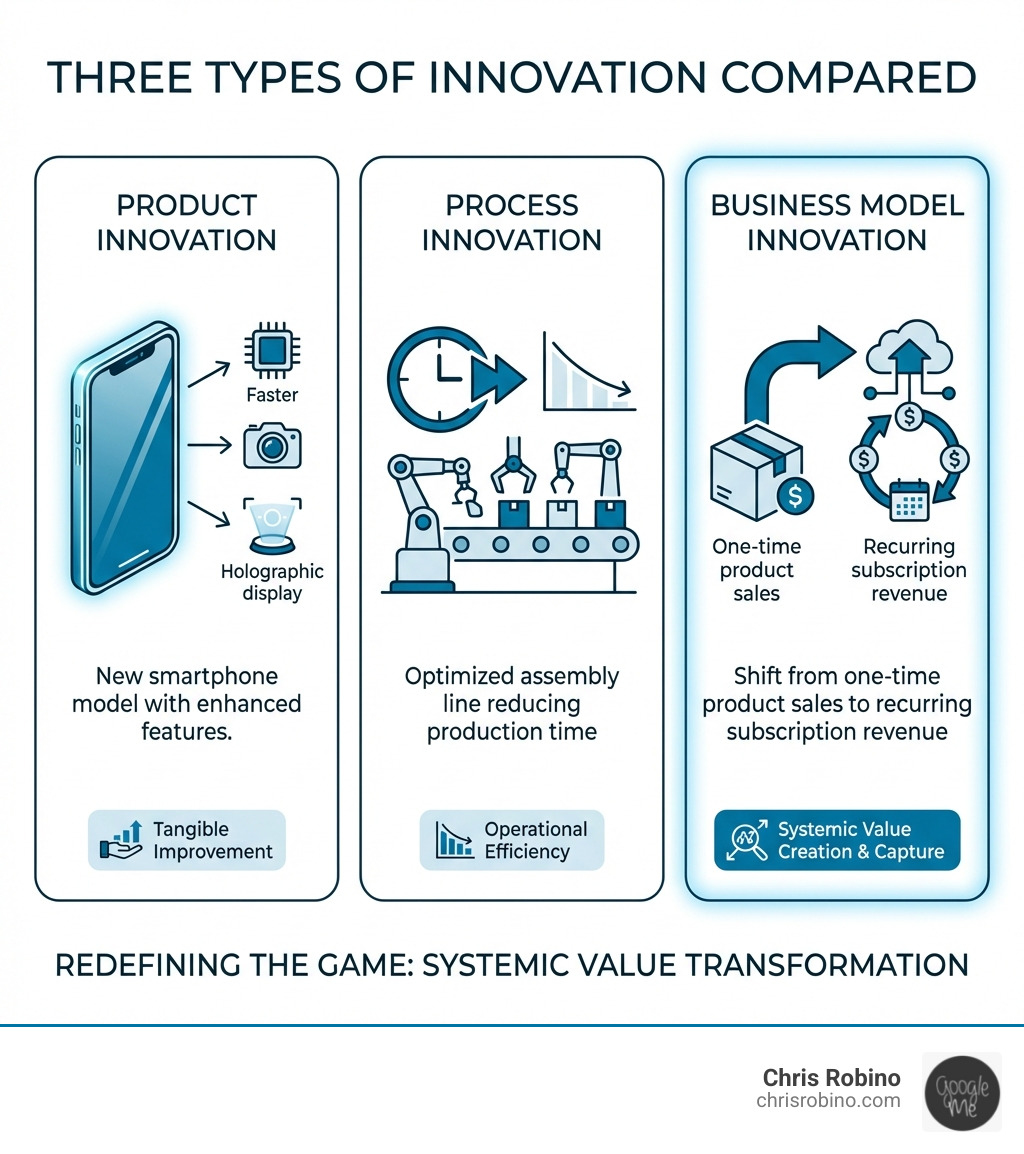
Unlike product innovation (new features) or process innovation (efficiency gains), business model innovation reshapes your entire system by altering core components:
- Value Proposition: What you offer and to whom.
- Operating Model: How you deliver it profitably.
- Revenue Model: How you capture value.
At scale, SEO becomes a strategic lever within this model. It influences how customers discover your value proposition, how content supports your operating model, and how organic traffic drives your revenue model.
Consider a diversified global enterprise. It might operate multiple brands, thousands of product pages, and dozens of regional sites. The companies that win in search are those that treat SEO as a strategic capability, embedded into their business model rather than a last‑mile marketing tactic.
Large organizations that prioritize this approach consistently see:
- Lower customer acquisition costs from organic channels.
- Stronger brand authority and trust.
- Higher lifetime value from better‑qualified organic traffic.
This guide breaks down what business model innovation is, how it intersects with SEO for large companies, four strategic paths you can take, and a practical framework for implementing SEO in a way that strengthens your overall model.
I’m Chris Robino, a digital strategy leader who has spent over two decades helping organizations—from tech startups to established enterprises—transform how they create and capture value using AI‑driven systems, strategic business model innovation, and scalable SEO strategies. I guide companies through rethinking their fundamental approach to digital growth, ensuring solutions are results‑oriented and aligned with long‑term performance.
In this context, business model innovation includes:
- Enterprise SEO strategy: How your organization uses organic search to support market entry, product positioning, and revenue models.
- Content monetization strategies: How search‑optimized content drives pipeline, direct revenue, or indirect value.
- Audience engagement strategies: How you use search insights to understand demand and design better offerings.
When SEO is aligned with your business model, it becomes a durable competitive edge rather than a checklist of technical tasks.
Understanding Business Model Innovation
At its core, business model innovation is about fundamentally rethinking how your company operates to deliver value. For large companies, this increasingly includes how you structure and scale your SEO strategy to match your markets, product lines, and regions.
What is Business Model Innovation and How Does It Differ?
Business model innovation improves value by making simultaneous changes to an organization’s value proposition and its underlying operating model. It uses the business model itself as the mechanism for innovation, going beyond products or processes.
How does it differ from other forms of innovation?
- Product Innovation: Focuses on what you offer, like creating a new smartphone model or software application.
- Process Innovation: Focuses on how you deliver, improving efficiency or quality. The moving assembly line, for example, revolutionized manufacturing by dramatically reducing production time.
Business model innovation is a holistic system change, rethinking how a company creates, delivers, and captures value. For digital enterprises, this includes how search, content, and data are integrated into the way the business functions.
For example, a company that once relied primarily on field sales might reorient its model so that:
- Organic search and educational content generate a significant share of qualified leads.
- Product, marketing, and SEO teams collaborate on search-driven product positioning.
- Search data informs which markets or segments to prioritize.
The Core Components and Where SEO Fits
To innovate your business model, you must understand its building blocks. The Business Model Canvas outlines nine key areas:

- Value Proposition – SEO reveals how customers describe their problems and desired outcomes. This language shapes how you frame your offerings.
- Customer Segments – Search behavior highlights which segments are actively researching solutions and the intent behind their queries.
- Customer Relationships – Evergreen, search-optimized content builds ongoing relationships and positions your brand as a trusted advisor.
- Channels – Organic search is a primary digital channel that can scale globally with the right structure.
- Revenue Streams – High-intent organic traffic often converts efficiently, supporting both direct sales and pipeline generation.
- Key Resources – Content, data, technical infrastructure, and SEO expertise become critical assets for growth.
- Key Activities – Continuous keyword research, technical optimization, and content development become core operating rhythms.
- Key Partnerships – Strategic partnerships (such as technology vendors or publishing partners) can extend your content reach and signals.
- Cost Structure – SEO requires upfront investment in people and platforms but typically lowers marginal acquisition costs as performance compounds.
Key SEO Drivers for Large Companies
Several forces push large enterprises to formalize and scale SEO as part of business model innovation:
- Technological Advancements: AI-supported content workflows, automation for large-scale technical fixes, and advanced analytics enable SEO at thousands of URLs.
- Shifting Customer Needs: Customers expect self-service research, transparent information, and localized content. SEO ensures that content surfaces at the right moment.
- Market Disruption: New digital-first entrants often gain share through strong organic visibility. Incumbents must respond with robust SEO strategies.
- Regulatory and Economic Shifts: Changes in privacy rules and rising paid media costs make organic search a more attractive, resilient channel.
Four Paths to Business Model and SEO Innovation
A useful way to think about business model innovation is through four strategic paths, each with SEO implications for large companies:

The Reinventor:
- Reinvents the core business to deliver a new value proposition.
- SEO Focus: Rebuilds information architecture, consolidates legacy domains, and aligns content with a refreshed positioning.
The Adapter:
- Adapts by exploring adjacent markets. A large consumer goods company entering the pet care industry, for example, exemplifies this approach.
- SEO Focus: Uses search demand data to identify promising adjacencies, then launches targeted content hubs and localized experiences.
The Maverick:
- Uses a core advantage to revolutionize an industry.
- SEO Focus: Educates the market on new categories, building authority around emerging topics and intent that traditional players ignore.
The Adventurer:
- Expands into new territories by leveraging existing strengths.
- SEO Focus: Scales into new geographies with localized keyword strategies, technical internationalization (hreflang, regional domains), and region-specific content.
Understanding these paths helps in designing an effective growth strategy where SEO is not just an add-on, but a structural component of how your business model performs.
Implementing Your New Business Model
Successfully implementing business model innovation and the SEO strategies that support it requires a structured approach that combines strategic foresight with rigorous experimentation.
A Step-by-Step Framework for SEO at Scale
To implement a new business model, organizations must shift from a product‑centric view to a holistic, system‑wide perspective. The same applies to SEO: it must move from one‑off optimizations to an integrated operating model.
Here is a practical, four‑step framework:
Measure Risks and Opportunities
- Audit your entire digital footprint: domains, subdomains, content libraries, and technical foundations.
- Map where organic traffic is strong, where it is underperforming, and where you are invisible.
- Identify risks such as duplicated content across brands, slow page performance at scale, and fragmented ownership.
- Quantify opportunity by aligning search demand with your strategic priorities (products, regions, customer segments).
Reallocate Resources and Responsibilities
- Decide how SEO ownership will be structured: centralized center of excellence, embedded specialists in business units, or a hybrid model.
- Align incentives across marketing, product, engineering, and content teams so SEO is a shared outcome, not a siloed metric.
- Ensure clear workflows for:
- Prioritizing technical fixes (crawlability, internal linking, site structure).
- Systematic content creation for key topics and stages of the funnel.
- Governance over templates, components, and metadata.
Experiment Rigorously
- Use test‑and‑learn approaches similar to product experimentation:
- Run controlled tests on page templates (layout, content depth, internal links).
- Pilot new content formats (guides, tools, case studies) in one region or product line before global rollout.
- Develop hypotheses such as:
- “Improving page speed across our top 500 URLs will increase organic conversions by X%.”
- “Launching a structured content hub around a core topic will lift non‑branded traffic by Y%.”
- Use analytics to validate results and feed them back into both SEO and broader business model decisions.
- Use test‑and‑learn approaches similar to product experimentation:
Roll Out and Operationalize
- After validating your model through experimentation, scale successful practices:
- Standardize winning page templates in your design system.
- Build content playbooks and keyword frameworks for global teams.
- Integrate SEO requirements into product and development roadmaps.
- Treat SEO as continuous improvement rather than a one‑time project, with regular reviews tied to business outcomes.
- After validating your model through experimentation, scale successful practices:
Navigating Risks and Balancing Novelty
Business model innovation and large‑scale SEO both carry risks, including internal resistance to change and the potential to disrupt existing channels. For example, teams heavily invested in paid media may worry about budget reallocation to organic initiatives.
A more subtle danger is the “novelty trap”—assuming that new formats or tactics alone guarantee success. High‑performing SEO programs at large companies balance novelty with operational discipline:
- New content is created within a clear, measurable framework.
- Technical standards are enforced consistently across brands and regions.
- Governance ensures that local experimentation does not fragment global performance.
Companies that once dominated through offline channels or legacy digital approaches can lose ground if they fail to adapt their business models and search strategies. Aligning SEO with business model evolution means:
- Revisiting how you define your market in terms of real search behavior.
- Ensuring your site structure matches how customers think, not just how your org chart is arranged.
- Continuously updating content and experiences based on changing demand.
The Role of Technology in Enterprise SEO
Technology is a fundamental enabler of business model innovation and SEO at scale. Modern advancements offer new ways to create, deliver, and capture value:
- Artificial Intelligence (AI):
- Accelerates keyword clustering and intent analysis.
- Supports content briefs, outlines, and optimization at scale while keeping human oversight for quality and originality.
- Automation and Cloud Infrastructure:
- Enable bulk technical improvements (metadata, internal linking, redirects) across thousands of pages.
- Support experimentation environments without risking core properties.
- Analytics and Data Platforms:
- Combine search data with CRM and revenue data to measure true impact on pipeline and customer value.
- Content Management Systems (CMS):
- Allow global teams to apply SEO best practices consistently through reusable templates and components.
Enterprises that adopt a customer‑defined perspective use technology not just to optimize rankings, but to understand intent, remove friction, and guide product and content decisions.
Measuring SEO Success in Large Organizations
Measuring success is critical, especially when SEO spans brands, languages, and business units. Key performance indicators (KPIs) to track include:
Organic Revenue and Pipeline Contribution
- Direct revenue from organic sessions (for e‑commerce or transactional models).
- Opportunities, deals, or subscriptions influenced by organic traffic (for B2B or subscription models).
Customer Acquisition Efficiency
- Changes in customer acquisition cost (CAC) as organic performance improves.
- Relative mix of organic vs. paid acquisition over time.
Visibility and Share of Voice
- Rankings and click‑through rates for strategic, non‑branded queries.
- Share of voice within critical topic clusters compared to your historical baseline.
Engagement and Quality Signals
- Time on page, depth of visit, and return visits from organic sources.
- Conversion rates by intent level (informational, consideration, transactional).
Operational and Technical Health
- Index coverage, crawl efficiency, and page speed for key templates.
- Reduction of duplicate and thin content across domains.
By monitoring these metrics, large companies can ensure that their business model innovation and SEO strategies are not just novel, but truly transformative and sustainable. When search is integrated into your operating model—rather than treated as an isolated tactic—it becomes a durable, compounding advantage that strengthens your position in existing markets and accelerates entry into new ones.