

Why Every Professional Needs a Clear Example of Thought Leadership Right Now
An example of thought leadership can be hard to pin down — so here are the most common forms you’ll encounter, especially as they relate to high-level digital strategy and enterprise-scale influence:
| Type | What It Looks Like |
|---|---|
| The Storyteller | A leader shares a personal failure and the lesson it taught |
| The Educator | An executive publishes original research that challenges industry norms |
| The Actionable Executive | A CEO outlines a real decision, with before/after results |
| The Lobbyist | A founder advocates publicly for a controversial industry change |
| The Motivator | A speaker inspires action through a compelling vision (think Simon Sinek’s Start With Why, viewed by over 60 million people) |
These aren’t just content types. They’re how real trust gets built — especially in B2B environments where the complexity of the sale requires a high degree of perceived authority. For large companies, this authority must be mirrored in their SEO strategy. It is no longer enough to rank for keywords; a large organization must own the “entity” of the topic itself.
Here’s the thing: a lot of content online looks like thought leadership but isn’t. It’s just repackaged advice with no real point of view. And decision-makers notice. According to Edelman, 71% of executives say that less than half of the thought leadership they consume actually gives them valuable insights. This gap is where enterprise SEO strategies must pivot from volume-based publishing to authority-based signaling.
True thought leadership takes a stand. It’s grounded in real experience. It challenges how people think, not just what they know. And in 2026, with AI flooding every feed with look-alike content, that kind of authentic voice matters more than ever. Large companies that fail to integrate their unique insights into their search strategy risk being buried by generic AI-generated summaries.
I’m Chris Robino, a digital strategy and AI search expert who has spent over two decades helping organizations build authority online — and finding a clear example of thought leadership that actually resonates with decision-makers is something I work on every day. Let’s break down exactly what that looks like in practice, particularly for large-scale organizations looking to dominate their niche.
Defining the Best Example of Thought Leadership for Your Brand
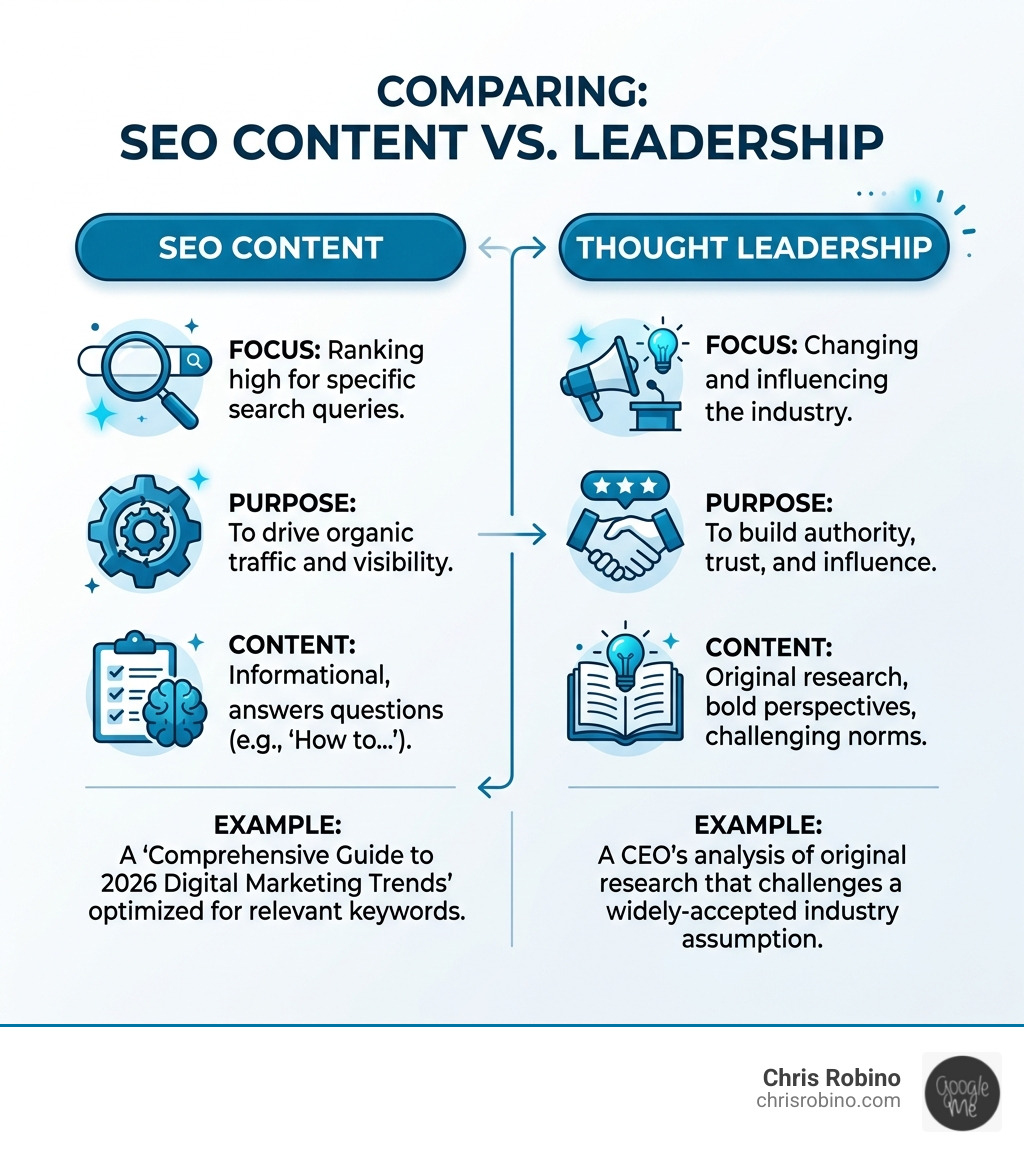
To find a winning example of thought leadership, we first have to separate it from traditional marketing. Traditional SEO content is designed to answer a search query; thought leadership is designed to change a mindset. While 71% of decision-makers read these pieces to develop new ideas, they are increasingly skeptical of “hollow” content. For large companies, the strategy must involve “Information Gain”—a concept where search engines reward content that provides new, unique information not found in other articles on the same topic.

True thought leadership requires three pillars: expert knowledge, intellectual courage, and industry authority. It isn’t about being “right” all the time; it’s about being willing to be wrong in pursuit of a better way forward. As we navigate April 2026, the rise of Generative AI has created a “sameness” in digital content. If your article sounds like a consensus-based AI summary, it isn’t thought leadership. In fact, some experts argue that Has AI Ended Thought Leadership? because the category is being commoditized by automated idea generation.
To stand out, we must lean into “earned insights”—lessons that could only be learned through the “bruises” of real-world experience. For large companies, this means mining the vast data sets they already own to produce insights that no one else can replicate.
| Feature | Traditional Marketing/SEO | Thought Leadership |
|---|---|---|
| Goal | Rank for keywords, drive traffic | Build trust, influence industry narrative |
| Source | Keyword research, common knowledge | Lived experience, original data, contrarian POV |
| Tone | Helpful, service-oriented | Authoritative, provocative, visionary |
| Outcome | Clicks and conversions | Authority, speaking invites, board seats |
The Storyteller: Using Personal Narrative as an Example of Thought Leadership
Humans are biologically wired to learn through stories. When a leader shares a narrative about hiring a former hacker to test security, or failing to scale a sales process at $20M ARR, they aren’t just “sharing a tip.” They are building a human connection. In large organizations, storytelling can humanize a massive brand, making it more relatable and trustworthy.
Vulnerability is a superpower here. Leaders like Brené Brown have shown that admitting to professional struggles doesn’t weaken authority—it reinforces it. In a world of polished corporate speak, authenticity is the ultimate differentiator. To succeed as a storyteller, you must learn how to write authentic thought leadership that avoids the “safety trap” of softening your opinions. For more inspiration, you can explore these examples of thought leadership content to see how narrative drives engagement.
The Educator: Challenging Industry Norms with Data
The Educator doesn’t just curate news; they create it. This is often the most powerful example of thought leadership for B2B brands. By conducting original research or annual surveys, a brand becomes the primary source for the entire industry. For large companies, this is a core SEO strategy: becoming the “source of truth” leads to high-quality, natural backlinks that are impossible to buy.
When you publish data that proves a common industry belief is actually a myth—such as challenging the necessity of “provable marketing attribution”—you force the market to pay attention. This “Educator” style is about providing a new framework for thinking about old problems. If you want to master this, our b2b thought leadership content guide offers a deep dive into using data to anchor your authority.
The Actionable Executive: Solving Real-World Problems
Some of the best thought leadership is purely practical. This style focuses on “decision leadership.” Instead of vague advice, an Actionable Executive shares “receipts”—specific decision memos, operating principles, or “anti-patterns” (things they tried that didn’t work). This is particularly effective for large companies where operational complexity is a shared pain point among their peers.
The goal here is to help your audience avoid mistakes you’ve already made. For example, a CEO might detail exactly how they implemented an asynchronous work culture, including the specific software used and the cultural friction they encountered. This builds immense trust because it shows you are “in the trenches.” Following thought leadership content best practices ensures that your actionable advice remains high-level enough to be strategic but specific enough to be useful.
The Lobbyist: Changing the Industry Narrative
The Lobbyist is a crusader. This example of thought leadership is about persuasion and advocacy. Whether it’s fighting for better ethical standards in AI or arguing against traditional management hierarchies, the Lobbyist uses their platform to shift the status quo. For large companies, this often involves shaping the regulatory or ethical landscape of their entire sector.
This style requires the most “intellectual courage” because it often involves taking a controversial stand. However, 64% of buyers expect thought leadership to challenge the way they think. By being the voice of change, you attract a loyal following of like-minded professionals. Building this kind of authority content is how you move from being a vendor to being a partner.
The Motivator: Inspiring Action Through Vision
The Motivator focuses on the “Why.” Simon Sinek is perhaps the most famous example, with his “Start With Why” TED talk reaching over 60 million people. This style isn’t about the what or the how—it’s about the purpose behind the work. In an enterprise context, this vision is what aligns global teams and attracts top-tier talent.
Motivators often touch on themes of resilience, psychological safety, and innovation. They don’t just give you a checklist; they give you a reason to get out of bed. If your goal is to lead a movement rather than just a company, you need to stand out from the crowd with brilliant thought leadership content ideas that tap into human emotion and vision.
How to Become a Recognized Industry Authority
Becoming a thought leader isn’t an overnight process—it’s a 12-month journey of consistency. In 2026, the “fakes” are being weeded out. While AI can simulate intellect, it cannot simulate a human soul or a verifiable track record.
To build real authority, we recommend a “niche-down” strategy. Don’t try to be a thought leader in “Marketing.” Be the thought leader in “AI-Driven Search Personalization for B2B SaaS.” The smaller the niche, the faster you become the go-to resource. For large companies, this means identifying specific sub-sectors where they can dominate the conversation through specialized SEO strategies.
SEO Strategies for Large Companies: Scaling Authority
For large organizations, SEO is no longer just about technical audits; it is about “Entity Authority.” Here are the strategies that perform best at scale:
- Entity-Based Content Architecture: Large companies should move away from keyword-stuffing and toward building a “knowledge graph” on their site. This involves creating comprehensive topic clusters that link your thought leadership pieces to your core service pages, signaling to search engines that you are an expert across the entire subject matter.
- Programmatic Thought Leadership: Use data-driven automation to scale insights. For example, a global logistics firm can use its internal shipping data to create real-time reports on supply chain health. This creates thousands of unique, high-value pages that serve as an example of thought leadership at scale.
- Internal Link Graphs: Large sites often suffer from “orphaned” content. A sophisticated internal linking strategy that prioritizes your most provocative and authoritative pieces ensures that search engine crawlers (and users) can find your best thinking easily.
- Global Governance and Localization: Thought leadership must be localized to resonate. A strategy that works in New York might fail in Tokyo. Large companies must empower regional leaders to adapt the core narrative to local market nuances while maintaining a consistent global brand voice.
Creating Your Own Example of Thought Leadership Step-by-Step
We believe that every executive has a “well of insights” they aren’t tapping into. Here is how we recommend building your authority:
- Mine Your Contrarian Instincts: Write down five things you believe about your industry that most people disagree with. Pick the one that makes you slightly nervous to publish.
- Capture, Don’t Just Create: Busy leaders don’t have time to write 3,000-word essays. Record a 15-minute voice note after a major client meeting or board session. Note the surprises and the trade-offs.
- Choose Your Primary Platform: While LinkedIn is great for reach, platforms like Medium are often better for “Authority Building” because they reward depth over frequency. Research shows that leveraging high-authority platforms can drive 5x more inbound opportunities than social media alone.
- Provide the “Receipts”: Don’t just say AI will change things. Show how you used AI to replace high-cost agency services and what the specific results were.
- Multi-Platform Distribution: Repurpose your flagship piece into a LinkedIn carousel, a short-form video for YouTube Shorts, and a series of “micro-insights” for your newsletter.
At ChrisRobino.com, we specialize in helping leaders navigate this exact path, providing a centralized portal for emerging tech insights and media strategy. If you’re ready to move beyond generic content, you can learn more about Chris Robino and how we help executives turn their expertise into industry-defining authority.
Common Mistakes to Avoid
Even a great example of thought leadership can fail if it falls into these traps, particularly at the enterprise level:
- The Sales Pitch Trap: If your article ends with a “Buy Now” button, it’s not thought leadership; it’s a brochure. True authority is built by providing value before asking for anything in return.
- The “Safe” Conclusion: If everyone agrees with you, you haven’t said anything new. Large companies often fall into the trap of “committee-approved” content that has had all the personality and risk polished out of it.
- Lack of Consistency: One brilliant post followed by six months of silence signals that your insights were a fluke, not a philosophy. For large companies, this requires a dedicated content governance model.
- Ignoring AI Search: In 2026, brand mentions are as important as backlinks. LLMs look for your name associated with specific topics to determine your “Entity Authority.” If your SEO strategy doesn’t account for how AI models perceive your brand, you are invisible to the next generation of search.
By focusing on “truer” content rather than “more” content, and integrating sophisticated SEO strategies for large companies, you can build a moat around your personal and corporate brand that no AI can cross. Thought leadership is, ultimately, intellectual courage made legible. It’s time to start writing.