
Why the Global Film Market Is at a Turning Point in 2025
Global film monetization trends 2025 are reshaping how money flows through the entire industry — from major studios to independent filmmakers working with lean budgets. As we look toward the 2026 landscape, the strategies implemented today are setting the foundation for a decade of digital-first dominance. The industry is no longer just about “making movies”; it is about managing high-value intellectual property across a fragmented global ecosystem.
Here’s a quick snapshot of the key revenue trends defining the market right now:
| Revenue Stream | 2025 Highlight |
|---|---|
| Global film media market | Valued at ~$117.69B in 2025, projected to reach $217.5B by 2034 |
| Global box office | Rebounded to ~$33.5B in 2025, up 7% vs. 2024 |
| SVOD + AVOD combined | Surpassing $165B globally in 2025 |
| PVOD | Adding up to 44% more earnings post-theatrical for qualifying films |
| Content spend (major studios) | ~$126B in 2024, a 9% year-over-year increase |
| Indie production | Rising to fill gaps left by reduced studio output |
| Asia-Pacific | Fastest-growing film distribution region; China alone up 22.1% YoY |
The film industry is not in a simple recovery. It’s in a restructuring. For large companies, this means moving away from legacy distribution and toward sophisticated, SEO-driven digital discovery models. When a major studio releases a tentpole film, their success is increasingly tied to how well they dominate search engine results pages (SERPs) for related queries, ensuring that their content is the first thing a user sees when looking for entertainment.
The 2023 writers’ and actors’ strikes halted production on signatory projects for nearly five months. Scripted series orders dropped from 600 in 2022 to 516 in 2023 — a 14% decline. Production levels in early 2024 were still running roughly 40% below pre-strike norms. Studios tightened spending, and streamers pulled back on big acquisition deals at festivals like Sundance. This “content austerity” has forced a shift toward efficiency and data-backed decision-making.
At the same time, streaming now accounts for nearly half of all U.S. television viewing time. PVOD has replaced DVD as the critical post-theatrical revenue lifeline. And emerging markets — particularly China, India, Nigeria, and Brazil — are driving global growth that North America alone cannot generate. For large enterprises, the challenge is maintaining visibility across these diverse regions. This is where enterprise-level SEO strategies become vital, allowing companies to capture localized search intent and drive users to their specific streaming or VOD platforms.
The old playbook is broken. The new one rewards filmmakers and distributors who understand multiple revenue streams, adaptive release windows, and data-driven audience strategy. By focusing on high-authority content and technical SEO optimization, large media organizations can ensure their IP remains relevant and discoverable in an increasingly crowded market.
I’m Chris Robino, a digital strategy and AI expert with over two decades of experience helping organizations navigate complex, fast-moving markets — and tracking global film monetization trends 2025 is exactly the kind of intersection of technology, data, and content strategy where that expertise applies. In the sections ahead, I’ll break down exactly how to position yourself to maximize revenue in this transformed landscape.
Global film monetization trends 2025 definitions:
- media industry trends 2024
- media production industry trends 2025
- emerging trends in entertainment and media industry
Mastering Global Film Monetization Trends 2025
To maximize revenue today, we have to look past the traditional “theatrical-then-DVD” model. The modern landscape is a digital-first environment where data dictates distribution. According to the Film Distribution Global Market Report 2025, the market is expanding at a CAGR of 3.7%, reaching nearly $100 billion this year. However, the way that money is collected has shifted toward a “hybrid” approach that prioritizes long-term digital visibility.

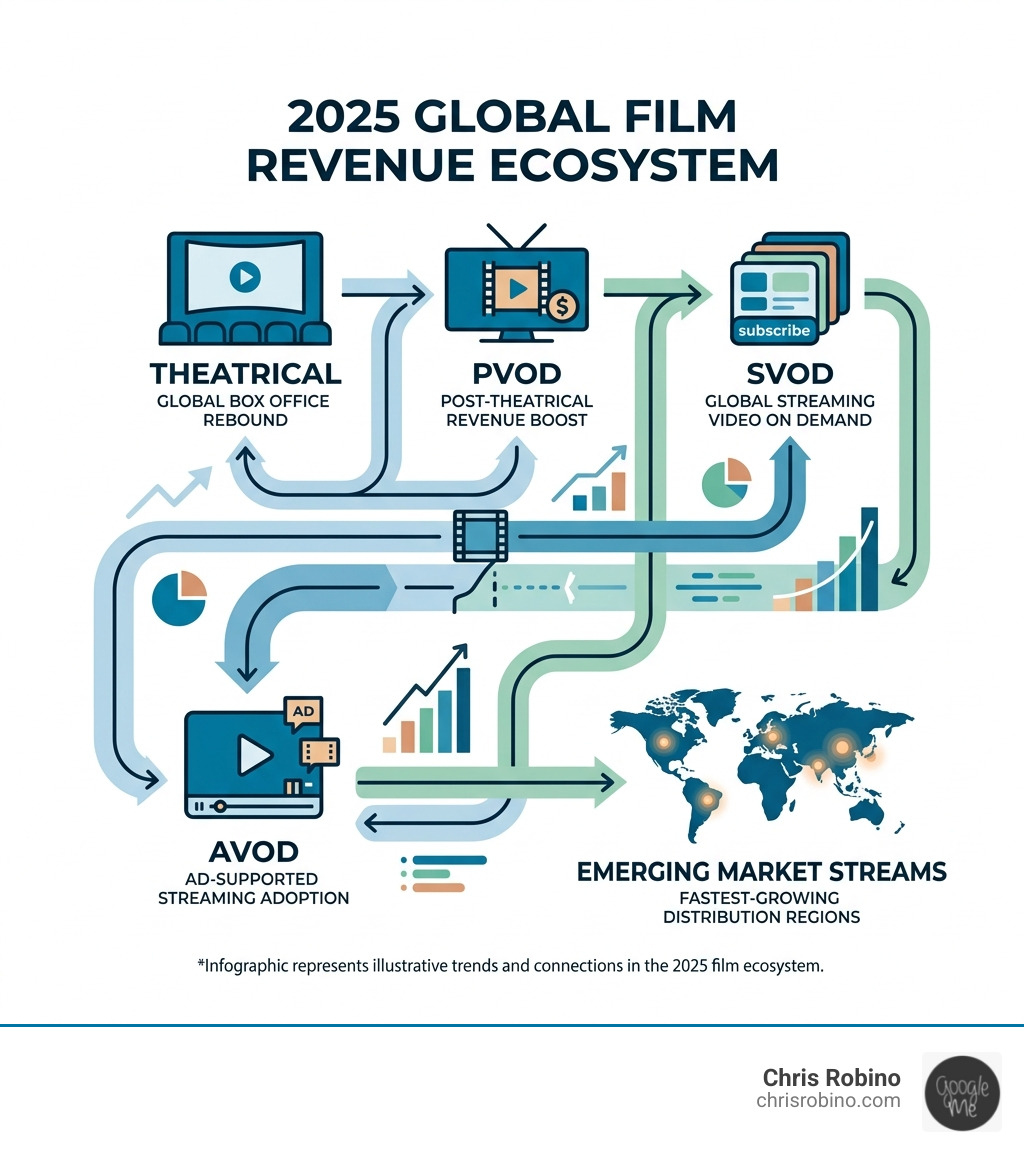
The most successful films in 2025 aren’t just chasing box office numbers; they are building a “waterfall” of revenue that captures different audience segments at different price points. For large companies, this waterfall is supported by robust SEO strategies that ensure each stage of the release window is optimized for search discovery.
| Distribution Channel | Typical Margin | Key Revenue Driver |
|---|---|---|
| Theatrical | 45-50% | Ticket sales, concessions (split with exhibitors) |
| PVOD (Premium VOD) | 80% | High-intent home viewers (early access) |
| SVOD (Subscription) | Fixed License | Platform exclusivity or “pay-1” windows |
| AVOD (Ad-supported) | Revenue Share | High-volume, long-tail viewership |
Enterprise SEO Strategies for Media Giants
For large media corporations, SEO is no longer a marketing afterthought; it is a core component of the monetization strategy. Large companies perform best when they utilize “Authority-led SEO.” This involves leveraging their high domain authority to rank for broad, high-volume keywords related to film releases and genre trends. By creating comprehensive content hubs around their major franchises, they can capture traffic at every stage of the buyer’s journey — from initial curiosity to the final purchase on a VOD platform.
Key SEO strategies for large-scale film monetization include:
- Programmatic SEO for Localization: Creating thousands of localized landing pages for different regions (e.g., “Watch [Movie Name] in Hindi” or “[Movie Name] release date Brazil”) to capture specific regional search volume.
- Entity-Based Optimization: Ensuring that search engines clearly understand the relationship between the film, the actors, the director, and the studio. This helps in appearing in Google’s Knowledge Graph and “People Also Ask” sections.
- Video SEO: Optimizing trailers and promotional clips on platforms like YouTube and TikTok to drive traffic back to the primary monetization site. This includes using keyword-rich transcripts and structured data (Schema.org) to help search engines index video content effectively.
Diversifying Revenue with SVOD and AVOD Bundling
The “Streaming Wars” have entered a new phase: the era of bundling and wholesale distribution. By mid-2025, streaming accounted for nearly half of all U.S. television viewing. However, with “serial churning” affecting 42% of subscribers, platforms are pivoting toward ad-supported tiers (AVOD) and retail media partnerships. This shift requires a new approach to Content Monetization Strategies where revenue is tied to e-commerce integrations and hybrid ad models.
We are seeing a massive convergence between retail and entertainment. Retail media ad spend is projected to overtake traditional TV by 2026. This means films are no longer just content; they are vehicles for targeted advertising. To survive, platforms are moving toward wholesale distribution — bundling streaming services with mobile plans or internet packages. This stabilizes the subscriber base and provides a more predictable foundation for Digital Content Monetization.
Capitalizing on Global Film Monetization Trends 2025 in Emerging Markets
If you want to “cash in” this year, you must look toward the Asia-Pacific region. While North America remains the largest market by total value, Asia-Pacific is the fastest-growing. China’s box office alone surged by over 22% in 2025, driven largely by local hits like Ne Zha 2, which demonstrated that localized, culturally resonant content can outperform global blockbusters.
According to the Film Distributors’ Association, international markets now account for roughly 73% of global box office receipts. This is a clear signal to filmmakers: localization is no longer an afterthought. It is a core financial strategy. Our Media Industry Guide 2025 emphasizes that “global” doesn’t mean “one-size-fits-all.” It means creating content that can be adapted — whether through region-specific dubbing or localized SEO campaigns that target specific cultural nuances.
Leveraging AI for Production Efficiency and Cost Reduction
AI is the “great equalizer” in global film monetization trends 2025. It isn’t about replacing human talent; it’s about reducing the friction between an idea and a finished product. Virtual production and AI-driven VFX are cutting post-production timelines by as much as 30%. As we discuss in AI in Filmmaking, the goal is to enhance human-led creativity. By lowering production costs (which have risen 45% for traditional models), AI allows more of the budget to go toward marketing and distribution. For more on these shifts, check out Media Production Industry Trends 2025.
Strategic Implementation for Independent Filmmakers
The “Peak TV” era is over, but for independent filmmakers, this “content austerity” from major studios is actually an opportunity. As studios reduce their output to focus on safe franchises, a massive gap has opened for high-quality, mid-budget independent films. To succeed, these creators must adopt the same data-driven mindset as large enterprises, particularly regarding digital discoverability and SEO.
Navigating the Post-Peak TV Landscape for Indie Success
In 2023, we saw a 14% decline in original scripted series. Studios like Disney and Warner Bros. are tightening their belts, which means they are buying fewer “indie darlings” at festivals. However, the demand for content hasn’t dropped — audiences still want new stories. The key to indie success in 2025 is “rapid packaging.” We recommend that filmmakers focus on market-ready projects that can be produced quickly to fill the gaps in streamer slates.
This requires a shift in mindset: you aren’t just an artist; you are an entrepreneur. By leveraging our Media Industry Trends Ultimate Guide, you can identify which genres (like horror or animated films) are seeing the highest demand growth on OTT platforms. Furthermore, independent creators should utilize “Niche SEO” to build a dedicated audience. By ranking for specific, long-tail keywords related to their film’s unique themes, they can bypass the competition of major studio blockbusters and reach their core demographic directly.
Maximizing Global Film Monetization Trends 2025 through Hybrid Release Windows
The 90-day theatrical window is a relic of the past. Today, the average window to streaming is closer to 30 days, with many films hitting PVOD (Premium Video on Demand) just 17 to 45 days after their theatrical debut. This “compression” is actually a financial win for many. Universal, for example, generated $1 billion from PVOD in less than three years, adding roughly 30% to their theatrical revenue.
For an independent film, PVOD is a critical lifeline because studios and distributors often keep up to 80% of the revenue, compared to the 50-50 split common in theaters. To maximize this trend:
- Eventize the Theatrical Run: Use limited, high-impact screenings (IMAX, Q&As, 70mm) to build “buzz” and generate high-authority backlinks from news outlets.
- Launch PVOD Early: Capture the audience that missed the theater while the marketing is still fresh in their minds. Ensure your website is optimized for “Watch [Film] Online” keywords during this peak interest period.
- Long-Tail Streaming: Use SVOD or AVOD for long-term discoverability and residual income. This is where a strong SEO foundation pays off, as your film continues to appear in search results for years to come.
Future-Proofing Your Film Business Model
The industry is moving toward a “Distribution Winter” where only the most disciplined and data-driven projects will thrive. At ChrisRobino.com, we specialize in helping creators and media companies navigate these shifts through IP consulting and digital strategy. Success in 2025 and beyond requires more than just a good script. It requires a comprehensive understanding of how search engines and algorithms drive viewer behavior.
Large companies that dominate the market do so by integrating SEO into their entire production lifecycle — from using search data to validate story ideas to optimizing every piece of promotional content for maximum reach. This data-driven strategy ensures that their projects aren’t just high-quality, but are also highly visible to the right audience at the right time.
Success in 2025 requires:
- Data-Driven Strategy: Understanding audience cohorts and search trends before you even break ground on production.
- Regulatory Compliance: Navigating new AI copyright laws and global data privacy standards.
- Discoverability: Building an audience community via social media, email lists, and SEO-optimized content from day one.
The barriers to making a film have never been lower, but the barriers to making a living from film have never been higher. By embracing these global film monetization trends 2025, you can ensure your project isn’t just seen, but is also profitable. For a deeper dive into how we can help you develop your IP from script to screen, explore our media industry consulting services. Let’s build the future of cinema together.