

What Makes Thought Leadership Content Stand Out?
For enterprise SEO, thought leadership is a high-leverage strategy that builds authority, earns natural links at scale, and signals real-world expertise to search engines and decision-makers alike. When you publish material that reframes a problem, introduces a defensible point of view, or surfaces proprietary data, you strengthen E-E-A-T signals, deepen entity recognition, and create demand for queries your brand can own.
Examples of thought leadership content include white papers with original research, provocative video series, industry-challenging articles, data-driven reports, and expert podcasts that reshape how people think about your field.
The key difference? True thought leadership creates tension and sparks debate, while regular content marketing simply informs or promotes. Beyond brand lift, this tension fuels enterprise SEO: contrarian, well-supported ideas attract editorial coverage, authoritative citations, and high-quality backlinks that compound over time.
While decision-makers find thought leadership more effective than traditional marketing, many executives report that less than half the content they consume provides valuable insights. This authority gap is a prime SEO opportunity for large companies that can publish unique evidence, expert analysis, and clear frameworks. When done right, thought leadership builds trust and establishes authority in ways standard marketing cannot match.
As Chris Robino, I have spent over two decades helping organizations transform their digital presence. I have seen how impactful examples of thought leadership content separate industry leaders from followers and drive measurable organic growth at scale.
Simple examples of thought leadership content word guide:
The Core Characteristics of Effective Thought Leadership
What makes enterprise-grade thought leadership move the needle in search? A few traits consistently correlate with rankings, links, and reputation:
- Strong, well-researched opinions that take a stand. Great leaders do not echo consensus; they publish a clear thesis backed by data, case studies, and repeatable methodology. This gives editors, analysts, and practitioners something to cite.
- Challenging assumptions. Content that reframes the problem introduces new language, mental models, or metrics, creating new demand signals and top-of-funnel queries your brand can define.
- Expert knowledge in a focused niche. Depth beats breadth for SEO. Concentrated publishing around a topic cluster accelerates topical authority and internal linking power.
- Audience-serving intent. The primary goal is to inform and empower the audience, not self-promote. Search engines reward helpfulness that demonstrates experience and expertise.
- Verifiable credibility. Include author bios, references, transparent methods, and original visuals. These are E-E-A-T signals that reinforce trust and improve findability. It is about providing a unique perspective that changes your industry, making us think about What Do You Stand For.
Thought Leadership vs. Content Marketing: A Crucial Distinction
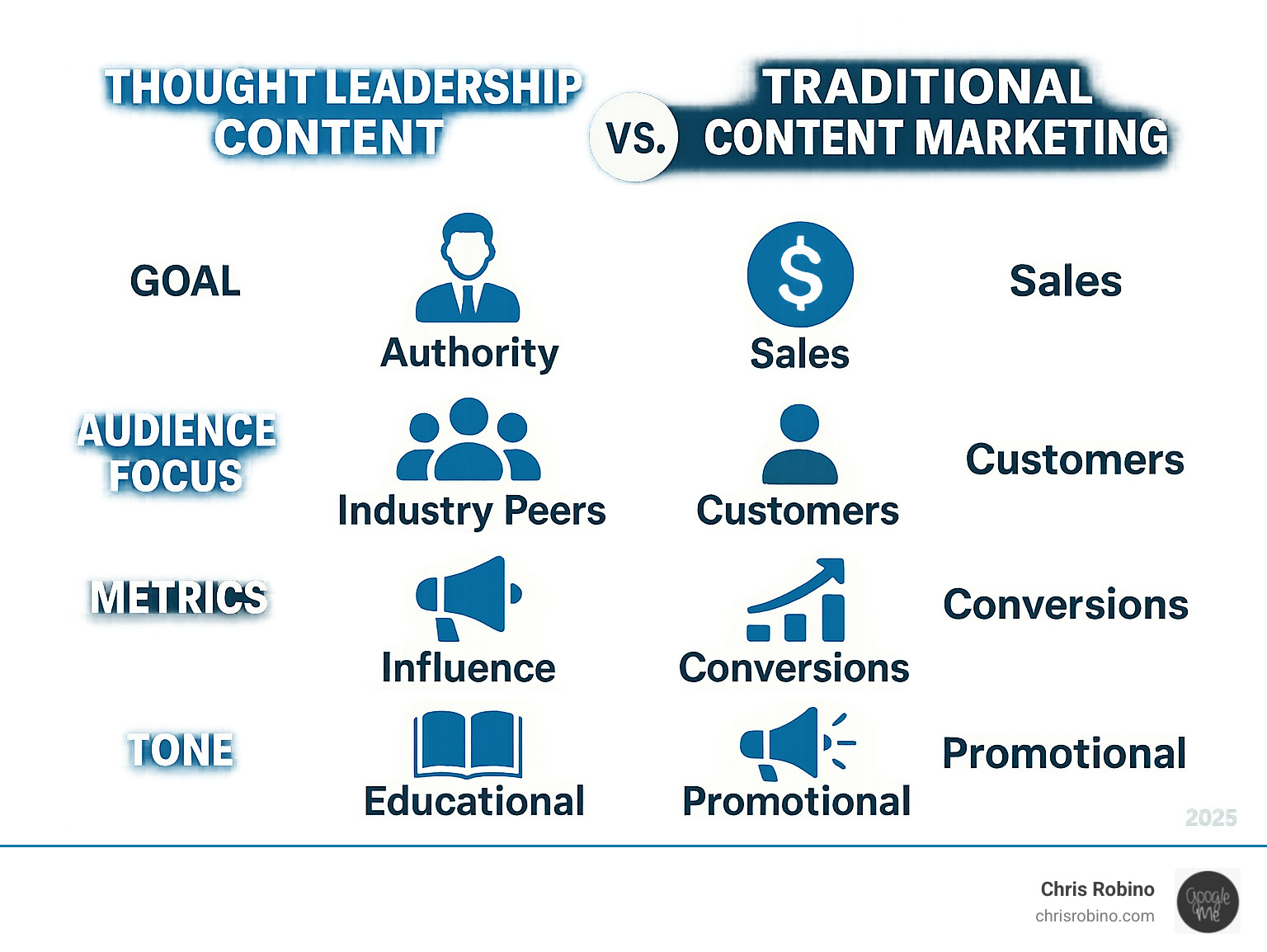
It is easy to confuse thought leadership with general content marketing, but their goals and approaches differ significantly. Traditional content marketing aims to generate leads and support sales, while thought leadership focuses on establishing authority and building long-term influence. One is a short-term tactic; the other is a long-term investment in reputation that strengthens entity signals and link equity. This distinction is crucial for our Search Engine Rankings, as thought leadership earns authority through its intellectual value.
This table clearly illustrates the crucial distinctions:
| Feature | Thought Leadership Content | Traditional Content Marketing |
|---|---|---|
| Primary Goal | Establish authority, influence, and trust; shape industry conversations | Drive leads, sales, brand awareness, and conversions |
| Audience Focus | Industry peers, decision-makers, innovators, early adopters | Prospective customers, general consumers, target market segments |
| Key Metrics | Industry citations, media mentions, speaking invitations, share of voice, reputation, influence | Website traffic, conversion rates, lead generation, sales revenue, SEO rankings |
| Tone | Provocative, insightful, educational, challenging, visionary | Informative, promotional, helpful, persuasive, problem-solving |
| Content Origin | Unique opinions, original research, proprietary data, expert experience | Curated information, rehashed ideas, keyword-driven content |
| Time Horizon | Long-term investment, builds over time | Short-to-medium term, measurable campaigns |
| Directness | Indirectly drives business through reputation | Directly drives business outcomes |
Understanding this table means recognizing that while both are valuable, they serve different strategic purposes. Thought leadership is the foundation upon which lasting influence is built, and it compounds organic visibility by earning links, mentions, and trust signals no ad budget can buy.
Powerful Examples of Thought Leadership Content
Enterprise SEO programs win when they blend ambition with rigor: publish distinctive ideas, package them in formats people want to share, and structure every asset for crawlability, entity clarity, and link-worthiness. The following examples of thought leadership content show how to operationalize that approach.

Whether it is through white papers with original data, video series that humanize complex topics, or provocative articles that challenge conventional wisdom, these formats can anchor topic clusters, earn editorial links, and expand your share of voice.
Data-Driven Reports and In-Depth White Papers
Data is the fuel of enterprise-grade authority. Data-driven reports and in-depth white papers give you a defensible reason to be cited and linked, increasing domain-level authority and building durable organic visibility.
A prime example is the original Bitcoin white paper. It did not just propose an idea; it provided a blueprint that launched an entirely new, trillion-dollar industry. This is the pinnacle of thought leadership: content that creates a market and a vocabulary others reference.
To replicate this at scale:
- Publish proprietary benchmarks, cost analyses, or longitudinal studies. Include methodology, downloadable datasets, and clear charts so editors and analysts can cite you.
- Add descriptive titles, schema where relevant, and internal links to supporting articles in your hub. This helps search engines understand entity relationships and users steer depth.
- Localize insights and segment findings by industry or role to multiply linkable angles.
Modern companies continue this tradition with reports on future-focused technology. For instance, a deep-dive paper on the future of urban air mobility positioned a ride-sharing company as a visionary in its field. Similarly, a well-crafted white paper campaign highlighting industry-specific cost savings can generate millions in new sales opportunities. Our own Tech Industry Report shows how focused analysis provides value to decision-makers.
Provocative Multimedia: Video and Podcast Examples of Thought Leadership Content
Video and audio deepen trust and expand your footprint across surfaces beyond the SERP, while still reinforcing your entity in search. They excel at storytelling, expert interviews, and serialized content that compounds.
Operational tips for SEO impact:
- Publish episodes with complete transcripts, detailed show notes, and chapter markers. Each episode deserves its own optimized landing page that links to related articles, white papers, and tools.
- Embed video on canonical articles, add descriptive alt text and captions, and use consistent naming to reinforce your entities and topics.
- Create playlists or series pages that act as index hubs, improving crawl paths and internal link flow.
For example, a major tech company created an episodic video series exploring how local cultures shape cloud technology implementation, making a complex subject relatable and fascinating. This approach mirrors the principles we discuss in Digital Change for Media.

Podcasts have become powerful platforms for deep, authentic conversations. Successful formats include shows focused on social impact through powerful stories or interview series with leaders in innovation and technology. Webinars also deserve mention, as they combine video’s impact with direct audience interaction, enabling live Q&A that can be repackaged into FAQ content, highlights, and email sequences.
Visionary Articles and Books That Challenge the Status Quo
Long-form written content is where many brands crystallize their frameworks. When these pieces challenge the status quo, they create new angles for journalists, analysts, and communities to reference.
Enterprise-ready execution:
- Publish contrarian essays with clear theses, evidence, and counterarguments. Structure for scannability, add executive summaries, and include quotable pull lines that increase citation likelihood.
- Turn cornerstone articles into content clusters: related explainers, implementation guides, checklists, and case studies. This builds topical depth and internal linking density.
- Codify frameworks in books or definitive guides that anchor your brand to an idea-space. These often rank, earn links, and influence the language used in future searches.
Influential essays that take a contrarian view can cement a leader’s reputation and attract innovators. This boldness is essential for Innovation in Media Companies. Books offer an opportunity to codify unique methodologies or internal frameworks. They do not just inform; they offer new solutions and challenge readers, much like we explore in Taking a Hammer to Perfectionism.
The key is authenticity. When leaders share genuine insights and are willing to defend a perspective with evidence, they produce content people search for, share, and cite.
Building Your Own Thought Leadership Strategy
Enterprise SEO rewards consistency, clarity, and contribution. To turn examples of thought leadership content into a durable advantage, build an operating system that marries editorial excellence with technical and distribution rigor.

Start with the fundamentals: identify your niche expertise, choose a unique angle, select formats that match your strengths, and align output to business goals. For SEO, this translates to topic clustering, entity definition, and repeatable content patterns that search engines and users can understand.
The landscape is evolving. AI in content creation can accelerate research, clustering, and outlines, but it cannot replace the lived experience, proprietary data, and editorial judgment that define true thought leadership. Use AI to scale quality control and synthesis, while keeping human subject-matter expertise at the core.
From Idea to Impact: A Framework for Your Next Campaign
To move from big ideas to measurable outcomes, follow a pragmatic, SEO-aware process:
1) Audience and query intelligence
- Define your audience personas: who they are, what decisions they make, and which information gaps block progress.
- Map the problem space: the questions they ask, the frameworks they trust, and the data they need to act.
2) Topic and entity mapping
- Establish your primary entities, subtopics, and supporting themes. Create a content hub-and-spoke model that covers the problem comprehensively.
- Align each asset to a role in the cluster: cornerstone essay, benchmark report, explainer, case study, or implementation guide.
3) Editorial standards that reinforce E-E-A-T
- Require authorship transparency, bios, references, and methods. Include charts, models, and examples that can be cited.
- Set style rules for titles, abstracts, TL;DRs, and pull quotes to maximize shareability and snippet capture.
4) Production workflow and governance
- Build repeatable templates for reports, playbooks, and interviews so quality remains high across regions and business units.
- Centralize editorial planning but allow local teams to adapt examples and data to their markets.
5) Technical SEO and content architecture
- Ensure clean information architecture, descriptive URLs, internal links from hub to spokes, and fast performance.
- Add appropriate schema and structure pages for crawlability, findability, and entity clarity.
6) Distribution and amplification
- Publish to your site first, then syndicate excerpts, visuals, and highlights to channels your audience already uses: LinkedIn, industry podcasts, newsletters, and trade publications.
- Package research into media-ready assets: charts, one-pagers, and executive quotes that make coverage easy.
7) Measurement that looks beyond vanity metrics
- Track citations, quality backlinks, speaking invitations, analyst mentions, and share of voice alongside traffic and conversions.
- Monitor how your topic clusters grow in impressions, rankings, and referring domains quarter over quarter.
Start by defining your audience personas — who you are trying to reach, and what problems they need to solve. Brainstorm content ideas that only you can create based on your unique expertise and data. A solid content distribution strategy is just as important as creation; meet your audience on the platforms they already use, whether it is LinkedIn, industry podcasts, or trade publications.
Measuring success requires looking beyond vanity metrics. Are you being invited to speak at events? Are journalists seeking your commentary? These qualitative signals often matter more than clicks and correlate with sustained organic growth. Finally, consistency is your secret weapon. It is better to publish one thoughtful piece per month than to publish ten in a burst and then go silent. A realistic content calendar is essential for building a reliable presence.
As someone who has spent over two decades in this space, I have learned that the most successful thought leaders are those who stay curious and committed to helping others. If you want to become a thought leader, focus on providing value first. For expert guidance on this journey, explore insights from a Writer, Speaker, and Entrepreneur who has steerd this path.
Thought leadership is ultimately about contribution, not self-promotion. For large companies, the SEO upside is real: compound link equity, durable rankings across topic clusters, higher brand demand, and a reputation strong enough to open doors long before a sales conversation begins.