

Why Your Organization Needs an Augmented Reality Strategy Now
An augmented reality strategy is no longer optional; it’s a fundamental shift in how we bridge the gap between digital data and the physical world. While smart products generate torrents of information, most of it remains trapped on 2D screens, limiting its real-world application. AR solves this by superimposing digital information directly onto our environment, making it more practical for business than virtual reality, which replaces the physical world entirely.
The business case is compelling. The AR market is projected to reach $50 billion by 2024, and companies using it report significant returns. Porsche cut service resolution time by up to 40%, and Boeing reduced assembly time by 35%. AR reduces “cognitive load” by putting data where it’s needed, enabling faster, more accurate decisions.
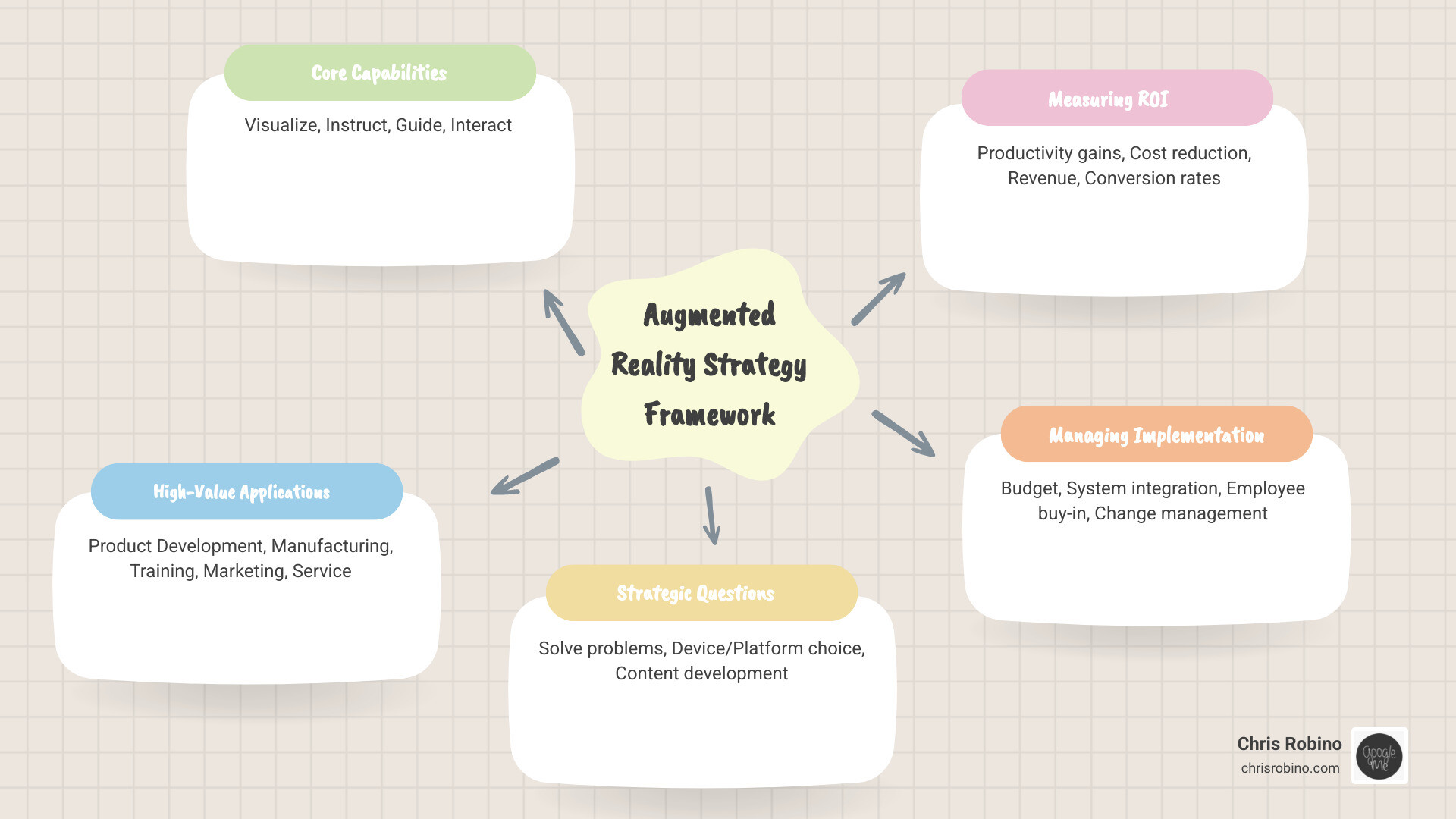
An effective augmented reality strategy requires:
- Understanding AR’s core capabilities: Visualize, Instruct, Guide, and Interact.
- Identifying high-value applications: Manufacturing, training, marketing, and service.
- Asking strategic questions: What problems will AR solve? Which devices and platforms?
- Measuring ROI: Track productivity, cost reduction, and time savings.
- Managing implementation: Address budget, system integration, and employee buy-in.
Organizations that develop a thoughtful AR strategy will gain competitive advantages through improved customer experiences, greater operational efficiency, and accelerated training.
I’m Chris Robino, a Digital Strategy Leader and AI & Search Expert with over two decades of experience helping organizations develop augmented reality strategy frameworks that drive measurable business results.
Find more about augmented reality strategy:
How to Build a Winning Augmented Reality Strategy
Building a successful augmented reality strategy isn’t about chasing fads; it’s about thoughtfully integrating a powerful tool to solve real business problems. Let’s explore the foundational steps.
Understanding AR’s Core Capabilities and Technology
At its heart, AR improves the real world with digital information, differing from VR, which creates a synthetic world. This makes AR a powerful new interface between humans and machines, reducing our “cognitive load” by putting data directly in our line of sight.
Its key business capabilities include:
- Visualize: Place 3D models or data overlays into a real-world view.
- Instruct: Provide step-by-step visual guidance for complex tasks.
- Guide: Allow remote experts to assist on-site users with digital cues.
- Interact: Replace physical controls with virtual ones superimposed on a product.
AR technology uses computer vision to interpret the environment and overlay content. Early marker-based AR required specific images (like QR codes) to trigger content. Today, markerless AR is dominant, using location data and advanced computer vision to place digital objects realistically without triggers.
AR can be delivered through downloadable app-based experiences or directly through a browser via Web-based AR (WebAR). WebAR’s key advantage is accessibility, as it requires no downloads and works on billions of devices, making it an excellent starting point for marketing and retail. While smartphones (80%) and tablets (67%) are the primary devices, specialized hardware like digital eyewear is gaining traction in enterprise settings for hands-free work.
To dive deeper into the technological underpinnings, explore our insights on Technology Trends for Business.
Identifying High-Value AR Applications Across Your Business
AR is a strategic enabler that improves customer experiences and increases efficiency. It creates value by becoming a product feature or by improving performance across the value chain.

Here are high-value applications:
- Product Development: AR improves visualization by allowing engineers to superimpose 3D CAD models onto physical prototypes. This speeds up design reviews, as seen with Volkswagen, which made the process five to ten times faster.
- Manufacturing: AR delivers critical information to assembly line workers, reducing errors and boosting efficiency. GE factory workers using AR with voice commands achieved a 34% increase in productivity.
- Logistics: In warehouses, AR improves picking accuracy and speed. DHL saw productivity gains of 25%, while Intel reduced picking time by 29% with near-zero error rates.
- Marketing & Sales: AR offers immersive and interactive campaigns that produce average dwell times of 75 seconds—four times longer than video. Brands like L’Oréal use it for virtual makeup try-ons, boosting customer confidence and conversion rates.
- Service: AR provides powerful after-sales service capabilities. Porsche shortened service resolution time by up to 40% by connecting technicians with remote experts via AR. Xerox saw a 67% increase in first-time fix rates.
- Training: AR offers step-by-step visual guidance that dramatically cuts training time. Boeing guided trainees through aircraft wing assembly, reducing work time by 35% and increasing first-time accuracy by 90%.
These applications demonstrate AR’s ability to solve complex problems and deliver tangible results across many business functions.
For more on how AR and VR are shaping business, check out our insights on AR/VR Business.
Asking the Right Strategic Questions for Your Augmented Reality Strategy
An effective AR journey demands a clear strategy built by asking critical questions. This ensures your initiatives align with business goals and deliver measurable value.

- What problem are we solving? Identify specific pain points or opportunities where AR can make a tangible difference, such as reducing training costs or improving customer engagement.
- What capabilities will we leverage? Based on the problem, determine if you need AR to Visualize, Instruct, Guide, or Interact.
- Which devices should we use? The use case dictates the hardware. Will smartphones suffice, or are hands-free Head-Mounted Displays (HMDs) required for specific tasks?
- How will we develop the experience? Choose between custom coding, authoring platforms, or ad hoc collaboration tools. Consider scalability and long-term maintenance.
- How will AR create a competitive advantage? Define how AR will reinforce product differentiation, improve your core offerings, or create unique customer experiences.
- Where will AR have the greatest impact on cost reduction? Prioritize efforts that align with strategic goals and offer the clearest ROI.
- Should we build or buy? Decide whether to develop internal AR capabilities or leverage external expertise for design and deployment.
Answering these questions will help you build a foundational augmented reality strategy custom to your business needs. For further guidance, explore our insights on Digital Strategy Advice.
Measuring the ROI of Your Augmented Reality Strategy
To justify investment in an augmented reality strategy, you must define and track specific success metrics. AR is already demonstrating significant, measurable benefits across industries, making a strong business case.
Focus on quantifiable outcomes linked to your initial business goals. Key areas to measure include:
- Productivity Gains: Track metrics like tasks completed per hour or time per task. GE, for example, saw a 34% productivity increase for factory workers using AR.
- Cost Reduction: Measure decreases in material waste, travel for service calls, and error-related rework. Lee Company calculates a $20 return for every $1 invested in AR.
- Revenue and Conversion: For sales and marketing, monitor increases in conversion rates and revenue per visit. Herschel Supply Co. reported a 152% increase in revenue per visit with AR visualization.
- Time Savings: Quantify the reduction in training time, service resolution, and assembly cycles. Porsche cut service resolution time by up to 40%.
- Quality and Accuracy: Measure the reduction in error rates. Cisco studies show AR training can increase first-use accuracy by 90%.
Diligently measuring these outcomes validates your investment and helps refine your strategy for future expansion. As you look ahead, understanding these trends is crucial. Explore more on Future Trends Analysis to stay ahead.
Overcoming Implementation Obstacles and Managing Change
While the benefits of AR are clear, implementing a new augmented reality strategy comes with challenges. With careful planning, you can steer these common obstacles successfully.
- Quantifying Qualitative Benefits: Some advantages, like improved collaboration, are hard to measure. Address this by establishing AR-specific benchmarks and conducting pilot programs with clear, measurable goals.
- Integration with Legacy IT Systems: Existing IT infrastructure may not support AR. Your strategy must include a plan for seamless integration, potentially using APIs or middleware to connect AR tools with existing data.
- Budget Constraints: The perception of high costs can be a barrier. Start with cost-effective WebAR solutions on existing smartphones and scale up gradually to manage budgets.
- Employee Buy-in and Change Management: Any change can meet resistance. A robust change management plan is essential. Introduce AR in phases, provide comprehensive training, create dedicated support teams, and communicate successes to build enthusiasm and demonstrate tangible benefits.
Proactively addressing these obstacles is crucial for a smooth transition and successful adoption. For deeper insights into navigating organizational shifts, our expertise in Business Transformation Consultant can provide valuable guidance.
Conclusion: Integrating AR into Your Digital Future
Developing a robust augmented reality strategy is about embracing a fundamental shift in how we interact with information. AR is becoming the new interface between humans and machines, bridging the disconnect between our digital and physical worlds.
By leveraging AR’s capabilities—to visualize, instruct, guide, and interact—organizations can empower teams, delight customers, and streamline operations. The future of AR is evolving rapidly with advancements like Apple Vision Pro and the convergence of AR with AI, promising even more seamless experiences.
As a Digital Strategy Leader and AI & Search Expert, I believe organizations that proactively integrate AR will not only gain a competitive edge but also redefine what’s possible. For businesses navigating this landscape, a clear augmented reality strategy is a strategic imperative. We’re here to help you accelerate your digital change and open up the full potential of AR.
Find more about how we can support your journey by exploring our insights on Digital Transformation for Media.