

Why Smart City Innovation is Reshaping Our Urban Future
Smart city innovation is the convergence of digital technologies—like IoT, AI, and data analytics—with urban infrastructure. The goal is to create more sustainable, efficient, and livable cities by using technology to solve real-world challenges, from traffic congestion and energy waste to pollution and citizen engagement.
The urgency is clear. By 2050, 70% of the world’s 9 billion people will live in urban centers. Cities already consume over 75% of global energy and generate 60% of greenhouse gas emissions. This has fueled a rapidly growing market, with some estimates projecting seven-fold growth by 2030 from a 2020 valuation of $1.5 trillion.
However, many cities struggle to move beyond isolated pilot projects and realize the full value of these technologies. As Chris Robino, a Digital Strategy Leader and AI Expert with over two decades of experience, I’ve seen how strategic approaches to smart city innovation can accelerate urban change. Throughout this guide, we’ll explore the technologies, trends, and tactics that are delivering measurable results in cities worldwide.
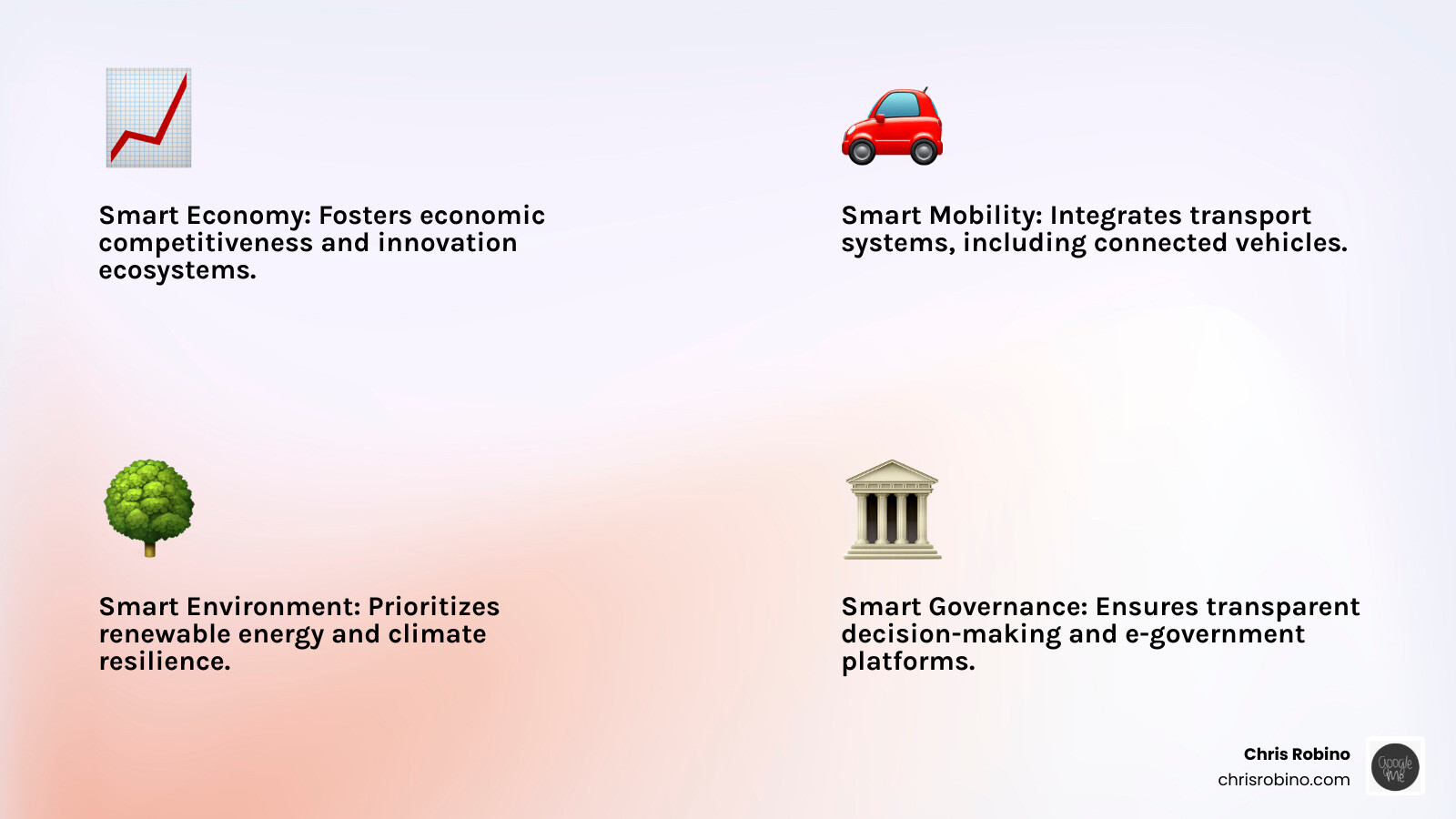
Core Pillars of Smart City Innovation
Smart city innovation is a symphony of technologies, policies, and human-centered design working together. It’s about guiding urban evolution with data to improve people’s lives. Let’s explore the pillars turning this vision into reality.
The Tech Backbone: IoT, AI, and Data
Every smart city needs a nervous system—a network of sensors and platforms that collect, analyze, and act on urban data. The foundation is the Internet of Things (IoT), which connects physical infrastructure to digital networks through billions of devices like traffic sensors, smart streetlights, and environmental monitors.
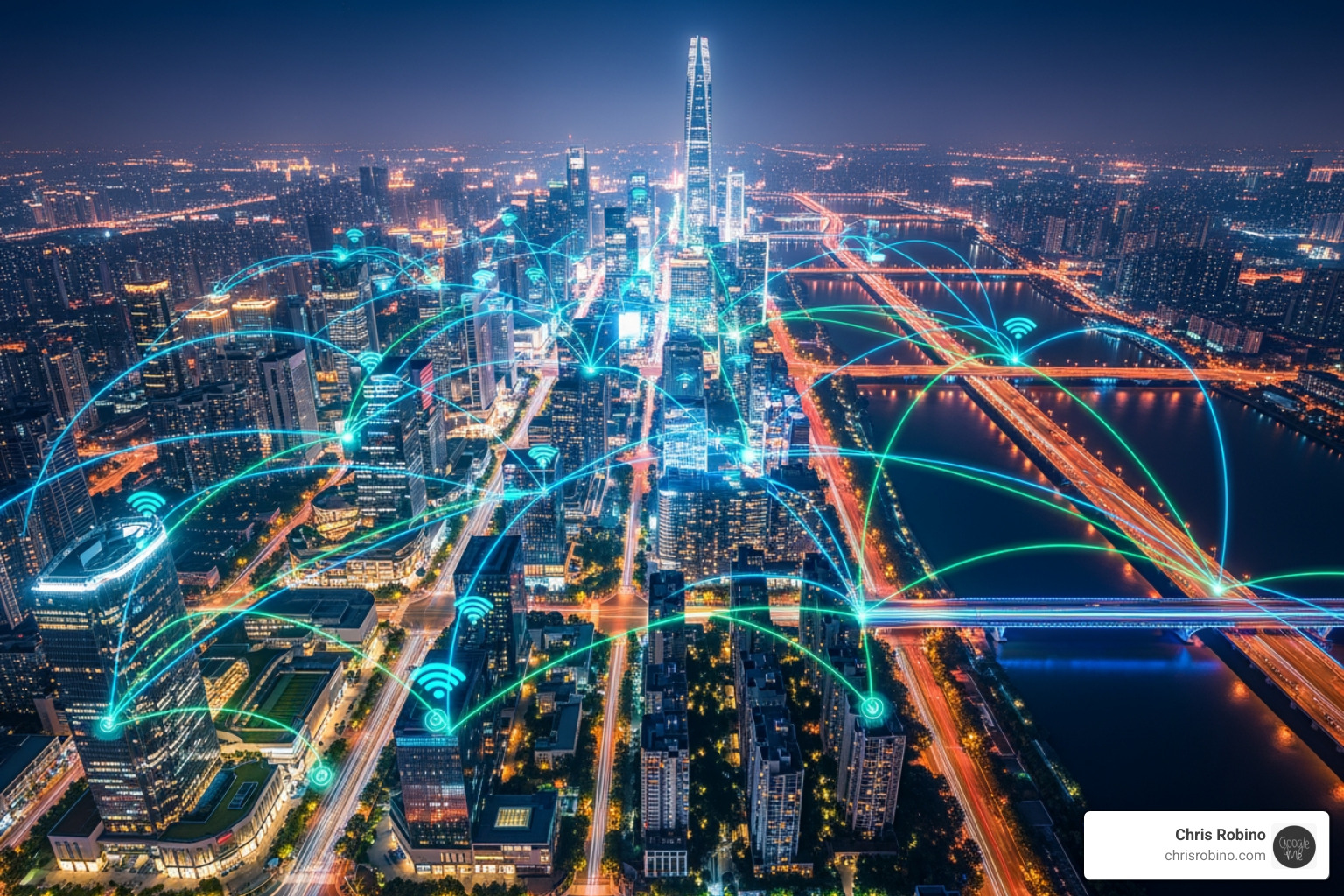
Collecting data is just the start. Sophisticated analytics platforms transform this raw information into actionable insights, helping cities move from reactive problem-solving to proactive planning. Instead of just fixing potholes, predictive maintenance can identify infrastructure issues before they become critical. This data-driven approach is supported by a “computing continuum” of cloud and edge environments that process data with minimal delay—essential for real-time applications like autonomous vehicles.
Artificial Intelligence (AI) and machine learning are the brains of this ecosystem. AI models can forecast population shifts, transportation bottlenecks, and environmental changes, allowing planners to design more resilient communities. Digital twin technology takes this further by creating virtual replicas of entire cities. Planners can test the impact of a new highway, simulate emergency evacuations, or model climate scenarios without disrupting the physical world.
Building Sustainable and Resilient Environments
The true test of smart city innovation is its ability to create more sustainable and resilient cities. With urban centers consuming most of the world’s energy and producing the majority of emissions, green technologies are now foundational.
Smart grids balance electricity demand with renewable energy sources. Water conservation systems monitor quality and detect leaks in real time, while automated systems help keep urban waterways clean. Air quality networks provide granular data that informs public health policies. Even waste management is getting smarter, with IoT sensors optimizing collection routes to reduce fuel consumption and costs. These solutions demonstrate that environmental responsibility and operational efficiency are two sides of the same coin, a core principle of our work in sustainable-tech-solutions.
However, technology must be inclusive. Initiatives providing public WiFi and digital literacy training are crucial for bridging the digital divide, ensuring all residents can benefit from smart city services. A smart city that only serves the affluent is not truly smart.
Revolutionizing Mobility and Urban Services
Smart mobility is dismantling the assumption that personal car ownership is the foundation of urban transport. The future is an integrated Mobility-as-a-Service (MaaS) ecosystem where apps make multi-modal journeys seamless. This includes everything from electric buses and autonomous shuttles to bike-sharing systems.
Connected transportation systems use real-time data to optimize traffic flow. San Francisco’s SFpark program, for example, uses sensors to provide real-time parking availability, reducing the congestion and emissions from drivers searching for a spot. The revolution is conceptual: designing cities around people, not cars. Research shows how these integrated systems create transportation networks that work for everyone.
Fostering People-Centric Smart City Innovation
Technology is just a tool; the real innovation is using it to empower people. Citizen engagement is evolving from suggestion boxes to dynamic digital platforms where residents can influence budgets and collaborate with city leaders.
Successful smart cities foster public-private partnerships (PPPs), creating urban innovation ecosystems where government, academia, and industry can test and deploy new technologies. This collaborative approach ensures that innovation aligns with public needs, creating a feedback loop where citizens identify problems and innovators develop solutions.
Navigating Challenges and the Future of Smart City Innovation
The path to smarter cities is not without obstacles. Data privacy and surveillance are major concerns, raising urgent questions about who owns and controls citizen data. Cybersecurity threats pose serious risks to interconnected urban infrastructure, while the digital divide threatens to leave some residents behind.
As urbanist Richard Sennett noted, we must avoid prioritizing technology over human needs. The goal is not the most wired city, but the most livable one. Effective government policies are essential for establishing data governance, privacy protection, and ethical AI frameworks. These guardrails, which we explore in our work on ethical-ai-development, allow innovation to flourish while protecting citizens’ rights.
Looking ahead, the future will involve deeper AI integration, more sophisticated digital twins, and emerging technologies like federated learning for privacy-preserving analytics. But as research on truly smart cities emphasizes, the most successful cities will be those that use technology to build urban environments that are more sustainable, equitable, and livable for all.
The Next Generation of Urban Living
Smart city innovation is fundamentally reimagining how we live, work, and connect in urban spaces. The cities that thrive won’t just be technologically advanced; they’ll be human-centric, using technology as a tool to solve real problems for their residents.
Social inclusion cannot be an afterthought. Bridging the digital divide, as seen in programs like Access Charlotte, is essential to ensure everyone can benefit from urban innovation. Equally critical is continuous innovation—a commitment to experimenting, learning, and adapting. The most successful cities create ecosystems where new ideas can be tested and citizens have a real voice.
After two decades of guiding organizations through complex technological change, I’ve learned that the gap between promise and reality is closed by strategic thinking and disciplined execution. My work focuses on moving beyond the buzzwords to create strategies that generate measurable impact. By implementing AI-driven analytics, developing digital ecosystems, and navigating the ethics of emerging tech, we help organizations achieve mission-driven outcomes that put people first.
The future of urban living is being written now. The next generation of cities will be more sustainable, connected, and responsive—and with the right strategy, that vision is within our reach.