
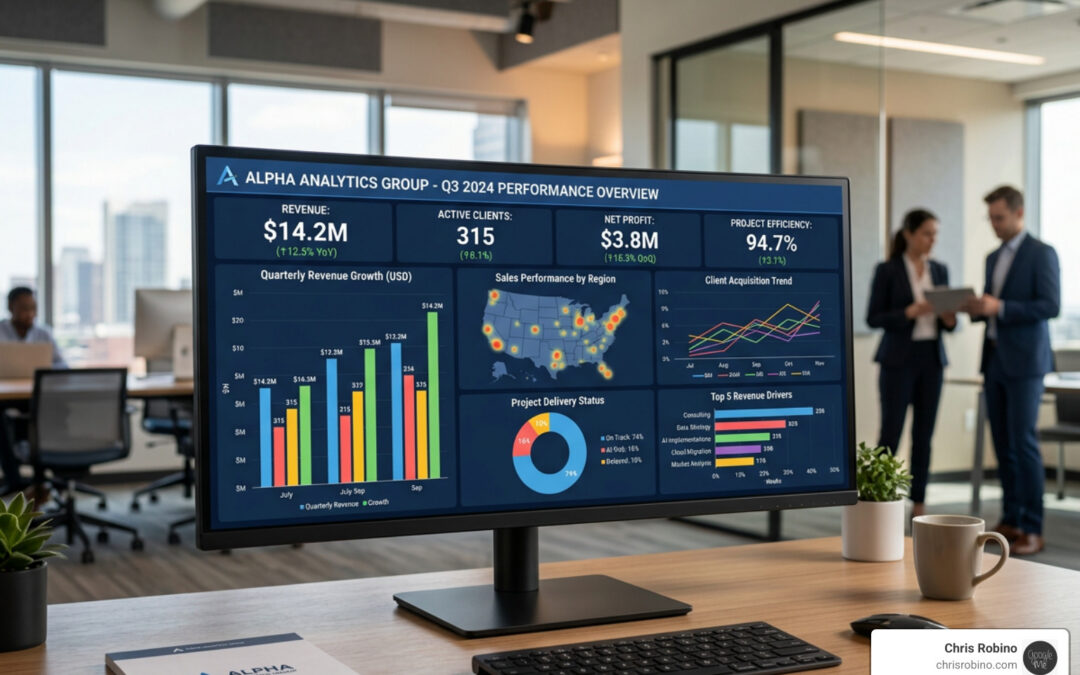
What Data Analytics Consulting Actually Does for Your Business
Data analytics consulting is the practice of hiring outside experts to help your organization collect, manage, and turn data into decisions that drive real business results.
Here’s a quick breakdown of what it covers:
- What it is: A service where specialists assess your data environment, build the right infrastructure, and deliver insights you can act on
- Who it’s for: Businesses of any size that want to stop guessing and start making smarter, faster decisions with their data
- What you get: Improved efficiency, better forecasting, stronger customer understanding, and measurable ROI
- How it works: Consultants guide you through strategy, implementation, and adoption — covering everything from data governance to AI-ready pipelines
- Why it matters now: 74% of mid-market companies plan to increase investment in AI and advanced analytics over the next two years — the window to get ahead is narrowing fast
Most organizations sit on enormous amounts of data. The problem isn’t a shortage of information — it’s that the data is scattered, siloed, or simply not being used. Spreadsheets get stretched past their limits. Reports lag behind decisions. Teams make calls based on gut feeling instead of evidence.
That’s exactly the gap data analytics consulting is built to close.
A good consulting partner doesn’t just hand you dashboards. They help you build a foundation — the right architecture, the right governance, the right tools — so that data becomes a genuine competitive advantage rather than a maintenance burden.
I’m Chris Robino, a digital strategy and AI search expert with over two decades of experience helping organizations — from startups to established enterprises — use data and technology to grow smarter; my work in data analytics consulting sits at the intersection of strategic insight and practical execution. If you want a clearer picture of what’s possible when data is done right, this guide will walk you through exactly that.
Simple guide to Data analytics consulting:
The Strategic Value of Data Analytics Consulting

In the modern marketplace, data is no longer just a byproduct of doing business; it is the fuel for growth. However, raw data is like crude oil—it’s only valuable once it’s refined. This is where data analytics consulting provides its highest ROI. By transforming scattered information into a strategic asset, we help businesses move from reactive reporting to proactive leadership.
The impact of high-level data analytics is measurable and significant. Research shows that organizations leveraging advanced analytics experience a 1.5x improvement in decision-making effectiveness. Furthermore, companies that successfully implement performance transformation projects often see a 4x average uplift in results.
Beyond the broad strokes, the granular benefits are even more compelling:
- Operational Efficiency: Streamlining processes can lead to a 3.5x improvement in turnaround time.
- Revenue Growth: Data-driven marketing can result in a 100% increase in marketing ROI.
- Sales Performance: Refined lead scoring and customer insights can drive a 1.5x better lead conversion ratio.
Key Services in Modern Data Analytics Consulting
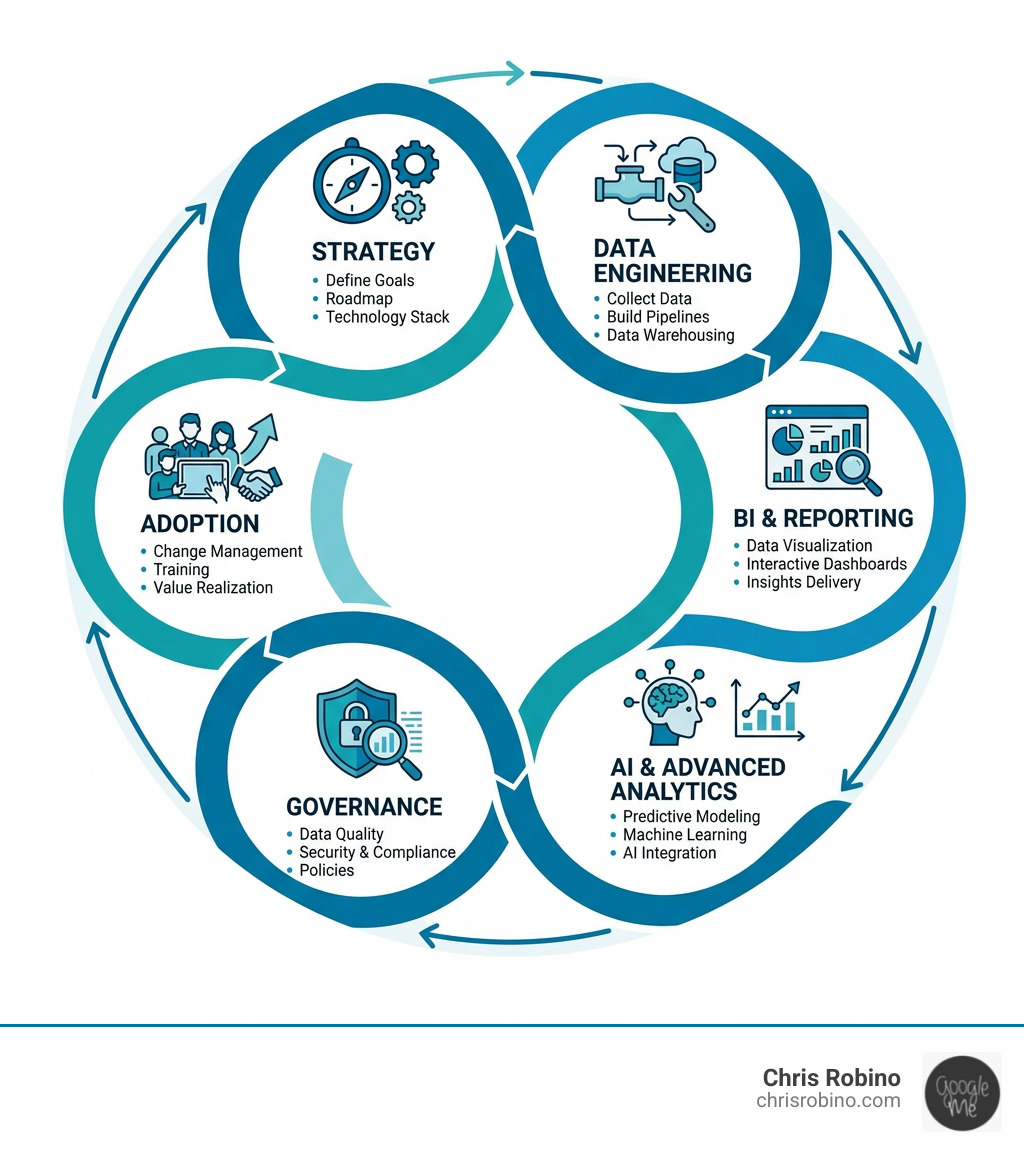
When we engage in a consulting project, we aren’t just looking at one piece of the puzzle. A comprehensive engagement covers the entire data lifecycle. We help you move beyond “What happened?” to “What will happen next?” through these core services:
- Data Strategy & Roadmap: We define the people, processes, and technology needed to reach your goals. This isn’t a generic plan; it’s a “business-first” playbook tailored to your specific industry hurdles.
- Data Governance: Data is only useful if it’s trusted. We help establish “right-sized” governance that ensures data quality and security without creating bureaucratic bottlenecks.
- Data Engineering & Architecture: This involves building the robust pipelines that move data from source to destination. Whether you are using a modern data lake or a cloud warehouse, we ensure your foundation is scalable.
- Business Intelligence (BI) & Visualization: We turn complex datasets into intuitive, real-time dashboards using tools like PowerBI, Tableau, or Looker.
- Predictive Modeling & Data Science: We use historical data to forecast future trends, helping you anticipate customer churn or market shifts before they happen.
- Cloud Migration: Moving legacy systems to the cloud is a high-stakes task. We manage this transition to ensure zero downtime and immediate scalability.
For those looking to stay ahead of the curve, AI-Powered Analytics is the new frontier, allowing for automated insights that would take human teams weeks to uncover.
Bridging the Gap: AI and Advanced Analytics
The hype around Artificial Intelligence is everywhere, but the reality is sobering: only 10% of companies succeed with AI. Why the high failure rate? Most businesses focus on the “cool” technology while neglecting the foundational data.
Successful AI integration follows the 10-20-70 rule:
- 10% of the effort goes into the algorithms.
- 20% goes into the underlying technology and data infrastructure.
- 70% goes into the business practices, people, and “agentic workforces” that actually use the AI.
Data analytics consulting bridges this gap by focusing on Data Readiness. Before you can leverage Google’s AI Overviews or custom Generative AI models, your data must be clean, accessible, and governed. We help you identify the high-impact use cases where AI can actually drive ROI, rather than just being a shiny new toy.
Overcoming Challenges with Data Analytics Consulting
Many businesses reach an “inflection point” where their current systems—often a chaotic mix of Excel sheets and manual Google Sheets—simply can’t keep up. This leads to several common “data drains”:
- Siloed Data: Marketing has one set of numbers, Sales has another, and Operations has a third. We create a “single version of the truth.”
- Legacy Systems: Old IT infrastructure often acts as a roadblock. We help decouple your valuable data from these aging systems so you can innovate faster.
- Manual Processes: If your team spends 80% of their time collecting data and only 20% analyzing it, you have a problem. We automate those repetitive tasks, resulting in up to a 20% reduction in operating costs.
- Technical Debt: Quick fixes from years ago often become the hurdles of today. We perform technical audits to clear the path for modern solutions.
By bringing in expert guidance, you avoid the “unicorn massacre” of over-engineered projects that fail to deliver value. We focus on pragmatic, practical solutions that solve your exact problems.
Implementing a Data-Driven Roadmap for 2026 and Beyond
As we look toward 2026, the landscape of search and data is shifting. With the rise of Generative Search Optimization (GSO) and AI-driven insights, the “standard” way of doing things is no longer enough.
The trend for mid-market companies is clear: 74% plan to increase investment in advanced analytics over the next two years. To stay competitive, you need a scalable framework that future-proofs your organization. This means moving away from static reporting and toward a “Modern Data Stack” that can handle real-time streaming and AI workloads.
Choosing the Right Partner and Measuring Success
Not all data analytics consulting firms are created equal. When choosing a partner, you should look for several key traits:
- Vendor Independence: You want a partner who recommends the best tool for your needs, not the one that pays them the highest commission.
- Business-First Philosophy: If a consultant starts talking about code before they understand your revenue drivers, walk away. The strategy must lead the technology.
- Proven Track Record: Look for experience across diverse industries—from healthcare tech to manufacturing.
- Phased Roadmap: Avoid the “Big Bang” approach. Successful projects “think big, start small, and scale fast.”
By conducting thorough technical audits and aligning data initiatives with executive goals, you gain a strategic advantage with your data and ensure that every dollar spent on analytics is an investment in future growth.
The Economics of Analytics: Costs and Career Paths
One of the most frequent questions we hear is: “How much does this cost?” The answer depends on the engagement model:
- Hourly Rates: Typically range from $75 to $250 per hour depending on the complexity and seniority of the consultants.
- Project-Based Fees: These are ideal for defined deliverables like a Data Strategy Assessment or a specific BI dashboard build.
- Monthly Retainers: Best for ongoing maintenance, adoption support, and continuous improvement.
For professionals in the field, the career paths are evolving. While internal BI roles at major tech companies often cap out around $200k–$250k, moving into data analytics consulting, Solution Architecture, or Sales Engineering offers a path to significantly higher earnings (often exceeding $300k) because these roles are directly tied to revenue generation.
Measuring the ROI of these investments shouldn’t be a guessing game. We look at tangible outcomes: Is the lead conversion higher? Are the operating costs lower? Is the time-to-insight faster? If you can’t measure it, it isn’t successful.
Conclusion: Future-Proofing Your Organization
The journey to becoming a data-driven organization is just that—a journey. It doesn’t happen overnight, and it doesn’t happen by accident. It requires a blend of strategic innovation, technical excellence, and a culture that values evidence over intuition.
At Chris Robino, we specialize in helping businesses navigate this transition. Whether you are a mid-sized company outgrowing your spreadsheets or a large enterprise looking to operationalize AI at scale, we provide the clarity needed to turn digital ambitions into reality.
The window to gain a data-driven edge is closing as more companies adopt these technologies. Don’t let your data remain a dormant asset. For a deeper dive into how to position your business for the next wave of technological change, check out our Emerging Tech Consultant Complete Guide.
The future belongs to those who can see it coming. Let’s make sure your data is telling you the right story.