

Why Every Business Needs a Technology Advisory Consultant Today
A technology advisory consultant is a specialist who helps businesses align their technology investments with their core goals — cutting through complexity to deliver strategy, execution, and measurable results. In the modern enterprise, this role has expanded beyond simple IT oversight to encompass the entire digital ecosystem, including how a company presents itself and captures value in the digital marketplace.
Here’s what a technology advisory consultant typically does:
- Develops IT roadmaps aligned with business priorities and long-term growth
- Advises on cloud migration, cybersecurity, and AI adoption to ensure future-proofing
- Manages vendor selection and ERP systems to streamline operations
- Guides digital transformation programs from strategy to delivery, ensuring no department is left behind
- Provides fractional or interim technology leadership (e.g., fractional CTO) for organizations in transition
- Identifies risks in IT systems and builds resilience plans to protect against market volatility
- Integrates advanced SEO strategies into the technical foundation of the business to ensure organic visibility at scale
In today’s fast-moving digital landscape, technology decisions can make or break a business. New tools emerge constantly. Risks multiply. And the gap between strategy and execution keeps growing. For large companies, the stakes are even higher. A single technical misstep in a site migration or a poorly executed cloud strategy can result in millions of dollars in lost revenue and years of technical debt.
Most organizations don’t lack ambition. They lack the right guidance to move fast and move smart. They often operate in silos where the marketing team’s SEO goals are at odds with the engineering team’s deployment schedules. A technology advisory consultant acts as the glue between these departments, ensuring that technical infrastructure supports marketing visibility and vice versa.
That’s exactly where a technology advisory consultant comes in — bridging technical depth with business strategy, so companies stop guessing and start growing. Whether you’re a startup navigating technical debt or an enterprise planning a major cloud migration, the right advisor helps you avoid costly mistakes and seize opportunities with purpose.
I’m Chris Robino, a Digital Strategy Leader and AI & Search Expert with over two decades of experience helping organizations — from emerging startups to established enterprises — harness technology as a technology advisory consultant to drive real, measurable growth. My work sits at the intersection of AI, digital transformation, and strategic execution, and this guide brings together everything I’ve learned to help you make smarter technology decisions. By focusing on the technical pillars that support organic growth and operational efficiency, I help large-scale organizations dominate their niche.
Glossary for technology advisory consultant:
The Role of a Technology Advisory Consultant in Modern Business

In the current landscape, success depends on more than just buying the latest software. It requires harnessing technology with purpose. A technology advisory consultant acts as the architect of this purposeful adoption. We don’t just look at code or servers; we look at how those assets drive business performance and operational integrity. For large companies, this often means looking at how the technical stack influences search engine visibility and user acquisition.
Core Services of a Technology Advisory Consultant
The modern advisory role is multifaceted. It isn’t just about giving advice; it’s about turning strategic plans into practical outcomes. Key services include:
- Roadmap Development: Creating a clear, phased plan that aligns tech investments with business priorities.
- Vendor Selection: Navigating the crowded marketplace to find the right partners, ensuring you don’t over-engineer or under-spec your stack.
- Cloud Migration & Infrastructure: Moving legacy systems to secure, scalable platforms to reduce costs and improve agility.
- Digital Innovation: Identifying new avenues for growth through digital innovation consulting.
- Technical Due Diligence: Providing deep-dive assessments for M&A activities to identify hidden technical debt or security risks.
SEO Strategies for Large Companies: A Technical Perspective
For large-scale organizations, SEO is not just about keywords; it is a technical engineering challenge. A technology advisory consultant ensures that the enterprise’s infrastructure is built to support massive organic growth. Key strategies include:
- Scalable Site Architecture: Large companies often deal with millions of pages. We implement hierarchical structures and internal linking logic that allow search engines to crawl and index the most valuable content efficiently. This involves optimizing the “crawl budget” to ensure that high-priority pages are updated frequently in search results.
- Edge SEO and Performance: Using Content Delivery Networks (CDNs) to implement SEO changes at the edge. This allows for rapid deployment of meta tags, redirects, and schema markup without waiting for long development cycles in the core CMS. This is critical for maintaining Core Web Vitals, which are essential for ranking in competitive enterprise sectors.
- Headless CMS Integration: Moving toward a headless architecture allows large companies to decouple their content from their presentation layer. This provides the flexibility to optimize for different platforms while maintaining a single source of truth for SEO data, ensuring consistency across web, mobile, and IoT devices.
- Automated Schema and Structured Data: At scale, manual tagging is impossible. We build automated systems that inject JSON-LD structured data into pages based on product or content types, helping search engines understand the context of the data and improving rich snippet visibility.
By simplifying processes and improving it consulting services, we ensure that technology serves the organization rather than the other way around.
Fractional CTO vs. Traditional Consulting Roles
One of the biggest shifts in the industry is the rise of the fractional CTO. Many organizations outgrow “ad-hoc” IT but aren’t ready for the $300k+ annual salary of a full-time executive. A tech consultant acting in a fractional capacity provides flexible leadership. We help build and scale engineering teams, manage technical debt, and bridge the communication gap between technical teams and business stakeholders. This model allows mission-driven teams to leverage high-level expertise for 10-15 hours a week, focusing on scalable systems and societal impact without the full-time overhead.
Navigating AI Adoption and Emerging Technologies
We are currently in a “tech-accelerated” world where Generative AI, quantum computing, and sustainable tech are no longer science fiction—they are competitive necessities. A technology advisory consultant helps you navigate this by:
- Assessing AI Readiness: Charting a path for ai strategy consulting that is safe, ethical, and value-driven.
- Data Strategy: Ensuring your underlying data architecture can actually support machine learning models.
- Exploring Emerging Tech: From photonics to immersive technologies (AR/VR), we help you identify which “shiny new objects” actually offer a return on investment.
Expert advisory services ensure that as you adopt these tools, you are doing so to solve complex problems, not just to follow a trend.
Maximizing ROI and Long-Term Value in Tech Partnerships
The ultimate goal of engaging a technology advisory consultant is to drive measurable value. Whether it’s unblocking a $7M deal, achieving a 60% reduction in cloud costs, or increasing organic traffic by 200% through technical SEO, the impact should be visible on the balance sheet. For large companies, the ROI of organic search is particularly high because it reduces the long-term reliance on expensive paid acquisition channels.
Strategic Steps to Engaging a Technology Advisory Consultant
Engaging a consultant shouldn’t be a shot in the dark. We recommend a structured approach to ensure that every dollar spent on advisory services returns multiples in efficiency and growth:
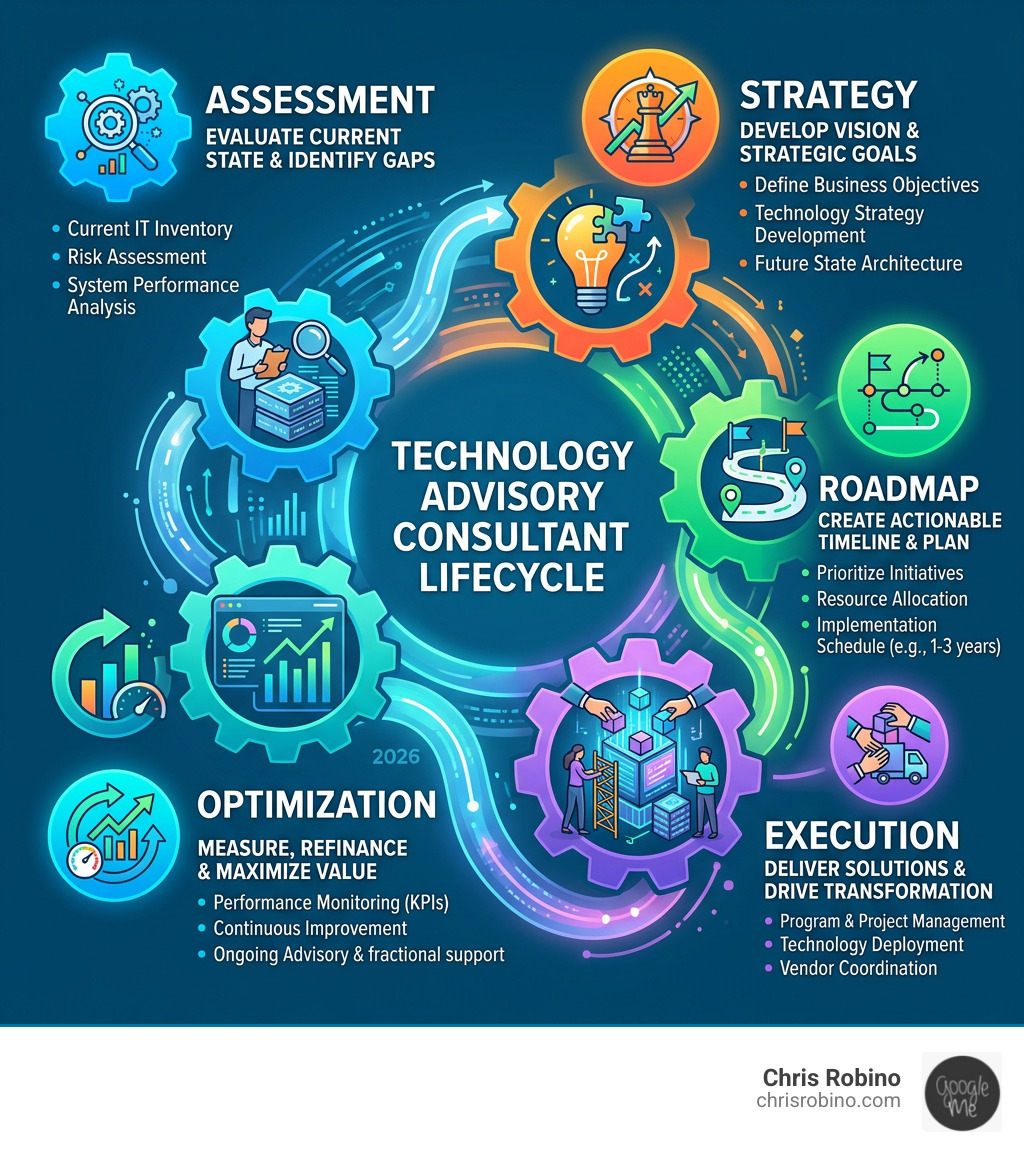
- Initial Assessment: A deep dive into your current tech stack, organizational alignment, and digital footprint. We look for bottlenecks in your development pipeline and gaps in your technical SEO foundation.
- Strategy Sessions: Using frameworks like business-and-technology-consulting to prioritize resources for maximum impact. This includes identifying “low-hanging fruit” like site speed optimizations that can yield immediate ranking improvements.
- Roadmap Execution: Turning the vision into reality through Innovation Workshops and executive advising. We work with your internal engineering teams to implement scalable solutions, from automated testing to CI/CD pipelines that include SEO checks.
- Ongoing Advisory: Maintaining a high-performance culture through continuous optimization and leadership support. Technology is not a “set it and forget it” asset; it requires constant tuning to stay ahead of competitors and algorithm changes.
Measuring Success: Metrics and Real-World Impact
How do you know if your technology advisory is working? We look at hard data. Research shows that the #1-ranked organic result on Google receives a click-through rate of 31.73%, highlighting the importance of visibility. In the consulting world, we track similar performance metrics to ensure our strategies are moving the needle:
- Velocity Improvement: Are releases happening faster? Large firms often see 50% improvements in deployment frequency after optimizing their technical workflows.
- Cost Reduction: Are we streamlining R&D and cloud spend? By eliminating redundant SaaS tools and optimizing server usage, we often find six-figure savings for enterprise clients.
- Organic Growth and Conversion: Are our digital platforms turning users into customers? We track organic sessions, keyword rankings for high-intent terms, and conversion rates. A healthy digital platform should see conversion rates of 2–5% (good) or higher (outstanding) depending on the industry.
- Technical Debt Reduction: We measure the percentage of the engineering budget spent on maintenance versus new feature development. A successful advisory engagement shifts this balance toward innovation.
| Pricing Model | Best For | Typical Structure |
|---|---|---|
| Retainer | Ongoing leadership & support | Monthly fee for set hours/deliverables |
| Project-Based | Specific transformations (e.g., ERP) | Fixed fee for defined scope |
| Fractional | Strategic leadership (CTO/CPO) | Long-term, part-time integration |
Choosing the Right Partner for Your Organization
Selecting a technology advisory consultant is about finding a partner who combines technical depth with a systematic problem-solving approach. At ChrisRobino.com, we pride ourselves on providing right-sized solutions that your team can actually sustain after the engagement ends. We focus on empowering your internal talent, not creating a dependency on outside help.
Whether you need to overhaul your capital structure, improve sales force effectiveness, or dive into emerging-technology-consultant trends, the right partner will treat your business as their own. For large companies, this means having an advisor who understands the complexities of global markets, multi-language SEO, and the rigorous security requirements of enterprise-grade software.
Ready to navigate the digital frontier and secure your place at the top of the search results? Start your next technology project with us today and let’s turn your strategic vision into a practical, high-performance reality.