

The 11% Problem: Why Most Media Companies Fail at Digital Transformation
A solid digital transformation strategy for media industry success comes down to one critical factor: starting in the right place. Here’s what that looks like in practice:
How to build a digital transformation strategy for media:
- Unify customer identity – Break data silos with a central identity platform (CIAM)
- Choose a focused entry point – Connectivity, automation, customer empowerment, or platform programmability
- Leverage AI and cloud – Use machine learning for personalization, cloud for scalable content delivery
- Monetize strategically – Build subscription, ad-tech, and value-based pricing models
- Measure and iterate – Track KPIs, run experiments, and build a digital-first culture
The media industry is at a breaking point. Content volumes keep rising. Devices keep multiplying. Audiences move faster than platforms can adapt.
And yet, most transformation efforts stall before they deliver results.
Industry research shows that 66% of leaders plan a digital transformation — but only 11% actually achieve it at scale. The most common reason? 57% of organizations never identify the right entry point.
That’s not a technology problem. It’s a strategy problem.
Legacy systems, fragmented data, traffic spikes from live events, and shifting consumer behavior — these aren’t new challenges. What’s new is the urgency. With Big Tech growing operating cash flow four times faster than legacy media, and 65% of consumers now preferring streaming over traditional TV, the window for incremental change has closed.
I’m Chris Robino, a digital strategy leader with over two decades of experience helping organizations navigate AI, SEO, and digital transformation — including building and executing digital transformation strategies for the media industry across startups and established enterprises. In the sections ahead, I’ll cut through the noise and show you exactly where to focus.
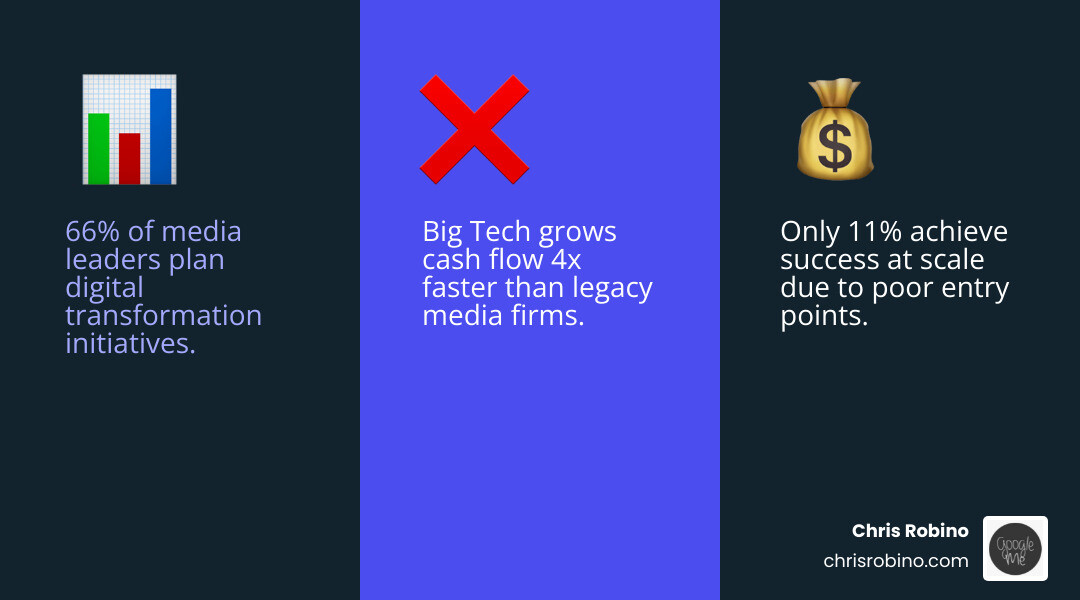
Quick look at digital transformation strategy for media industry:
Core Pillars of a Digital Transformation Strategy for Media Industry
Digital transformation in the media and entertainment industry isn’t just about moving from print to web or broadcast to streaming. It is the comprehensive modernization of content delivery, customer experience, and operational efficiency using advanced technologies. To succeed, we must move beyond “digital lipstick” on legacy pigs and embrace a holistic shift in how we create and distribute value.
The global entertainment and media market is projected to hit $3.5 trillion by 2029. Capturing a slice of that pie requires a strategy built on four specific entry points:
- Operational Connectivity: Making data accessible across the entire ecosystem.
- Automation: Using real-time data to update content and personalize experiences without manual intervention.
- Customer Empowerment: Providing self-service journeys that allow users to manage their own profiles and subscriptions seamlessly.
- Programmable Platforms: Utilizing cloud-native, flexible architectures that can scale instantly.
Without these pillars, media organizations face fragmented audience journeys and skyrocketing operational costs. We’ve seen that digital transformation for media succeeds only when technology is treated as a core asset rather than a support function.
Overcoming Legacy Silos with a Unified Digital Transformation Strategy for Media Industry
One of the biggest hurdles we face is the “data silo” problem. In many legacy media houses, the subscription data lives in one database, the newsletter list in another, and the website analytics in a third. This creates a fragmented experience where a loyal subscriber might still see “Please Subscribe” pop-ups.
The foundation of a modern digital transformation strategy for media industry is Customer Identity and Access Management (CIAM). By implementing a unified identity layer, we can create a single source of truth for every user. This allows for:
- Single Sign-On (SSO): Users log in once and access all properties (e.g., news, sports, and video sections).
- Unified Profiles: Enriched data that tracks behavior across all touchpoints.
- Progressive Profiling: Gathering data over time rather than hitting users with long forms upfront.
| Feature | Legacy Infrastructure | Modern Cloud-Native Stack |
|---|---|---|
| Data Storage | On-premise silos | Unified Cloud Data Warehouse |
| Scalability | Manual provisioning | Elastic auto-scaling |
| User Identity | Property-specific logins | Centralized CIAM / SSO |
| Updates | Monthly/Quarterly releases | Continuous Integration (CI/CD) |
By shifting to these media tech solutions, we remove the friction that kills conversion rates.
Leveraging AI and Emerging Tech in Your Digital Transformation Strategy for Media Industry
Artificial Intelligence (AI) and Machine Learning (ML) are no longer futuristic concepts; they are the engines driving current industry growth. According to research on AI-powered media, AI-powered ads and personalized content recommendations are the primary drivers of the next decade of revenue.
In our work on innovation in media companies, we focus on several key tech applications:
- Generative AI: Streamlining content workflows, from automated transcription to generating social media snippets.
- Blockchain: Providing transparent solutions for digital rights management and ensuring creators are paid fairly in a complex distribution web.
- 5G and VR: Enabling high-quality, low-latency streaming for immersive experiences. 5G, in particular, allows for “neighborhood vibe” features in local media and interactive live events.
- Predictive Analytics: Moving from looking at what happened yesterday to predicting what an audience will want tomorrow using sentiment analysis.
Scaling Operations through Cloud and OTT Solutions
Scalability is the lifeblood of media. Imagine a major live sporting event or a breaking news story—your systems must handle a jump from 1,000 to 150,000 logins per second without breaking a sweat.
We recommend a cloud-first infrastructure strategy. Using platforms like AWS or Azure allows for elastic scaling, meaning you only pay for the server power you use. This is particularly critical for Direct-to-Consumer (D2C) Over-The-Top (OTT) platforms.
Building a custom OTT platform—rather than relying on third-party aggregators—gives media companies full control over their data and monetization. While the “buy” option might be faster, the “build” (or “customized build”) approach ensures that the platform aligns perfectly with your brand’s unique needs and provides long-term ROI. Typically, we see OTT platforms reach profitability after about 24 months of steady user base growth.

Explore our cloud solutions for media to see how to build a foundation that never goes down when the “big story” hits.
Implementing and Measuring Transformation Success
Success in digital transformation isn’t measured by the number of new tools you buy, but by how those tools change the culture and the bottom line. It requires a “leadership-driven” approach. True transformation begins in the boardroom, not the server room. We need executives who champion digital initiatives and are willing to invest in digital skills development for their staff.
Key metrics to track include:
- Customer Lifetime Value (CLV): Is personalization actually keeping users longer?
- Operational Efficiency: Has automation reduced the time-to-market for new content?
- Engagement Rates: Are users interacting with more than one type of media on your platform?
For a deeper dive into current shifts, check out our media industry trends guide.
Monetization and New Revenue Streams
The old “ad-only” or “print-subscription” models are obsolete. Modern media companies must act like “audience aggregators” or “content merchants.”
New revenue streams include:
- Shoppable TV: Integrating e-commerce directly into video content.
- Value-Based Pricing: Moving away from cost-plus models to pricing based on the unique value provided to specific segments.
- Community-Driven Content: As highlighted in research on community-driven media, local engagement can create high-trust environments that advertisers are willing to pay a premium for.
- Lifestyle Bundles: Offering a single app for news, podcasts, sports, and even shopping.
Our media industry analysis shows that companies diversifying into these areas are the ones surviving the Big Tech onslaught.
Identity-Driven Customer Experiences
Personalization is now the deciding factor for audience attention. If your recommendation engine doesn’t match a user’s interests, they are part of the 47% of consumers who canceled a service last year.
By using CIAM, we can offer:
- Seamless SSO: No more password fatigue.
- Self-Service Portals: Let users manage their own privacy settings and subscription tiers.
- NPI/Verification: For specialized media (like healthcare), automating professional verification during login.
Stay ahead with media production industry trends 2025.
Future Outlook and Radical Reinvention
The future belongs to the “Radical.” Incremental changes—like just adding a “video” tab to a website—are no longer enough. We must rethink the very nature of media.
Gen Z, the first truly digital-native generation, views user-generated content (UGC) as equally entertaining as traditional media. To compete, legacy brands must adopt one of three archetypes:
- Audience Aggregators: Bundling multiple services to provide a one-stop shop.
- Audience Cultivators: Focusing on deep, niche monetization.
- Content Merchants: Producing standout content to sell to other platforms.
As we look toward the media industry guide 2025, it’s clear that the organizations that will thrive are those that view technology not as a cost center, but as the core of their identity.
Digital transformation is an existential imperative. It’s time to stop talking about the buzz and start building the strategy. Let’s get to work.