

Why Tech Trends Are Changing How We Work and Compete
Tech trends are no longer incremental improvements; they are fundamental shifts in how businesses operate and create value. In 2026, the gap between emerging and mainstream technology is collapsing faster than ever, turning years of adoption into months.
The most significant tech trends shaping 2026 include:
- Agentic & Physical AI: Autonomous AI systems and intelligent robotics.
- Embedded Finance 2.0 & Tokenized Assets: Integrated financial services and blockchain-based assets.
- Green Computing & Nuclear Innovation: Sustainable tech to meet rising energy demands.
- Quantum Computing: Practical applications driven by error correction breakthroughs.
This rapid change brings challenges. AI accelerates cyber threats, and traditional business models struggle to keep up. Key data points underscore this shift: data center power usage is set to double by 2026, and it’s predicted that agentic AI will make 15% of daily work decisions by 2028.
Success requires more than just adopting new tools. It demands redesigning processes, connecting investments to business outcomes, and executing with velocity.
I’m Chris Robino, a Digital Strategy Leader and AI & Search Expert. For over two decades, I’ve helped organizations steer tech trends and drive digital change. My work translates complex technology into actionable strategies that deliver measurable results.
The Accelerating Pace of Innovation
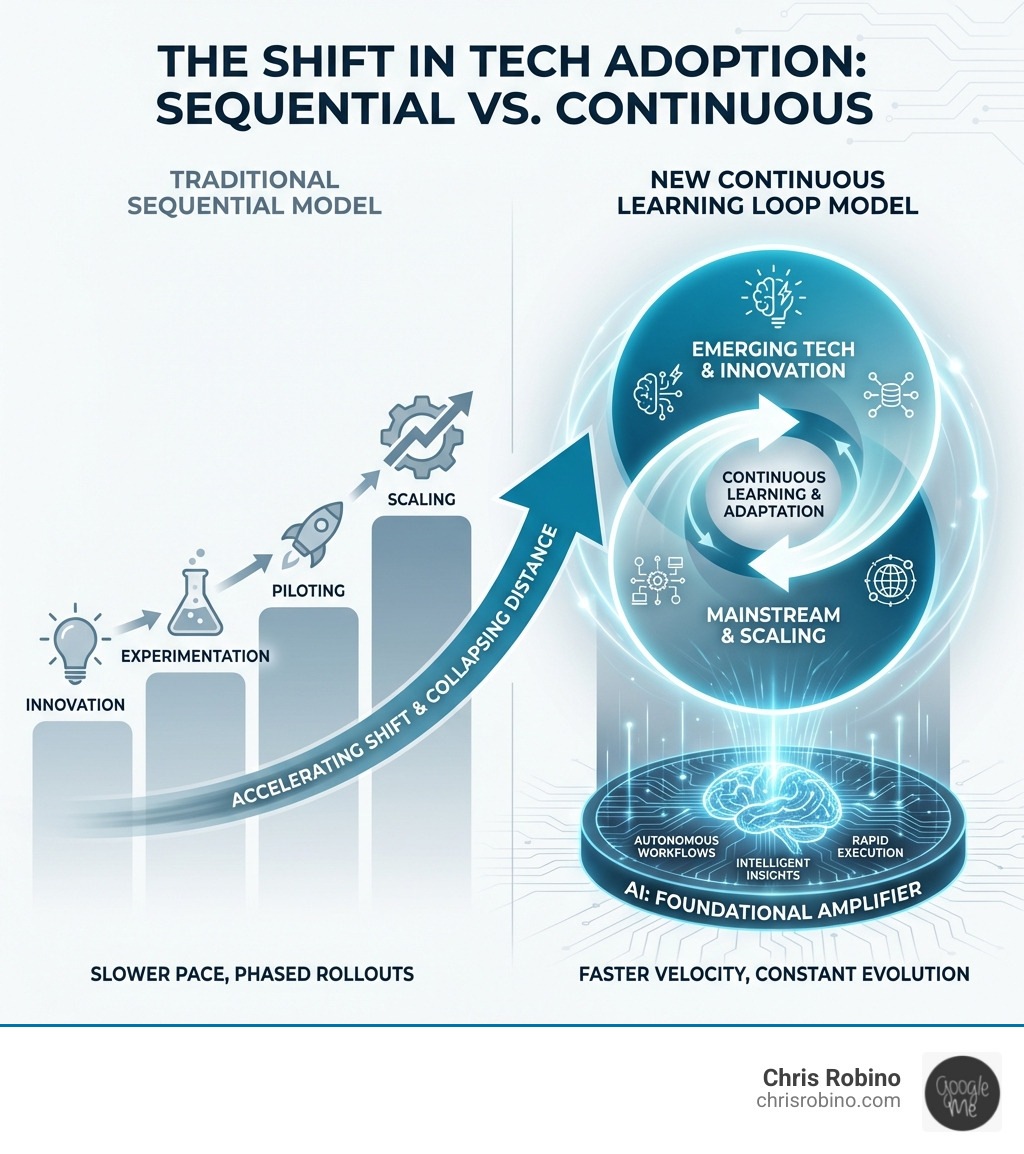
The traditional S-curve of technology adoption is compressing, dramatically shrinking the time for innovations to become mainstream. This acceleration, amplified by AI, is widening the gap between tech leaders and laggards.
This new reality demands a shift from sequential improvement to continuous learning loops. Success no longer comes from lengthy, phased rollouts but from the velocity to execute quickly. Organizations must lead with specific business problems, prioritizing value over technology for its own sake. The focus should be on solving major challenges to achieve significant outcomes, not getting stuck in endless proofs of concept.
To keep pace, businesses must accept rapid iteration and learning through small pilots. This “velocity over perfection” approach allows for failing fast on a small scale rather than missing the opportunity entirely. Navigating today’s tech trends requires a new mindset, as explained by the concept of S-curves.
The Dominant Tech Trends Shaping 2026 and Beyond
Looking toward 2026, several interconnected tech trends are reshaping industries, with AI as the central amplifying engine.
The Evolution of AI: From Generative to Agentic and Physical
AI is rapidly evolving beyond content creation tools that generate text and images into more autonomous and physically integrated forms.

The new frontier is Agentic AI, which transitions AI from a passive assistant to an active participant. Powered by Large Action Models (LAMs), these agents can reason, plan, and execute multi-step workflows with minimal human oversight. This shift enables significant resource efficiencies and complex task automation, as seen with platforms that have cut loan processing times in half. For more on this, see our insights on AI Driven Automation and the AI Future Impact.
Beyond digital autonomy, Physical AI is giving AI a physical presence by converging machine learning with robotics and sensors. This allows AI to perceive and interact with the physical world, leading to humanoid robots in logistics and smart infrastructure capable of self-repair. This integration is a major step toward truly intelligent environments.
The New Digital Fabric: Embedded Finance and Tokenized Assets
The financial landscape is being revolutionized by tech trends that seamlessly integrate financial services and create new forms of asset ownership.
Embedded Finance 2.0 moves beyond simple payment buttons to offer intelligent, context-aware financial solutions within non-financial platforms. For example, a logistics app could automatically offer and settle equipment insurance based on real-time data, making financial interactions invisible and intuitive.
Complementing this is the tokenization of Real-World Assets (RWAs), which digitally represents physical assets like real estate or bonds on a blockchain. This enables fractional ownership and 24/7 trading, increasing liquidity and accessibility for traditionally illiquid assets. Learn more about Blockchain Technology Implementation and the Future of Web3.
Powering the Future: Green Computing and Nuclear Innovation
The exponential growth of AI is causing data center energy consumption to skyrocket, driving innovation in Green Computing and sustainable energy.
Green Computing aims to reduce technology’s environmental impact through sustainable IT practices. Innovations include energy-efficient hardware and carbon-aware data centers that shift workloads to locations with peak renewable energy production. This intelligent energy management is key to Sustainable Tech Solutions.
To meet this energy demand, Nuclear Innovation is re-emerging. Small Modular Reactors (SMRs) offer a scalable and safer alternative to traditional nuclear power. Tech giants are now investing in SMRs to power their AI infrastructure, making reliable, carbon-free energy a top priority. The accelerating pace of change in energy is integral to future tech trends.
Frontier Technologies: Quantum, Metamaterials, and Cislunar Space
Frontier tech trends are pushing boundaries and promising paradigm shifts across industries.

Quantum Computing is advancing with breakthroughs in error correction, moving closer to practical applications in cryptography, material science, and optimization. Hybrid quantum-classical systems are already being explored to prepare for its integration.
Metamaterials are substances engineered to have properties not found in nature. By designing their microscopic structure, we can create materials that manipulate light, sound, and heat in new ways, enabling novel designs in multiple industries.
The Cislunar Space economy is also emerging, with private companies pursuing orbital manufacturing, refueling stations, and resource utilization on the Moon. This new economic sphere presents vast infrastructure and investment opportunities. Explore more in our Emerging Tech Insights.
Key Strategic Tech Trends for Business Agility
Strategic tech trends are crucial for building organizational resilience in a complex global environment.
Geopolitical shifts are driving a move toward resilient supply chains, prioritizing reliability over pure cost savings. This includes localizing production and building sovereign infrastructure to reduce risk.
This requires integrated organizational resilience, with IT orchestrating enterprise-wide risk management. We also see a rise in cross-company collaboration, or “Unlikely Alliances,” to pool resources and accelerate innovation.
Finally, responsible innovation is a strategic imperative. Building trust through transparency and accountability is critical for scaling new technologies. A problem-led strategy ensures innovations are both technologically advanced and ethically sound. Learn more in our Business Agility Consulting Guide 2025 and Technology Innovation Consulting Complete Guide.
Navigating the Future: How to Capitalize on Emerging Technology
The rapid pace of tech trends presents both opportunities and challenges. Thriving in this landscape requires a strategic and agile approach to innovation.
Critical Success Factors for Adopting New Tech Trends
To steer the complexity of the global technology landscape, focus on these critical success factors:
- Problem-Led Adoption: Focus on technologies that solve specific business problems and create tangible value.
- Velocity Over Perfection: Prioritize rapid iteration and learning through small pilots to stay ahead.
- User-Centric Design: Involve end-users to ensure new technologies augment human capabilities.
- Integrated Risk Management: Build trust with a holistic approach to cybersecurity, resilience, and ethical AI. Innovators are nearly 2.5 times more likely to fully integrate risk management.
- Invest in Talent and Infrastructure: Commit resources to the talent and infrastructure needed to scale new technologies.
- Foster Alliances: Collaborate with partners to bridge ecosystem gaps and steer regulatory shifts.
- Accept Continuous Learning: Adapt strategies and operations constantly to keep up with the evolving landscape.
At ChrisRobino.com, our expertise helps organizations accelerate adoption and prepare for future technological change. We help you identify high-impact domains and invest wisely to capitalize on emerging opportunities. To learn how we can help you steer these tech trends, explore our AI Adoption Strategies Complete Guide or Explore our projects to see our work in action.