

What Is Competitive Landscape Analysis (And Why It Matters for Enterprise SEO)
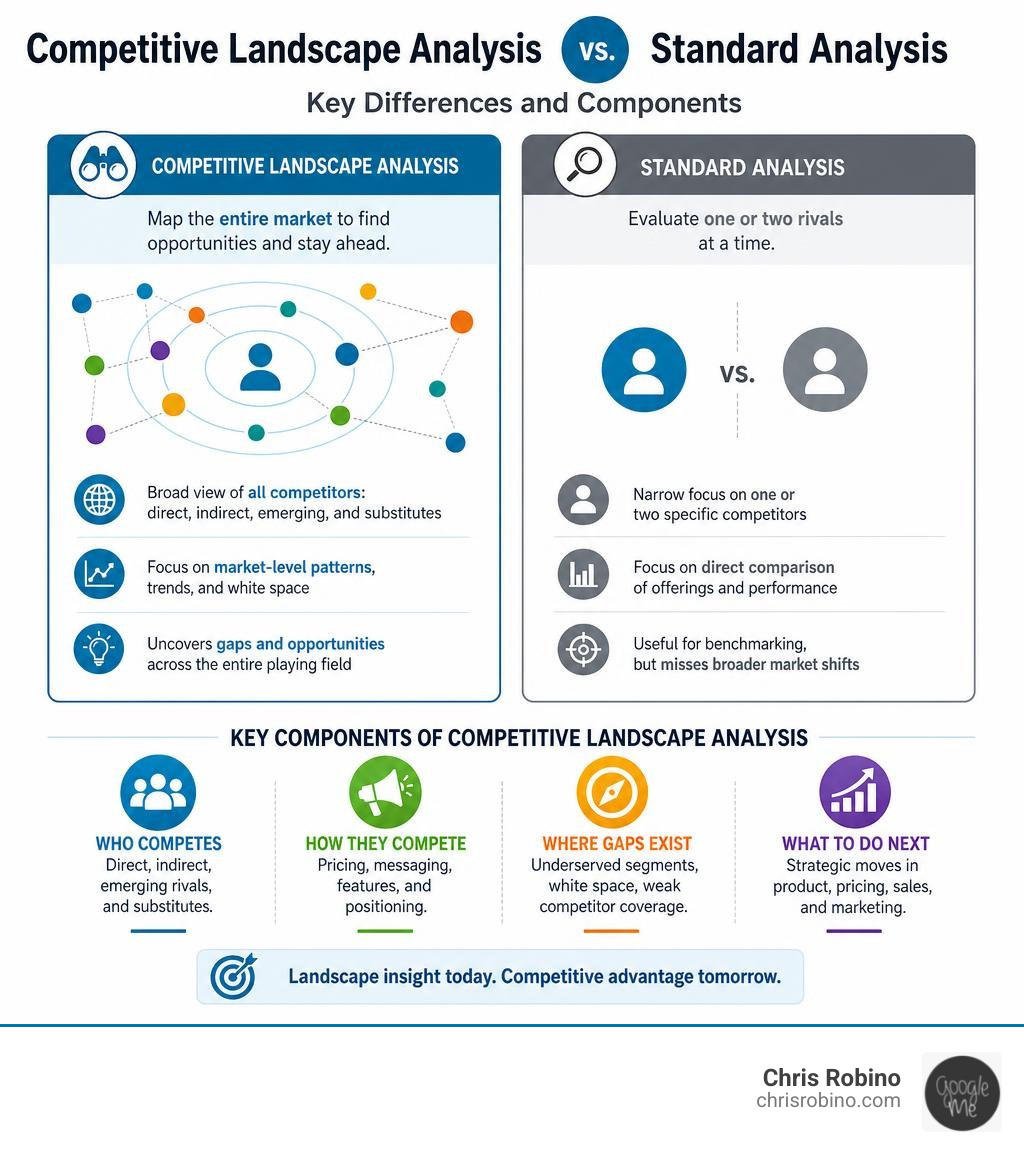
For large companies, search engine optimization (SEO) is not merely about tracking individual keywords; it is about dominating market share across complex digital ecosystems. Competitive landscape analysis is the structured process of identifying who competes for your organic search buyers, how they position their digital assets, and where the content gaps and technical opportunities exist in your market.
Here is a quick breakdown of what an enterprise-level SEO landscape analysis covers:
| Component | What It Answers for Large Companies |
|---|---|
| Who competes | Direct business rivals, media publishers, aggregators, and search-only entities |
| How they compete | Content depth, backlink authority, technical site speed, and search intent alignment |
| Where gaps exist | Unaddressed search queries, underserved user intents, and weak competitor content hubs |
| What to do next | Strategic resource allocation across technical SEO, content creation, and digital PR |
Unlike standard keyword research—which evaluates search volume and difficulty in isolation—a competitive landscape analysis maps the entire digital field your buyers navigate. For large enterprises, this is critical because search landscapes shift rapidly. Algorithm updates, emerging AI search features, and competitor content refreshes can quickly erode organic visibility.
I’m Chris Robino, a digital strategy leader with over two decades of experience helping organizations from early-stage startups to established enterprises use competitive landscape analysis and data-driven insights to sharpen positioning and drive measurable growth. In the sections ahead, I’ll walk you through how to build, visualize, and execute SEO strategies that perform well for large companies.
Quick Competitive landscape analysis definitions:
Demystifying Competitive Landscape Analysis in Enterprise SEO

When we analyze the search market structure of modern industries, we are no longer looking at static, slow-moving monoliths. In massive digital markets, thousands of new pages are indexed daily. Trying to maintain organic dominance using spreadsheets updated once a year is like trying to navigate a bustling metropolis with a paper map from the 1990s. You will eventually lose your rankings to more agile players.
To build true strategic differentiation, large companies must measure and understand competitive search intensity. How crowded is the search engine results page (SERP)? Are we fighting over the exact same high-volume keywords, or can we carve out a unique space with long-tail, high-intent content hubs? When we help brands find their footing, we emphasize that a healthy market map is the foundation of all strategic choices.
Understanding these market shifts is why many organizations partner with a Business Growth Consultant Ultimate Guide to design their growth maps. Relying on gut feelings is a recipe for disaster. Building a strategy on unverified estimates misdirects valuable capital; instead, we need hard, structured data to make decisions that stick.
Core Frameworks for Competitive Landscape Analysis in SEO
To make sense of search engine complexity, we rely on established strategic frameworks. No single framework answers every question, so we often combine them to build a comprehensive view.
| Framework | Best Used For | What It Measures in SEO |
|---|---|---|
| SWOT Analysis | Internal & External Alignment | Technical site health vs. competitor content gaps |
| Porter’s Five Forces | Industry Attractiveness & Structure | Threat of new informational sites, search engine feature changes |
| Feature Matrix | Frontline Sales & Product Parity | Comparison of digital tools, calculators, and interactive content |
| Positioning Map | Identifying White Space | Competitor placement along search intent and content depth dimensions |
| BCG Growth-Share Matrix | Portfolio Resource Allocation | High-performing organic directories vs. low-performing legacy pages |
When we run a SWOT analysis for enterprise SEO, we must move beyond standard bulleted lists. We want to run a cross-analysis: pairing internal technical strengths with external search opportunities to design offensive plays, and matching legacy site weaknesses with search engine algorithm threats to build defensive guardrails.
For teams looking to operationalize this, using a structured competitive analysis framework can save weeks of setup time. This structured approach helps ensure your competitive intelligence translates directly into a broader Business Innovation Strategy Complete Guide, rather than remaining a passive research project.
Identifying Direct, Indirect, and Emerging Search Competitors
One of the most common pitfalls we see in enterprise SEO is competitor myopia. Teams focus entirely on their direct business competitors—the ones who sell the same product. But in search, your competitors are anyone occupying real estate on the SERP for your target queries.
We group search competitors into four distinct tiers:
- Direct Competitors: They offer a nearly identical solution and target the same transactional keywords.
- Indirect Competitors: They solve the same core problem but in a fundamentally different way, competing for informational search terms.
- Emerging Entrants: New startups, niche blogs, or adjacent players who are rapidly building domain authority.
- Substitutes: Informational giants, aggregators, or Q&A platforms that satisfy the user’s query without recommending a specific product.
To measure market concentration and understand how consolidated your search industry is, we look at metrics like share of voice (SOV) across key topic clusters. If the search landscape is highly fragmented, it is full of opportunities for targeted content hubs. If it is highly concentrated, meaning a few legacy domains dominate, we need a highly specialized niche strategy to survive.
We also use structured data and industry classifications to define market boundaries. This keeps our assessments grounded in reality rather than hype. Mapping the variables that truly impact your bottom line is essential for structuring these tiers. Armed with this clarity, we can explore The Art Of Business Model Innovation Why Its Your Next Big Move to disrupt established players who are too slow to adapt.
Executing and Visualizing Your SEO Market Map

Data is only as good as its visualization. A massive spreadsheet with thousands of keywords will not help your content team execute a campaign, nor will it help your executive team approve an SEO budget. We need to turn raw search data into clean, visual representations that drive strategic response.
By visualizing where competitors cluster in terms of domain authority and content depth, we can easily identify market opportunities and optimize our organic search efforts. We want our teams to look at a positioning map and instantly see the empty quadrant—the high-intent search topics that nobody else is claiming. This is where we focus our Innovation Strategy Development to build content hubs and tools that make the competition irrelevant. Building an always-on system for these insights ensures your team can react dynamically to market shifts.
Step-by-Step Guide to Conducting an Enterprise SEO Landscape Analysis
Ready to build your own search map? Here is the step-by-step process we use:
- Define Your Search Boundaries: Establish exactly which topic clusters and keyword categories you are analyzing. Don’t make the boundary too wide, or you will drown in irrelevant search data.
- Identify Your Search Players: Build a registry of 5 to 10 key competitors across direct, indirect, and emerging search tiers.
- Gather Sourced Data: Collect domain authority metrics, backlink profiles, content depth scores, and technical performance data. Make sure to date every piece of information.
- Build a Capability Scorecard: Rate competitors on a 1-to-5 scale across key SEO pillars (technical health, content quality, backlink profile, and user experience). Weight these criteria based on what search engines and users actually care about.
- Conduct Search Intent Analysis: Analyze the types of content (videos, guides, tools) ranking in the top positions. This reveals what search engines deem most relevant for your target audience.
Choosing the right dimensions for your visual axes ensures your data collection remains tight and actionable, pairing beautifully with our insights on A Practical Guide To Technology Trend Analysis.
Gathering Real-Time Search Data and Avoiding Common Pitfalls
Search markets do not wait for your annual planning cycle. With algorithm updates, search engine feature changes, and competitor content refreshes happening weekly, real-time monitoring is a necessity for large companies.
But as we gather this data, we must actively guard against confirmation bias—the tendency to look only for search terms where we already rank well. We also want to avoid competitor obsession. If we spend all our time copying the content structure of the market leader, we will always remain a second-rate version of them.
Instead, look for subtle strategic signals. For example, monitoring competitor job postings can reveal an upcoming international expansion (if they are suddenly hiring native-speaking SEO specialists) or a shift toward video content (if they are heavily recruiting multimedia producers) 6 to 12 months before these changes show up on the SERPs.
Keeping an eye on these shifts helps us deliver relevant, forward-looking Tech Industry Insights.
Turning Search Insights into Actionable Enterprise Strategy
The final step is turning our beautifully visualized search map into real-world results. For your content team, this means distilling complex competitor profiles into highly digestible, one-page content briefs. These briefs should focus on search intent, required subtopics, and clear internal linking structures.
For your product and marketing teams, the map reveals the “white space”—the underserved search queries that competitors are ignoring. This is where we design our strategic response, aligning our content roadmap with real market gaps.
At ChrisRobino.com, we specialize in helping businesses navigate these complex transitions. Whether you are looking to redefine your organic search positioning or execute a massive digital transformation, we provide the strategic advisory and hands-on content expertise to make it happen.
If you are ready to modernize your approach, explore our dedicated resources on Digital Transformation for Media to learn how we help brands adapt, innovate, and win in fast-changing markets. Let’s build a map that guides your business straight to its next phase of growth.