

Why Future of Work Trends Matter Now More Than Ever
The world of work is undergoing a seismic shift, and this includes how large companies approach digital visibility. Future of work trends are not distant predictions; they are reshaping how enterprises design roles, build teams, and deploy SEO strategies that can scale across regions, business units, and product lines.
For large organizations, search is now embedded in the broader future-of-work agenda. AI and automation are transforming how marketing teams operate, enabling always-on optimization, sophisticated user intent analysis, and large-scale content operations. At the same time, human-centric changes like hybrid work, distributed teams, and skills evolution are redefining how SEO programs are organized, governed, and measured.
Enterprise-level SEO success depends on four realities:
- Complex websites with thousands of pages and overlapping stakeholders
- Global audiences with different languages, regulations, and cultural expectations
- Rapidly evolving search algorithms and AI-driven experiences
- The need for durable, scalable processes rather than one-off tactics
These realities sit squarely within broader Future of work trends: AI-augmented roles, cross-functional collaboration, and continuous upskilling. To thrive, large companies must treat SEO as a strategic, cross-disciplinary capability rather than a narrow marketing function.
I’m Chris Robino, a Digital Strategy Leader and AI & Search Expert. For over two decades, I’ve helped large organizations design and execute scalable search strategies that align with their future-of-work and digital transformation priorities.
Future of work trends terms to learn:
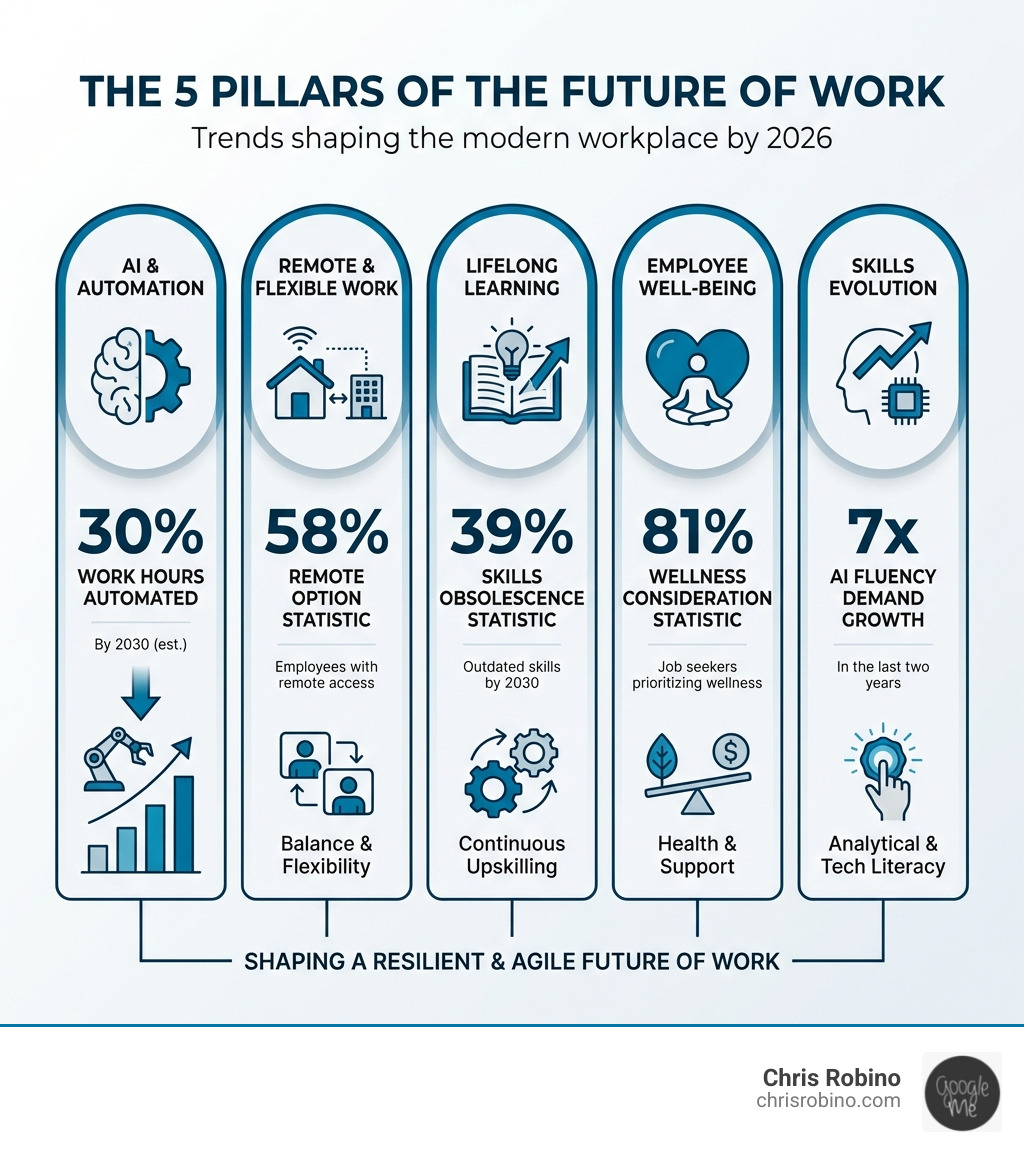
The 5 Core Pillars Defining Future of Work Trends
The landscape of work is undergoing a profound change, driven by the intersection of technological innovation, shifting societal values, and evolving global dynamics. To understand how this impacts large organizations, we can look at five core pillars that define Future of work trends and highlight what effective enterprise SEO strategies look like within each.

AI and Automation: The Technological Engine of Future of Work Trends
AI and automation are the primary technological drivers of change in both work and search. Research on generative AI and the future of work indicates that up to 30% of work hours could be automated by 2030. For large companies, this reshapes how SEO research, implementation, and reporting are done.
Enterprise SEO strategies that align with this pillar:
- AI-augmented keyword and intent research: Use AI tools to cluster queries by intent, segment them by product or journey stage, and prioritize based on business value rather than raw volume.
- Automation for technical monitoring: Implement automated crawls and alerting for issues like indexation, page speed, schema errors, and broken links across thousands of URLs.
- Programmatic optimization at scale: Use templates and component-based design so metadata, internal links, and structured data can be rolled out across large page sets without manual effort.
This shift is not about replacing humans but redefining roles. Human experts focus on strategy, governance, and messaging, while AI supports data processing, pattern detection, and repetitive optimization. The future lies in collaborative workflows that connect people, AI agents, and automation across marketing, product, and engineering.
Key skills for enterprise SEO in this context include analytical and creative thinking, AI fluency, and comfort working with big data and experimentation frameworks.
The Human Element: Evolving Work Models and Culture
While technology is powerful, human preferences and organizational culture are equally transformative. Hybrid and remote work have become standard in many large companies, affecting how SEO teams are structured and how decisions are made.
Remote and Flexible Work
Distributed teams require clear processes and shared tools to drive consistent SEO execution across regions and brands. Effective strategies include:
- Centralized SEO governance: A small core team sets standards for information architecture, meta patterns, structured data, and measurement.
- Local execution with global guardrails: Regional teams adapt content to local language and culture while adhering to central technical and brand guidelines.
- Shared source of truth: A central documentation hub for SEO playbooks, checklists, and decision logs ensures continuity despite turnover or reorganization.
The Gig Economy and DEI
As large companies tap external specialists—writers, analysts, developers—they must integrate them into coherent SEO workflows. Diversity, equity, and inclusion also shape how content is researched and written. Research shows that companies with diverse teams are 35% more likely to outperform their peers.
SEO strategies that reflect this human element include:
- Inclusive content design: Conduct research across diverse user groups to avoid biased assumptions and ensure content speaks to different backgrounds and abilities.
- Clear collaboration models: Define roles (strategy, copy, design, dev, legal, SEO) and approval flows so external and internal contributors can move efficiently without sacrificing quality.
Future-Proofing the Workforce: Lifelong Learning and Well-being
The shelf life of skills is shrinking, and search is no exception. Algorithms, user behavior, and devices continually change, making continuous learning essential for sustainable SEO performance.

Lifelong Learning: The New Imperative
For enterprise SEO, lifelong learning means:
- Regular training for non-SEO roles: Educate product managers, developers, and writers on key SEO principles so changes aren’t blocked or undone by misalignment.
- Experimentation culture: Treat SEO as an ongoing test-and-learn program, running controlled experiments on templates, internal linking, and content formats.
- Cross-functional knowledge sharing: Create forums where analytics, UX, product, and SEO teams review outcomes together and refine hypotheses.
Workplace Well-being and Sustainable SEO
SEO is a long-term discipline. Burnout in teams responsible for constant content production and large-scale site maintenance can lead to inconsistent execution.
Large companies can support sustainable SEO by:
- Avoiding reactive, last-minute launches that bypass SEO basics
- Providing tools that reduce manual busywork (bulk editing, automated QA)
- Aligning goals and timelines so teams can prioritize quality, not just speed
Global Shifts: How Macro-Trends Influence the Future of Work
Broader global trends shape search behavior, regulations, and technology adoption. Global reports on the future of jobs highlight how demographic shifts and technological advancement are creating net job growth of 7% by 2030, with particular expansion in healthcare, STEM, and green transition sectors.
Demographic and Geopolitical Factors
For large companies, this translates into:
- Localized SEO strategies: Adapt keyword strategies, content, and metadata to local languages and regional search behavior instead of simply translating.
- Compliance-aware implementation: Ensure structured data, tracking, and content adhere to local privacy and content regulations.
Job Creation and Destruction in Digital Roles
As some traditional roles decline, demand grows for:
- Technical SEO specialists who can work closely with engineering
- Content strategists who understand both brand and search intent
- Analytics professionals who can translate search data into business insights
Understanding these shifts is vital for resourcing SEO programs that can withstand organizational changes, mergers, and new market entries.
Strategic Leadership: Navigating the Complexities of Future of Work Trends
Leadership is critical to turning SEO from a set of isolated tactics into an enterprise capability.
For large companies, strategic SEO leadership should focus on:
- Positioning SEO as a revenue and risk function: Demonstrate how organic visibility supports acquisition, retention, and brand authority, while also reducing paid media dependency.
- Embedding SEO in core processes: Integrate SEO checks into product findy, design reviews, content workflows, and release management.
- Defining clear operating models: Decide where SEO sits (central marketing, digital, product) and how it collaborates with other teams.
A persistent barrier is the skills and understanding gap between SEO specialists and senior decision-makers. Leaders can close this gap by:
- Using business language (revenue impact, cost efficiency, risk mitigation) instead of technical jargon
- Setting realistic time horizons for SEO impact and measuring leading indicators (crawl health, rankings, engagement) alongside business metrics
- Building trust through transparent reporting and clear prioritization frameworks
When aligned with Future of work trends, enterprise SEO becomes more than a traffic lever: it becomes a strategic discipline that connects technology, content, people, and process across the entire organization.
Conclusion: Embracing the Future, Today
The Future of work trends reveal a landscape where technology, people, and global dynamics are tightly interwoven. For large companies, this has direct implications for how they design and execute SEO strategies that can endure continuous change.
Winning in this environment requires:
- Treating SEO as a cross-functional capability embedded in product, content, and engineering
- Leveraging AI and automation for scale while keeping humans focused on strategy and storytelling
- Building governance, documentation, and training so SEO best practices survive reorganizations and turnover
- Aligning global and local teams around shared standards, metrics, and experimentation
Ultimately, success comes from a dual investment in technology and people. By tying enterprise SEO to the broader future-of-work agenda—hybrid models, skills evolution, and trust-based leadership—organizations can create durable, adaptable systems that drive sustainable growth.
My work focuses on helping organizations connect these dots, building SEO programs that not only perform today but are architected to thrive in the work environments of tomorrow.
To steer the rapid changes in your industry, explore our guide on Digital Transformation for Media.