

Why the Current Trend in Technology for Improving Global Business Can’t Be Ignored
The current trend in technology for improving global business is the convergence of artificial intelligence, autonomous agents, robotics, and hyperconnectivity — moving organizations from isolated digital experiments to fully integrated, self-operating enterprises.
Here are the top technology trends reshaping global business right now:
- Agentic AI – Autonomous software agents that plan and execute complex workflows with minimal human input
- Generative AI at scale – AI tools embedded across every business function, from supply chain to customer service
- Physical AI – The convergence of AI with robotics and IoT on factory floors and in global logistics
- Strategic hybrid infrastructure – Balancing cloud, on-premises, and edge computing to control AI costs
- Digital trust and cybersecurity – Governance frameworks that make autonomous systems safe to deploy at scale
- Open-weight AI models – Free, customizable models that reduce token costs and protect data sovereignty
- Born Global SMEs – Small businesses using AI to expand internationally from day one
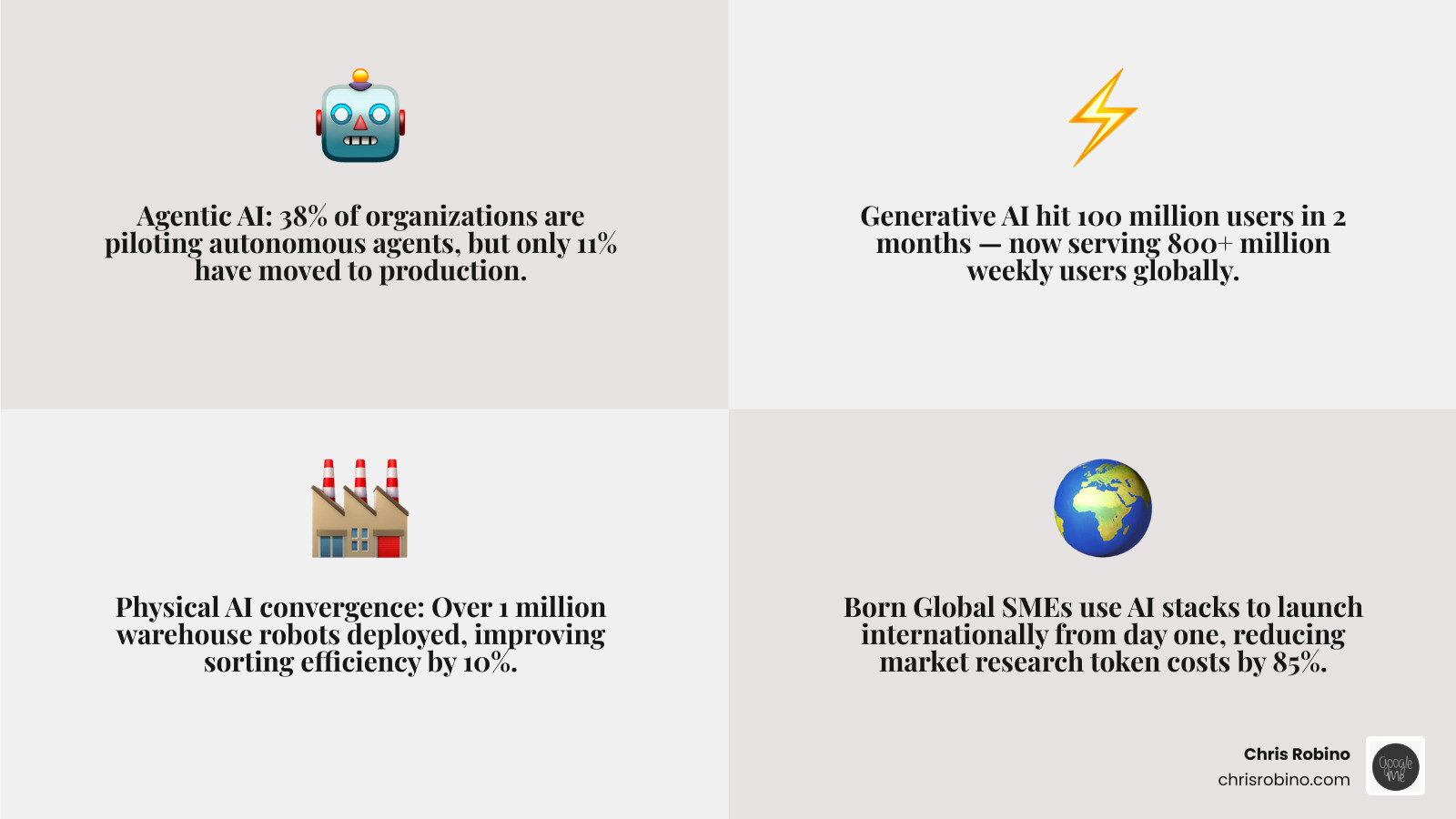
The pace of change is hard to overstate. The telephone took 50 years to reach 50 million users. A leading generative AI tool hit 100 million in just two months — and now serves over 800 million users every week. Global AI spending is forecast to reach $2.59 trillion in 2026. Token costs have dropped 280-fold in two years. AI startups are scaling five times faster than traditional SaaS companies ever did.
This is not a gradual evolution. It is a structural reshaping of how global business operates.
I’m Chris Robino, a digital strategy and AI search expert with over two decades of experience helping organizations — from tech startups to large enterprises — align technology investments with real business growth, and I’ve tracked the current trend in technology for improving global business through every major shift, from early SEO to today’s agentic AI era. In the sections ahead, I’ll break down exactly what’s driving this transformation and what your organization needs to do about it.
Important current trend in technology for improving global business terms:
The Primary Current Trend in Technology for Improving Global Business: Agentic and Generative AI
The global enterprise AI market is projected to reach $620 billion by 2028, fueled by a massive capital expenditure supercycle. Hyperscalers are committing over $725 billion to AI infrastructure in 2026 alone, driving down token costs 280-fold over a two-year period.
Consequently, the most transformative current trend in technology for improving global business is the rapid transition from human-augmenting chatbots to autonomous agentic AI. These systems independently plan, execute, and course-correct across complex workflows with minimal human oversight. While 38% of organizations are piloting these agents, only 11% have successfully moved them into production. Gartner predicts that 40% of agentic AI projects will fail by 2027, primarily because organizations attempt to automate existing, broken processes instead of redesigning operations. To successfully navigate this transition, check out our ai adoption strategies complete guide.
How Agentic AI Serves as a Current Trend in Technology for Improving Global Business
To understand how agentic AI is revolutionizing global business operations, we must look at the shifting economics of enterprise software. As analyzed in Microsoft’s $80 Billion Autonomous AI Agent Bet Is Reshaping Enterprise Tech – USA Business Times, Microsoft’s massive commitment is actively shifting monetization from flat subscription licensing to consumption-based, “per-action” pricing.
This technological shift allows multinational corporations to delegate entire operational domains to digital workforces. In financial services, autonomous agents reconcile complex cross-border trades, while in healthcare, they manage paper-heavy prior authorization workflows. By navigating data across multiple disparate platforms, agentic AI allows organizations to scale their output and expand net profit margins without a proportional increase in human headcount. To learn how these patterns fit into long-term market shifts, explore our future trends analysis.
The Convergence of AI, IoT, and Enterprise SEO
The true power of modern technology lies in combinatorial innovation—the convergence of physical and digital systems. When AI is integrated with the Internet of Things (IoT) and advanced robotics, it creates “Physical AI.” As highlighted in the Global Economic Growth Acceleration Driven By Artificial Intelligence Investment And Resilient Trade analysis, this convergence is highly disruptive, with major retailers deploying over one million warehouse robots coordinated by AI to improve sorting efficiency by 10%.
Simultaneously, global businesses are redefining how they capture market demand online. Traditional search is shifting, making modern SEO strategies that perform well for large companies a critical priority. For global enterprises, successful SEO strategies rely on programmatic SEO, automated schema markup, and semantic search optimization. By leveraging AI to generate high-quality, localized landing pages at scale and optimizing for AI-driven search engines, large companies maintain dominant visibility across millions of search queries.
This integrated tech stack also democratizes international trade for “Born Global” SMEs. By utilizing Search as Code (SaC) to execute complex market research queries, smaller firms reduce token consumption by 85% while achieving a 29% to 45% gain in research precision. Combined with multilingual AI agents operating on high-open-rate channels like WhatsApp, smaller manufacturers can qualify international leads and manage global distribution pipelines. Refer to the insights on AI & Export: How SMEs Go International From Day One (2026) | Busony to see how this trend is leveling the global playing field, particularly when considering digital transformation in media what it is and why it matters.
Overcoming Scaling Challenges and Building Trust in Global Tech Adoption
As global organizations transition from experimental AI pilots to large-scale production, they face infrastructure and economic challenges. Running compute-intensive workloads in the cloud introduces financial volatility. To optimize economics, enterprises are shifting toward strategic hybrid infrastructure models—utilizing the public cloud for elasticity, on-premises systems for cost consistency, and edge computing for low-latency processing.
This shift is heavily influenced by open-weight AI models. Meta’s Llama 4 supercluster, backed by a $40 billion capital commitment, is redefining enterprise AI by offering highly capable, open-weight models. By deploying these on private infrastructure, global investment banks and healthcare providers reduce API token costs to roughly one-sixth of proprietary cloud alternatives while ensuring data sovereignty. To explore how these infrastructure shifts impact broader corporate strategies, read more about Meta’s Llama 4 Supercluster Is Quietly Redefining Enterprise AI – USA Business Times. For a detailed breakdown of where these investments are flowing, review the data in AI Spending Statistics 2026: Where $2.59 Trillion Is Going, and align your roadmap using our guide on technology trends for business.
Infrastructure, Regulatory, and Operational Hurdles
Scaling these advanced technologies requires navigating physical and regulatory constraints. The massive energy consumption of AI data centers is straining global electrical grids, forcing tech giants to secure long-term, zero-carbon power. On a regulatory level, businesses must comply with fragmented frameworks like the European Union’s AI Act, which mandates strict transparency by August 2026.
To successfully adopt the current trend in technology for improving global business, organizations must fundamentally redesign their operating models. As highlighted in the SAP Study Finds Business Value of AI Is Spiking | SAP News Center, a significant governance gap exists: 69% of business leaders admit their organizations deploy AI agents faster than they can govern them, and 73% struggle with low-quality data. To mitigate these risks, organizations must establish robust digital trust frameworks, including centralized registries, strict access controls, and human-in-the-loop checkpoints.
The transition to an autonomous, tech-enabled global business is a human change. Leaders must foster a culture where employees view technology as an upskilling tool. For organizations seeking to navigate this complex digital landscape, partnering with an experienced industry expert is vital. ChrisRobino.com centralizes our work and insights as a professional in the emerging tech and media industry, providing a single portal for streamlined communication and access to our deep expertise. By designing resilient operating models, securing data pipelines, and implementing robust SEO strategies that perform well for large companies, forward-thinking leaders can confidently position their organizations to drive the next wave of global economic transformation.
To begin future-proofing your organization and aligning your operations with the latest digital advancements, explore the comprehensive resources and strategic advisory services available at technology trends for business.