

Why Your Business Needs an Intelligent Automation Strategy in 2026
An intelligent automation strategy is a structured plan for combining AI, robotic process automation (RPA), machine learning, and data orchestration to automate complex business processes — not just simple, repetitive tasks.
Here is a quick breakdown of what it covers:
| Element | What It Means |
|---|---|
| What it is | A roadmap for deploying AI-powered automation across end-to-end workflows |
| How it differs from RPA | Goes beyond rule-based tasks to handle decisions, exceptions, and unstructured data |
| Core components | AI, machine learning, NLP, process orchestration, governance |
| Why it matters | Unlocks compounding efficiency gains, cost savings, and competitive agility |
| Where most fail | Scaling from pilots to production — only 5% of organizations succeed |
Here is the uncomfortable truth about automation in 2026: most enterprises are stuck.
80% of organizations are exploring AI tools. 60% are evaluating enterprise solutions. But only 5% have successfully deployed intelligent automation into production with real, measurable ROI.
That gap — between exploring and actually scaling — is exactly what an intelligent automation strategy is designed to close.
The problem is rarely the technology itself. It is the absence of a coherent plan that connects automation investments to business outcomes, governance, and the people doing the work.
Industry analysts estimate companies can unlock up to 20% in labor savings by blending automation with AI. Leading global consultancies predict AI could drive a 38% increase in overall profitability. Those numbers are real — but only for organizations that move beyond scattered pilots and build automation as a true enterprise capability.
I’m Chris Robino, a digital strategy leader with over two decades of experience helping organizations — from early-stage startups to established enterprises — implement intelligent automation strategy frameworks that actually reach production. In the guide below, I’ll walk you through exactly how to design, prioritize, and scale automation the right way.
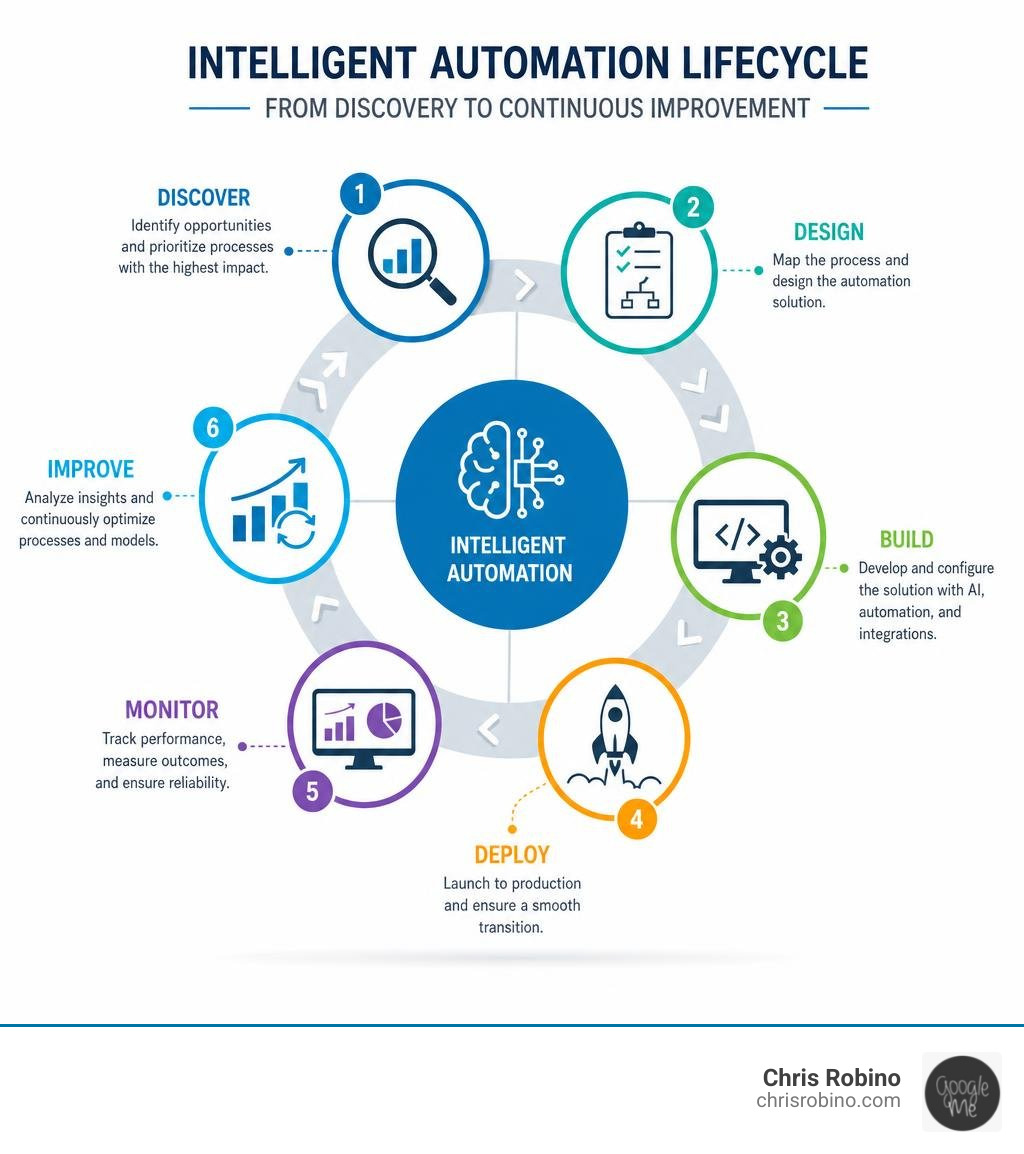
Know your Intelligent automation strategy terms:
Designing a Scalable Intelligent Automation Strategy

To build an automation engine that runs on autopilot, we must treat automation as a strategic capability rather than a series of software purchases. Far too many companies buy a shiny new tool, throw it at a broken process, and wonder why they ended up with a faster version of a broken process.
True strategic alignment means starting with your business outcomes. Are you trying to reduce your cost-to-serve, accelerate cycle times, improve compliance, or rescue your employees from the soul-crushing despair of manual data entry? Once these outcomes are clear, we design a technology integration layer that connects your legacy infrastructure with modern cognitive tools. If you want to dive deeper into this planning phase, check out our guide on AI Implementation Strategies.
Beyond RPA: What is Intelligent Automation?
To understand how to scale, we must first understand the technology evolution. Traditional Robotics Process Automation is like a digital factory worker. It is fantastic at executing repetitive, rule-based tasks with structured data—like copying numbers from an Excel sheet and pasting them into an ERP system.
But what happens when the invoice format changes, or an email contains a complex customer complaint? Traditional RPA breaks. That is where we transition to the next levels of capability. To learn more about the foundations of basic task automation, read The Definitive Guide to Robotic Automation.
Intelligent automation (IA) adds cognitive capabilities like machine learning, natural language processing (NLP), and computer vision. It allows systems to read unstructured documents, interpret customer intent, and make data-driven decisions.
In 2026, we are also seeing the rise of Agentic Process Automation (APA), which introduces autonomous agents capable of self-correction and goal-oriented execution.
| Capability | Robotic Process Automation (RPA) | Intelligent Automation (IA) | Agentic Process Automation (APA) |
|---|---|---|---|
| Primary Focus | Task execution | Process orchestration & decisioning | Goal-oriented, autonomous operations |
| Data Type | Structured only | Structured & Unstructured | Dynamic & Multimodal |
| Decision Logic | Strict, pre-defined rules | Machine learning & predictive models | Autonomous reasoning & self-correction |
| Handling Exceptions | Fails; requires human intervention | Learns from human feedback over time | Autonomously resolves or routes intelligently |
Why Most Enterprises Fail to Scale Beyond Pilots
If the technology is so powerful, why do 95% of enterprise AI pilots fail to deliver measurable profit and loss impact? We call this the “pilot paradox.” Organizations get caught in a loop of endless proofs-of-concept because they underestimate the friction required to move into production.
This friction generally falls into three categories:
- Human Friction: A lack of trust in automated decisions and fear of job displacement. The World Economic Forum estimates automation will impact 100% of jobs within the next decade. Without active change management, employees will quietly resist or bypass the new systems.
- Organizational Friction: Siloed departments, unclear ownership, and the absence of a unified operating model. If marketing generates automated leads that sales cannot process, or if finance operates on quarterly cycles while operations need weekly adjustments, the system stalls.
- Technical Friction: Legacy systems and technical debt. Trying to build advanced AI on top of a fragmented, poor-quality data foundation is like building a skyscraper on quicksand.
To overcome these roadblocks, organizations must proactively modernize their operational structures. You can learn how to bypass these scaling bottlenecks in our guide to Accelerate Digital Transformation.
Core Pillars of an Intelligent Automation Strategy
To build a production-grade intelligent automation strategy, your framework must rest on several interconnected pillars:
- Process Orchestration: Seamlessly coordinating tasks, data, and decisions across humans, bots, and legacy systems. This ensures end-to-end workflow continuity rather than isolated task optimization.
- Data-Driven Intelligence: Building a trusted, unified data foundation. Machine learning models require high-quality, continuously updated data to maintain accuracy and prevent performance degradation.
- Decision Automation: Moving beyond simple rules to leverage predictive models and AI-driven rules. This allows the system to handle complex variations and exceptions on the fly.
- Adaptive Governance: Establishing clear controls, audit trails, and role-based access. According to leading industry analysts, diffuse hyperautomation spending can drive up the total cost of ownership 40-fold without adaptive governance in place.
By combining these elements, you transition from simple task-level scripts to comprehensive, self-improving workflows. For a deeper look at these technical components, explore our resources on AI-Driven Automation and AI-Powered Automation.
Prioritizing Use Cases for Your Intelligent Automation Strategy
You cannot automate everything at once, and trying to do so is a guaranteed recipe for chaos. Successful organizations use a structured scoring framework to select and prioritize use cases based on two primary axes: Feasibility and Business Impact.
- Feasibility Assessment: Evaluate data readiness, technical complexity, and system integration requirements. Does the process rely on structured data? Are the legacy systems accessible via APIs?
- Business Impact Evaluation: Measure potential ROI, cycle time reduction, cost-to-serve improvements, and customer experience benefits. For example, 49% of consumers report abandoning a brand after just one bad experience. Automating customer service triage to deliver instant decisions can dramatically improve customer retention.
By balancing low-risk “quick wins” with high-impact, transformative initiatives, you build momentum while proving immediate financial value. Our AI Adoption Strategies Complete Guide provides a step-by-step methodology for setting up this prioritization matrix.
Governance, Compliance, and the EU AI Act
As automation systems become more autonomous, risk management becomes a critical board-level priority. This is especially true under modern regulatory frameworks like the EU AI Act, which classifies AI applications by risk level and mandates strict compliance, documentation, and human oversight for high-risk systems.
To scale safely, your strategy must incorporate:
- Accountability and Transparency: Every automated decision must be explainable and auditable. If an automated system flags a transaction as fraudulent or denies a loan application, you must be able to trace exactly why that decision was made.
- Human-in-the-Loop Guardrails: Consequential decisions should never run entirely on autopilot. Designing clear escalation paths ensures that high-risk or ambiguous cases are seamlessly routed to human experts for review.
- Data Privacy and Security: Implementing strict role-based access, data lineage tracking, and encryption to protect sensitive customer and enterprise data.
Viewing governance as an enabler rather than administrative overhead is what separates the 5% of successful enterprises from the rest. For expert guidance on structuring your compliance framework, check out our AI Strategy Consulting Ultimate Guide.
Conclusion: Navigating the Future of Enterprise Automation

Putting your business on autopilot is not a one-time technology implementation; it is a continuous journey of operational refinement. As we navigate 2026 and beyond, the competitive gap will continue to widen between companies that use basic, fragmented tools and those that execute a cohesive, enterprise-wide intelligent automation strategy.
By aligning your technology choices with organizational maturity, establishing rigorous governance, and focusing on high-impact use cases, you can build a self-improving operational engine that drives compounding business value.
At ChrisRobino.com, we specialize in helping organizations bridge the gap between automation pilots and production-grade reality. If you are ready to design a custom roadmap that aligns your business goals with cutting-edge cognitive systems, explore our AI-Driven Business Solutions or Explore technology trends for business to start transforming your operations today.