

Why an Audio Content Strategy Is Your Brand’s Most Underused Growth Lever
An audio content strategy is a structured plan for creating, distributing, and optimizing spoken-word content — like podcasts, audio blogs, and sonic branding — to reach specific business goals.
Here’s what a strong audio content strategy covers:
- Define your goals — brand awareness, lead generation, or audience retention
- Know your audience — when, where, and how they listen
- Choose your formats — podcasts, short-form audio, audio newsletters, or smart speaker skills
- Produce with quality — clear audio builds trust; poor audio destroys it
- Optimize for SEO — keyword-rich titles, transcripts, and detailed show notes
- Distribute widely — embed on your site, push to streaming platforms, share on social
- Measure what matters — completion rates and pipeline impact, not just downloads
Most content strategies are built around text and video. Audio is the channel most brands are still ignoring — and that gap is a real opportunity.
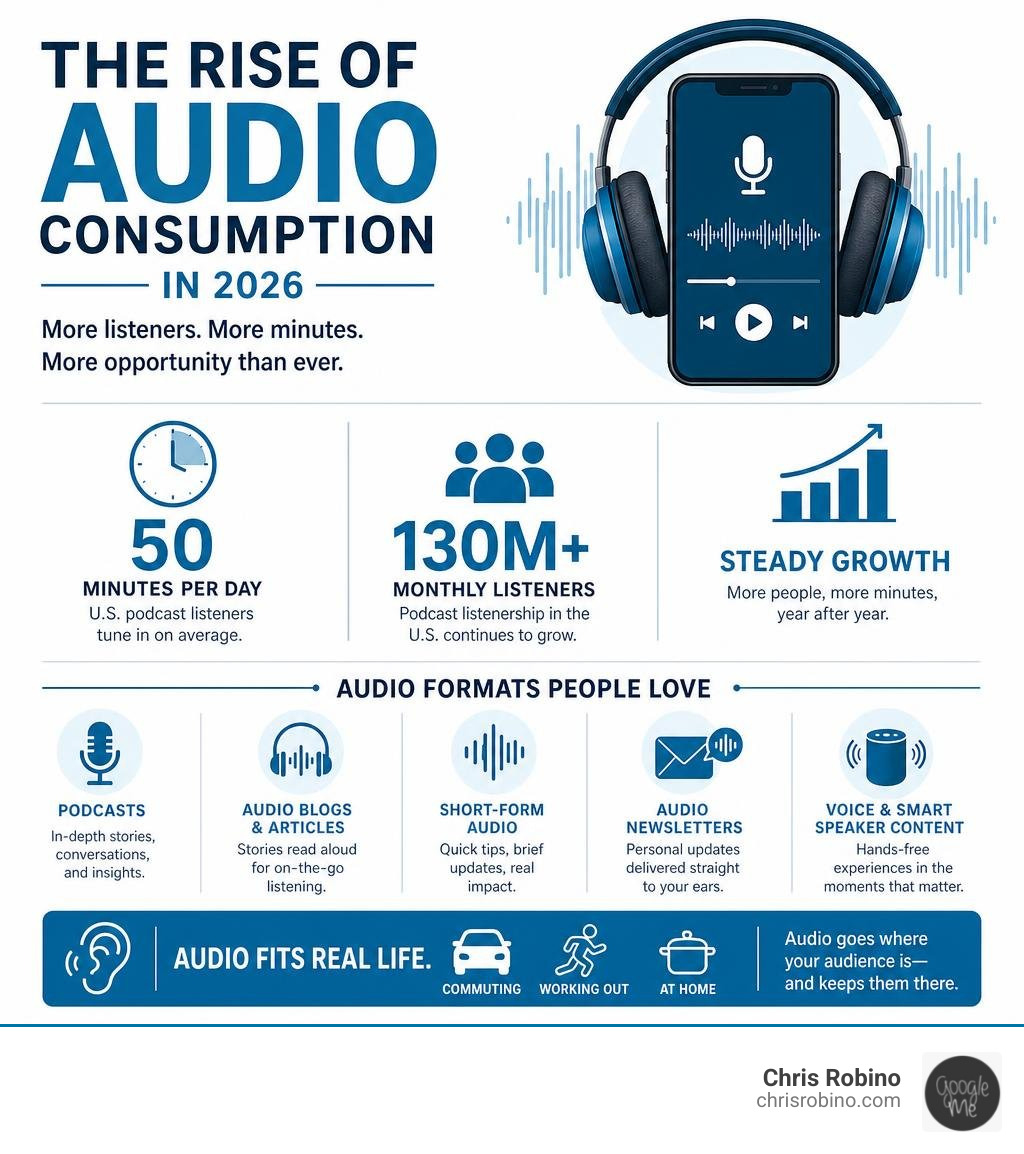
Think about it: when someone is commuting, working out, or doing dishes, they can’t read a blog post or watch a video. But they can listen. Audio slides into those in-between moments and holds attention in a way no other format can.
The numbers back this up. U.S. podcast listeners now tune in for an average of 50 minutes per day. There are 440 million blogs and 23 million YouTube channels competing for attention — but only around 750,000 podcasts. The space is less crowded, the attention is deeper, and the trust built through voice is harder to replicate with text alone.
And yet most brands still treat audio as an afterthought.
The brands winning right now aren’t just adding a podcast to their content mix. They’re building their entire content engine around audio — using a single recorded episode to generate blog posts, social clips, newsletters, and sales assets. One recording. Many outputs.
I’m Chris Robino, a digital strategy leader with over two decades of experience helping brands build scalable content systems — including audio content strategy frameworks that drive real business results, not just vanity metrics. In the sections ahead, I’ll walk you through exactly how to design, launch, and optimize an audio strategy built for 2026 and beyond.
Audio content strategy vocab explained:
Designing a Modern Audio Content Strategy
When we design a modern audio content strategy, we aren’t just thinking about launching a podcast. We treat audio as a holistic system that integrates with your entire marketing engine. This requires careful strategic planning, deep audience research, and a highly efficient production workflow.

To build a framework that actually drives business value, we start with our Content Strategy Consulting services to map your business goals to specific audio formats. We define listener personas, schedule a consistent content calendar, and establish distribution channels that place your voice exactly where your audience already spends their time.
Why Brands Prioritize an Audio Content Strategy
Why should your brand prioritize audio over other, more established formats? The answer lies in the unique cognitive space audio occupies. Unlike text and video, which demand undivided visual attention, audio thrives on passive consumption. It allows your audience to multitask, accompanying them during screen-free activities like commutes, workouts, and household chores.
According to a study published in the Journal of Advertising Research, coherent audio branding elements improve long-term brand attribution. Hearing a warm, authentic human voice builds an immediate sense of intimacy that text simply cannot match. In an era of intense screen fatigue, offering an audio option is a powerful way to respect your audience’s time while deepening their emotional connection to your brand.
This is why Every Brand Needs an Audio Content Strategy – DEV Community. By transitioning from aggressive, visual-heavy selling to narrative-driven, human-centric audio storytelling, you can capture undivided attention in a highly saturated digital market. This approach forms a core pillar of modern Digital Media Marketing, where building community trust is far more valuable than chasing fleeting clicks.
Core Components of a Podcast-First Content Engine
If you want to maximize your marketing efficiency, you should run your podcast as the central engine of your entire content program. Instead of treating a podcast as one of fifteen separate channels, we utilize a podcast-first model. In this setup, a single recorded interview or thought leadership episode serves as the “source of truth” from which all other derivative marketing assets flow downstream.
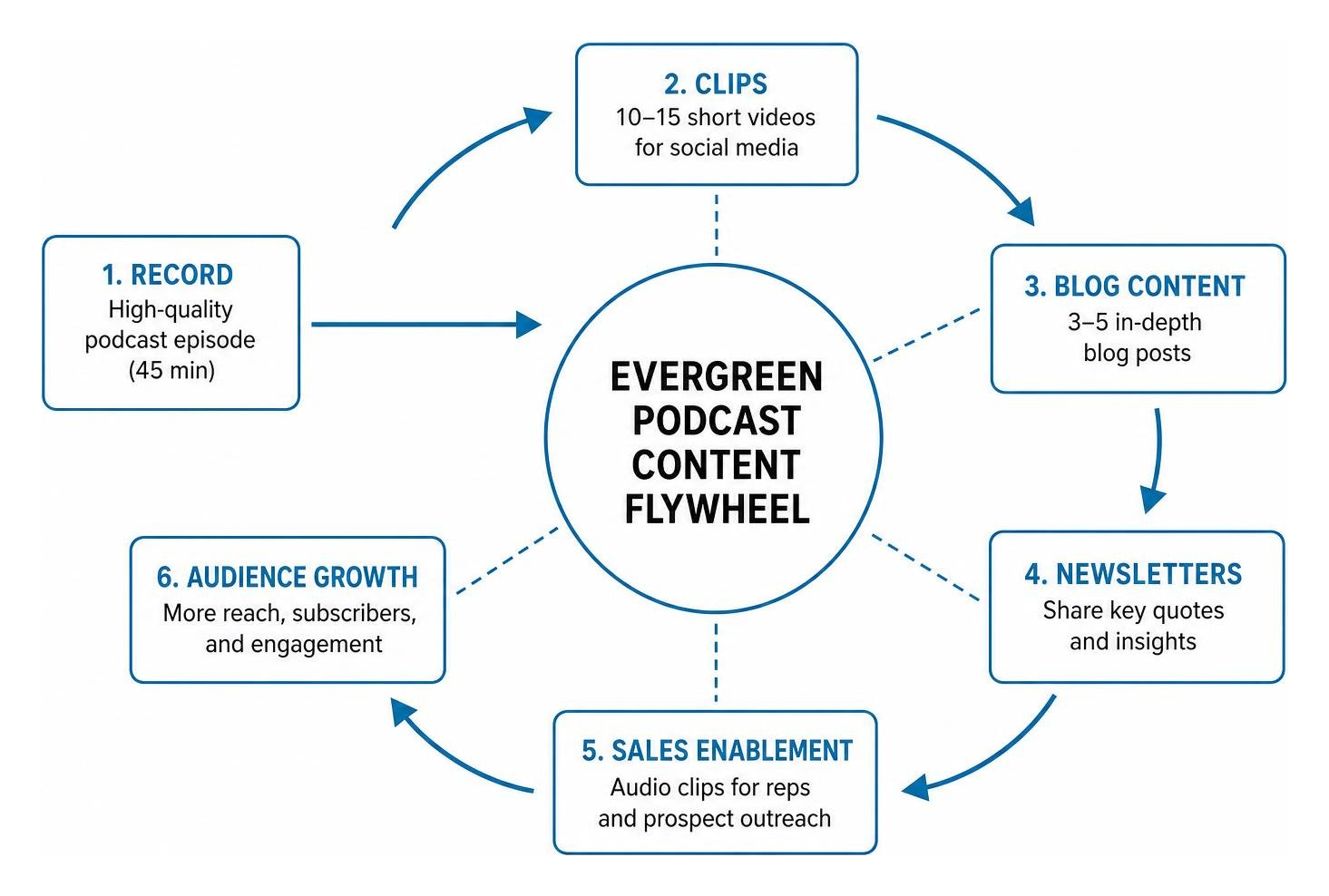
Operationally, this engine works by recording a single, high-quality 45-minute episode and using it to feed your entire marketing ecosystem:
- Short-form Video: Extract 10 to 15 highly engaging clips for TikTok, Instagram Reels, and YouTube Shorts.
- Written Content: Draft 3 to 5 comprehensive blog posts based on the episode’s key takeaways.
- Email Newsletters: Share the best quotes and insights with your subscriber list.
- Sales Enablement: Equipping your sales representatives with specific, authoritative audio clips to send to prospective clients during the buying process.
This workflow dramatically reduces content creation bottlenecks for busy executives and founders. By focusing on a single, high-leverage recording session, we can build a compounding library of digital assets. To streamline this process and keep your team from burning out, we recommend implementing the principles in our Media Workflow Efficiency Guide.
Repurposing and Optimizing Your Audio Content Strategy for SEO
For large companies, SEO strategies must perform at scale. Instead of manual optimization, enterprise brands deploy programmatic audio players across thousands of high-authority pages. This enterprise SEO strategy leverages existing domain authority to dramatically increase dwell time, signaling search engines that the content is highly valuable.
Adding spoken versions of your articles significantly increases average on-page dwell time. Search engines interpret these extended visits as a strong signal of a high-quality user experience, which in turn boosts your organic search rankings. In our Content Automation Guide, we explore how modern AI voice tools can automatically convert text to audio, making scale both affordable and immediate.
To make sure your audio content is fully indexable by search engines, you must follow established optimization guidelines. This includes writing keyword-rich show titles, providing detailed show notes with timestamps, and publishing full, accurate text transcripts on your website.
Implementing Sonic Branding and Future Voice Technologies
As we look toward the future of digital media in 2026, voice user interfaces (VUI) are rapidly becoming as fundamental to the web as HTML. Brands can no longer rely solely on visual guidelines. To maintain a cohesive identity across smart speakers, mobile apps, and streaming platforms, you must design a dedicated sonic identity.

We help organizations build and deploy these audio assets systematically. Through our Broadcast Consulting Services Guide, we assist brands in developing technical audio standards, selecting appropriate voice talent, and ensuring seamless cross-platform delivery.
Building an Audio Brand Toolkit and Sonic Identity
An audio brand toolkit is the sonic equivalent of a visual style guide. It takes the guesswork out of your audio production by transforming random music choices into strategic, repeatable brand moments. Without a centralized toolkit, different teams and external agencies will inevitably use inconsistent sounds, leading to a fragmented and unprofessional brand experience.
To construct a highly effective toolkit, consult the Audio Content Strategy Guide for 2026. Your toolkit should include:
- The Sonic Logo: A short, distinct sequence of notes (usually 2 to 4 seconds) that triggers instant brand recall. For example, TikTok’s sonic logo achieved an 81% user familiarity rate within a year of launch, leading to a 15% uplift in global brand attribution.
- Brand Theme Music: Long-form, custom musical compositions designed for podcasts, event intros, and video campaigns. Research shows that using on-brand music boosts emotional engagement on digital content by 27% compared to generic stock music.
- Voice and Tone Guidelines: Explicit rules defining the gender, age, tempo, and emotional energy of the voices representing your brand.
Emerging Tech: AI Voice, Smart Speakers, and Voice Search
The rapid rise of voice-enabled devices is fundamentally reshaping how consumers find information. With hundreds of millions of smart speakers and voice assistants in active use globally, optimizing for voice search is no longer optional.
This shift has introduced Generative Engine Optimization (GEO). For large companies, this SEO strategy performs exceptionally well because AI-driven search engines prioritize depth, natural conversation, and topic authority (E-E-A-T signals) over simple keyword stuffing. Because long-form podcast transcripts naturally contain these organic conversational patterns, they are highly favored by modern AI search models.
Additionally, brands are leveraging advanced text-to-speech (TTS) technology to deliver daily flash briefings and interactive audio experiences directly through smart speakers. This allows you to establish a recurring, screen-free morning habit loop with your target audience, delivering valuable industry news directly to their homes or offices.
Measuring ROI and Avoiding Common Audio Pitfalls
The most common mistake brands make when launching an audio strategy is focusing on the wrong metrics. Chasing raw download numbers is a recipe for frustration. For most B2B and niche consumer brands, a small, highly targeted group of engaged listeners is infinitely more valuable than millions of accidental clicks.
To build a sustainable model, you must focus on evergreen production. By creating high-value, timeless audio assets, you build a compounding library of authority that continues to attract clients years after publication.
To accurately measure your audio ROI, you should look beyond basic downloads and track deep engagement and pipeline impact:
| Podcast Vanity Metrics | Business ROI Metrics |
|---|---|
| Raw Downloads | Average Completion Rate (Aim for 70%+) |
| Social Media Likes | Inbound Qualitative Inquiries (e.g., “I heard you on your podcast”) |
| Total Subscriber Count | Downstream Pipeline Attribution via UTM Tracking & CRM Tagging |
| Episode Release Frequency | Sales Enablement Asset Utility (How often sales reps share clips) |
Additionally, never compromise on your audio quality. Poor sound acts as a strong negative trust signal, communicating to listeners that your brand treats its content as an afterthought. Invest in proper recording environments, reliable microphones, and professional post-production to ensure your voice matches the high standards of your business.
Ready to transform your brand’s digital presence and build a scalable content engine for 2026? Explore our comprehensive resources on digital transformation for media to see how we can help you turn your strategic vision into a powerful, high-ROI reality.