

Why Marketing Automation Content Matters Now More Than Ever
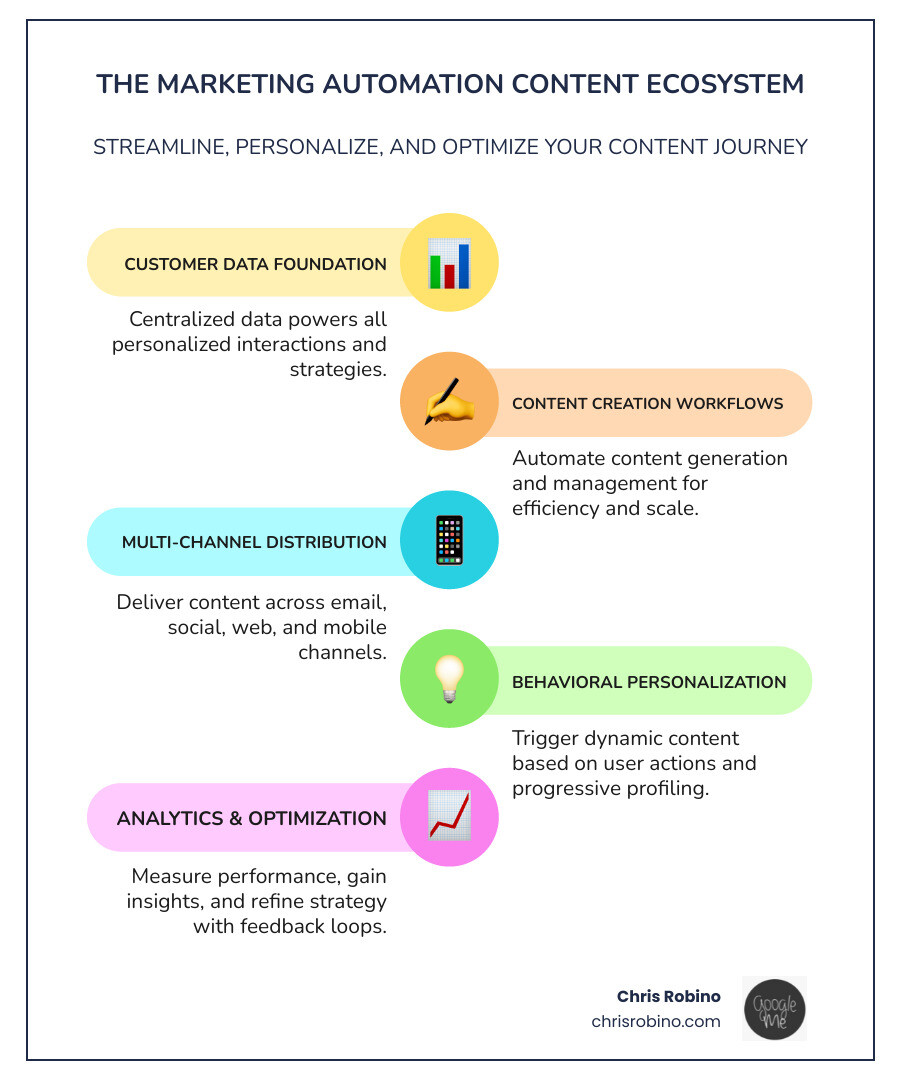
Marketing automation content is the strategic use of technology platforms to streamline, personalize, and optimize how you create, distribute, and measure content across your customer journey—from initial awareness through to advocacy.
Here’s what you need to know:
Core Definition:
- Marketing automation content = Content strategy + automated workflows + data-driven personalization
- It uses software to handle repetitive marketing tasks without manual intervention
- It differs from basic email marketing by coordinating content across multiple channels and lifecycle stages
Key Components:
- Dynamic content that adapts based on user behavior and data
- Behavioral triggers that deliver the right message at the right time
- Multi-channel coordination across email, social, web, and mobile
- Progressive profiling that learns more about contacts over time
Why It’s Critical:
- Content demand nearly doubled between 2023 and 2024
- Organizations using automation saw 29% greater revenue impact
- Teams report spending up to 80% less time on routine tasks
- Marketing leaders using automation are 24% more likely to meet content demands
The stakes are high. Customer expectations for personally relevant, emotionally resonant content have never been greater. Traditional manual approaches simply can’t keep pace with the volume and personalization required in today’s market.
As Chris Robino, I’ve spent over two decades helping organizations steer digital change through AI automation and intelligent search solutions, with a particular focus on optimizing Marketing automation content strategies that drive measurable ROI. Throughout this guide, I’ll share practical frameworks and proven strategies to help you implement smarter, more effective content automation.
Explore more about Marketing automation content:
- content marketing strategies for tech companies
- content marketing tips for tech startups
- tech content marketing
The Strategic Imperative of Marketing Automation
In today’s digital landscape, the sheer volume of content required to engage audiences is staggering. Enterprise brands and high-growth organizations are experiencing a massive surge, with demand for content increasing by more than 90% in recent years. This isn’t just about creating more; it’s about creating more effective content and aligning it with scalable SEO strategies. This is where Marketing automation content becomes not just a tool, but a strategic imperative.
From Manual to Automated: Core Benefits and Efficiency Gains
At its heart, marketing automation refers to software platforms and technologies designed to help businesses automate repetitive marketing tasks. Think of it as a digital assistant that handles the mundane, allowing your human team to focus on strategy, creativity, and high-impact SEO initiatives.
While traditional marketing often involves manual, time-consuming processes like sending individual emails or scheduling social media posts one by one, marketing automation streamlines these operations and connects them to search-focused content programs.
For large companies managing thousands of pages, product lines, and customer segments, this is critical. Strong SEO performance increasingly depends on:
- Maintaining consistent technical health across complex sites
- Publishing and updating content at scale
- Aligning on-page optimization with user intent and behavior
- Using data to refine topics, formats, and internal linking
Marketing automation operationalizes these activities.
The benefits of implementing marketing automation are profound and directly impact a business’s bottom line:
- Increased Efficiency and Time Savings: Organizations using content automation typically see a 50-70% reduction in content production time. Teams report spending up to 80% less time on routine content tasks. This frees up resources for strategic SEO initiatives like topic clustering, schema implementation, and content refresh cycles.
- Cost Reduction: By optimizing workflows and reducing manual labor, marketing automation can reduce overall marketing spend by around 12 percent. For enterprises investing heavily in organic search, this helps redirect budget to higher-value initiatives like in-depth research, experimentation, and advanced analytics.
- Improved Productivity and Creativity: When automation handles repetitive tasks (workflows, notifications, basic segmentation), teams can focus on high-impact work: building comprehensive pillar pages, refining information architecture, and designing search-optimized resource hubs that capture intent across the funnel.
- Improved Lead Nurturing and Management: One of the most compelling advantages is the ability to nurture leads effectively. Nurtured leads often make significantly larger purchases than non-nurtured leads. With SEO and automation working together, findy (search) feeds nurture programs (email, in-app, retargeting) that educate, qualify, and convert over time.
- Greater Revenue Impact: Content that ranks well in search, combined with automated follow-up and personalization, leads to measurable revenue impact. Businesses that use marketing automation alongside strong SEO processes typically grow their pipeline more quickly and see higher revenue per visitor.
- Sales Enablement: Automation doesn’t just help marketing. It provides sales with warmer, more qualified leads and insights into prospect behavior—such as which search-driven content they consumed, which topics they engaged with, and what problems they are trying to solve.
For tech startups and enterprises alike, these efficiencies are critical for rapid growth and scaling. Find more about tailoring content strategies for emerging businesses in our Content Marketing Tips for Tech Startups guide.
From an SEO perspective, automation also supports:
- Scheduled publication of optimized content based on keyword research and seasonality
- Automated internal linking suggestions aligned with priority URLs
- Rules-based updates for metadata or CTAs across large content sets
- Consistent deployment of structured data and canonical tags
Over time, this combination of process, tooling, and content intelligence compounds organic visibility.
Personalizing the Customer Journey at Enterprise Scale
In an age where customers expect brands to understand their individual needs, personalization is no longer a luxury—it is a necessity. Marketing automation content is the engine that drives personalized customer journeys at scale, turning impersonal interactions into meaningful relationships.
Customer journeys are the sum of individual personalized experiences with your brand. The goal is to tailor every interaction based on customer data, creating ongoing, seamless journeys through every touchpoint—from the first search query to post-purchase advocacy.
This goes far beyond simply inserting a customer’s first name into an email subject line (though that alone can improve engagement). For large companies, high-performing SEO and automation work together as follows:
- Search brings the right people to the right content based on intent.
- Automation uses behavior on that content (time on page, downloads, viewed topics) to segment and score users.
- Follow-up content, offers, and experiences are custom based on this behavior.
Here is how automation makes this possible:
- Dynamic Content: Content adapts in real time based on user behavior, preferences, or demographic data. A search visitor landing on a resource hub might see different recommended assets depending on their industry, browsing history, or past downloads.
- Behavioral Triggers: Automation platforms can respond to specific actions (or inactions) taken by a prospect. For example, downloading an SEO-optimized white paper might trigger a follow-up series, or abandoning a pricing page could prompt a personalized reminder sequence.
- Progressive Profiling: Instead of overwhelming new leads with long forms, automation allows you to gather information gradually over time through various interactions. Each action is an added data point, helping you build a richer understanding of your audience and refine your SEO content roadmap.
- Multi-channel Coordination: Marketing automation ensures a consistent and cohesive experience across all channels—email, mobile (SMS/MMS, push notifications), social media, paid media, and the website. This orchestration ensures that content finded via search is reinforced across channels in a timely and relevant way.
While the fundamental goal of engaging customers remains the same, B2B and B2C companies often approach Marketing automation content with different strategic priorities due to their distinct audiences, customer lifetime values (CLV), and sales cycles.
For large B2B organizations, SEO and automation must support long, complex buying journeys with multiple stakeholders. Content strategies emphasize:
- Deep educational resources optimized for problem-, solution-, and brand-level keywords
- Account-based segments aligned with industry, company size, and use case
- Lead scoring models tuned to high-intent behaviors (e.g., demo page visits, pricing research)
For large B2C organizations, SEO and automation focus more on reach, frequency, and conversion at scale:
- High-volume, intent-rich keywords around products, categories, and comparisons
- Behavior-based triggers for browse abandonment, cart abandonment, and replenishment
- Personalized offers based on search terms, product views, and historical purchases
You can explore additional ways to keep audiences engaged across touchpoints in our Audience Engagement Strategies guide.
Below is a comparison of typical B2B vs. B2C automation focus that aligns with SEO-driven content strategies:
| Aspect | B2B Marketing Automation | B2C Marketing Automation |
|---|---|---|
| Primary Goals | Pipeline quality, deal velocity, account expansion | Traffic growth, conversion rate, repeat purchases |
| Core Content Types | White papers, case studies, webinars, comparison guides, long-form blogs | Product pages, category hubs, how-to content, promos, reviews |
| Typical Cycle Length | Weeks to months (or longer) | Minutes to days |
| SEO Focus | Thought leadership, niche topics, intent at each funnel stage | High-volume queries, product findy, local and transactional intent |
| Key Success Metrics | Marketing-qualified leads (MQLs), opportunity creation, influenced revenue | Organic sessions, add-to-cart rate, revenue per visitor, customer lifetime value |
Unifying the Revenue Engine: Sales, Marketing & Support Integration
To truly open up the value of Marketing automation content and enterprise SEO, large organizations need to break down silos between teams. Search performance, lead follow-up, and customer support interactions all depend on shared context and data.
A unified revenue engine typically relies on:
- Centralized Customer Data: A single, reliable profile for each contact that consolidates behavioral, transactional, and search-driven insights.
- CRM Integration: Tight connections between your marketing automation platform, CRM, and analytics tools ensure that data flows freely in both directions.
- Automated Lead Hand-offs: When a visitor finded via search meets agreed-upon scoring thresholds, they are automatically routed to the appropriate sales or success team—along with the context of which content and queries brought them in.
- Bi-directional Sync: Updates from sales or support (deal stage changes, ticket outcomes) feed back into automation and SEO strategy, helping you prioritize future content and refine qualification criteria.
- Closed-loop Reporting: Teams can see how organic traffic, specific content pieces, and automation flows contribute to pipeline, revenue, and retention.
For SEO leaders in large organizations, this integration makes it possible to:
- Attribute revenue to specific search terms and content clusters
- Identify which topics produce the highest-value customers
- Spot gaps in the content journey where leads stall or drop
- Align on shared KPIs with sales and support
You can dive deeper into creating a cohesive digital ecosystem in our Digital Marketing Strategy Advice resource.
Over time, this integrated approach enables:
- Sales Enablement: Reps get direct access to search-optimized content libraries, custom by persona and stage, and can see which assets prospects have already engaged with.
- Support Enablement: Customer success teams leverage the same content to deflect tickets and improve self-service, feeding back insights on recurring issues into SEO and content planning.
- Strategic SEO Alignment: Marketing, sales, and support contribute to a unified content roadmap, ensuring that search-focused assets support real customer questions and commercial priorities.
By treating SEO, automation, and customer operations as parts of the same system, large companies build a compounding advantage in findability, conversion, and retention.