

Why a Content Partnership Strategy Is the Growth Lever Most Brands Are Missing
A solid content partnership strategy is one of the most efficient ways for modern media brands to break through a saturated content landscape — without inflating their production budget.
Here is a quick answer to what it involves and why it works:
| Element | What It Means |
|---|---|
| What it is | A structured collaboration between two or more brands to co-create, co-distribute, or co-promote content for mutual benefit |
| Why it works | Each partner brings something the other lacks: audience, credibility, distribution, or a distinct point of view |
| Key types | Co-creation, syndication, guest posting, media partnerships, influencer collaborations |
| How to measure it | Sales attribution, pipeline growth, brand perception shifts, and net new audience gained — not just reach or impressions |
| Biggest risk | Misaligned values, unclear roles, or no defined distribution commitments from either side |
Content marketing already costs 62% less than traditional marketing while generating three times as many leads. Partnerships multiply that advantage further by layering in borrowed trust, cross-audience exposure, and shared production resources.
But most brands approach partnerships the wrong way. They chase logo recognition or follower counts instead of genuine audience fit. They agree on a format before agreeing on a point of view. They create content together — then leave distribution as an afterthought.
The result? Content that is technically co-created but commercially invisible.
The brands getting this right are doing something different. They are identifying partners who serve a similar buyer through a different lens, defining roles and distribution commitments before a single word is written, and measuring outcomes tied to real business objectives — not vanity metrics.
This guide walks through exactly how to do that.
I’m Chris Robino, a digital strategy leader with over two decades of experience helping brands — from early-stage startups to established enterprises — build content programs that drive measurable growth, including developing and scaling content partnership strategies that create lasting audience and revenue impact. In the sections ahead, I’ll share a practical, structured framework you can apply immediately.
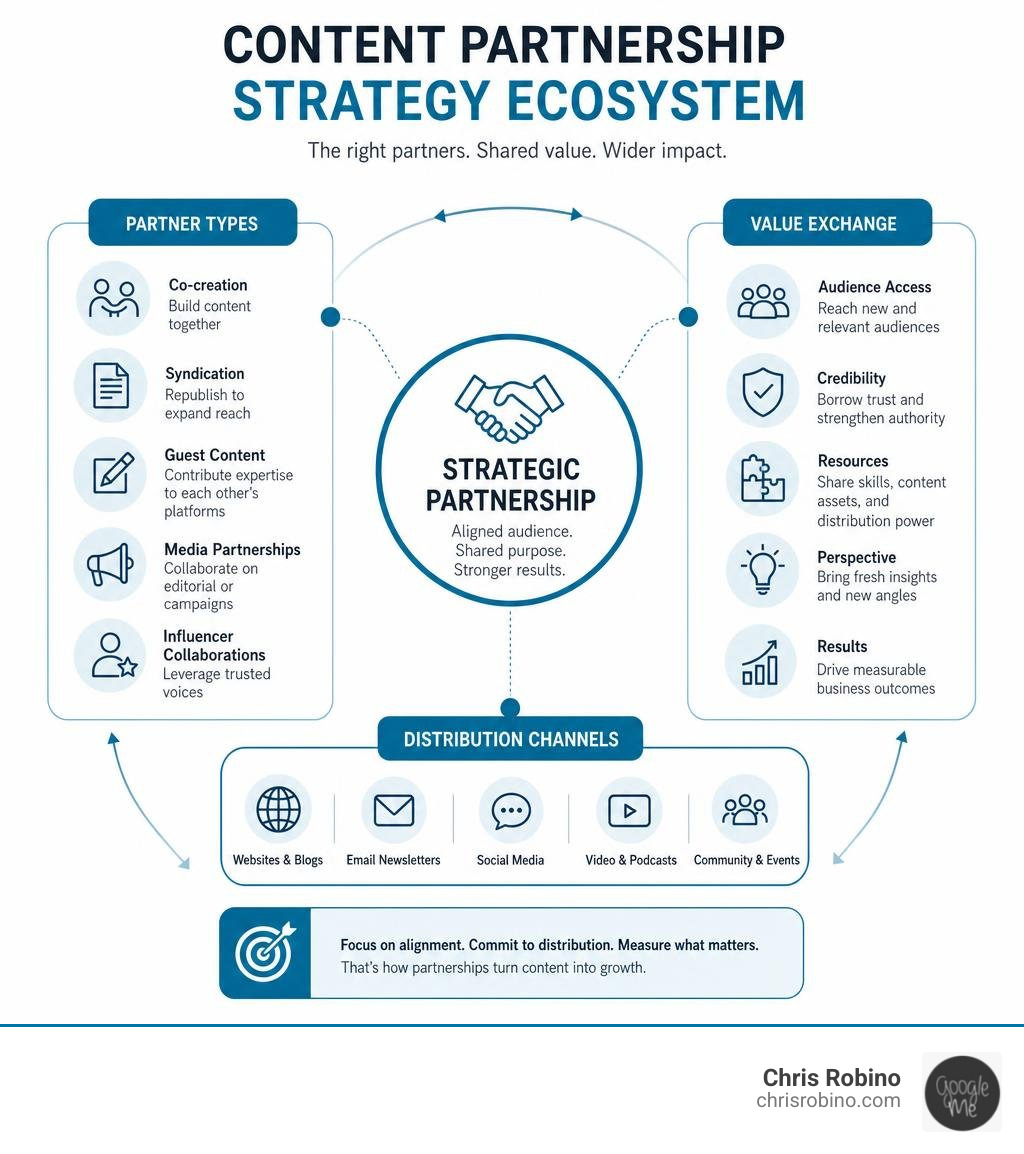
Easy Content partnership strategy word list:
Designing a High-Impact Content Partnership Strategy

To transition from ad-hoc, campaign-based collaborations to a scalable engine, we must design a repeatable framework. Successful programs rely on strategic alignment, shared resources, and a commitment to brand lift and market expansion.
Core Models of a Modern Content Partnership Strategy
Not all collaborations are created equal. Depending on our business objectives, target audience, and resource availability, we must choose the model that fits our goals. In the B2B space, where 90% of marketers rely on traditional content distribution, finding the right partnerships is the key to standing out.
Here is how the primary partnership models compare:
| Partnership Model | Primary Objective | Best For | Key Advantage |
|---|---|---|---|
| Co-Creation | Deep thought leadership & original data | B2B, SaaS, Professional Services | High search equity and original backlinks |
| Content Syndication | Maximum reach & lead generation | Scaling existing high-performing assets | Low production cost, fast execution |
| Guest Posting | Brand authority & search visibility | Niche audience building | Direct access to editorial channels |
| Media Partnerships | Brand lift & credibility transfer | Broad awareness campaigns | Up to 50% higher brand lift |
| Influencer/Expert | Targeted engagement & trust | Specialized or consumer niches | High audience trust and authenticity |
| Retail Partnerships | Direct conversions & attribution | E-commerce, consumer brands | Highly qualified buyer intent |
For media organizations looking to expand their footprint, building a structured approach around these models is a core pillar of a comprehensive audience development media ultimate guide.
Selecting the Right Partners for Audience Alignment
The most common reason collaborations fail is chasing prestige over audience fit. A partner with a massive but passive audience will always underperform compared to a partner with a smaller, highly engaged, and tightly aligned community.
When evaluating potential partners, we look for an overlap in target buyers without direct product competition. For instance, a project management consultancy partnering with a collaboration software vendor creates a natural, complementary value exchange.
To systematically vet prospects, we recommend using a scorecard that evaluates:
- Audience Overlap: Do they serve our exact buyer at a different stage of their journey?
- Value Exchange: What unique asset, data, or distribution channel do they bring?
- Editorial Standards: Does their content meet our quality and depth requirements?
For early-stage startups and growing brands, establishing these evaluation criteria early is essential to building long-term alliances that compound in value over time. This approach ensures that our collaborative efforts naturally align with thought leadership content best practices.
Structuring Agreements and Mitigating Brand Risks
A handshake agreement is a recipe for operational friction. Before producing any creative assets, both parties must align on governance, editorial sign-off workflows, and explicit distribution commitments.
Our agreements should clearly document:
- Content Ownership: Who owns the intellectual property after publication, and how can it be repurposed?
- Editorial Sign-off: Who has the final say on the copy, and what is the turnaround timeline?
- Distribution Commitments: Which channels will be used, what is the frequency of promotion, and what are the minimum audience sizes targeted?
This level of structure is particularly critical in specialist or regulated industries, such as healthcare, finance, or youth-focused markets, where compliance and data protection laws dictate what can be published. By establishing clear guardrails, we protect our brand reputation and preserve audience trust. For a deeper look at managing these operational structures, refer to our comprehensive b2b thought leadership content guide.
Executing and Measuring Collaborative Content Programs

Once the strategic foundation is laid, execution requires operational alignment and structured workflows to ensure both brands contribute equitably and maximize the impact of the shared assets.
High-Value Formats and Distribution Workflows
The most effective formats for co-created content are those structurally built for two voices. While blog posts are common, they often dilute individual editorial perspectives. Instead, we prioritize formats that naturally showcase collaborative expertise:
- Joint Research and Data Reports: This is the highest-value format for B2B. Original data naturally attracts high-authority backlinks, media coverage, and downloads.
- Co-Hosted Webinars and Virtual Events: These create immediate pipeline activity and allow both brands to engage overlapping audiences in real time.
- Podcasts and Video Series: Dialogues and interview formats are built for partnerships, making the exchange of perspectives feel natural and authentic.
- Co-Branded Ebooks and Toolkits: Packaging actionable resources gives audiences a highly practical asset that continues to generate leads long after launch.
To maximize efficiency, we recommend creating one major “anchor asset” (like a joint research report) and then breaking it down into derivative content — such as social snippets, guest articles, and newsletter cameos — that each partner can distribute independently. For more insights on maximizing these assets, explore our proven content marketing strategies for tech companies.
Implementing a Safe SEO Content Partnership Strategy
When syndicating or cross-publishing content with partners, search engine optimization must be handled carefully to avoid diluting search equity. While duplicate content does not trigger direct penalties from search engines, it can confuse search crawlers and divide your organic ranking signals.
To execute a safe syndication strategy, we follow these best practices:
- Use Canonical Tags: Ensure the syndicated version on the partner’s site contains a canonical link pointing directly to the original article on your domain.
- Write Unique Introductions: Differentiate syndicated articles by writing a custom, 150-word introduction that contextualizes the piece for the partner’s specific audience.
- Delay Republication: Wait one to two weeks before republishing an asset on a partner site to allow search engines to index and establish the original piece as the authoritative version.
By maintaining these technical standards, we build a healthy backlink profile and elevate our topical authority without risking our search rankings. For detailed execution steps, read our saas content marketing guide.
Measuring Success Beyond Vanity Metrics
With 48% of marketers reporting that thought leadership content directly drives sales and generates leads, we must move past vanity metrics like reach, impressions, and social shares. To calculate the true return on investment of our content partnership strategy, we must track commercial outcomes:
- Sourced vs. Influenced Leads: Sourced leads are those captured directly via collaborative landing pages. Influenced leads are existing pipeline opportunities that engaged with the partnership content before converting.
- Sales Attribution and Pipeline Value: Connect collaborative campaigns directly to CRM data to trace how many closed-won deals touched the co-created assets.
- SEO Equity and Domain Authority: Monitor the growth of high-quality, contextual backlinks pointing to your domain from the partner’s high-authority site.
At ChrisRobino.com, we help brands navigate these exact measurement challenges. We align creative storytelling with robust data infrastructure, ensuring your partnership programs are treated as growth engines rather than soft brand exercises. To explore more about tracking these metrics, learn how our content strategy consulting can help.
If you are ready to modernize your media operations, scale your audience, and build a highly profitable partner program, explore our specialized services in digital transformation for media and let’s get to work.