

Why Every Enterprise Needs a Robotic Process Automation Strategy Now
A well-built robotic process automation strategy is the difference between scattered bots that break and a scalable digital workforce that compounds value over time. Here’s what that looks like at a glance:
What makes a strong RPA strategy?
- Discover the right processes – High-volume, rule-based tasks with exception rates below 20%
- Redesign before you automate – Simplify processes first; automating inefficiency just magnifies it
- Establish governance early – A Center of Excellence (CoE) with shared IT and business ownership
- Manage the human side – Change management and upskilling prevent adoption failure
- Align data and AI – Governed data and AI capabilities extend RPA into intelligent automation
- Monitor and scale – Track metrics, retire redundant bots, and expand what works
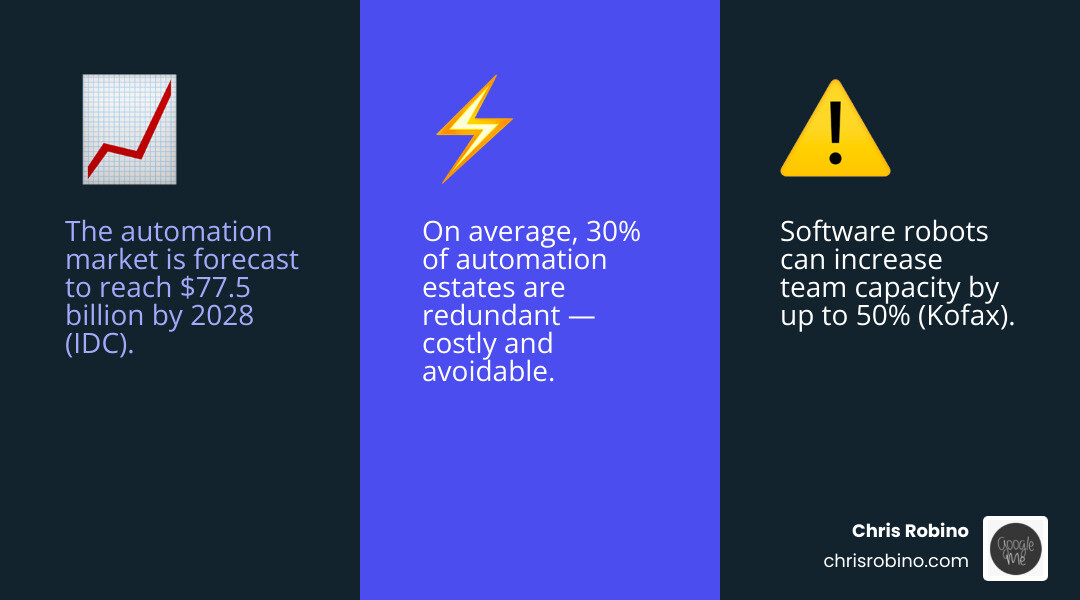
The promise of RPA is real. When properly configured, software robots can increase a team’s capacity for work by up to 50% (Kofax). The broader automation market is forecast to reach $77.5 billion by 2028. And yet, despite this growth, RPA remains the least-scaled intelligent automation technology across the enterprise, according to research by HFS and KPMG.
Why the gap? Most organizations treat automation as a side project rather than a core operating model. They automate the wrong processes, skip governance, and underestimate the human element. The result is fragile bots, redundant automations, and stalled programs. Research shows that on average, 30% of automation estates are redundant – a costly and avoidable problem.
The organizations pulling ahead aren’t just deploying more bots. They’re building strategic capabilities – combining process discovery, change management, data governance, and AI integration into a unified, sustainable program.
I’m Chris Robino, a Digital Strategy Leader with over two decades of experience helping organizations navigate digital transformation, including guiding enterprises through the complexities of building a robotic process automation strategy that scales. In the sections below, I’ll walk you through the frameworks, decisions, and pitfalls that separate programs that stall from those that deliver lasting ROI.
Robotic process automation strategy vocab explained:
Designing a Resilient Robotic Process Automation Strategy
When we set out to build a robotic process automation strategy, we must shift our perspective from tactical task-solving to long-term capability building. Too often, organizations deploy a bot to patch a leaky process, only to watch it break the moment an underlying software system updates. To capture genuine business value, we must treat automation as a core component of our digital operating model.
The primary drivers for this journey go far beyond simple cost reduction. By standardizing workflows and freeing human workers from manual drudgery, we unlock unprecedented levels of operational efficiency and process accuracy. However, achieving these outcomes requires a structured approach that avoids common pitfalls. If you want to build a program that stands the test of time, you can learn how to lay the groundwork in our guide on How to Build an Enterprise Automation Strategy Without the Headache.
Defining the Core Pillars of a Robotic Process Automation Strategy
To construct a resilient strategy, we must first understand the technical levers at our disposal. RPA operates across three primary modes, each serving a distinct operational need:
- Attended Automation: These digital assistants run on a user’s desktop, triggered directly by human employees to assist with specific sub-tasks (e.g., retrieving customer records during a live call).
- Unattended Automation: These background bots run independently on virtual servers, triggered by system events or schedules to process high-volume, back-office transactions.
- Hybrid Automation: A collaborative workflow where unattended bots handle bulk processing, but dynamically hand off exceptions to human workers before completing the task.
At its core, RPA excels at mimicking human interactions at the user interface (UI) level. This means bots can copy, paste, log into legacy systems, and move data across applications exactly like a human would—without requiring expensive back-end API integrations. By targeting highly structured, rule-based tasks, we can deploy solutions rapidly. To dive deeper into how these components function together, check out The Definitive Guide to Robotic Automation.
Process Discovery and Prioritization Frameworks
One of the most valuable automation skills we can possess is restraint—knowing when to say “not yet” to an unstable process. Automating an inefficient workflow simply produces an “efficiently inefficient” process, magnifying waste rather than creating value.
To identify viable candidates, we must combine modern process discovery tools—such as process mining and task mining—with practical human evaluation.
When evaluating candidate processes, we look for workflows that meet the following criteria:
- Rule-Based and Standardized: The steps are predictable and do not require subjective human judgment.
- High Volume and Frequency: The task runs regularly enough to justify the development costs.
- Low Exception Rates: Workflows with exception rates below 20% are ideal. If a process owner cannot explain the exceptions without opening multiple tabs and messaging colleagues, it is not ready for automation.
- Digital Inputs and Outputs: The data must be structured and digital (e.g., databases, spreadsheets, or standardized PDFs).
Before writing a single line of bot code, we must apply lean principles to redesign and simplify the workflow. Redesigning first can reduce process complexity by 30% to 50%, delivering up to three times the ROI of automation alone. Once the process is streamlined, we can map out the technical deployment using our RPA Infrastructure Setup Guide From Blueprints to Bots.
Overcoming Cultural Resistance and the Fear of Robots
Let’s address the elephant in the server room: the “fear of robots.” A global PwC survey found that 60% of workers are worried about automation making their jobs obsolete. If we ignore this anxiety, cultural resistance will quietly dismantle our automation program.
To succeed, our change management strategy must be proactive, transparent, and empathetic. We should frame RPA bots not as job-stealing rivals, but as “digital coworkers” designed to take over the boring, repetitive tasks that cause burnout.
Upskilling is the secret weapon of workforce transition. By training our existing employees to oversee, guide, and manage these digital workers, we leverage their deep process knowledge while elevating their careers. Successful automation programs routinely invest 15% to 20% of their total budget into change management and communication. To understand how to foster this collaborative human-machine relationship, read about Why Your Factory Needs a Robotic Best Friend.
Scaling and Governing Your Automation Ecosystem
As an enterprise automation program grows, it inevitably faces the challenge of scale. Without proper oversight, organizations quickly fall victim to “bot sprawl”—a chaotic state where hundreds of fragmented, undocumented bots run without clear ownership. This lack of governance inflates maintenance costs (which typically consume 20% to 30% of the initial development budget annually) and leads to massive redundancies.
To prevent this, we must understand how basic RPA fits into the broader spectrum of digital transformation technologies:
| Capability | Robotic Process Automation (RPA) | Intelligent Automation (IA) | Agentic AI (APA) |
|---|---|---|---|
| Primary Focus | Task execution (doing) | Process orchestration (understanding) | Autonomous reasoning (thinking) |
| Decision Logic | Deterministic (strict rules) | Probabilistic (machine learning) | Cognitive (goal-oriented) |
| Data Handling | Highly structured inputs | Unstructured documents & data | Dynamic, ambient context |
| Human Role | Initiator / Exception handler | Supervisor / Validator | Strategic partner / Director |
To navigate this progression cleanly and avoid costly architectural mistakes, consult our RPA Robotic Automation Ultimate Guide.
Establishing a Center of Excellence for Your Robotic Process Automation Strategy
A sustainable robotic process automation strategy requires a centralized governing body: a Center of Excellence (CoE). Siloed ownership—where IT or individual business units build automations in isolation—is one of the primary reasons automation projects fail.
A hybrid CoE model solves this by establishing shared ownership:
- Centralized Standards: The CoE defines security standards, manages credential vaults (ensuring bots use dedicated service accounts instead of hardcoded passwords), and maintains the master automation registry.
- Decentralized Accountability: Day-to-day process selection and operational uptime remain with the business units that own the workflows.
By bringing together operations leads, technical architects, security reviewers, and business analysts, the CoE ensures that every bot built is secure, compliant, and directly aligned with high-level business objectives. Discover how to structure this governing body effectively in our guide on Robotics Process Automation.
Aligning Data Governance and Agentic AI Capabilities
To transition from simple task automation to intelligent, scalable systems, we must align our technology, data, and AI capabilities. Bots are only as good as the data we feed them; poor data quality leads to broken workflows and faulty decisions.
Instead of building complex data warehouses or meshes, forward-thinking organizations utilize a data fabric. This modern architecture provides a secure, central semantic layer over existing databases, enforcing row-level security and ensuring our bots always access clean, authorized data.
Once this data foundation is secure, we can layer on cognitive capabilities:
- Intelligent Document Processing (IDP): Combining RPA with OCR and machine learning to read, extract, and validate unstructured data from invoices or contracts.
- Agentic AI: Moving beyond rigid scripts to deploy autonomous agents that can reason, handle complex exceptions, and self-optimize workflows.
To explore how these technologies converge to create an autonomous enterprise, read about AI Powered Automation and discover how to elevate your workflows in Beyond the Scan Elevating Your Automation with RPA and OCR.
Driving Long-Term Value with Chris Robino
Building a sustainable, enterprise-wide automation capability is an evolutionary journey. It requires a balance of operational discipline, technical architecture, and cultural readiness.
At ChrisRobino.com, we specialize in helping organizations cut through the noise of emerging technologies to build practical, high-impact strategies. Whether you are launching your first pilot or restructuring an existing automation estate to eliminate redundancies, we provide the streamlined insights and strategic roadmaps you need to succeed.
Ready to transform your manual operations into a resilient digital workforce? Start your journey today by exploring The Definitive Guide to Robotic Automation, and let us help you build an automation capability designed for the future.