
Why RPA Robotic Automation Is Transforming the Way Businesses Work
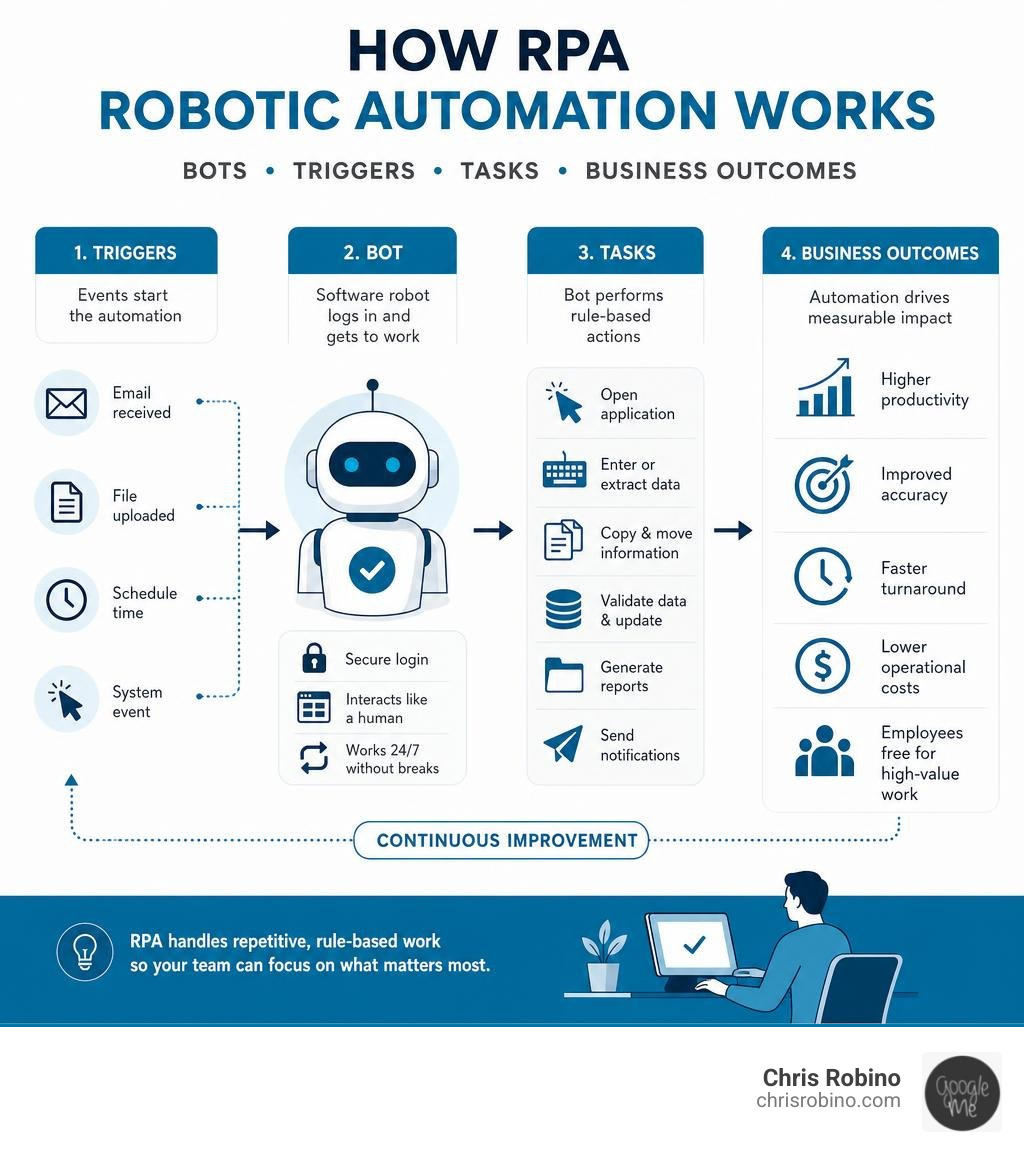
RPA robotic automation is software technology that uses digital “bots” to mimic human actions — clicking, typing, copying, and navigating — to complete repetitive, rule-based tasks automatically, without changing your existing systems.
Quick answer: What is RPA robotic automation?
- What it is: Software robots that replicate human interactions with digital systems
- What it does: Automates high-volume, repetitive tasks like data entry, invoice processing, and report generation
- How it works: Bots interact with application interfaces (UI), APIs, and task scripts — no backend changes required
- Who it’s for: Any organization running manual, rules-based processes across legacy or modern systems
- Key benefit: Faster processes, fewer errors, lower costs, and employees freed for higher-value work
Think about how your team spends its day. Research shows employees dedicate roughly one-third of their time to routine administrative tasks — not the skilled, strategic work they were actually hired to do. Unsurprisingly, 64% of those workers experience burnout at least once a month.
That’s a real business problem. And it’s exactly the gap RPA was built to close.
RPA is not a complex, months-long IT overhaul. It’s a low- to no-code technology that can be deployed in days or weeks. It sits on top of your existing software, doing the repetitive work your team shouldn’t have to do — accurately, continuously, and at scale.
The results speak for themselves. Companies across industries have used RPA to save hundreds of thousands of work hours, cut costs by millions, and reduce process times by up to 80%.
I’m Chris Robino, a Digital Strategy Leader and AI & Search Expert with over two decades of experience helping organizations leverage automation — including RPA robotic automation — to streamline operations and drive measurable growth. In this guide, I’ll walk you through everything you need to know, from core concepts to implementation and the future of intelligent automation.
Demystifying RPA Robotic Automation: Core Concepts and Business Value
To truly understand rpa robotic automation, we must look at how it drives actual business outcomes. At its core, RPA replaces low-value manual labor with digital execution. This creates immediate operational improvements, modernized workflows, and substantial cost reductions.
Let’s look at real-world data showing how enterprises scale their operations:
- Merck automated 64 distinct business processes across 14 complex SAP environments, saving an incredible 150,000 hours per year.
- Cargill saved $10 million to $15 million annually by automating a single order-processing workflow, reducing processing times to under one minute.
- Sicoob utilized RPA tools to slash process cycle times by up to 80% while cutting operational costs by 20%.
- New Mexico Mutual freed its employees from repetitive administrative tasks, saving 3.5 hours per day per employee.

By deploying RPA, organizations shift human capital away from mundane, error-prone tasks and toward strategic, customer-facing roles. It “takes the robot out of the human,” letting your team focus on skilled work.
How RPA Robotic Automation Works Across Legacy Systems
One of RPA’s greatest strengths is its non-invasive nature. Unlike traditional IT integrations that require complex API development or backend database overhauls, RPA interacts with systems exactly like a human employee does.
RPA bots operate primarily through three layers:
- User Interface (UI) Interactions: Bots read the screen, locate buttons, copy text, and fill in form fields.
- Task Scripting: Predefined business rules guide the bot step-by-step through a workflow.
- API Integrations: When available, modern RPA platforms seamlessly transition between UI scraping and direct system-to-system API calls.
This hybrid approach makes RPA the perfect bridge for legacy systems that lack modern APIs. If you want to dive deeper into how this infrastructure is built, check out our Rpa Infrastructure Setup Guide From Blueprints To Bots or explore The Definitive Guide To Robotic Automation to understand the foundational architecture.
The Strategic Synergy: RPA Robotic Automation vs. Artificial Intelligence
A common point of confusion is whether RPA is the same thing as Artificial Intelligence (AI). It is not.
Think of RPA as the muscle of digital labor, while AI is the brain. RPA excels at high-speed, rules-based execution where data is highly structured and unchanging. AI, on the other hand, handles cognitive computing, machine learning, and complex decision-making based on unstructured data.
| Feature / Capability | RPA (Robotic Process Automation) | AI (Artificial Intelligence) |
|---|---|---|
| Primary Focus | Mimicking human actions (doing) | Mimicking human intelligence (thinking) |
| Data Requirements | Highly structured, predictable data | Unstructured data (emails, images, voice) |
| Logic | Rules-based, “if-this-then-that” | Cognitive, probabilistic, learning-based |
| Handling Exceptions | Requires human intervention | Learns and adapts to handle exceptions |
| System Impact | Non-invasive; works on top of existing UIs | Requires data pipelines and model training |
When combined, they form Intelligent Automation (IA). For instance, an AI model can read an unstructured email, extract the customer’s sentiment and intent, and then hand that structured data to an RPA bot to update the legacy CRM system. To explore this synergy further, read our guide on Robotics Process Automation.
High-Value Use Cases and Industry Applications
Where does rpa robotic automation perform best? Virtually any department with high-volume, repetitive, standardized tasks can benefit.
- Finance & Accounting: Automating invoice and payment processing. Bots extract PDF data, match invoices with purchase orders, and post them directly to ERPs.
- Healthcare: Patient data management, appointment scheduling, and claims processing.
- Human Resources: Streamlining employee onboarding, payroll validation, and timesheet processing.
- Supply Chain & Logistics: Demand forecasting, inventory reconciliation, and tracking order shipments.
To see how companies combine document scanning with intelligent extraction, read Beyond The Scan Elevating Your Automation With Rpa And Ocr. If you operate in industrial or manufacturing spaces, discover Why Your Factory Needs A Robotic Best Friend.
Implementing and Scaling Automation for the Future
As we navigate July 2026, scaling automation requires moving beyond isolated desktop tasks to enterprise-grade, cloud-native platforms. Modern architectures rely on resilient systems that can scale dynamically to handle millions of transactions across hybrid environments.

Enterprise platforms offer the cloud-native infrastructure required to orchestrate complex, multi-system workflows safely and efficiently.
Key Platform Capabilities, Security, and Governance
When selecting an RPA vendor, look for features that ensure enterprise-grade stability, compliance, and ease of use:
- Intelligent Exception Handling: The platform must gracefully manage unexpected UI shifts or system timeouts without crashing.
- Advanced Security & Compliance: Look for native data encryption, role-based access controls (RBAC), and comprehensive audit trails to meet strict regulatory standards.
- Centralized Orchestration: A single dashboard to monitor, schedule, and manage both attended (collaborative) and unattended (background) bots.
- Low-Code/No-Code Development: Modern tools allow business users (citizen developers) to build simple automations safely under IT governance.
Overcoming Implementation Challenges and Best Practices
Despite the clear benefits, many RPA initiatives stall because of poor planning. To ensure long-term success, we recommend following these proven best practices:
- Prioritize Process Selection: Do not automate a broken process. Map workflows first, and target highly stable, rules-based tasks with structured data.
- Establish a Center of Excellence (CoE): Build a cross-functional team of IT professionals, business analysts, and executives to govern bot development, enforce coding standards, and manage change.
- Focus on Data Quality: Ensure your input data is clean. Bots execute instructions perfectly—which means they will enter bad data into your systems at lightning speed if you let them.
- Start with a Pilot: Choose a low-risk, high-visibility process for your first pilot. Prove the ROI, build confidence within the organization, and then scale.
The Agentic Era: The Future of Digital Labor
The automation landscape is evolving rapidly. In this current era of July 2026, we are witnessing the rise of agentic automation. Traditional RPA is no longer just a standalone tool; it serves as the critical execution layer for AI agents.
While an AI agent uses Large Language Models (LLMs) and a Process Reasoning Engine to plan, analyze, and make complex decisions, it lacks the ability to log into a legacy ERP system or fill out a desktop application form. That is where RPA comes in. The AI agent acts as the brain, orchestrating the workflow, while the RPA bot acts as the hands, executing the manual UI steps with perfect accuracy.
Using advanced suites, enterprises can deploy self-healing workflows. For example, if a legacy system’s UI changes, an AI “healing agent” can dynamically update the RPA bot’s selectors in real-time, preventing operational downtime.
At ChrisRobino.com, we help businesses navigate this exciting intersection of RPA, AI, and agentic workflows. We centralize cutting-edge insights and strategic consulting to help you build a resilient, future-proof digital workforce.
Ready to take the next step in your automation journey? Read our comprehensive resource, The Definitive Guide To Robotic Automation, to discover how you can scale your operations, eliminate employee burnout, and unlock unprecedented business value today.