

Why Current Technology Trends for Business Define Your Strategy in 2026
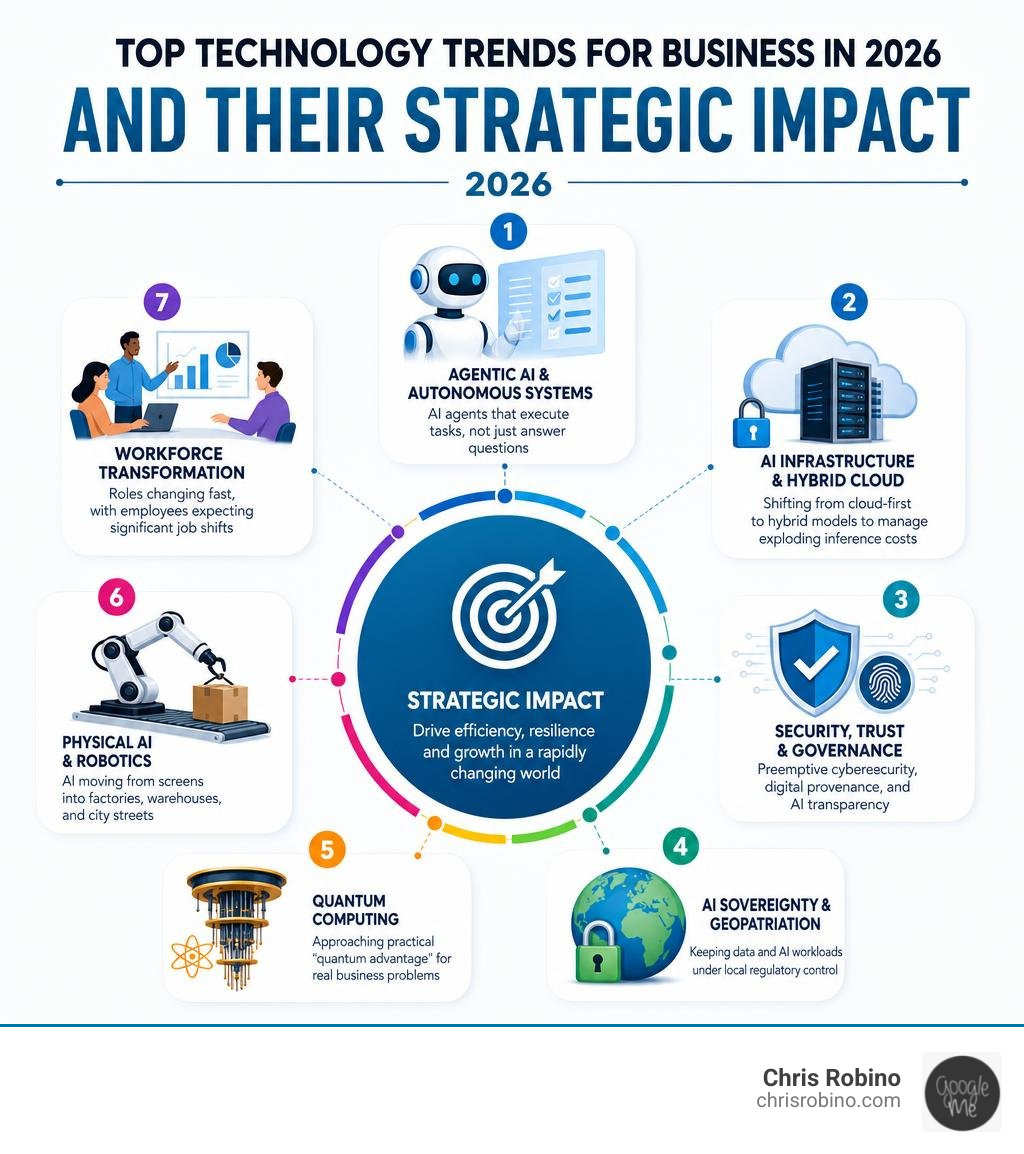
The current technology trends for business in 2026 are not subtle shifts — they are structural breaks from everything that came before. Here is a quick snapshot of the most important ones:
- Agentic AI & Autonomous Systems — AI agents that execute tasks, not just answer questions
- AI Infrastructure & Hybrid Cloud — Shifting from cloud-first to hybrid models to manage exploding inference costs
- Security, Trust & Governance — Preemptive cybersecurity, digital provenance, and AI transparency
- AI Sovereignty & Geopatriation — Keeping data and AI workloads under local regulatory control
- Quantum Computing — Approaching practical “quantum advantage” for real business problems
- Physical AI & Robotics — AI moving from screens into factories, warehouses, and city streets
- Workforce Transformation — Roles changing fast, with 61% of employees expecting significant job shifts in 2026
Think about this for a moment: the telephone took 50 years to reach 50 million users. A leading generative AI tool hit 100 million in two months. That is not incremental change — that is a compression of entire technology cycles into months.
And yet, most organizations are still stuck in pilot mode.
Only 11% of businesses have AI agents running in production. Nearly 40% are still experimenting. The gap between experimenting with technology and actually extracting value from it has never been more costly to ignore.
The businesses pulling ahead are not necessarily the ones with the biggest budgets or the most sophisticated tools. They are the ones willing to redesign how they operate — not just layer new technology on top of old processes.
This guide breaks down the most critical technology trends shaping business strategy right now, what is overhyped versus what quietly matters, and what you need to do to stay ahead.
I’m Chris Robino, a digital strategy leader with over two decades of experience helping organizations — from startups to large enterprises — navigate and capitalize on current technology trends for business. I’ll cut through the noise and give you what actually matters for your strategy this year.
Explore more about current technology trends for business:
Navigating Current Technology Trends for Business in 2026
As we navigate the mid-point of 2026, technology strategy is no longer about isolated innovations. The true competitive advantage comes from how we connect and orchestrate these advancements into a unified system. To make sense of the overwhelming landscape, we can view enterprise readiness through three distinct strategic personas:
- The Architect: Builds the secure, scalable, and hybrid infrastructure foundations required to support heavy AI workloads.
- The Synthesist: Orchestrates specialized models, multi-agent systems, and human-agent teams to streamline complex enterprise workflows.
- The Vanguard: Protects enterprise value through proactive security, ethical AI governance, digital trust, and regulatory compliance.
To help us separate the signal from the noise, let’s look at which technologies are delivering real results versus those that remain in the laboratory.
Overhyped vs. Underhyped Technologies in 2026
| Technology Trend | Hype Level | Reality Check for 2026 |
|---|---|---|
| General-Purpose LLMs | Overhyped | Often unreliable and prone to hallucinations; businesses are swapping general models for highly tuned, domain-specific alternatives. |
| Piecemeal AI Pilots | Overhyped | “Innovation theater” that fails to scale; value is unlocked only by redesigning end-to-end processes. |
| Quantum Computing | Underhyped | Often dismissed as a distant future, but we are rapidly approaching practical “quantum advantage” for optimization, cryptography, and chemistry. |
| Digital Provenance | Underhyped | Crucial for verifying the origin and integrity of data and software in an era flooded with synthetic, AI-generated content. |
| Physical AI & Robotics | Underhyped | Moving rapidly from laboratory concepts to active deployment in logistics, warehouse management, and manufacturing. |
From AI Experimentation to Real Business Impact
The biggest shift we are seeing in 2026 is the transition from “what can AI do?” to “how does AI deliver measurable ROI?” According to global research, the average business spends $28 million annually on AI. Historically, much of this budget was lost in endless proof-of-concept loops. Today, however, companies expect to drive an average AI ROI of 21% this year, which is projected to rise to 38% within the next two years.
But achieving these numbers isn’t automatic. The biggest roadblock to AI success remains data quality. Research shows that 73% of companies struggle with incomplete or messy data, and 79% experience project delays or rework due to low-quality AI outputs.
For large enterprises, the path to value requires a systematic framework. We must move away from generic AI tools and build structured pipelines that ground models in contextual, high-quality enterprise data. To design a roadmap that moves your business beyond the pilot phase, explore our AI Adoption Strategies Complete Guide.
To maximize value, large organizations are also applying advanced SEO strategies that perform well at scale. This includes deploying AI-driven keyword clustering to map content to multi-stakeholder B2B buyer journeys, ensuring that technical decision-makers (from IT and security to procurement) find exact, authoritative answers. By integrating these technical content hubs with digital PR initiatives, enterprises are securing high-authority backlinks that defend their search rankings against AI-driven search engine updates.
For a deeper dive into how these systems are scaling, check out the SAP Study Finds Business Value of AI Is Spiking | SAP News Center .
Agentic AI and Autonomous Systems: The Silicon Workforce

We have officially entered the era of the “silicon-based workforce.” While 76% of global CXOs identify AI agents and autonomous systems as the top megatrend shaping the next decade, only 11% of organizations currently have AI agents running in production.
The gap exists because many businesses attempt to automate broken, legacy workflows. True success requires us to redesign our processes from scratch to accommodate autonomous collaboration.
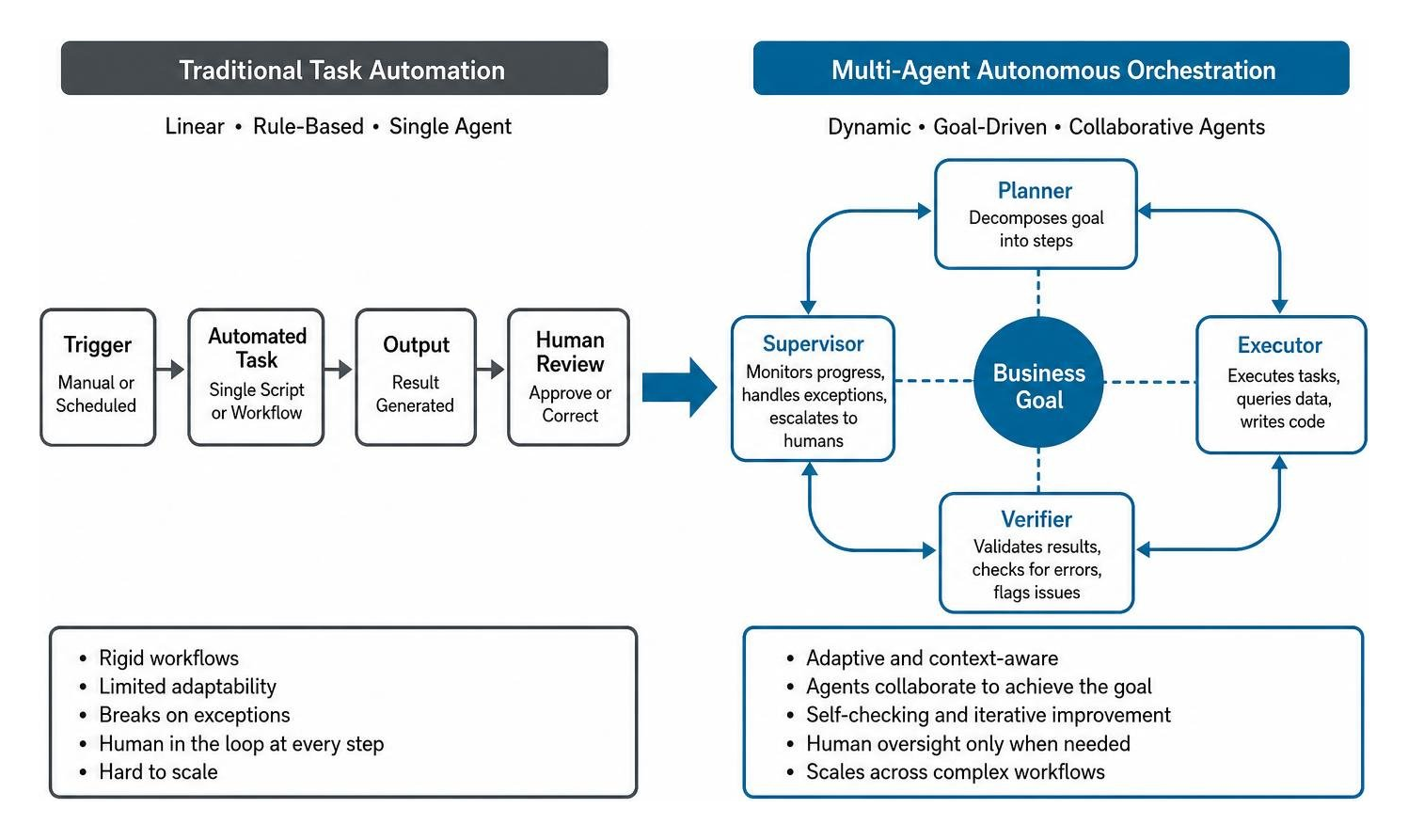
In a multi-agent system, modular AI agents work together, separating roles to execute complex tasks:
- The Planner: Decomposes a business goal into actionable steps.
- The Executor: Runs specific tasks, writes code, or queries databases.
- The Verifier: Audits outputs, checks for errors, and flags anomalies.
- The Supervisor: Escalates exceptions to human managers when human judgment is required.
This collaborative dynamic is explored in detail in our guide, From AI to Autonomous Systems What’s Next in Tech Trends.
To scale these systems without introducing operational risk, we must establish rigorous governance. This includes maintaining centralized agent registries, setting strict access controls, and keeping humans in the loop for high-stakes decisions.
Infrastructure and Sovereignty: Supporting Current Technology Trends for Business
Our traditional, cloud-first infrastructure is undergoing a massive reckoning. While token costs for AI models have dropped an incredible 280-fold over the past two years, overall enterprise compute spending is skyrocketing due to the sheer volume of production inference.
To manage these costs, we are transitioning to Cloud 3.0 — a highly distributed, hybrid execution backbone. This model balances workloads dynamically:
- Public Cloud: Used for elasticity and training massive models.
- On-Premises Systems: Used for consistent, predictable production inference.
- Edge Computing: Used for immediate, low-latency applications on the factory floor or in retail environments.
At the same time, geopolitical volatility is forcing us to rethink where our data lives. An overwhelming 93% of executives state they must factor AI sovereignty into their 2026 business strategy. This has led to the rise of geopatriation — the strategic shifting of sensitive workloads to sovereign, regional cloud providers to comply with local data residency laws and mitigate regulatory risks.
For a strategic breakdown of how to prepare your infrastructure for these shifts, see our list of 13 Future Business Tech Trends to Watch.
Security, Trust, and Governance in Current Technology Trends for Business
As autonomous systems take on more operational authority, trust has become our most valuable currency. Security is no longer just about protecting the network perimeter; we must secure the entire AI pipeline across four distinct domains: data, models, applications, and infrastructure.
This requires a shift from reactive defense to preemptive cybersecurity, using AI to detect, simulate, and neutralize threats at machine speed before they can impact operations. Additionally, technologies like confidential computing are being used to protect sensitive data while it is actively being processed in memory.
At the same time, the flood of synthetic content has made digital provenance non-negotiable. Organizations must implement cryptographic watermarking and verification frameworks to prove the origin and integrity of their data, software, and public communications. Consumers are demanding this transparency: two-thirds of consumers state they would switch brands if a company intentionally concealed the use of AI in their customer experience.
To build a secure, compliant, and trustworthy framework for your organization, check out our AI Strategy Consulting Ultimate Guide.
Preparing for Frontier Tech: Quantum Advantage and Beyond
While we optimize our current AI architectures, we must also prepare for the next wave of disruptive, frontier technologies. Chief among these is quantum computing.
Quantum advantage — the point at which a quantum computer can solve complex problems far more efficiently than classical systems — is no longer a distant dream. Forward-thinking organizations are already preparing by migrating their encryption protocols to Post-Quantum Cryptography (PQC) to secure long-lived data against future decryption capabilities. Because quantum infrastructure is highly resource-intensive, successful adoption requires businesses to join collaborative, multi-partner ecosystems to share computational power and expertise.
We are also seeing the rise of neuromorphic computing, which mimics the physical structure of the human brain to process real-time data with extreme energy efficiency. When combined with physical AI, these advanced compute architectures are powering a new generation of adaptive robotics and autonomous vehicles that can perceive, learn, and navigate complex physical environments in real time.
Stay ahead of these fast-moving developments by exploring our Emerging Tech Insights.
Workforce Evolution: Upskilling for the AI Era
The rapid rise of the current technology trends for business is fundamentally changing the nature of work. In 2026, 61% of employees expect their job roles to change significantly due to the integration of AI agents and automation.
Crucially, employees are not resisting this shift. Instead, many are embracing AI as an “escape hatch” from mundane, administrative tasks, allowing them to focus on high-value, strategic work. In fact, 61% of employees state that AI makes their jobs less mundane, and 48% even report feeling comfortable being managed by an AI agent.
However, a massive training gap remains. Organizations currently spend an average of 93% of their AI budgets on technology and only 7% on people. To close this gap, IT and business leaders must overcome common upskilling barriers, such as a lack of time (cited by 61% of professionals) and the cost of education (52%).
To build a culture of continuous learning and prepare your team for human-agent collaboration, explore our guide on Digital Transformation Innovation.
Conclusion: Building a Resilient, Tech-Driven Future
The pace of technological change in 2026 can feel overwhelming, but it also presents an unprecedented opportunity. Success in this landscape does not require us to chase every emerging trend. Instead, it requires the strategic agility to build a resilient, adaptable foundation that can bend without breaking.
By focusing on robust hybrid infrastructure, clear AI governance, and continuous workforce upskilling, we can turn technological disruption into a powerful driver of long-term growth.
Your 2026 Technology Action Plan:
- Redesign, Don’t Just Automate: Rebuild your core business processes from the ground up to support a collaborative, human-agent workforce.
- Optimize Your Compute Strategy: Transition to a strategic hybrid cloud model to manage AI inference costs and maintain operational flexibility.
- Establish Clear AI Governance: Implement centralized agent registries, strict access controls, and human-in-the-loop protocols.
- Build Digital Trust: Prioritize data quality, maintain transparency with customers, and implement digital provenance frameworks.
- Invest in Your People: Rebalance your technology budgets to prioritize continuous upskilling, training, and change management.
At ChrisRobino.com, we specialize in helping businesses navigate these complex transitions, providing a single portal to access the strategic insights and hands-on expertise you need to scale securely.
To take the next step in aligning your business strategy with the future of technology, explore our core resources on Technology Trends for Business.