

Why Content is King in the Tech Sector
Technology content marketing is the strategic creation and distribution of valuable content to attract, engage, and convert tech buyers—building trust and authority while driving measurable business growth.
In enterprise SEO and digital strategy, content is the engine that powers visibility, pipeline, and long-term brand equity. Well-executed content gives search algorithms clear topical signals, while giving human buyers the depth and clarity they need to justify high-stakes technology investments.
Quick Answer: What is Technology Content Marketing?
- Definition: Educational content about tech products, trends, and solutions that builds credibility without hard selling
- Primary Goals: Brand awareness, lead generation, thought leadership, and customer retention
- Key Formats: Blog posts, whitepapers, case studies, videos, webinars, and executive briefs
- Success Metric: 56% of IT decision-makers have switched suppliers based partly on content consumed
- Core Advantage: Helps tech companies cut through market noise by demonstrating expertise and solving real problems
The numbers tell a compelling story. Fifty-six percent of IT decision-makers have switched technology suppliers at least partly due to content they consumed. That is not just engagement—it is direct business impact.
In the fast-moving tech sector, clarity really is currency. Your potential buyers often consume an average of 13 pieces of content before making a purchase decision. They are looking for substance, not sales pitches. They want research-backed insights, peer validation, and proof that you understand their challenges.
But there is a challenge: 68% of tech content marketers struggle to create content that appeals to multiple roles within buying organizations. The buying process often involves 5–30 stakeholders across different departments, each with unique information needs. Your content strategy must address CIOs worried about risk, technical teams evaluating implementation, and executives focused on ROI.
The good news is that tech marketers who get this right are seeing real results. A majority of top performers have a documented content strategy in place, and many are increasing their content budgets. They understand that technology content marketing is not just another marketing tactic—it is how modern B2B tech companies win customers and build lasting market position.
For large organizations, this also ties directly to enterprise SEO. High-quality, research-led content:
- Expands your topical authority across complex solution areas
- Captures high-intent keywords at every stage of the funnel
- Generates natural backlinks from analysts, partners, and media
- Strengthens your brand’s knowledge graph presence in search
I am Chris Robino, a Digital Strategy Leader and AI & Search Expert with over 20 years of experience helping tech companies transform their online performance through strategic technology content marketing and AI-driven search solutions. Throughout my career, I have helped emerging startups and large enterprises build content programs that actually drive pipeline and revenue.
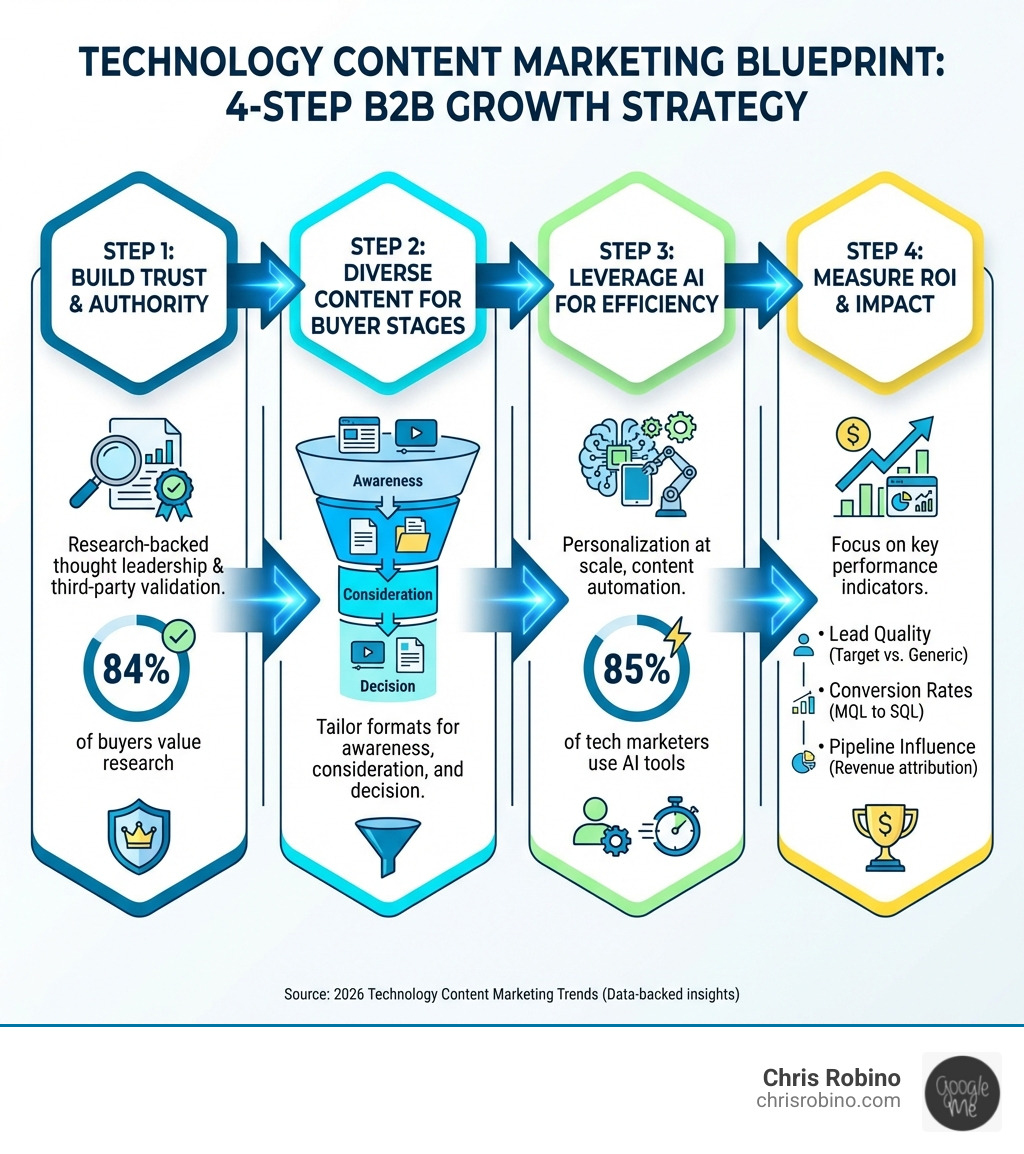
Core Strategies for Effective Technology Content Marketing
Effective technology content marketing is not about creating content for its own sake; it is about strategic impact. For large companies, the goal is to build a scalable content and SEO engine that supports multi-year growth targets and complex sales cycles.
Enterprise B2B technology purchases are often high-stakes, involve multiple decision-makers, and require a deep level of trust and validation. Unlike many B2C journeys, where emotional appeal might drive quick sales, B2B demands rigorous, evidence-based content that speaks to both technical requirements and business outcomes. This makes content central to modern SEO strategies: search visibility follows from genuine authority and usefulness.
Build Trust and Establish Authority
In the B2B tech landscape, trust is non-negotiable. Building authority ensures your content cuts through the noise and resonates with skeptical, well-informed buyers and search engines alike.

Leverage Subject Matter Experts (SMEs): Content becomes credible when it is informed by real expertise. Thought leadership is a powerful way to connect with decision-makers and earn credibility. In enterprise SEO, SME-driven content tends to earn stronger engagement, dwell time, and backlinks—signals that search engines reward.
Accept E-E-A-T: Search algorithms increasingly emphasize Experience, Expertise, Authoritativeness, and Trustworthiness (E-E-A-T), which is particularly relevant in tech. Demonstrate this by featuring actual experts, citing robust research, and keeping your content factually impeccable. For large companies, creating clear author profiles, expert bios, and transparent sourcing is critical.
Prioritize Third-Party Validation: Independent validation is a game-changer. Many end-user decision-makers believe third-party content to be more trustworthy than content produced solely by vendors. Partnering with independent researchers, industry analysts, or reputable media outlets to validate your claims can significantly boost credibility and off-page SEO signals.
Underpin Content with Research: The depth of your research matters. Eighty-four percent of those surveyed consider content underpinned by research to have more authority. This means leveraging data, studies, and empirical evidence to support your arguments, especially in areas like cybersecurity, cloud computing, and data platforms, which carry greater perceived risk and complexity.
Address Pain Points and Offer Customer-Centric Solutions: Modern marketing demands a proactive approach to understanding customer needs. Focusing on the customer experience is paramount. Your content should speak directly to the challenges your audience faces, offering actionable insights and solutions. This involves analyzing search queries, listening to customer reviews, monitoring social sentiment, and coordinating with sales teams to understand objections.
By focusing on these elements, you move beyond generic marketing and position your brand as a trusted advisor—both to human buyers and to search algorithms that are designed to surface the most authoritative answers. For a deeper dive into strategic thinking, explore the insights on Innovation Strategy Development.
Create High-Impact Content with Storytelling and Visuals
Even the most complex technology can be understood and appreciated when presented clearly. Storytelling and powerful visuals are essential tools in technology content marketing, and they directly support SEO by increasing engagement, dwell time, and linkability.

Map Content Types to the Tech Buyer’s Journey
B2B tech buyers consume numerous pieces of content across their journey. Large organizations should build an editorial and SEO roadmap that includes:
Awareness Stage
- Blog Posts and Pillar Pages: Short- and long-form articles targeting problem-focused and category-level keywords. These are excellent for SEO, helping you rank for terms early in the journey and building topical authority.
- Infographics and Short Videos: Used in findy channels and embedded in pages to explain complex concepts quickly, increasing shareability and organic reach.
Consideration Stage
- Whitepapers and Guides: Ideal for demonstrating deep expertise and capturing leads. These assets can target mid-funnel queries and support gated content strategies, integrating with marketing automation for lead scoring.
- Webinars and Executive Briefs: Custom for time-crunched executives, offering snack-sized, strategic insights drawn from real customer scenarios and market trends.
Decision Stage
- Case Studies and Customer Success Stories: These provide crucial social proof and keyword opportunities around verticals, use cases, and product combinations.
- Product Demos and Free Trial Content: FAQs, implementation guides, and comparison pages that answer high-intent queries and reduce friction before purchase.
The Power of Visual Storytelling
Approximately 65% of the population are visual learners, making visuals critical for engagement and memorization. For SEO at scale, this means:
- Turning data and architectures into diagrams, process flows, and annotated screenshots
- Reusing charts and visuals across blog posts, landing pages, and thought leadership assets
- Optimizing images with descriptive file names, alt text, and structured data where appropriate
Story-driven content is still underused in many technology organizations, yet it creates an emotional and personalized connection between your brand and its audience, making complex concepts more relatable. Narratives increase time on page, encourage shares, and improve the likelihood of natural backlinks—all essential for enterprise SEO.
For more insights on crafting compelling narratives that convert, visit the Content Marketing for Consultants Ultimate Guide.
Leverage AI and Emerging Trends for a Competitive Edge
The tech marketing landscape is constantly evolving, with AI, personalization, and account-centric strategies leading the charge. For large organizations, these capabilities must be integrated into a coherent SEO and content operations framework.
AI Opportunities in Technology Content Marketing
Boost Productivity and Efficiency: AI tools can dramatically increase content velocity. Teams can use AI to generate outlines, first drafts, social snippets, and basic SEO recommendations, then refine with human expertise. This allows large companies to cover more keywords and topics without sacrificing quality.
Improved Personalization: Many tech marketers personalize content, but personalization often remains basic. AI makes it possible to move beyond simple tokens to context-aware experiences—adjusting recommendations, messaging, and next-best content based on behavior, firmographics, and intent signals.
Predictive Analytics: AI-powered tools can forecast demand, highlight emerging topics, and identify high-potential accounts. This supports smarter editorial planning, ABM programs, and budget allocation.
Content Creation and Optimization: Generative AI systems can assist in drafting blog posts, landing pages, email nurture sequences, and video scripts. They can also support SEO by suggesting related topics, semantic keywords, and content gaps in your existing library. Many tech organizations are already developing or using AI tools as part of their marketing stack.
Explore this in more depth in the resource on AI-Driven Content Strategy.
AI Challenges and Responsible Use
Maintaining Quality and Accuracy: AI is a powerful assistant but not a replacement for expert judgment. Large organizations must implement review workflows, style guides, and governance so that AI-generated content stays accurate, on-brand, and differentiated.
Ethical and Data Considerations: Data privacy and algorithmic bias are significant concerns. Ensure compliance with relevant regulations, maintain clear consent practices, and regularly audit models and datasets.
Balancing Tools with Talent: Investing in AI tools without parallel investment in strategy, training, and editorial leadership limits impact. The most effective programs treat AI as an accelerator for skilled marketers, not a substitute.
Emerging Trends: Personalization and ABM/ABX
Deep Personalization: Moving beyond basic segmentation, deep personalization uses behavioral, contextual, and intent data to deliver orchestrated experiences across channels. For SEO, this means aligning content clusters and internal linking with real user journeys, not just keyword lists.
Account-Based Marketing (ABM) and Account-Based Experience (ABX): Many tech marketers now use ABM/ABX to align marketing and sales around high-value accounts. Content and SEO support this by creating:
- Vertical-specific resource hubs
- Role-based landing pages and decision guides
- Custom case studies and solution briefs
These programs work best when they are grounded in strong data governance and shared measurement frameworks. For broader insights into the future of tech and its impact on go-to-market, visit the Technology Trends for Business page.
Measure Your Technology Content Marketing ROI
In technology content marketing, measurement is essential for proving value and guiding enterprise SEO investments. If you cannot measure it, you cannot manage it—or justify it.
Key performance indicators (KPIs) for large companies typically include:
Lead Quality and Quantity: Volume of leads attributed to content, and the proportion that fit your ideal customer profile. This connects marketing activity to pipeline quality.
Conversion Rates: Progression from anonymous visitor to subscriber, MQL, SQL, opportunity, and closed-won. Analyze which content types and topics contribute most to each stage.
Customer Acquisition Cost (CAC): How content and SEO reduce dependency on paid acquisition and lower blended CAC over time.
Engagement Metrics: Time on page, scroll depth, repeat visits, return user ratio, and content shares. These signal relevance and help prioritize optimization.
Search Performance and Visibility: Rankings and click-through rates for strategic keywords, growth in non-branded organic traffic, and share of voice in critical solution areas. Strong Search Engine Rankings are both an input to and outcome of effective content.
Sales Alignment and Impact: Influence on pipeline, sales cycle length, deal velocity, and win rates when specific assets are used in the deal process. The earlier statistic that 56% of IT decision-makers switched suppliers partly due to content is a clear reminder of this impact.
Customer Loyalty and Retention: Content does not stop after the sale. Onboarding materials, product education, and ongoing thought leadership drive adoption, renewal, and expansion. Many content marketers successfully use content to strengthen customer loyalty.
A data-informed strategy means using analytics to identify what content performs best, for which audience segments, and at what stage of the buyer’s journey. Large organizations should connect web analytics, marketing automation, CRM, and product data to form a unified view of content performance.
It is no coincidence that a high share of top performers in tech content marketing have a documented content strategy in place. For enterprise teams, this strategy should:
- Define audience segments, use cases, and priority themes
- Map topics and keywords to every stage of the buyer journey
- Outline governance, workflows, and review processes
- Set clear KPIs and reporting cadences
Done well, technology content marketing becomes a durable, compounding asset—supporting organic search performance, sales productivity, and customer success for years rather than weeks.
Conclusion: Implementing Your Tech Content Blueprint
We have explored the critical role of technology content marketing in the B2B landscape, from building trust and authority to leveraging AI and carefully measuring ROI. For large companies, a well-structured content and SEO program is one of the few levers that can simultaneously improve findability, accelerate pipeline, and reinforce brand leadership.
Key takeaways:
- Trust and Authority Are Paramount: In a market saturated with options, credibility wins. Focus on expertise, research, and third-party validation to satisfy both buyers and search algorithms.
- Diverse, Engaging Content Is Essential: Support every stage of the buyer’s journey with a mix of formats—from in-depth whitepapers and case studies to compelling visual stories, videos, and role-specific resources.
- AI Is a Powerful Ally, Not a Replacement: Use AI for efficiency, topic findy, and personalization, but maintain human oversight to protect quality, ethics, and brand authenticity.
- Measure Everything: Treat data as your compass. Track performance across SEO, demand generation, sales enablement, and customer success to refine your strategy continuously.
Technology content marketing is a long-term strategy, not a quick fix. It requires:
- Continuous improvement based on analytics and customer feedback
- Close collaboration between marketing, sales, product, and data teams
- A commitment to delivering genuine value in every interaction
As an expert in emerging tech and media, Chris Robino helps businesses steer these complexities, turning their content into a powerful engine for B2B growth and sustainable search performance.
Ready to build a content strategy that truly differentiates your tech brand and drives measurable results? Explore comprehensive new tech and media strategies in this guide.