
The New Retail Reality: An Introduction
Retail is undergoing a profound transformation, and retail tech trends sit at the center of that change. For large companies, this evolution is inseparable from search: if customers can’t find you, they can’t buy from you. That’s why modern retail strategy and enterprise SEO now move in lockstep.
AI, unified data, and immersive experiences are reshaping how products are discovered, evaluated, and purchased. At the same time, search engines increasingly reward brands that demonstrate technical excellence, deep expertise, and strong user experiences across all digital touchpoints.
For large retailers, winning in this environment requires:
- A scalable SEO strategy aligned with enterprise technology investments.
- A unified view of content, data, and customer journeys across channels.
- Continuous optimization fueled by AI-driven insights and testing.
This article outlines the retail technology shifts defining 2025 and connects them to SEO strategies that perform well for large companies, so you can turn innovation into sustainable organic growth.
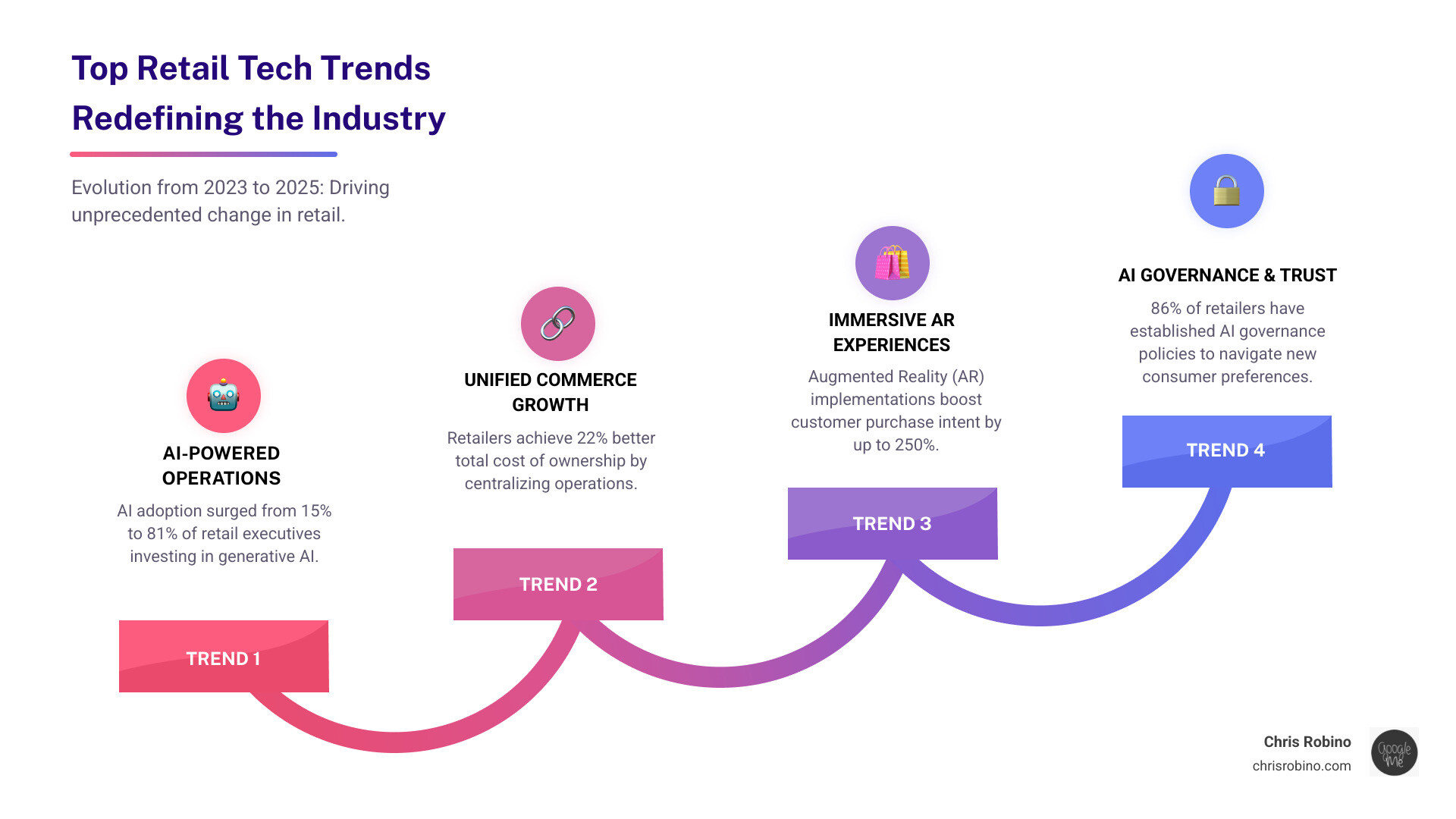
As you explore the sections below, consider how each retail tech trend can be translated into:
- Better crawlability and indexation for complex catalogs.
- More relevant content mapped to every stage of the funnel.
- Richer search experiences powered by structured data, reviews, and media.
Top 5 Retail Tech Trends Redefining the Industry
AI-Powered Operations and Enterprise SEO
At the heart of the modern retail revolution are AI-powered operations. For large companies, these same AI capabilities can dramatically improve SEO performance.

AI optimizes inventory, pricing, and merchandising; those decisions should feed directly into how you structure and optimize your site at scale. For large retailers, effective enterprise SEO includes:
- Automated metadata at scale: Use AI to generate and refine title tags, meta descriptions, and on-page copy for thousands of SKUs, while enforcing strong brand and compliance rules.
- Smart internal linking: Algorithmic internal link recommendations that strengthen category and subcategory pages, distribute authority, and support topic clusters.
- Demand forecasting meets keyword forecasting: Align AI demand predictions with keyword trend data to prioritize the products and categories most likely to drive incremental organic revenue.
- Content gap analysis: AI can surface missed questions, intents, and content opportunities that matter across millions of queries.
For large companies, the impact is twofold: AI improves operational efficiency, and the same intelligence is used to create better-optimized, more findable digital experiences. Generative AI could add up to $600 billion in annual value to the retail and consumer packaged goods sectors.
Unified Commerce, Hyper-Personalization, and Search Visibility
The future of retail is unified commerce—a single platform that integrates all sales channels and operations. For SEO, this unified foundation is critical.
Unified commerce enables:
- Consistent data and URLs across channels: Avoiding duplicate content problems caused by disjointed systems, and ensuring one canonical, authoritative source for each product and category.
- Centralized product information management (PIM): Clean, enriched product data that can feed structured data markup to win rich results.
- Personalized but crawlable experiences: Large retailers can combine personalization with server-side rendering and strong information architecture so search engines still see a complete, coherent site.
Hyper-personalization, driven by unified customer data, strengthens SEO when it informs:
- Which content topics to prioritize based on real customer behavior.
- How to tailor landing pages for key audience segments while preserving indexable default versions.
- How to design faceted navigation and filters that serve users without creating infinite URL combinations.
Unified commerce isn’t just about transactions; it provides the structured, reliable foundation large companies need for scalable, high-performing SEO.
The Phygital Store and Local + On-Site Search
The phygital store blends physical and digital experiences. For large retailers, this creates opportunities to align:

- Local SEO: Ensure every store has a robust, optimized location page with accurate NAP (name, address, phone), opening hours, localized content, and store-specific inventory highlights.
- “Near me” and inventory-driven queries: Connect real-time inventory systems with landing pages so customers searching for products nearby can see availability by location.
- AR and rich media: While AR experiences themselves may not always be crawlable, supporting content (guides, FAQs, how-tos) can be optimized for organic search, capturing findy traffic and feeding customers into immersive tools.
The phygital model strengthens SEO when digital content clearly explains in-store experiences, services, and local offerings, creating a seamless path from search results to store visits.
Evolving In-Store Tools and Data-Rich Product Pages
As barcodes evolve into advanced codes carrying richer data, large retailers gain more detailed product information. When that data is surfaced online, it directly benefits SEO:
- Deeper product content: Detailed specs, sourcing information, care instructions, and compatibility data drive long-tail traffic and improve conversion.
- User trust and engagement signals: Transparent information supports higher engagement, better reviews, and lower return rates—all positive user signals.
- Fraud and safety tools in e-commerce: Clear policies and secure checkout experiences reduce cart abandonment and support trust-related queries.
In-store technology investments should be mirrored by equally robust, information-dense product and category pages that are fully optimized for search.
AI Governance, Brand Trust, and Content Quality
As AI becomes integral to retail, AI governance is essential—not only for compliance, but also for SEO.
Large companies need frameworks that ensure AI-generated content is:
- Accurate, reviewed by subject-matter experts, and regularly updated.
- Aligned with brand voice and legal requirements.
- Transparent where appropriate, reinforcing user trust.
Search engines increasingly reward brands that demonstrate depth, reliability, and accountability. Governance ensures that automation improves quality instead of diluting it. For large organizations, this is the bridge between aggressive scale and sustainable organic performance.
Becoming an AI-First Retailer: Your Next Steps
The retail industry is shifting to an AI-first model, where technology underpins everything from operations to customer experience. For large companies, the same mindset should apply to SEO.
An AI-first approach to search means:
- Using machine learning to prioritize initiatives with the highest impact on revenue and visibility.
- Continuously testing page templates, navigation, and content structures at scale.
- Bringing SEO considerations into platform, PIM, and CMS decisions rather than treating them as an afterthought.
The future is integrated, intelligent, and deeply connected to how customers search. Thriving in this reality requires a clear strategy for technology adoption, governance, and innovation that keeps organic discovery and user needs at the center.
By aligning retail tech investments with SEO best practices, large companies can turn complexity into a durable competitive advantage—driving sustained, high‑intent traffic and long‑term growth.
SEO Strategies for Large Companies (Concise Content)
- Comprehensive Content Hubs: Build in-depth, interlinked content clusters around core topics, categories, and use cases. For large catalogs, use hubs to organize informational, navigational, and transactional intent so users and search engines can easily understand your structure.
- Technical SEO Excellence: Prioritize site speed, mobile-first design, and clean URL structures. Implement structured data on product, category, FAQ, and article pages to enable rich results and improve visibility across large, complex sites.
- Scalable Information Architecture: Design a logical hierarchy for millions of URLs, with clear paths from top-level categories to long‑tail products. Use canonical tags and controlled faceted navigation to avoid duplicate content and crawl traps.
- First-Party Data Utilization: Use logged-in behavior, purchase history, and on-site search data to inform keyword targeting, new content topics, and internal linking. Let real customer interests guide your editorial and merchandising priorities.
- AI-Driven Insights: Employ AI tools for large-scale keyword clustering, intent detection, and content optimization. Use predictive models to forecast seasonal demand and align SEO roadmaps with commercial priorities.
- E-E-A-T Focus: Highlight real experts, authors, and practitioners across your content. Incorporate detailed bios, case studies, and transparent sourcing to build experience, expertise, authority, and trust at enterprise scale.
- Scalable Local SEO: For multi-location retailers, maintain accurate, consistent data for every store. Create optimized location pages, manage business profiles centrally, and support them with localized content and offers.
- Content Refresh Strategy: Systematically audit high-traffic and revenue-driving pages. Update stats, refine internal links, add FAQs, and expand sections to keep evergreen and seasonal content competitive over time.
- Strategic Link Building and Digital PR: Leverage thought leadership, original research, and brand partnerships to earn high-quality, relevant backlinks. For large companies, focus on reputation-building initiatives that also support organic visibility.
- On-Site Search Optimization: Analyze internal search queries to uncover unmet needs, new keyword opportunities, and navigation problems. Optimize results pages and filters so customers quickly find what they’re looking for.
- International and Multilingual SEO: For global brands, use proper hreflang implementation, localized content, and region-specific keyword research. Ensure technical setups prevent cannibalization between markets.
- Voice and Visual Search Readiness: Structure content in concise, answer-focused formats to capture conversational queries, and ensure high-quality images with descriptive alt text and schema to support visual search.
- Performance Measurement: Tie SEO KPIs directly to business outcomes—revenue, margin, acquisition cost, and retention. Use dashboards to monitor rankings, crawl health, content performance, and store-level results, then feed those insights back into your broader retail and technology strategy.